Kathmandu
Tuesday, June 9, 2026





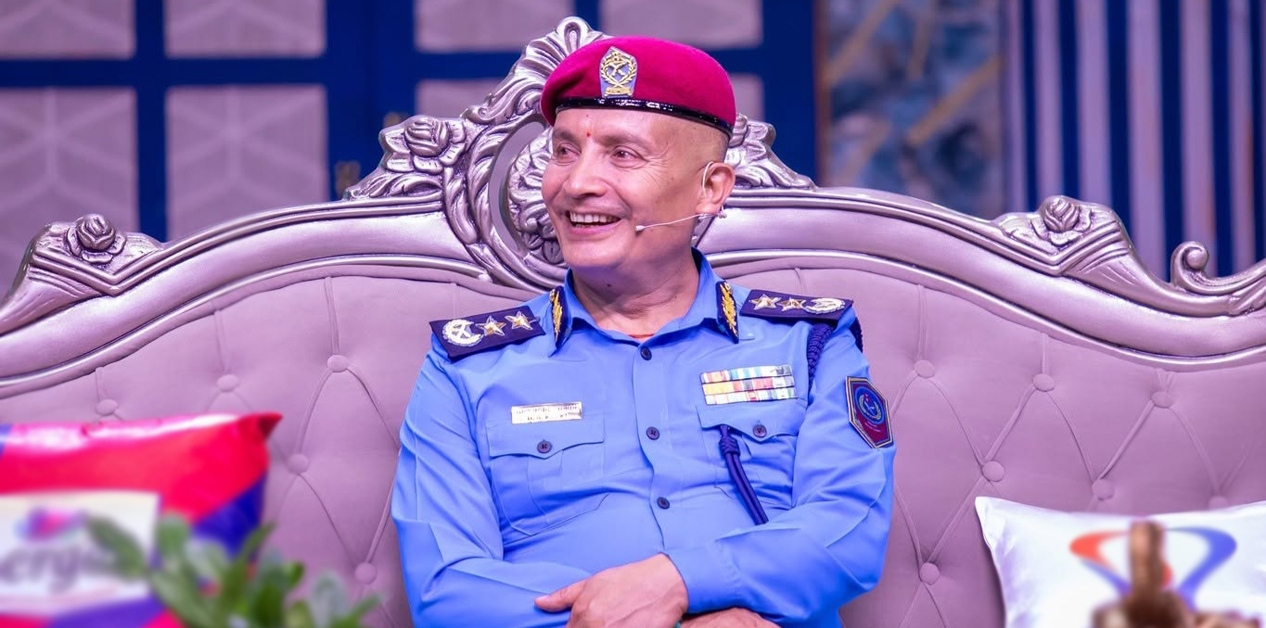
KATHMANDU: The Chief of Nepal Police, Inspector General of Police (IGP) Dan Bahadur Karki, has appeared on ‘Comedy Night with Champions’, a show hosted and run by artists Bishal Bhandari, Deepa Shree Niraula, and others. On Monday, a short video clip of about eight minutes from the comedy show was released. The full video of the episode is scheduled to air next Tuesday.
The video reveals that not only IGP Karki but also one hundred other police personnel were brought to the comedy show as members of the audience. In the short video clip released so far, the police—ranging from the Inspector General himself to uniformed personnel—were positioned as figures of amusement.
The short promotional video of the comedy show has been uploaded to a YouTube channel named OSR Reality. By the time this report was prepared, the video had already crossed 200,000 views, with over 300 comments posted under it. Most of the comments, however, are positive.
The clip begins with artist Bhandari welcoming Karki. Following this, Niraula welcomes him by offering a bouquet of flowers and saluting him. Karki is seen returning the salute as Niraula salutes him.
The comedy kicks off right after. Artist Pawan Bhattarai appears on screen alongside Bishal Bhandari. He calls out to Niraula, and when she does not respond, Bhattarai walks over to sit next to her.
Bhandari asks, “Why did you go over there to sit with Deepa Sister?”
Bhattarai fires back, “What do you mean why did I sit here? They say that if the police catch a boy and a girl sitting together, they force them to get married!”
IGP Karki smiles subtly at the joke. Bhandari’s laughter, however, appears forced and unnatural. Bhandari’s laughter rings louder than the applause of the audience.
Deepa then jokingly grabs Bhattarai by the neck. Feeling uneasy, he tries to break free while calling out, “IGP Saab, IGP Saab!”
Once Deepa lets go of his neck, Bhattarai turns to the IGP and says, “You are the biggest person in this entire room; if we are in agreement, let’s shake hands.”
Bhandari asks, “Hey Jhari Dai, can you even shake hands from all the way over there? You need to step closer to shake hands!”
Bhattarai responds, “Isn’t it true that the long arm of the law reaches everywhere?” Here too, the police force is framed as an object of humor.
Next, another artist, Karma Singh Lama, makes an appearance. He addresses the IGP as “Thulo Mama” (Elder Maternal Uncle). Karki responds with a polite “Yes, yes.”
Lama then asks, “Elder Maternal Uncle, is Durga Prasai your regular customer? Because every time I see him, he is always being arrested.”
Karki wittily replies, “Sometimes, friends of my nephew show up as well.”
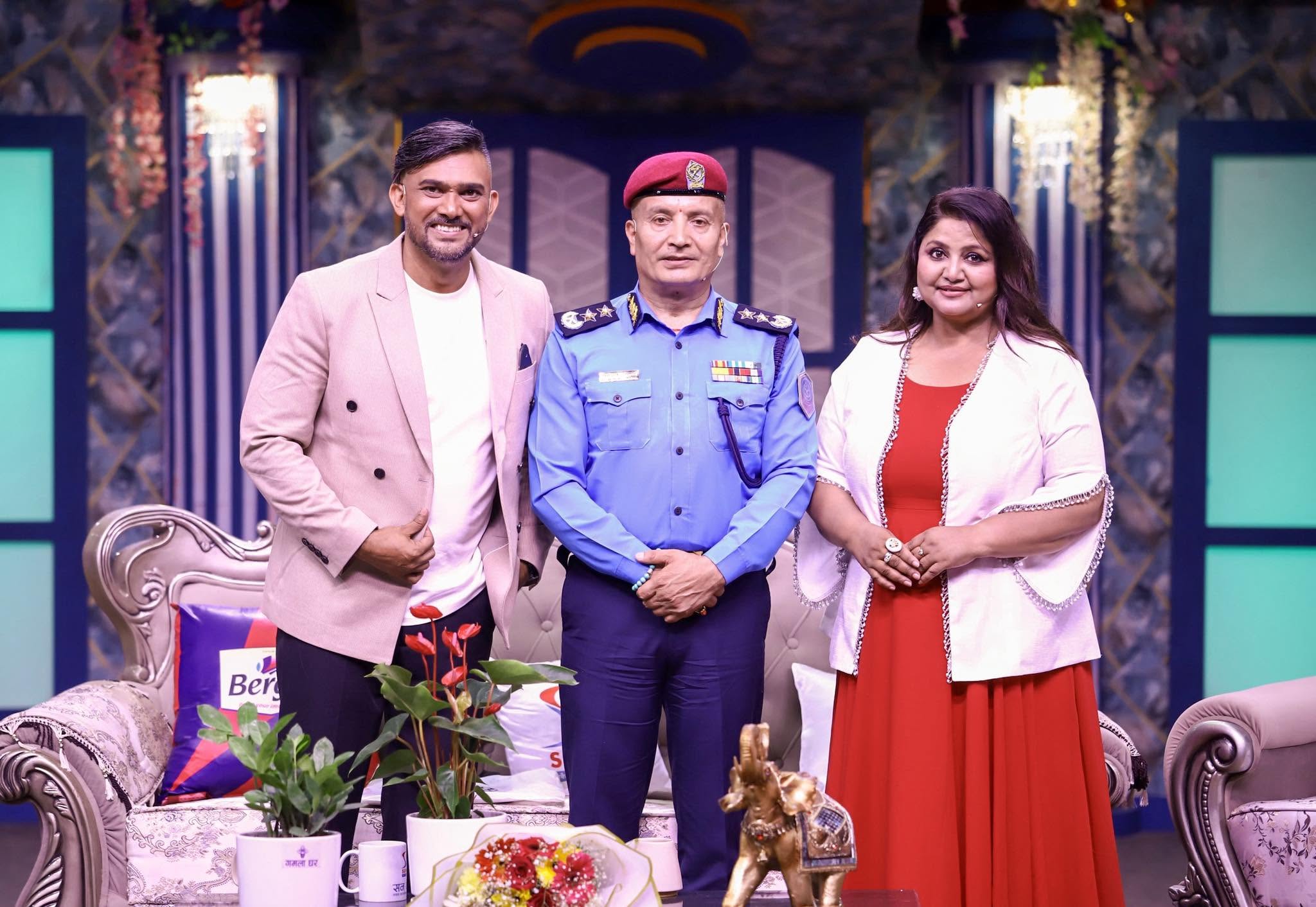
Inspector General of Police Karki between program host Bishal Bhandari and artist Deepashree Niraula. Photo source: Facebook page of Comedy Night with Champions
Following this, artist Suman Karki appears on stage dressed in a traffic police uniform. Satirizing a song composed by IGP Karki himself, he says, “I have returned, I have returned after swallowing the dust of Koteshwor.”
He slaps his pockets, asking, “How much income did we make today?” He adds, “We need to save. For us traffic police, this dust is our only saving; we can’t save from our actual salary. This dust is our true saving, since the salary cannot be saved.”
Next, another artist, Kailash Karki, enters the stage holding a bottle and acting drunk. “Hello everyone, look at you all sitting here with your polished, shiny boots. Just for your information, let me tell you—the doctor has strictly advised me to avoid anything ‘oily and greasy’ (polished).”
Another roar of laughter erupts from the crowd.
Stumbling, he staggers toward Bhandari and says, “Look Solti, for the first time, I respect you. You are going to write your name in history.”
“Why, Solti?” Bhandari asks.
“Because for the first time in history, a thief has invited the police,” Karki delivers the punchline.
After this, another artist, Sajan Shrestha, appears on stage dressed as a Police Inspector. A siren blares. “The drunkard we were searching for has been found right here, you damn drunkard,” he says, dragging the character away.
Another performer, Bharat Mani Paudel, then appears disguised as a landlord.
“The IGP used to live as a tenant in my house. He climbed the ranks to become a DSP, an SP, and an SSP before finally leaving my house. Only after the IGP Saab vacated did Bhandari move into my house.”
“And so, IGP Saab, you lived in my house and now you have become the head of the nation’s police. Your salary must have increased by now, so please clear those two months of back rent from earlier.”
In almost all segments of the comedy show, the police force is projected as an object of laughter. According to the Police Spokesperson, SSP Deep Shamsher Rana, IGP Karki attended the comedy show after the artists personally reached out and requested his presence. “Sir went there after the artists came directly to the Police Headquarters to request him. Although the program used a humorous, satirical, and lighthearted style, it delivered a positive message regarding the police,” he stated.
At the very end of the comedy segment, artist Suman Koirala takes the stage to recite:
“My duty lies upon the ground,
My desires beyond the horizon.
Our deeds may fade like passing mist,
But our emotions carry weight.
Defying fire, sun, and rain,
Always on the path of duty, the Nepal Police.”
The comedy show concludes after he delivers this praise celebrating the work and duties of the police.
The majority of the satire presented on ‘Comedy Night with Champions’ focused on the police organization, its operational methods, public perceptions of the traffic police, the handling of intoxicated individuals, the arrest process, and the overall social image of the police force.
While it is not inherently wrong for the chief of a law enforcement agency to participate in a comedy program, the police chief was seen attending this comedy show accompanied by a massive contingent of uniformed personnel. It is natural for public institutions to adopt modern mediums to engage with citizens. However, the justification of such moves is determined by the objective of the program, the standard of the presentation, and how well the dignity of the office was preserved.
The police chief retains the right to laugh, converse, and attend public functions. However, wherever he goes, he does not go merely as a private citizen but as the sole representative of the entire Nepal Police organization. Therefore, such participation must be evaluated based on institutional prestige and public trust rather than individual discretion.
According to former Deputy Inspector General (DIG) Hemanta Malla Thakuri, it is fitting for an organizational head to participate in public programs that connect with citizens in a constructive manner. “Attending a show is fine. But if the dignity of the institution is blown away for laughs, it does not send a good message,” he warns. “If the content mocks the position and its dignity, one must carefully introspect.”
Programs of this nature can occasionally trigger controversies. According to Thakuri, if the police chief utilized the platform to touch upon police reforms, citizen-police relations, and institutional messaging, it could be viewed as a positive practice. However, if the program was designed purely for entertainment, self-promotion, or actions that diminish the dignity of the office, public criticism becomes entirely justified. Furthermore, when such participation involves police expenditures, time, and resources, questions regarding public accountability naturally arise. “There are social values attached to the police force. Every single word spoken can influence society, and we must weigh how deeply such words impact the public,” Malla notes.
During the Gen Z protest movement, three police officers lost their lives. A total of 459 police offices were either set on fire or vandalized, suffering partial or total destruction. Among them, 451 offices have been brought back into operation, while the remaining 8 offices are yet to be rebuilt. The morale of the police force plummeted significantly following the arson attacks, physical assaults, and fatalities suffered during the Gen Z movement. The Police Headquarters has yet to roll out a concrete action plan to rebuild the morale of its personnel. Against this backdrop, the physical presence of the Inspector General of Police himself at a comedy show—and that too, involving uniformed police personnel as participants in an entertainment stage performance—has raised serious questions regarding the actual priorities of the organization.
On the other hand, the host and director of the show, Bhandari, claimed that the episode pays tribute to the dedication, sacrifice, and service of the Nepal Police. He asserted that the episode would play an important role in infusing positive energy across the entire organization.