Kathmandu
Tuesday, June 9, 2026





Enhanced security surveillance in India’s northeastern states over recent years has disrupted traditional illicit marijuana supply chains, turning Nepal into an alternative sourcing destination.
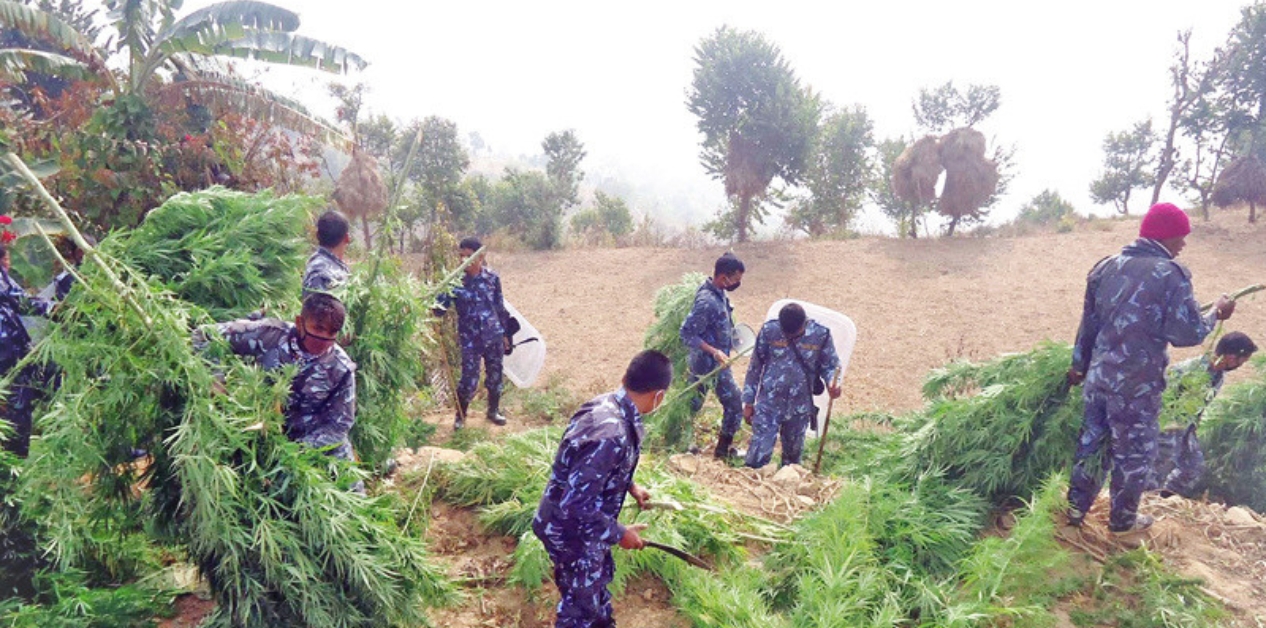
KATHMANDU: The production of illicit drugs like marijuana, hashish, and opium is never determined solely by local demand. Their production and distribution are influenced far more by external markets than by domestic factors. Whenever security surveillance tightens in a specific region, borders are fortified, or the nature of demand shifts, drug production sites and trafficking routes naturally migrate toward new territories. The recent surge in marijuana cultivation and the massive quantities seized in Nepal over the past few years must be understood within this exact context.
Generally, illicit crop cultivation is tied directly to market demand rather than a farmer’s individual needs. If demand rises in external markets, production is highly likely to follow suit. Over time, traditional commodities like opium can be displaced by newer substances; for instance, synthetic drugs have begun replacing conventional narcotics in several countries, leading to a drop in the production of certain substances. However, when it comes to marijuana and its derivative, hashish, global consumption remains relatively stable. Consequently, fluctuations in its production tend to be minimal.
In Nepal, marijuana has historically been cultivated across various hilly and remote regions. Even though marijuana cultivation is legally banned, production has never completely stopped. Cultivation continues covertly in remote villages, driven primarily by cross-border markets rather than domestic consumption. Production thrives here because the demand exists across the border. Since it offers significantly higher profit margins compared to traditional crops, local farmers are willing to take the risk to secure a livelihood.
The shifting landscape of regional security has also mounted pressure on Nepal’s smuggling routes. For example, due to heightened security surveillance, enhanced border management, and international pressure in India’s northeastern states over the last few years, illicit drug activities there face severe crackdowns. As the traditional marijuana supply chains operating out of Northeast India faced disruptions, syndicates searched for alternative sources and routes, causing Nepal to emerge as a prominent source of marijuana. When supply becomes constrained in one region, market demand forces traffickers to scout for alternative sources. As a result, entirely new territories risk transforming into production and supply hubs—a dynamic that looks set to pile even more pressure on Nepal.
Nepali marijuana routinely transits through smuggling networks to reach Bihar. It is occasionally claimed that this marijuana is brought there for pharmaceutical manufacturing, but that is simply not true. The marijuana smuggled into Bihar is actually destined for Europe, the United States, and Canada. While the open cultivation of marijuana was suppressed in Nepal following the introduction of the Narcotic Drugs (Control) Act in 1976, it began surging again from the 2010s onward.
A major driver behind the flourishing marijuana cultivation in Nepal is a shift in Indian politics. Following Narendra Modi’s ascension to power, India began tightening security across its northeastern states. Citing a rise in Western activities in northeastern states like Assam, Meghalaya, Nagaland, Manipur, Mizoram, and Tripura, India overhauled its security strategy, effectively shutting down the extensive marijuana cultivation that used to take place in that region. Consequently, to meet the supply demands of the illicit market, cultivation expanded massively inside Nepal. Following the security clampdown, organized syndicates operating across the northeastern states and Bihar turned Bihar State into a transit hub, expanding marijuana cultivation inside Nepal to feed their network. It is this very syndicate that channels Nepali marijuana through Bihar to Europe, Canada, and the US.
If external demand persists and security surveillance across Northeast India grows even tighter, the direct fallout will be felt in Nepal. Under these circumstances, the risk of marijuana smuggling from Nepal escalating further is deeply concerning. Therefore, it is entirely insufficient to believe that this crisis can be controlled through police operations alone. Resolving this issue demands a comprehensive approach: alongside law enforcement crackdowns, we must prioritize the economic empowerment of rural communities, expand legitimate employment opportunities, fortify border security, enhance international coordination between enforcement agencies, and ensure the proper allocation of resources and equipment for our security forces.
(The author is a former Deputy Inspector General of Police who spent a decade and a half specializing in narcotics control.)