Kathmandu
Saturday, June 13, 2026





Despite an uplift in domestic production, paddy and rice imports have exceeded Rs 10 billion (10 arba) within the initial four months of the current fiscal year
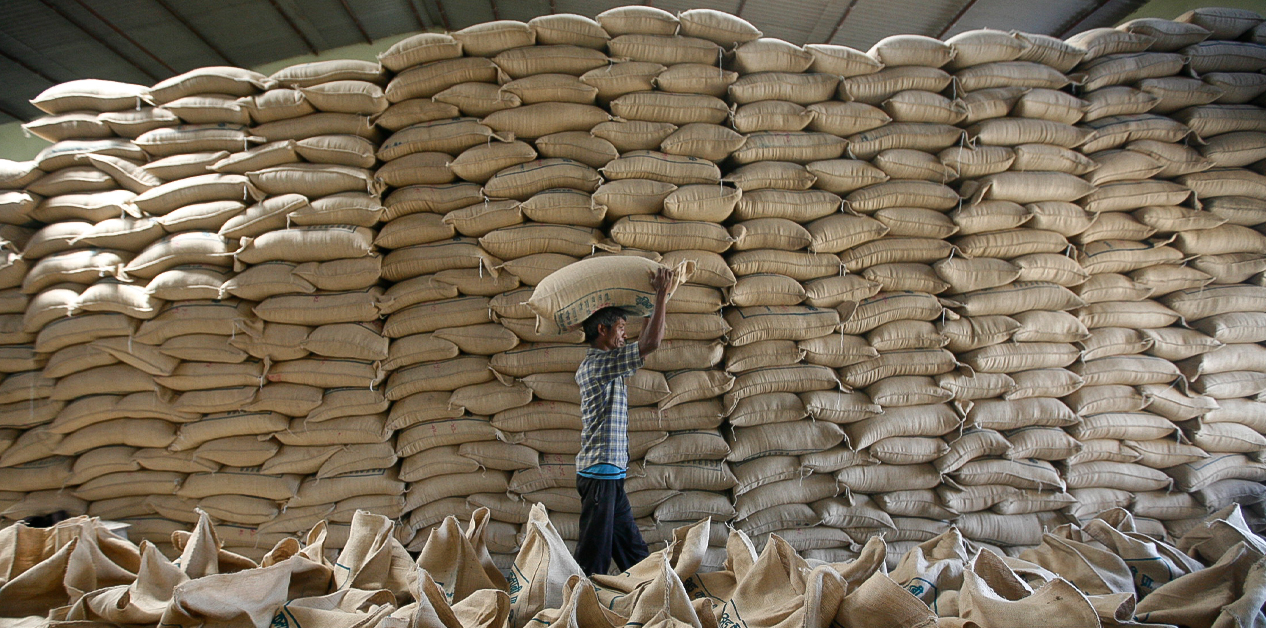
KATHMANDU: Sipahi Lal Pandey, a farmer residing in the Rapti Sonari Rural Municipality of Banke District, cultivated a total yield of 60 quintals of paddy this year. He successfully sold 40 quintals of this harvest to the Food Management and Trading Company (FMTC). However, the remainder of his produce was necessarily offloaded to local traders at a significantly cheaper rate.
This year, the government established the procurement price for coarse paddy (fat-sized paddy) at Rs 3,463.81 per quintal and for medium-sized paddy at Rs 3,628.33 per quintal. Notwithstanding this official price, Mahadev Pandey, another farmer from Rapti Sunari, reports that cultivators are compelled to sell their paddy to private traders at a drastically cheaper rate, specifically between Rs 2,500 and Rs 2,600 per quintal, a price nearly Rs 1,000 less than the guaranteed rate.
Last year, some 5.9 million metric tons of paddy were produced in Nepal. The Ministry of Agriculture and Livestock Development estimates that a similar amount of paddy will be produced this year as well. However, the ministry has not yet completed the collection of paddy production data.
Mahananda Joshi, Senior Agricultural Economist at the Ministry, says that it will take a few more weeks to receive data from across the country, integrate all the statistics, and analyze them.
Even if the production is the same as last year’s volume, the government-owned FTMC plans to purchase only 180,000 metric tons. The remaining paddy, after farmers’ consumption, will be purchased by local traders.
At this time, when domestic farmers are not receiving a fair price for their paddy, the country has imported paddy and rice worth more than Rs 10 billion. According to the Department of Customs data, from July 17 to November 16 of the current fiscal year, the import of food grains, including paddy and rice, amounted to Rs 10.184 billion. The Department of Customs data shows that in the fiscal year 2024/25, the import of paddy and rice amounted to Rs 40.189.
For a few months in the fiscal year 2023/24, India had banned the export of paddy and rice to Nepal. Government data shows that during that year, paddy and rice worth Rs 22.23 were imported from. Even then, most of the farmers sold their paddy to traders. The FTMC managed to acquire only 40,000 quintals of paddy with great difficulty.
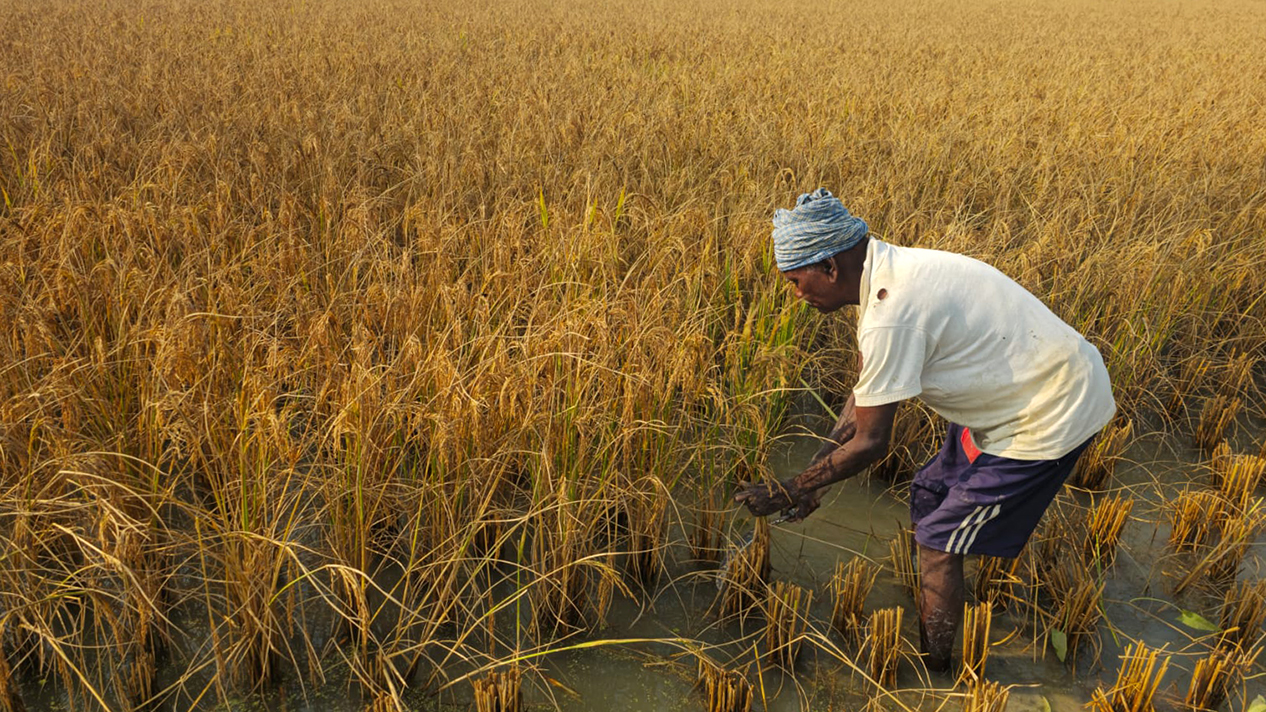
A farmer in Dhanusha harvesting monsoon paddy. Photo: Birendra Raman/Nepal News
Looking at the data from the past few years, the area dedicated to paddy cultivation in Nepal is decreasing, but production is increasing. Despite the increase in production, imports have not decreased.
According to the Ministry of Agriculture and Livestock Development, some 5.9 million metric tons of paddy were produced in the last fiscal year, 2024/25. In the fiscal year 2023/24, some 5.7 metric tons of paddy were produced from some 1.4 million hectares of cultivated land.
The main reason for the increase in production despite the decrease in the cultivated area is the use of chemical fertilizers, medicines, and hybrid seeds. The excessive use of high-yielding paddy seeds is causing indigenous varieties to disappear.
Paddy is Nepal’s main crop. The production of paddy impacts Nepal’s Gross Domestic Product (GDP) itself. Paddy contributes about 15 percent to the GDP. The overall agriculture sector contributes about 24 percent to the GDP.
If we look 50 years ago, Nepal was not importing but exporting paddy. In the 1970s and 1980s, Nepali rice reached South Asian countries, including South Korea, Malaysia, and China.
According to the Panchayat Smarika (Panchayat Commemorative Volume) published in the fiscal year 1986/87 on the occasion of the Panchayat Silver Jubilee, Nepal exported rice worth Rs 29.7 million in the fiscal year 1973/74 and Rs 243.9 million in the fiscal year 1978/79. The volume of imported paddy and rice is almost equal to the amount of paddy produced in Nepal.
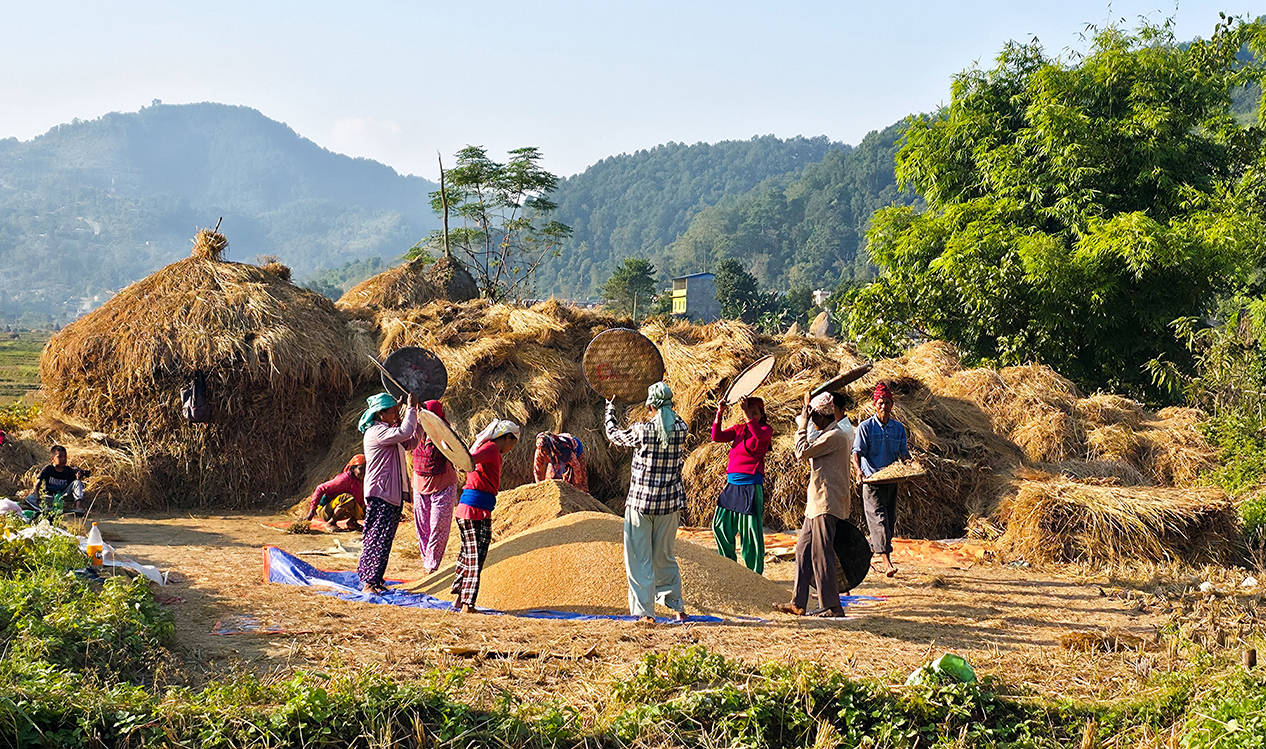
Farmers harvesting paddy in Barbote, located in Byas Municipality-5, Tanahun District. Photo: Sagar Giri/RSS
The Terai region of Nepal produces the largest amount of paddy, and it is the paddy from there that reaches the market for sale. Most of the paddy produced in the middle hills is consumed by the farmers themselves.
Farmer Mahadev Pandey says that because the government buys only a small amount despite offering a good price, much of the paddy has to be sold to traders. “The price set by the government is good, but the standards set by the FTMC have created problems for farmers,” Pandey says. “We are forced to sell even medium-sized paddy at the price of fat-sized paddy.”
The cheap export from India is a major factor in Nepali farmers not getting a fair price for their paddy. Every year, India sells old rice at auction and stockpiles new paddy. Nepali traders purchase this auctioned rice and bring it in, and its price is cheaper than Nepali rice.
“Even now, traders are bringing rice from India at the rate of Rs 4,000 per quintal. We are buying paddy itself at Rs 3,628.33 in Nepal,” says Ram Sharan Lamichhane, Chief of the FTMC office in Nepalgunj, Banke district. “Paddy produced here cannot compete with the cheap rice imported from India.”
This example from Banke is sufficient to understand how the import of Indian paddy forces Nepali farmers to sell their paddy cheaply.
It is estimated that 1.5 million quintals of paddy were harvested in Banke this year. However, the FTMC will only buy 20,000 quintals of paddy, for which it has issued coupons to 655 farmers to buy at a rate of 40 quintals per farmer. “We are only buying paddy from 500 farmers at a rate of 40 quintals each. We distributed more coupons because we thought not everyone would bring their paddy. We have told them that if everyone brings 40 quintals of paddy, we will only buy from 500 people, and the rest will not get a turn,” Lamichhane says. “We have already purchased 8,000 quintals of paddy.”
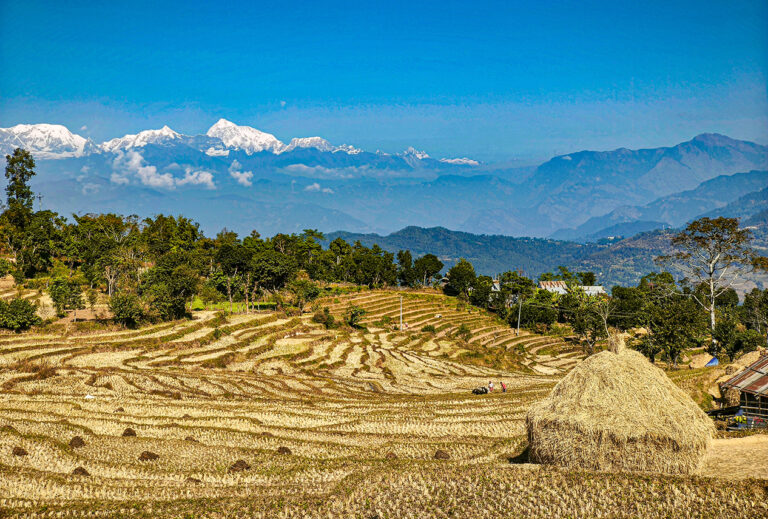
A view of the paddy fields in Panchedobato, Chainpur Municipality-7, Sankhuwasabha district, during harvest season, with Mt. Makalu visible in the background. Photo: Sujan Bajracharya/RSS
Ananta Paudel, Chief of Procurement at the FTMC, says that the company has already purchased 80,838 quintals of paddy nationwide. He says, “The company will now purchase only 100,000 quintals of paddy.”
Increasing imports in Terai region
Madhesh Province is considered fertile for agricultural production, but due to the lack of timely access to fertilizer and irrigation, the consumption of Indian rice is starting to increase here as well.
Kari Mandal of Laxminiya Rural Municipality-3, Dhanusha District, is farming on rented land. However, he does not have the government subsidies for fertilizer and irrigation that are available across the border in India.
Bipat Sah of Nagarain Municipality, Dhanusha, suggests that rice imports have also increased because Nepali farmers are unable to produce good quality. “Polished rice with good processing comes from across the border,” Sah says. “Even though our rice is intrinsically tastier and superior in quality, consumer habits have shifted, and Indian rice is now what is routinely consumed and prepared.”
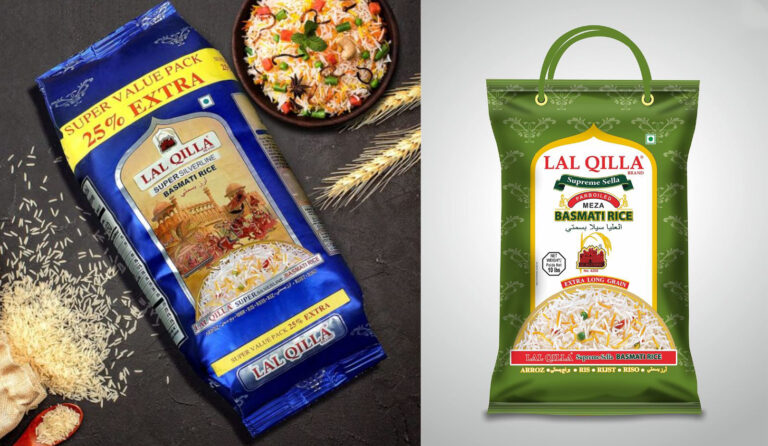
Examples of Indian-branded rice readily available across Nepal
Dr. Ram Chandra Yadav, Chief of the Agriculture Knowledge Centre, Dhanusha, agrees with this. According to him, since it takes a lot of effort to turn paddy into rice, it has been observed that Nepali paddy goes to India through illegal channels, and farmers then buy rice from there. “It is also becoming difficult to find farmhands in the villages and settlements like before, so farmers are starting to grow paddy and import rice,” he says.
Bhagwat Mandal, a farmer from Aurahi Rural Municipality-1, Dhanusha, says that the increase in imports from across the border is also due to him keeping only the paddy he needs for consumption and selling the rest. “There are no farmhands to cultivate paddy easily in the current time, and we sell it because we are afraid that the rice will spoil if stored for a long time,” he says.
Madhesh Province encompasses 542,580 hectares of total arable land, of which 520,224 hectares are currently under cultivation. Within this cultivated area, 362,344 hectares are utilized for monsoon paddy, and 20,839 hectares are designated for spring paddy cultivation.
According to the Ministry of Land Management, Agriculture, and Cooperatives, Madhesh Province, the production of monsoon paddy is 100,270 metric tons with a productivity of 4.81 metric tons per hectare, while the production of spring paddy is some 1.2 million metric tons with a productivity of 3.41 metric tons per hectare.
(With inputs from district correspondents Birendra Raman, Janakpur.)