Kathmandu
Tuesday, March 3, 2026





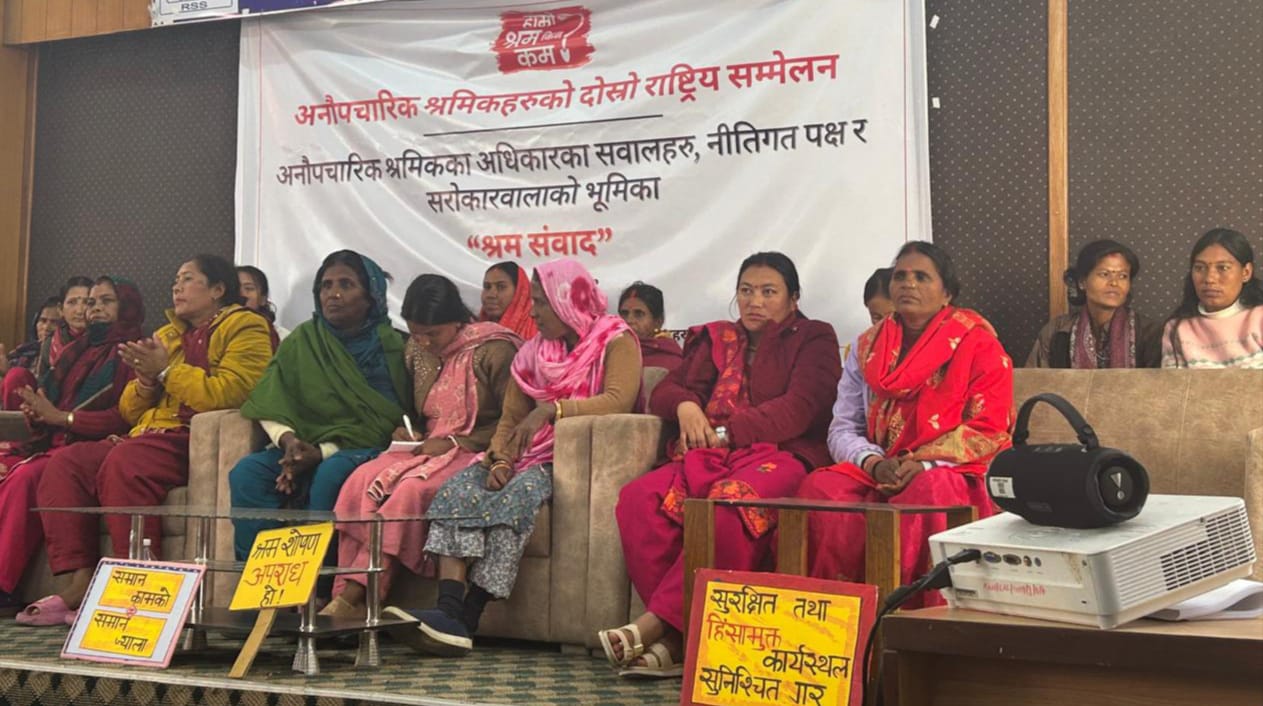
KATHMANDU: “We are not destined to take a holiday. If we take leave out of urgent need, the next day we are forced to work double to ‘compensate’ for the previous day,” said Chiran Budha Magar of Chitwan.
She was sharing her lived experiences with the media recently during the 2nd National Conference of the Informal Sector Workers. Her statement reflected what participants described as widespread violations of labour rights faced by women in the informal economy.
Some 40 women workers from the informal sector travelled to the federal capital from 13 districts across five provinces, hoping that the central authorities would hear them and respond fairly.
Talking to the media amidst the press meet held during the conference, they shared that their stories are painful and that they don’t even know where to start.
According to Nepal’s Labour Force Survey 2017-18, of the total employed population in the country, 84.6 percent is engaged in the informal sector, and women make up 90 percent of it, explicitly showing that the informal service sector is largely dominated by women, who have both occupational and specific needs, but are being overlooked.
Workers with young children face additional challenges in continuing their work. At home, they have no reliable support to look after their young kids, and at the workplace, employees do not tolerate the presence of their children. “We are forced to leave our young children behind at home uncared,” they said.
Their challenges and occupational obstacles are compounded. “During menstruation, we find it challenging to find a decent space to change our menstrual products. Toilets we access don’t lock properly, and they do not have running water. Could you empathize with our problems?” said one of the participants, sharing their stories with the media. “Being menstruators, we have certain specific needs, but who is there to address them?”
As they mentioned, they are largely not registered at the local level. They have neither appointment letters nor formal contracts and are barred from seeking legal remedy upon exploitation, which ranges from sexual harassment to non-payment, delayed payment, underpayment, and gender-based discrimination.
“In such cases, we don’t have evidence to claim legal remedies. We are neither registered nor have a professional identity.”
Voice Up: Gender Discrimination in Payment
Gender discrimination is another persistent challenge that women workers face in the informal sector. For example, as they cite, in agriculture, women earn around 10 percent less than men.
Gita Kumal from Bardiya shared that in her locality women in agriculture get just Rs 500 for working the whole day, while their male counterparts are entitled to Rs 600 to 650 per day. “Our demand is for Rs 754 per day regardless of gender.”
Anita Gaha from Baganaskali rural municipality in Palpa said her wages from agricultural labour have been Rs 400-500 per day for the past 10 years, while men earn Rs 700-800. “Isn’t it discrimination?” she questions the concerned authorities.
Women from the waste management sector complained that they hardly get Rs 400 per day, with only a light snack provided, as they cannot afford more. Besides, being waste management workers, they require appropriate safety tools such as gloves, boots, and masks but are denied standard-quality materials.
Sita Kumari Parki from Doti explained that, although their numbers may seem small, they represent the voices of many informal laborers. “Traveling to the federal capital from distant areas is not easy for them; it requires financial resources, time, and a supportive environment both at home and in the workplace. So we arrive here as their representatives.”
According to Bhagavati Adhikari, Executive Director of Nepal Mahila Ekata Samaj, an organisation that also carries the voices and agenda of informal sector women, women from informal sectors reportedly do not receive the officially determined wage of Rs 754 per day. On one hand, they are underpaid, and on the other hand, they receive less than male colleagues.
Though continued advocacy, a few of local levels including the Budhanilkantha Municipality of Kathmandu has registered them, she added.
“We work for the rights, fair pay, and justice of women workers and advocate that local authorities build a safe and secure workplace environment for them,” she said, adding that the organization has the Valley Level Informal Sector Women Network with 350 members and coordinates with other local levels outside the Valley to improve the rights of informal sector women.
Through the press meet, they demanded formal registration at the local level, stating that this step is crucial for ensuring that workers are recognized and entitled to the benefits and protections they deserve under the law.
Likewise, they emphasized that receiving fair wages in line with the minimum wage standards set out by the Labour Act of 2017, safe working conditions, and access to insurance is necessary to protect informal workers from accidents, illness, and other risks inherent in their jobs.
Considering women’s vulnerability to sexual harassment, exploitation, and discrimination, the gathering highlighted the need for systemic changes to protect female workers, who often face heightened risks in informal sectors, and to safeguard their right to dignity.
They insist on support for working mothers by providing breastfeeding spaces, childcare-friendly spaces, and access to drinking water and toilets.
Furthermore, they stressed that a Labour Monitoring Mechanism at the local level is essential to ensure that workers’ rights are protected and that workplaces comply with labor laws.
Furthermore, informal sector workers are seeking guaranteed, sustainable job opportunities that would provide long-term financial stability, as well as inclusion in social security schemes and insurance.
Another demand includes political support for workers’ rights. They call upon all political parties to prioritize the issues of informal sector workers in their election manifestos so that their concerns are politically recognized and addressed. Theme: “Our Labour, Why Is It Undervalued?”
The Conference was themed “Our Labour, Why Is It Undervalued?”, suggesting the lack of recognition and undervaluation of labor, specifically of women, in the informal sector. The theme itself calls for justice and equality for those who contribute significantly to the economy but are often left unprotected and undervalued, Adhikari added.
ActionAid Nepal, citing data from the Nepal Labour Survey 2018, also acknowledges that women workers are reported to be deprived of minimum wages, decent working conditions, and social protection coverage, compared to 59.7 percent of male informal workers.