Kathmandu
Sunday, July 12, 2026





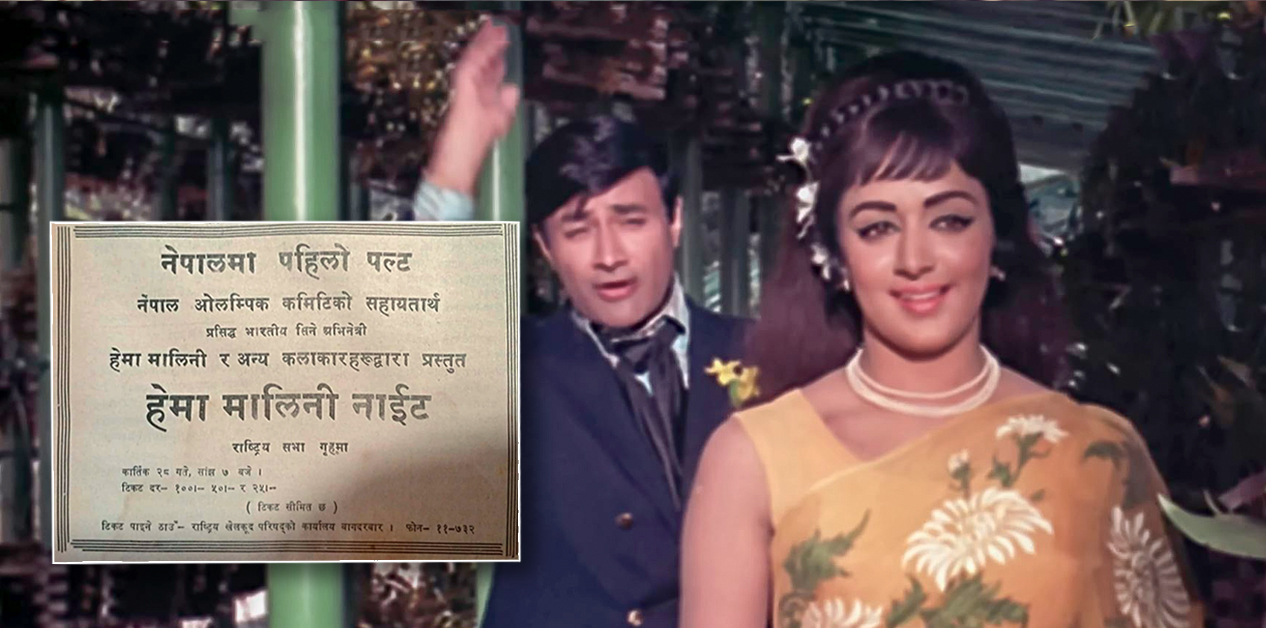
Tickets for a dance show by Indian actor Hema Malini were already on sale in 1970, but India’s sudden economic blockade against Nepal brought the event to a halt. What had exactly happened?
KATHMANDU: Merely two years prior, she had embarked on her Bollywood debut with Sapno Ka Saudagar in 1968. Great expectations surrounded her as she graced the screen in a role opposite the legendary Showman of the Indian cinematic world, Raj Kapoor. However, the pairing of the 44-year-old Raj Kapoor with her, who had just turned 16, failed to resonate with the audience. The film flopped. Later, Raj Kapoor himself admitted that acting in that film was a monumental mistake on his part.
She means Hema Malini, the Dream Girl of Bollywood. Although her first film crashed badly at the box office, she had enchanted the audience with her beauty and dance.
Following this, she received many film proposals. The next year after that, she worked in films like Waris with Jeetendra and Jahan Pyar Miley with Shashi Kapoor. Both films failed to do good business.
In the second year, in 1970, she was seen in Tum Haseen Main Jawan with Dharmendra. That was her first film with Dharmendra. While working on that film, a love relationship developed between the two.
They got married 10 years after this. In 1970, at least five of Hema’s films were released. Among them, her dance in Sharafat received much praise. In this film starring Ashok Kumar and Dharmendra, the song Sharafat Chhod Di Maine, in which Hema danced, became such a hit that it succeeded in occupying the ninth position in that year’s Binaca Geetmala list.
She had performed a Mujra (a South Asian performance art, rooted in classical dance and music, that literally means “to bow down and pay respect) in that song. Before Hema, Waheeda Rehman received great acclaim in Indian cinema. In those times, it was said that there was no artist who could dance as well as her.
However, after seeing Hema’s dance in the film Sharafat, Hema’s fame reached new heights. The admirers of her art were not limited only to India; whispers also started in Nepal. Meanwhile, the Indian Embassy in Nepal held a press conference on October 29, 1970, and announced the organization of an Indian Film Festival in various places in Kathmandu from November 6 to November 14, 1970
. Information was given that about 60 people, including famous film actors and actresses, producers of various short films, and directors, would come from India.
Finally, it was said that Hema Malini’s dance would be presented in the Evening with the Stars program on November 14.
After receiving this information, the joy of Nepali admirers of Hindi films knew no bounds. The day after tomorrow, an advertisement about Hema Malini’s dance show was printed in Gorkhapatra (the oldest national daily newspaper in Nepal). In which it was written: Dance performance by Hema Malini-
“Watch this program at
Rashtriya Sabha Griha on Saturday,
on November 14, 1970, in the evening
Ticket rates are Rs 100, 50, 25, and 10.”
The then Prince Basundhara Shah, the brother of King Mahendra, was appointed as the chairman of the Indian Film Festival Organizing Committee. Since the Indian Ambassador Raj Bahadur himself was the vice chairman, the film lovers of Kathmandu were confident that Hema Malini would arrive for the program under any circumstances.
At that time, Basundhara was also the patron of the National Sports Council (NSC) and the president of the Nepal Olympic Committee. Therefore, the money raised from Hema Malini’s program was to go to the account of the Olympic Committee, and the location to get tickets was fixed at the NSC office in Bagh Durbar. Preparations for the program also started with intensity and a great sense of anticipation.
But in the meantime, an incident occurred. After Nepal started removing the Indian check posts located on the northern border, the Government of India suddenly imposed an economic blockade on Nepal. The term of the Trade and Transit Treaty signed between Nepal and India in 1960 was ending on October 31, 1970. Nepal had started efforts to extend the period of the treaty one year in advance. However, India was procrastinating.
Nepal wanted to sign treaties with India on two subjects: commerce and transit. Nepal’s opinion was that the commerce treaty should be done keeping mutual interests in mind to strengthen the Nepal-India trade relationship, but a transit facility is a subject needed for a landlocked country for trade with a third country.
Minister for Industry and Commerce Nava Raj Subedi went to Delhi on October 28, 1970, to talk with his Indian counterpart Lalit Narayan Mishra on this very subject. However, the talks were not successful. To influence Subedi, Indian Prime Minister Indira Gandhi had expressed a desire to meet him.
But he returned without meeting her. Remembering the sequence of events of that time, he says, “I avoided it by saying the King had not given me the mandate to meet the Prime Minister.”
After returning from Delhi, Subedi accused the Indian policy towards Nepal of being uncooperative in a seminar organized by the Nepal Chamber of Commerce. Previously, in the context of removing Indian check posts, the then King Mahendra had said in an interview given to Dilip Mukherjee, the Delhi bureau chief of the Indian newspaper Times of India, on October 19: “After the military teams are withdrawn, we have a full understanding with India regarding exchanging information of the kind that would hit the interests of Nepal or India.
They have wanted to keep high military officers in the embassy here. If they are to be kept for a specific period and work, we have no objection.”
In between, many efforts were made to improve relations. But they did not work. After India imposed the blockade, such a big anti-India atmosphere was created within Nepal that the Indian Film Festival Committee had to hold an emergency meeting on November 3, 1970, and announce that the festival was canceled.
The meeting held under the chairmanship of the Indian Ambassador Raj Bahadur said, “Since the talks regarding trade and transit between Nepal and India have not concluded, and as there is currently no atmosphere for the festival, the meeting of the said committee held this evening has made the decision to consider the demand made by some groups of students that the proposed Indian Film Festival should not be organized.”
Students held protest meetings in Kathmandu against the blockade. They placed a demand before the government to ban Hindi films. Many elites of Kathmandu had already bought tickets to watch Hema Malini’s dance. But after the festival was canceled, their desire remained unfulfilled.
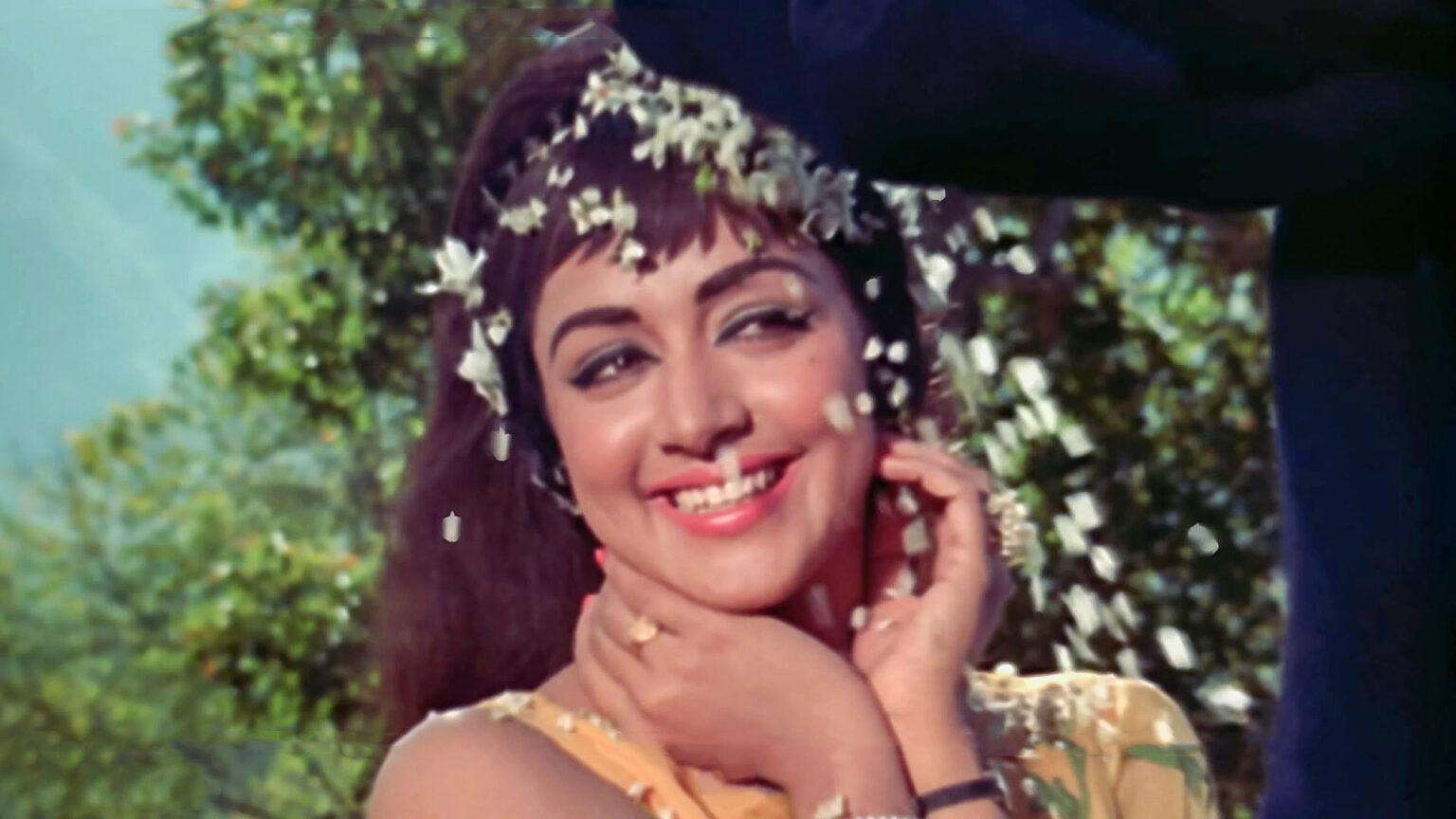
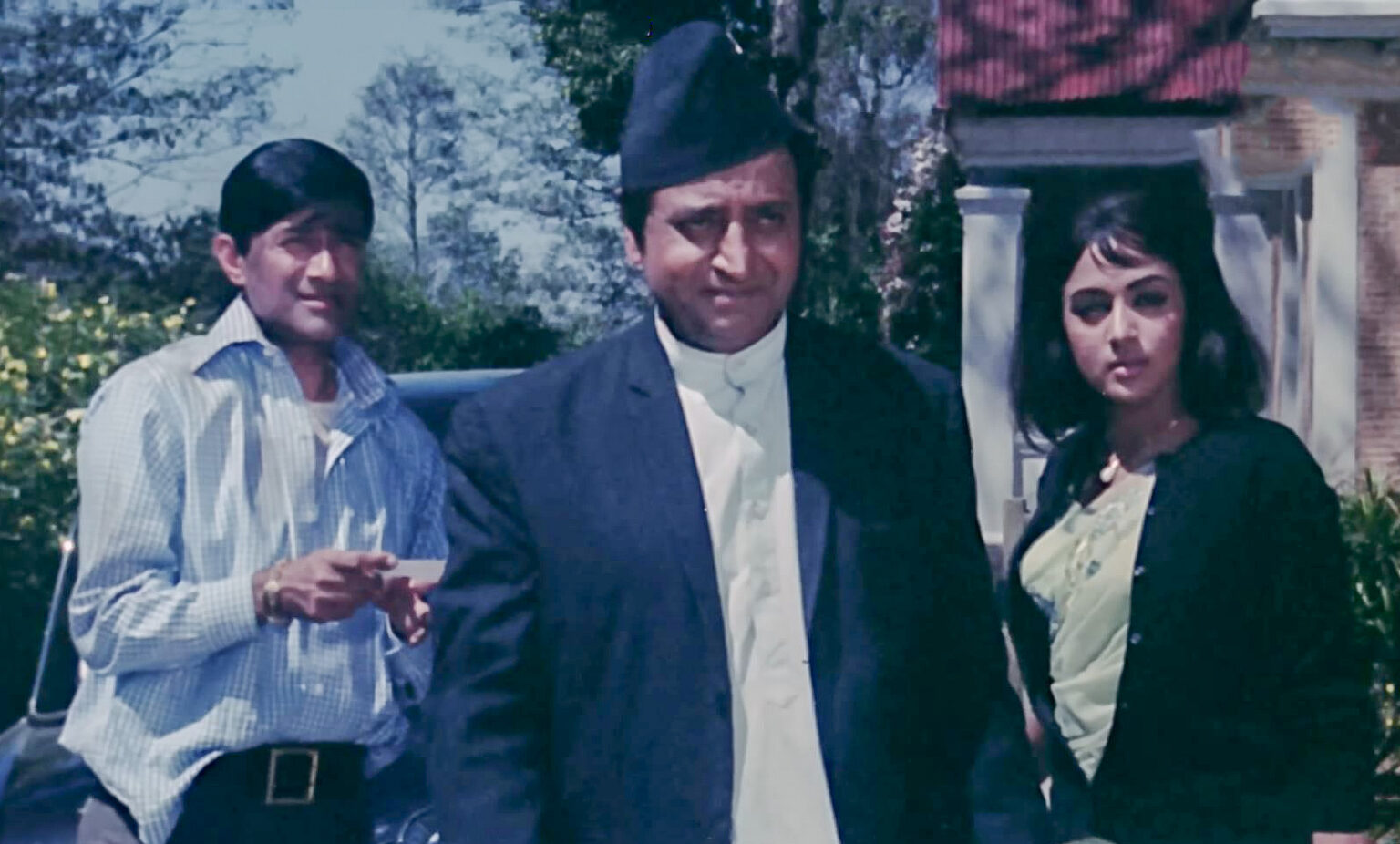
An interesting thing is that while Hema Malini’s program was being canceled in Kathmandu, another film starring her was released in India 17 days later on November 20: Johny Mera Naam. Later, that film was also screened in the cinema halls of Kathmandu. The distributors of the film were themselves surprised to see the enthusiasm of the audience to watch this film. There were three major reasons why Nepalis took more interest in that film. The first reason was Hema Malini’s canceled program. Second, the role of Dev Anand as the opposite artist. Third, the filming of the movie was done in various places in Nepal, such as the botanical garden in Godawari, Lalitpur, Nagarkot, and the casino of Soaltee Hotel, among others.
Dev Anand had come to Kathmandu on March 9, 1970, to participate in the wedding of the then Crown Prince Birendra Bir Bkram Shah
. At that time, he was enchanted by the natural beauty of Nepal. Therefore, the next month, he came to Kathmandu for the filming of Johny Mera Naam with his brother, film director Vijay Anand, and the shooting unit.
All the scenes of the film’s famous song Nafrat karne walon ke sine mein pyar bhar doon were filmed in the garden of Godawari. The shot seen in the lyrics “Kaho yeh gaalon ke angare kis ke liye hain” of another famous song, O Mere Raja Khafa Na Hona, was also filmed in Nepal. Some scenes of conflict were filmed in Nagarkot.
Professor P. Kharel, who wrote for a long time in the entertainment genre along with sports in the Nepali government newspaper The Rising Nepal, says, “We were surprised to see the crowd gathered in the cinema halls of Kathmandu to watch that film. For one, there was the craze of Dev Anand, and on top of that, since there was a lot of buzz that some scenes of the movie were shot in Kathmandu, there were hardly any young men or women who did not watch the film.”
That was Hema Malini’s first blockbuster film. The film had earned INR 80 million that year.
Professor Kharel says, “Forty cinema halls celebrated the silver jubilee, they used to say. Not only in Nepal, the film had made good earnings even in Burma (Myanmar).”
Before Johny Mera Naam, Hema Malini had already worked in a total of nine films, including two from South India and seven in Hindi. However, no previous film had been able to give her the kind of fame that Johny Mera Naam did. After this, a fun comment was made in Kathmandu: “See, after shooting in our Nepal, Hema Malini’s film career shot up!”