Kathmandu
Monday, July 20, 2026





A 1969 clash with Tulsi Giri, triggered by a barb over “babbling” and a sharp retort to look in the mirror, landed Rishikesh Shah in jail
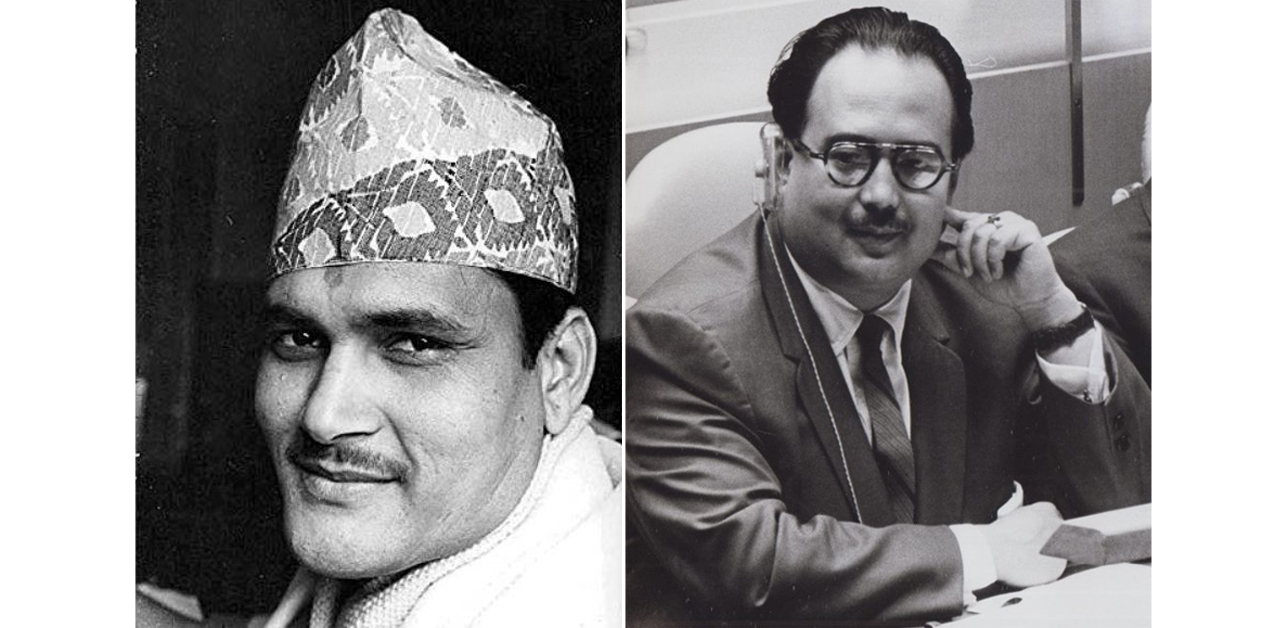
KATHMANDU: Tulsi Giri, known as the ‘Mother’ of the Panchayat, had built an image in his political life as one who spoke little but was firm and gentle. Contrary to that nature, an incident occurred around the year 1969, which for the first time gave a push to his image.
The incident was a dispute with another shrewd player of Nepali diplomacy, Rishikesh Shah.
On July 10, 1969, Shah, who was then only a member of the National Panchayat, held a press conference sitting at his residence in Kamalpokhari, and he even managed to say, “It is heard that some government individuals and advisors sitting in high positions are engaged in the idea that a monarchy endowed with unlimited autocracy is the core element and main basis of the Panchayat system. This is nothing but a bell of danger and an attempt to ascend to power and fulfil personal interests.”
As soon as this statement of his became public in the newspaper the next day, the level of Tulsi Giri’s anger got the best of him. Sending his written response to the newspapers that same day, he said, “Rishikesh Shah has a habit of babbling too much.”
The terminology in Shaha’s statement that pricked Giri the most was “some government individuals and advisors sitting in high positions”. Because, in that same year, King Mahendra had formed a four-member Special Advisory Committee consisting of Tulsi Giri and Bishwa Bandhu Thapa, along with Prime Minister Kirtinidhi Bista. Shah fiercely opposed this, calling it unconstitutional.
Kirtinidhi was himself the Prime Minister of the country; then how is it appropriate for him to sit in another constitutional committee formed by the then King? Shah had a great objection to this matter.
Similarly, it was an interesting event in itself that Giri, who had resigned from the post of Chairman of the Council of Ministers some time ago after having a ‘constitutional disagreement’ with the King, was re-appointed as a Special Advisor. Some newspapers had also raised questions regarding Giri’s appointment.
Thapa had also refused to contest the Panchayat elections while demanding the restoration of the multi-party system. His presence in the Special Advisory Committee also became a matter of surprise for everyone.
Prime Minister Bista evaded Shaha’s opposition by saying only this, “This is not an unconstitutional matter. This committee has been formed by His Majesty the King according to the special powers inherent in His Majesty. I do not find it appropriate to comment in this way on a matter done by His Majesty, keeping the national interest in mind.”
Tulsi Giri, however, came down in a mood to fight. Targeting Shaha, he said, “In the year 1960, when King Mahendra ‘couped’ the parliamentary system, in which system were you staying when you jumped to become a minister after quitting your United Nations job?”
On December 15, 1960, when King Mahendra deposed the democratic government, Rishikesh Shah was working as the Permanent Representative of Nepal to the United Nations. In ‘couping’ the popularly elected government of B.P. Koirala, among the three major characters who internally assisted the King, the role of Rishikesh Shah was equal to that of Tulsi Giri and Bishwa Bandhu Thapa.
Giri wanted to remind him of this very incident. When King Mahendra implemented the partyless system, all three of these individuals became ministers. Furthermore, Shaha, while holding the position of Chairman of the Constitution Drafting Committee, had submitted the Panchayat constitution to the Palace on December 16, 1962.
Giri’s level of anger did not stop there. He further managed to say, “When a message was sent by His Majesty to the National Panchayat to understand the feeling if there is any alternative to the current system, is Rishikesh Shaha not the very person who scrambled to bring a proposal to declare a political system as without alternative and got that proposal passed unanimously?”
He added, “Individuals like Rishikesh Shaha, who want to weave a web like creating a parliamentary base to fulfil their interests under the guise of the Panchayat system, are fatal for both systems.”
Seeing Giri’s fierce form, all the Panchas of that time were astonished. Because, at one time, Giri and Shaha were called the ‘nail and flesh’ of King Mahendra.
Former Chairman of the National Panchayat, Nawaraj Subedi, still laughs when remembering that incident. He says, “At that time, the war of statements between the two had become dangerous. We felt awkward. Dr Giri was a person who would not present himself like that. He exploded in an unpleasant manner.”
In Kirtinidhi’s cabinet, Subedi was the Minister of Industry and Commerce. “Rishikesh Shah was also a learned man. That dispute was indeed forceful,” he remembers.
Shaha was also very irritated by Giri’s statement. Saying that Giri had personally slandered him, he held a press conference at his house again. And, he managed to say, “He gave that statement only like ‘when asked who is the thief, the thief pulled back his leg’ (an idiom meaning the guilty person gives themselves away).”
He also did not stop at this. He added further, “The one who had the audacity to compare His Majesty the King with ‘Karimulla and Giri’ before the year 1960, and his statement is available in the Magistrate Office. I do not care about the reaction of such a person. Let Dr. Giri look at his face in the mirror; the people have recognized him plenty.”
In the year 1969, when King Mahendra decided to release the political prisoners of 1960, Giri had fiercely opposed it. He was not happy with that move of the king. Interestingly, when Giri went to Janakpur in the year 1969, he was arrested right there and kept in custody. At that time, King Mahendra was staying in Tikapur to rest due to his heart ailment. But how could Giri, who had received the epithet of the most burning leader of the Panchayat, fall into custody without his instruction? That was not possible at all.
The meaning of saying ‘Tulsi Giri’s statement is available in the Magistrate Office’ in Shaha’s statement was also this—’Did you not go to jail because you held a disagreement with the King?’
After this, the fight between these two individuals became personal rather than institutional. Shaha could not stay without opposing Tulsi Giri on any public platform, nor could Giri stay without opposing Shaha. A fun fact: when King Mahendra took the governance system into his own hands in 1960, he had shown both of them the temptation of giving the prime ministership. However, Mahendra did not make either of these two the prime minister throughout his tenure.
He initially made Tulsi Giri the Vice-Chairman of the Cabinet and ran the administration himself by becoming the Chairman. Later, after voices started rising that the King himself was becoming the leader, he did make Giri the Chairman of the Cabinet but did not designate him as Prime Minister. Instead, he made Surya Bahadur Thapa and Kirtinidhi Bista the prime minister.
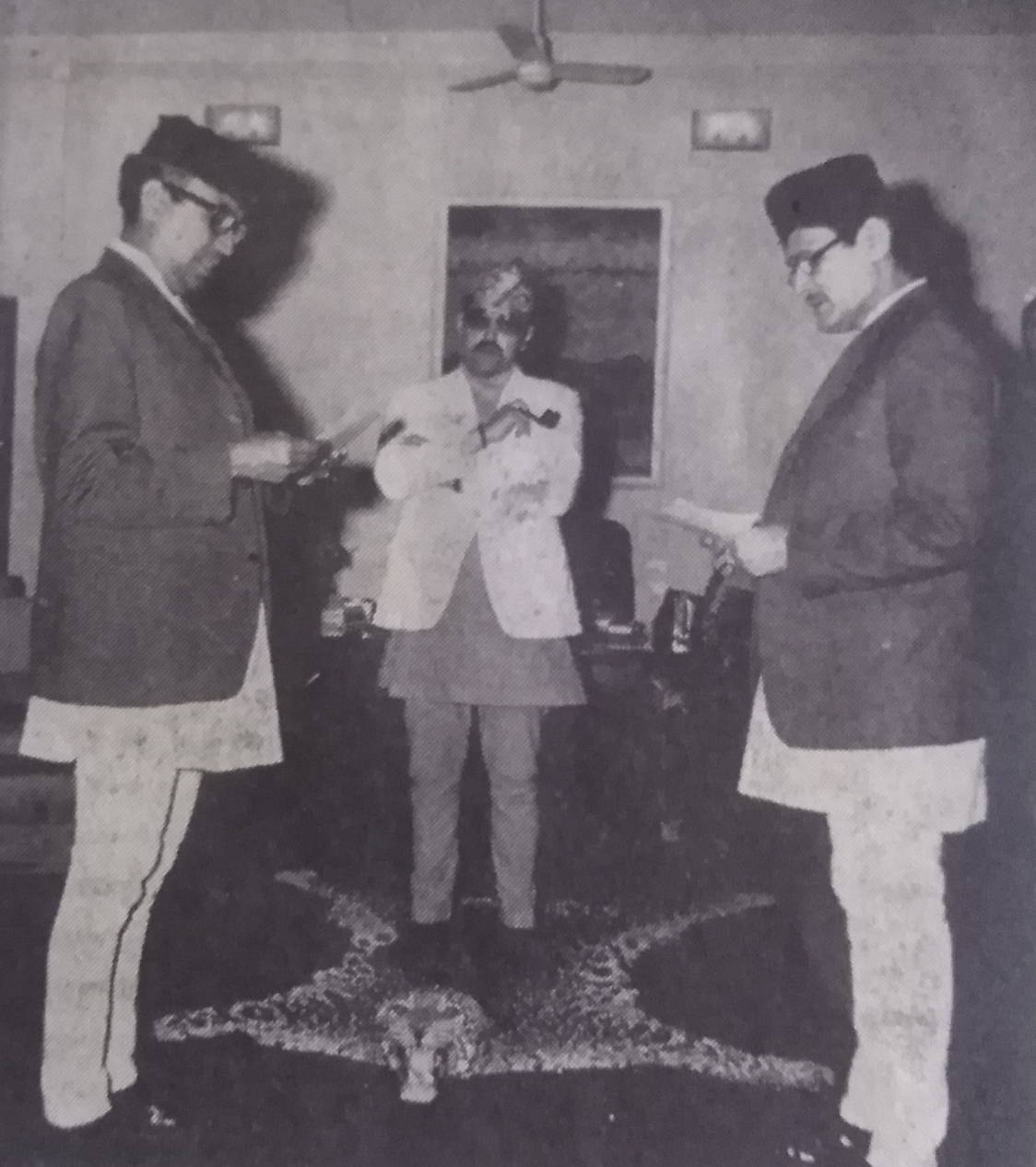
Tulsi Giri administers the oath of office to Jogmehar Shrestha, left, in the presence of King Birendra
Professor of History Hemant Shamsher Rana says, “Actually, the character whom King Mahendra wanted to make prime minister first of all was Brother Rishikesh. That is why he had called him from the United Nations.” Rana is a brother to Rishikesh by relation.
Rishikesh was a renowned scholar since the Rana period. Due to teaching at Tri-Chandra College (and later at Tribhuvan University) and having gathered experience in the diplomatic field, Shaha was like an alternative-less character for King Mahendra for the post of Prime Minister. Again, being a descendant of the Bhirkote King, he had a good relationship with the palace since childhood. Before being appointed as the first Nepali Ambassador to the USA, he had worked in the prestigious position of General Secretary of the Nepali Congress.
Despite having so much experience, he could never become Prime Minister. Rana states that his ‘habit of not counting anyone’ was the major reason for this. Sharing a striking story related to the Great Poet Laxmi Prasad Devkota during the Rana period, Rana says, “During the Rana period, there used to be a crowd at Great Poet Devkota’s house for tuition for the SLC examination. In this process, Mohan Bikram Shaha, the son of Queen Ratna’s maternal uncle, had also gone to study. At that time, after Devkota found out about Brother Mohan’s family connection, he reportedly said, “What kind of scholar am I?” Rishikesh Shaha is a greater scholar than me. After hearing this, Brother Rishikesh’s feet were not on the ground after hearing such a big compliment from the Great Poet himself.”
Rishikesh had great pride regarding his knowledge. “He also liked to have drinks. Once in a family gathering, he belittled King Mahendra by saying, “What does that ‘squint-eyed’ know?” (since King Mahendra’s eyes were slightly squinted). The word reached. After that, the prime minister post that had come into hand was lost,” he says.
Why would Rishikesh, who did not leave the king unaddressed, count Giri? He continuously kept making sarcastic remarks toward Giri on public platforms. It was a result of this that on October 12, 1969, he was arrested for the first time in a state-offense case. He was kept in Bhadragol Jail for about 8.5 months.
Released from jail, he did not forget to say that he remains firm on his old policy. This meant opposition to Tulsi Giri’s policy of making the king active. On that day, the government had also announced the release of Krishna Prasad Bhattarai, the Speaker of the Parliament dissolved in 1960. Devendralal Nepali, the president of the Tribhuvan University Students’ Union, and Rishikesh Gautam were also released on the same day.
Tulsi Giri, however, was appointed Prime Minister during the time of King Birendra on December 1, 1975. But, that could not last for a long time. After B.P. Koirala returned from India, taking the policy of national unity and reconciliation, his tenure was shortened. Having been prime minister for one year and 285 days, he handed over the post to Kirtinidhi.