Kathmandu
Saturday, July 25, 2026





Large physical infrastructures built in Lumbini Province with the investment of billions of rupees remain unused or abandoned
In 2009, the CPN-UML held its eighth general convention at Butwal Mandap by setting up tents. However, a sudden storm blew away the stage built for the closed session, and ballot papers were lost.
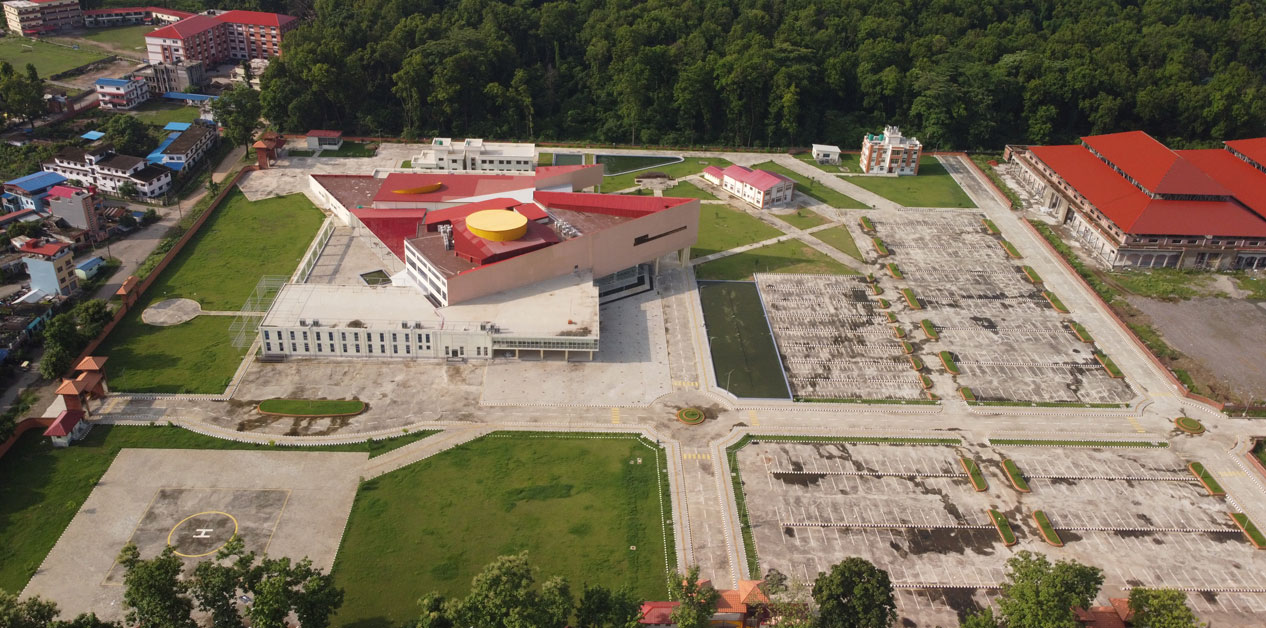
Citing the lack of a proper hall in Butwal to organize large programs and gatherings, UML announced immediately after the convention that it would build a grand conference center.
In fiscal year 2009/10, Rs 10 million was allocated for a detailed study of the conference center. After Butwal Sub-Metropolitan City provided about 6.3 hectares of land at Ramnagar, Ward No. 10, the foundation stone of the Butwal International Conference Center was laid on 29 January 2015. The conference center, constructed over eight years, was inaugurated on 27 August 2022 by the then Prime Minister Sher Bahadur Deuba.
Built at a cost of Rs 1.11 billion, the conference center remains unused. It includes a main hall with a capacity of 1,000 people and 12 smaller halls. The Department of Urban Development and Building Construction has fixed the rental rate of the main hall at Rs 176,000 per day. However, due to the lack of programs, it has failed to generate the expected revenue. Even before becoming fully operational, the conference center has reached a stage where maintenance is required.
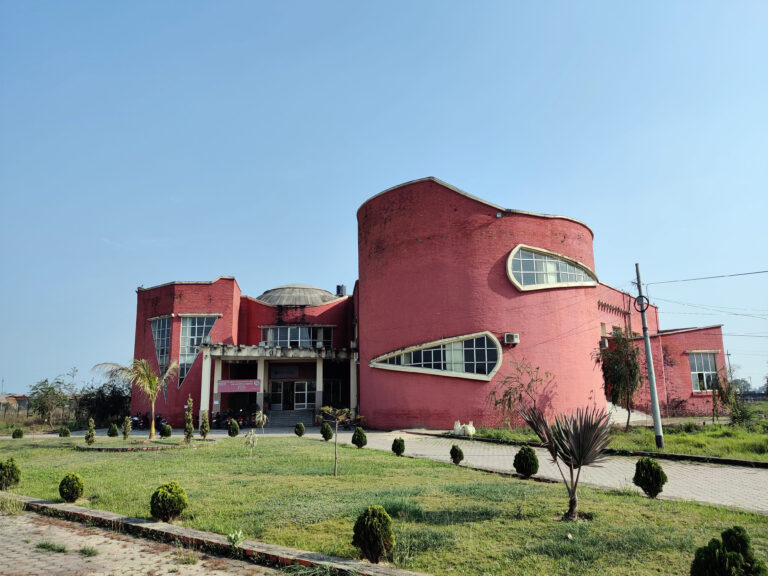
A building located in the Special Economic Zone in Bhairahawa
Apart from occasional conventions of political parties, small club events, and cultural programs, large-scale conferences are rare in Butwal. Head of the Conference Center Management Office, Dharmendra Panthi, says, “There may be two or four programs in a month at most; otherwise, there’s hardly anything.”
While the international conference center was under construction in Butwal, on 21 May 2016, during the celebration of the 2560th Buddha Jayanti in Lumbini, a temporary tent set up in an open area near the research center collapsed due to a storm accompanied by rain. As the program descended into chaos, then Prime Minister KP Sharma Oli, who was present as the chief guest, announced the need for a permanent hall to host large events in Lumbini and declared the construction of a hall with a capacity of 5,000 people.
The Oli-led government allocated a budget in fiscal year 2017/18 for the construction of the Lumbini International Buddhist Meditation Center and Convention Hall. Although the initial estimated cost under the Lumbini Development Project was Rs 330 million, the expenditure rose to nearly Rs 700 million by completion. The hall, constructed over four years, was inaugurated in May 2022 by then-Prime Minister Sher Bahadur Deuba.
Spread over 8,300 square meters, this modern and well-equipped hall has a daily rental rate of Rs 150,000. Except for annual Buddha Jayanti celebrations and a few programs, it has not been adequately utilized. There is no operational guideline for its management. Since conferences are rare, the air-conditioned hall with a capacity of 5,000 people remains mostly closed. Most major programs in Lumbini are held in open grounds and monasteries.
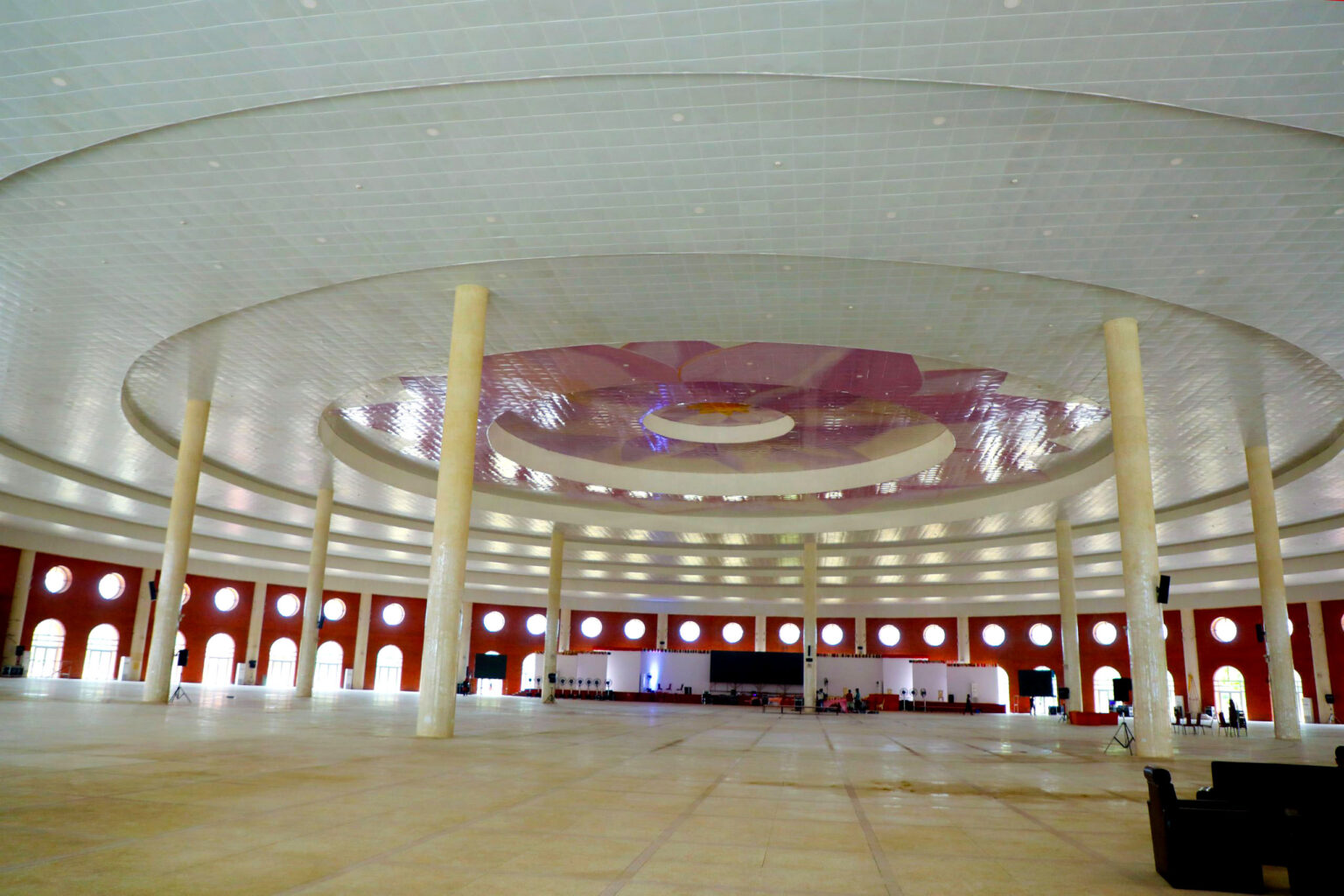
Assembly Hall in Lumbini
Although this hall, built at a cost of Rs 700 million, was claimed to be soundproof, echoes make speeches unclear. On 27 April this year, during the inauguration of the Fourth Asian Buddhist Cultural Festival at the same hall, then Prime Minister Oli commented on the technical shortcomings, saying: “It’s hard to understand what I’m saying; there’s an echo in the sound, making it uncomfortable to listen. Even if it costs Rs30-40 million, that’s fine – please arrange sound-absorbing panels and ensure the sound system doesn’t echo as soon as possible.”
A billion-rupee stadium left unused
The Nepalgunj Stadium located at Nepalgunj Sub-Metropolitan City–13 in Banke was built at a cost of nearly Rs 1 billion. The stadium spans 4.74 hectares of land.
Originally constructed some 42 years ago, the stadium was upgraded for the Eighth National Games in 2019, with sports infrastructures built at a cost of approximately Rs 1.5 billion. Facilities constructed included a football ground, parapet, swimming pool, weightlifting academy, shooting range, handball court, volleyball and badminton courts with parking, and a basketball court. At present, these structures are lying unused.
The stadium’s parapet can accommodate 4,000 spectators. Despite having the capacity to host national-level sporting events, it has been waiting for major competitions for seven years. Only small-scale tournaments are organized here. Stadium Office Chief Mahesh Chand says that apart from the annual district-level President’s Running Shield competition, no major events are held.
So how is the stadium managing its internal expenses? According to Chand, around Rs 1.8 million collected annually from athlete training programs and local school events is used to manage internal costs. However, due to the lack of revenue, managing expenses has become difficult. He says, “That amount is spent on salaries and allowances of five internal staff and minor maintenance works. It’s very hard to cover management costs. Electricity bills alone range from Rs 30,000–40,000 up to Rs 100,000.”
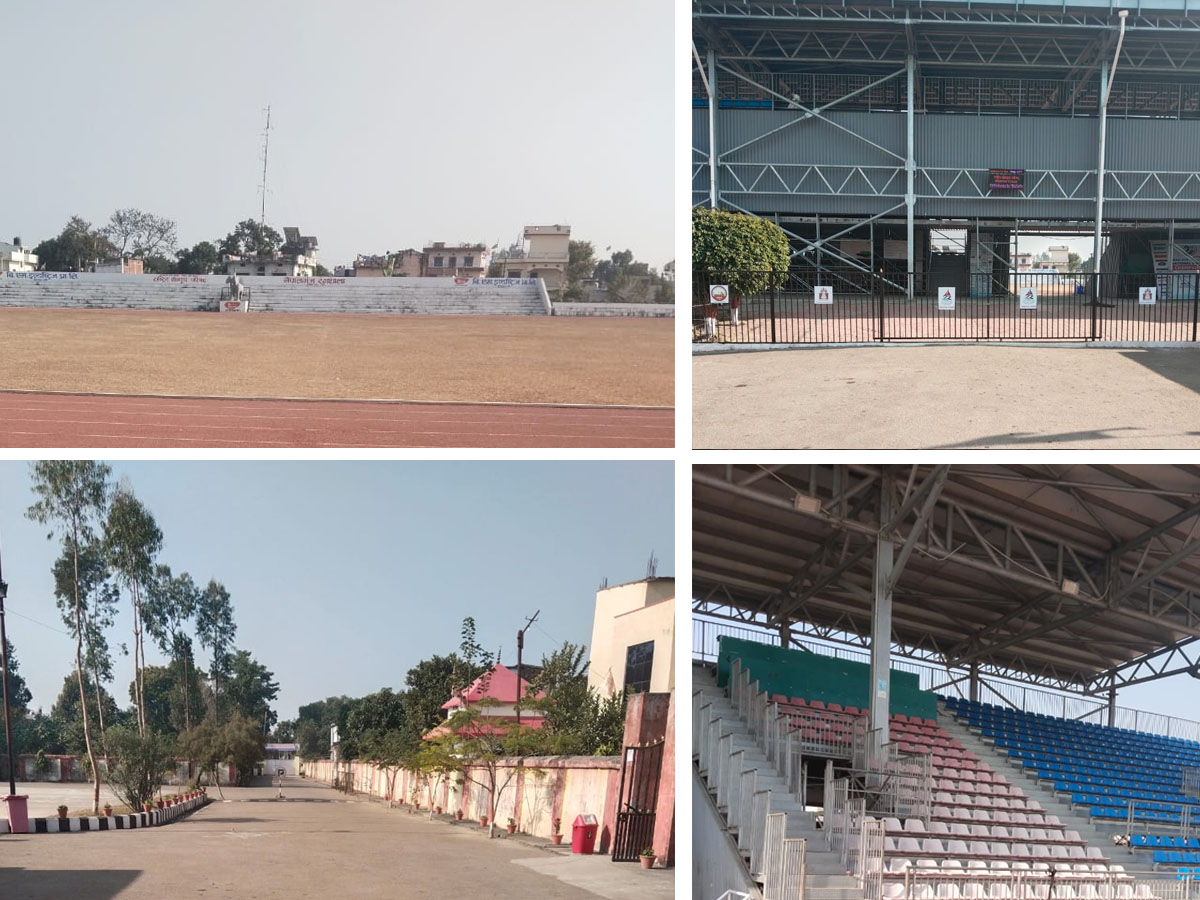
Nepalgunj Stadium
Although the parapet needs repairs every two years, lack of funds has prevented any action. Chand warns that if national-level competitions are not organized and the government does not take interest in protection and management, the stadium could turn into scrap within five to seven years. He adds that due to lack of water management, the football field has dried up and the grass has died, while the running track has deteriorated due to lack of maintenance.
Cricket stadium overgrown with grass
The cricket stadium in Deukhuri, Dang, has been abandoned due to the lack of games. Although capable of hosting large national-level tournaments, no competition has been held in the past year. Since the Prime Minister Cup One-Day Men’s National Cricket Tournament held in March 2025, there has been no sign of other events. Grass has grown on the field, and garbage has accumulated.
The Lamahi Town Development Committee constructed the stadium at a cost of Rs 80 million. It has seating for 2,000 spectators and a VIP parapet with a capacity of 390 seats.
Spread over four hectares, the stadium complex includes 15 commercial shops that generate a monthly income of Rs 150,000, which is used for stadium maintenance. When the Detailed Project Report (DPR) was prepared in 2008, the estimated cost was Rs 240 million. According to the DPR, construction of the full infrastructure remains incomplete.
Although events such as the Eighth National Women’s Cricket Tournament and the Prime Minister Cup Women’s Cricket Tournament have been held here, no other competitions have taken place. While there were plans to hand over the ground to the Cricket Association of Nepal (CAN), formal procedures have not moved forward, according to Sub-Engineer Tulsiram Aryal of the Lamahi Town Development Committee.
“The Town Development Committee dreamed that national-level cricket tournaments would be held in Lamahi and that the area would develop accordingly, which is why this structure was built,” he says. “But competitions did not happen as expected. It’s been nearly two years without any tournament, and no schedule or proposal has come forward.”
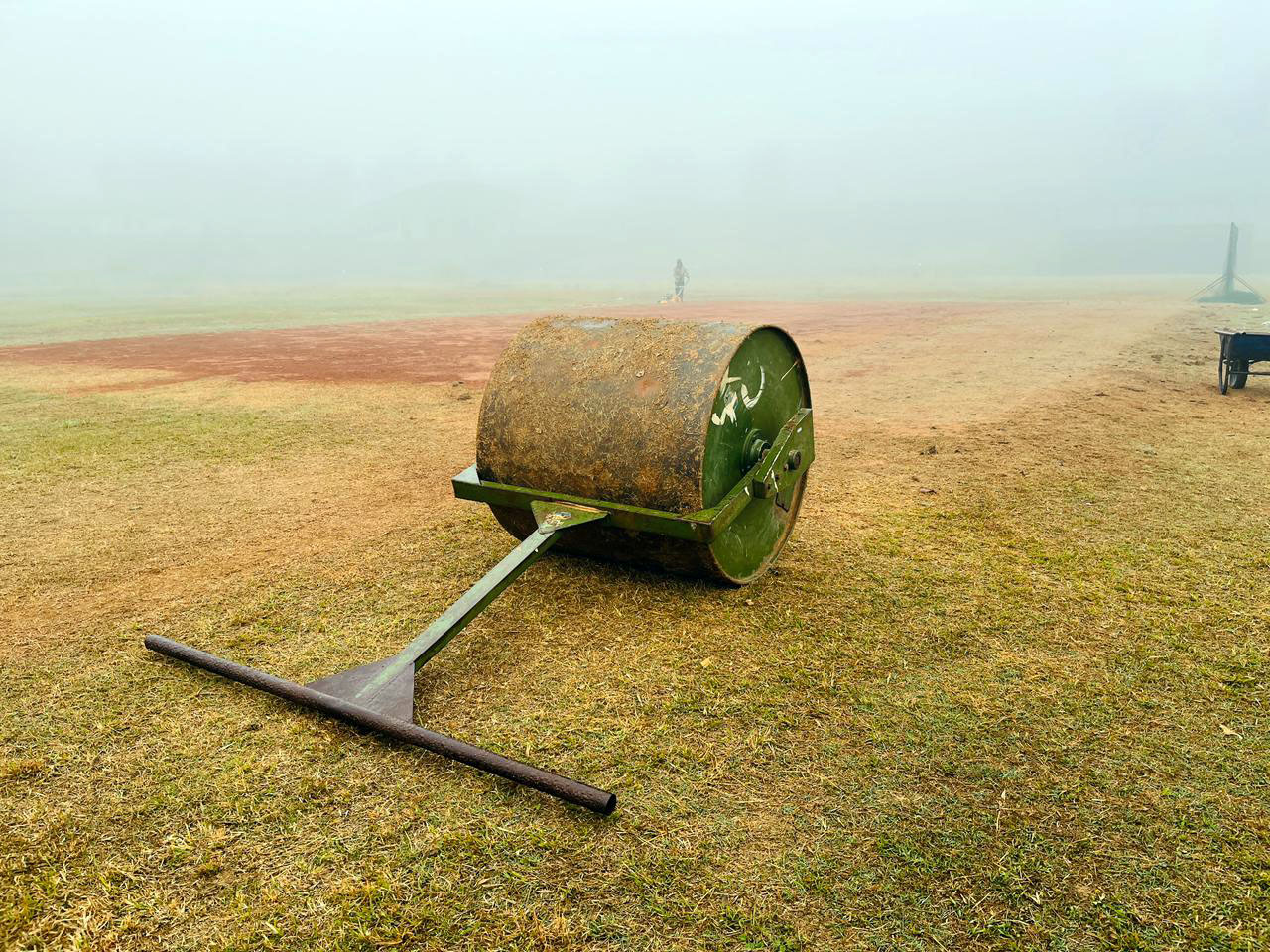
Dang Cricket Stadium
Due to the absence of competitions, the field has turned into a playground for children.
These three examples of large physical infrastructures built with massive state investment in Lumbini Province but remaining unused highlight the gap between infrastructure construction and actual utilization. These are not the only cases; several other major infrastructures in the province are also awaiting operation.
This situation has arisen due to political leadership hastily pouring large budgets into infrastructure construction without paying attention to their utilization after completion. The fact that such large infrastructures in the province remain unused raises serious questions about the proper use of public funds.
According to Manikar Karki, a researcher and analyst, there is no serious analysis of a project’s objectives, potential users, financial sustainability, or long-term operational model. He says,
“After construction, there is no discussion at all about how the structure will be operated, how many people will be needed, how operating costs will be recovered, where the funds for operation will come from, how local people will be involved in running such structures, and who will bear the long-term responsibility.”
More white-elephant structures
Another example of ineffective use of public funds in large infrastructure projects is the Special Economic Zone (SEZ).
With the objectives of increasing domestic and foreign investment, creating employment, promoting export-oriented industries, increasing exports to reduce the trade deficit, and boosting the national economy, the Government of Nepal established the Special Economic Zone Authority in January 2004. Under this, SEZs were announced in various parts of the country to provide entrepreneurs with special tax and customs exemptions, flexible labor policies, and infrastructure-equipped industrial areas. SEZs were planned in Panchkhal, Simara, and Bhairahawa; except for Panchkhal, SEZs have been established and are operational in the other two locations.
However, while SEZs meant for industrialization should be filled with factories and goods, this has not happened. As a result, billions of rupees from the state treasury have become unproductive. The Bhairahawa SEZ, built at a cost of Rs 850 million over an area of 35.24 hectares, has 69 industrial plots, but only 13 industries have been established. Of these, only 11 are operational. Two industries are closed after their electricity supply was cut due to a dispute over trunk-line electricity tariffs with the Nepal Electricity Authority.
The government announces special provisions to attract industrialists to the Bhairahawa SEZ in almost every annual budget, but entrepreneurs are not being attracted. For the first two years after inauguration, the SEZ could not even begin operation. In subsequent years, a few industries entered, but even now the SEZ has not been able to operate at full capacity. SEZ Information Officer Meghraj Shankar says no new industries have been added.
Not only federally built infrastructure, but also large projects constructed by the provincial government are lying idle. With the aim of providing long-distance drivers and travelers with rest areas, toilets, and snack facilities, the Lumbini Provincial Government began constructing modern refreshment centers at five locations along the East–West Highway, investing about Rs 110 million.
Such structures were initiated in 2020 at Bardaghat in Nawalparasi West, Sainamaina in Rupandehi, Chandrauta in Kapilvastu, Lamahi in Dang, and Bardiya.
Although the initial budgets were implemented, the projects were abandoned after not being included in subsequent budget cycles. In Sainamaina, the building has been completed but remains unused due to uncertainty over who will operate it. Construction in Chandrauta is only 75 percent complete, while that in Bardaghat is only 50 percent complete.
In Butwal, a slaughterhouse built at a cost of Rs 221.3 million remains unused due to disputes arising after the operating contract was awarded. The slaughterhouse, funded with Rs 70 million from the Lumbini Provincial Government, Rs 30 million from Butwal Sub-Metropolitan City, and technical investment from Heifer International, has been left idle after Muktinath Livestock Bank, which was given the responsibility to operate it, failed to do so. According to Butwal Sub-Metropolitan City Spokesperson Shiva Rana, problems between local business operators and the operating company have emerged, and efforts are underway to resolve them and bring the facility into operation.
Similarly, a multipurpose view tower built in Tilottama, Rupandehi, at a cost of about Rs 140 million is also lying idle. Although the view tower was inaugurated on 29 March 2022 by then Prime Minister KP Sharma Oli, repeated bidding processes have failed to bring it into operation. The ten-story tower was funded with 30 percent investment from the Shankarnagar Forest Recreation and Research Center and 70 percent from Tilottama Municipality, and was intended to house a hotel, shops, and a library. Tilottama Municipality Information Officer Gangaram Acharya says that a new tender has recently been called to operate the tower.
No study, no operational model
There is a clear lack of operational models for structures built with large investments. Even years after completion, no operational models have been developed for facilities ranging from stadiums to international conference centers. No institution or authority has been designated to manage and operate these structures, and operational regulations have not been formulated.
Krishna Prasad Sharma, president of the Federation of Nepalese Chambers of Commerce and Industry (FNCCI), Lumbini Province, says that because structures were not built with private-sector participation and ownership, no operational foundation was prepared.
“There was never any discussion about what the private sector needs or what kinds of structures are necessary. Structures were built without consultation,” he says. “The private sector invested in the hope that these structures would become operational and that the market would become dynamic, but they did not. The clearest example of this is Bhairahawa International Airport.”
Indeed, looking at Rupandehi’s international airport, Lumbini, the birthplace of Buddha, and the Butwal International Conference Center, several five-star hotels have been established along the Bhairahawa–Lumbini road since 2015, including Lumbini Heritage, Siddhartha Vilasa in Anchalpur, Hyatt Palace in Butwal, and Tiger Palace along the Bhairahawa–Butwal road. Another five-star hotel is under construction at Buddha Chowk in Bhairahawa by the Ghimire Group.
However, entrepreneurs are disappointed because the airport has not been operating as expected and tourist arrivals in Lumbini have not increased accordingly. Tourism entrepreneur CP Shrestha says that although Rs 10–12 billion was invested in the Bhairahawa area in anticipation of regular airport operations and tourist inflow to Lumbini, returns have not matched expectations. According to him, this investment occurred after airport construction began.
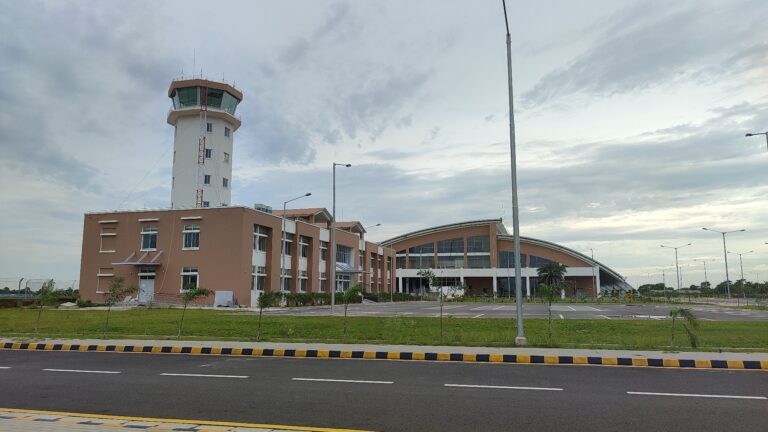
Gautam Buddha International Airport
“Once airport construction started, hotel investments poured in rapidly. If we calculate investments before and after that period, around Rs 30 billion has already been invested in the Bhairahawa area alone, but things did not turn out as expected,” he says.
Former finance minister Bishnu Paudel argues that the constructed structures will eventually come into operation sooner or later. He says, “We built these structures because they were needed. If they had not been built, we would not even be in a position to talk about operations. The structures are already in place, and sooner or later they will be operated.”
Experts say that a shared weakness seen after the construction of structures considered symbols of development is the mindset that equates infrastructure construction with development, while not considering operation and management as integral parts of development.
Infrastructure expert Surya Raj Acharya says such problems have emerged because structures were built without long-term thinking and planning. “We are only looking at large structures. From small view towers, city conference halls, tiger and elephant statues in parks, to airports in Bhairahawa and Pokhara – why did these not come into use even after government decisions to build them? This means they were built without proper thought,” he says.
He argues that the most fundamental aspect of physical infrastructure is thinking about its future before construction. “Leave infrastructure aside. Even if you build a house costing Rs 10-20 million without proper thought, after four or five years you yourself and your family will no longer like it, and then you’ll have to demolish it. That’s why one must think about why to build, for whom to build, how to operate it after construction, and whether there is a market,” he says.
Acharya also points out weaknesses not only at the state mechanism and political level, but also at the technical level, where projects move directly to contracting without basic analysis. He notes that public discussion often focuses on how much budget an official has spent, but not on what kind of structure is being built.
Due to the lack of long-term thinking in infrastructure construction, many projects are now unused or abandoned. The question now is how these completed structures can be brought into operation.
Infrastructure expert Acharya says that plans must be developed to operate abandoned structures. He argues that appropriate operational models should be developed with the participation of experts, technicians, and local communities.
“We must conduct fresh studies on needs and feasibility and decide whether such structures should be operated by the federal, provincial, or local governments, or whether the private sector or communities can take the lead. They should not be left in limbo.”
If abandoned physical infrastructure is left merely for staff to watch over, the number of closed structures will keep increasing every year, and billions of rupees from the state treasury will continue to be wasted, he warns.