Kathmandu
Sunday, July 12, 2026





Even after winning, having to fight another battle for the implementation of court verdicts fuels growing distrust in the judiciary
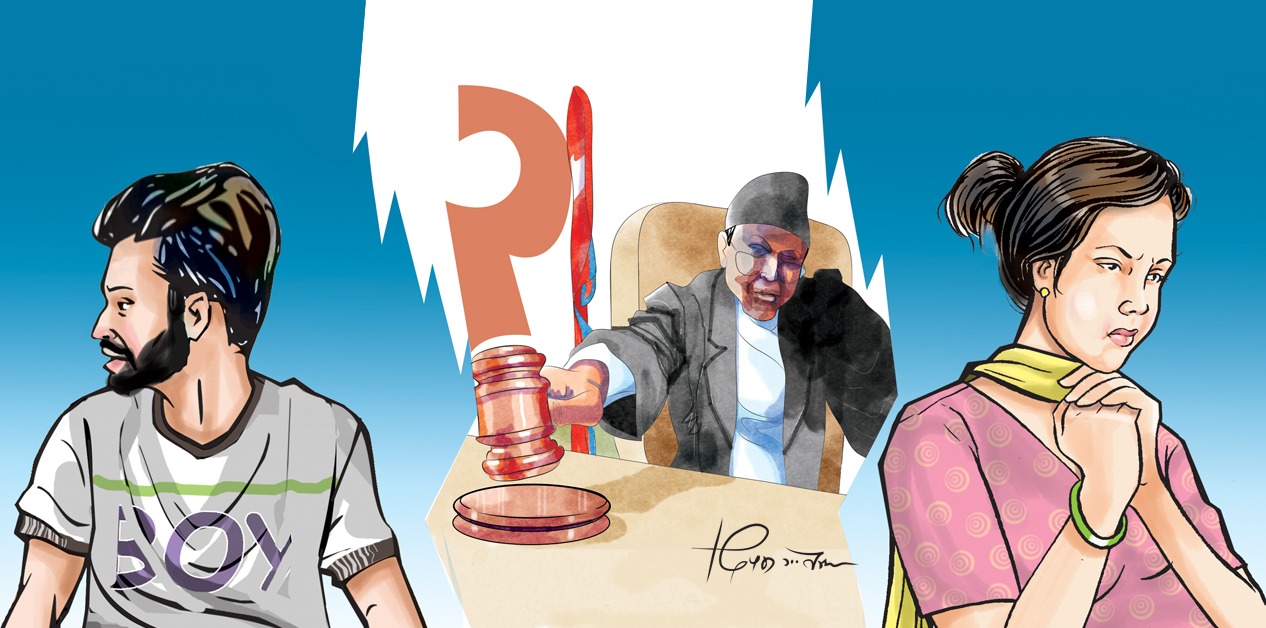
KATHMANDU: Sixteen years after her marriage, in 2064 BS (2007/08), Gyanulaxmi Shrestha of Kathmandu filed a divorce case along with a claim for property share against her husband, Lalkaji Shrestha, at the Kathmandu District Court. Three years later, on 20 December 2010, the court ruled in favor of divorce and decided that the property should be divided into four equal parts.
Dissatisfied with the district court’s verdict, Lalkaji appealed to the Patan High Court seeking annulment of the decision. In 2068 BS (2011/12), the high court upheld the district court’s ruling. In 2070 BS (2013/14), Lalkaji again filed a petition seeking annulment of the high court’s verdict. The high court rejected the petition and reaffirmed its decision for the second time. After that, he approached the Supreme Court, once again seeking to annul the verdict.
After Lalkaji entered into another marriage, Gyanulaxmi fought the case while running her own business to support and educate their two daughters. When she learned that Lalkaji was trying to sell a ten-room house in Nagarjun–9, Satungal, property built from the clothing business they had jointly run, she first had the land and house registered under restriction.
Although the court ruled in her favor, Lalkaji, determined not to give her the property share, kept filing appeals and took the case all the way to the Supreme Court.
Eventually, the Supreme Court also upheld the district court’s decision and ruled that the property must be divided. On 8 February 2024, when the Supreme Court again upheld the district court’s verdict, Gyanulaxmi finally won. The court ruled that the house would be divided among Gyanulaxmi, her husband, and their two daughters.
After winning the case at all three levels of court, including the Supreme Court, Gyanulaxmi was confident that she and her daughters would finally receive their rights. She believed her days of running from court to court were over. She then filed an application at the Kathmandu District Court for enforcement of the verdict.
When the verdict allocated one out of four shares to Lalkaji, the verdict enforcement section appointed officials to carry out the division. However, Lalkaji immediately filed another petition at court to suspend the enforcement process. “We face problems enforcing decisions in many property-share cases like this,” says Dhan Bahadur Karki, an officer at the Kathmandu District Court responsible for verdict enforcement. “The opposing party always comes up with one pretext or another and files new petitions. The law itself is such that even cases finalized by the Supreme Court cannot be easily enforced, even if we want to.”
For Gyanulaxmi, judicial justice remains confined to paper. “There are so many ways to delay. A case ends in one court, then you can file another case again. I am exhausted,” says the 49-year-old Gyanulaxmi. “May even one’s worst enemy not have to suffer the ordeal of running around courts like this.”
According to Gyanulaxmi, she claimed a share only in the property that both of them had earned together, not in ancestral property. She says that during the long legal battle she had to sell all the gold jewelry she owned. “Many times, I felt like giving up the case midway. The suffering it has caused is beyond words,” she says.
When the case had reached its final stage of enforcement, Lalkaji again filed a petition, this time demanding a share for a son born to his second wife. The court dismissed that case. He then appealed the dismissal to the High Court. Subsequently, the Kathmandu District Court even granted a property share to the minor son from the second marriage. Dissatisfied with that as well, Lalkaji again filed a petition seeking annulment, according to enforcement officer Karki.
If a party is dissatisfied with the actions taken by the district court during enforcement of a verdict, the law allows them to file a complaint within 15 days. Lalkaji appears to have taken full advantage of this provision. He even had his mother file petitions seeking annulment and file property-share cases.
There is no certainty about when this process will end. Gyanulaxmi, who began fighting the case when her daughters were very young, is now supported by her daughters, who accompany her to court hearings.
Whenever a person’s rights are violated, they file a case in court. But justice is not achieved merely by obtaining a verdict. For justice to be realized, the verdict must be enforced. Those who exploit loopholes in the law do not allow court decisions to be implemented. They are able to repeatedly file petitions seeking annulment, and this cycle continues endlessly.

Kathmandu District Court/ Photo: Bikram Rai
In an effort to prevent property from being transferred into another person’s name after partition, the Kathmandu District Court has had to endure significant complications. The court issues a verdict on property division, but petitions seeking annulment are immediately filed.
“When the court enforces a verdict by dividing property, in some cases people only receive a land ownership certificate on paper. They are not even able to enjoy or use the property,” enforcement officer Karki explains. “Our legal process itself seems to be enabling those who do not want to hand over property and who wish to harass the party that has won the case.”
There are not many problems in enforcing verdicts in cases involving loans, transactions, or compensation claims. However, enforcing verdicts in property-share cases is extremely difficult. Even issues settled by the Supreme Court should reach a point where the door is closed.
“The provision that allows petitions to be filed against every order if one is dissatisfied is causing immense hardship,” says Karki.
Section 241 of the Muluki Civil Procedure Code, 2074 BS (2017 AD), provides for the division of property shares. It states that “while dividing property in accordance with a verdict, the court must complete the division and partition within five months.” The court must separate the share of any co-heir who does not appear and distribute the shares among those who are present.
If the court must appoint officials to divide the property, the law requires that employees be sent to carry out the partition. If the persons entitled to shares cannot reach agreement regarding the property to be divided, the Code states that the court must equalize the value of the property, draw lots, and divide it accordingly.
Former president of the Nepal Bar Association and senior advocate Gopal Krishna Ghimire says that weaknesses in verdict enforcement raise questions about the very credibility of the courts.
“One of the reasons the credibility of justice delivered by courts is questioned is verdict enforcement. It is not enough to deliver justice; justice must also be seen to be delivered,” says Ghimire. “There are many complaints regarding the enforcement of verdicts.” He explains that the portion of property division decided by the court is a person’s natural right, and if there are technical problems in its enforcement, everyone should work together to fix them.
“If the problem lies in the regulations, they should be amended. We legal professionals fight cases on behalf of one side, but the winning party must receive justice,” he says.
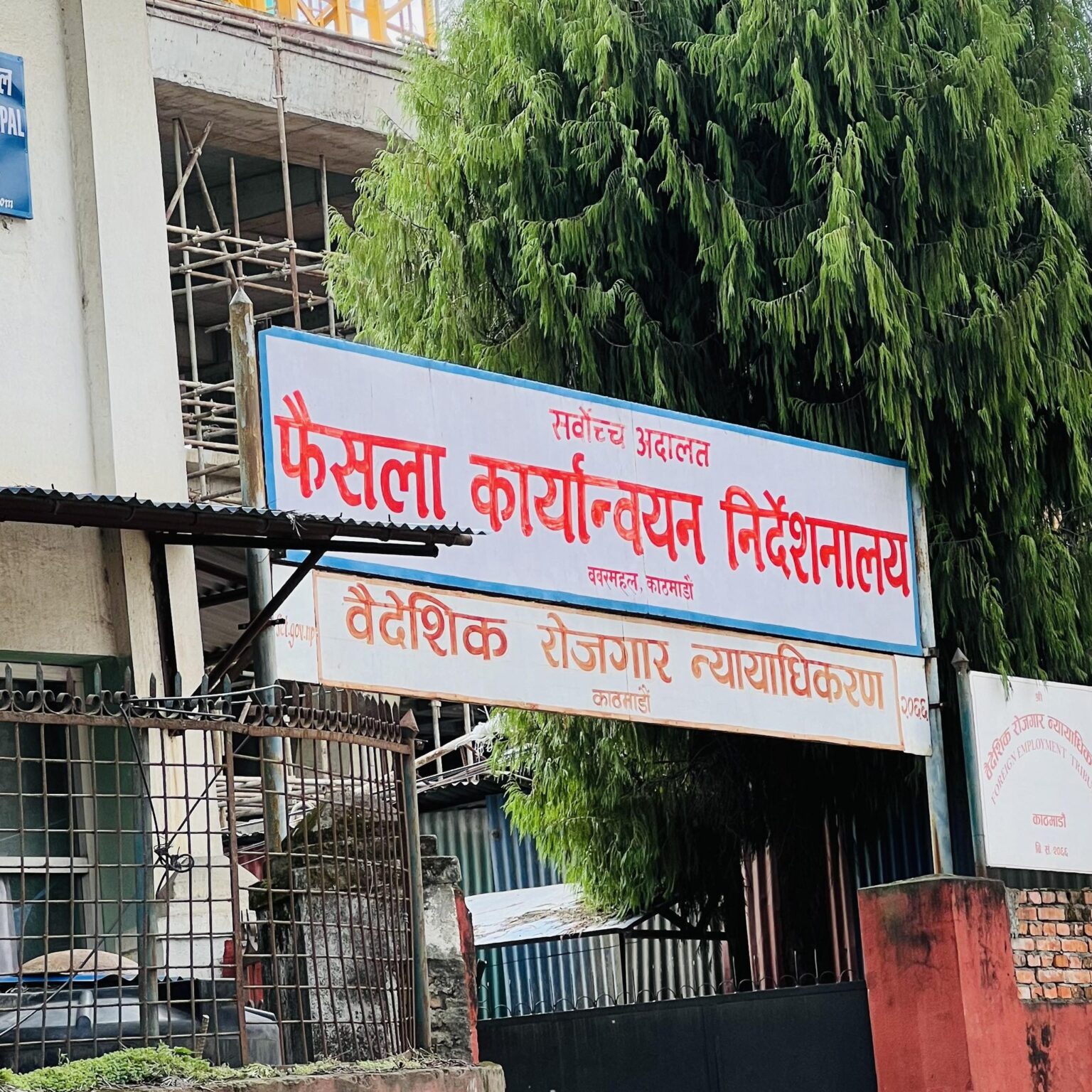
Among the applications pending at the revenue (execution) section of the Kathmandu District Court, the largest number relate to the recovery of compensation or dues (bigo). The second largest category consists of verdicts ordering the division of property shares. According to the court, from last Shrawan to Mangsir (mid-July to mid-November), around 850 applications related solely to property partition were registered. Out of 5,942 applications filed for enforcement after verdicts were issued, work is still pending on all of them.
32,000 verdicts waiting for justice
“Since a verdict merely declares the rights and entitlements of the parties to a case, the feeling of having received justice arises only after the verdict is enforced,” states an information booklet on verdict enforcement published by the Supreme Court.
After a court delivers a final decision in a case, putting that decision into practice is what constitutes verdict enforcement. A person truly experiences justice only after the decision is enforced. In criminal cases, enforcement of a verdict means serving the prison sentence determined by the court and paying fines or compensation. Imposing punishment, collecting fines, compensation or damages, compelling or prohibiting certain acts, reinstating or removing a person from a position – these are the practical forms of enforcing court decisions. For justice to be genuinely felt, court verdicts must be implemented in practice.
According to the Verdict Enforcement Directive, 2075 BS (2018/19), regardless of which level of court issues the verdict, enforcement is to be carried out by the district court.
The courts themselves appear to acknowledge that only effective enforcement of verdicts can allow service seekers to feel justice and maintain trust in the judiciary. Even the Supreme Court’s annual report for fiscal year 2080/81 BS (2023/24 AD) admits that decisions issued by courts have remained unenforced for years.
“Although strategic plans have been adopted, the expected achievements have not been attained. For this, it appears necessary to adopt strategies such as special prosecution,” the report states.
According to data from Shrawan 2080 to the end of Ashad 2081 (mid-July 2023 to mid-July 2024), 32,368 applications related to cases already decided by courts across the country are awaiting enforcement. As per the Supreme Court’s annual report, prison sentences totaling 114,637 years, 4 months, and 10 days remain to be enforced. Similarly, fines amounting to Rs 32.12 billion are yet to be recovered. The same report notes that, in fiscal year 2080/81, there are 2,566 verdicts pending enforcement at the Kathmandu District Court alone.
The annual report further states that since verdict enforcement cannot be accomplished by the courts’ efforts alone, the tasks that must be carried out by the executive organs of the state need to be properly managed. It also suggests that the revenue sections of district courts should be surveyed and kept under the supervision of the Verdict Enforcement Directorate.
The Supreme Court has pointed out that the government must take appropriate initiatives to effectively implement existing laws that restrict the delivery of public services to individuals who have outstanding enforcement records until such records are cleared. The report also emphasizes that appropriate initiatives are needed from the Ministry of Law, Justice and Parliamentary Affairs and from the government to ensure the swift and lawful implementation in practice of matters decided by the courts.
Chief Justice Prakash Man Singh Raut, in the judiciary’s Five-Year Plan, has stated that the judiciary aims to enhance public trust and confidence in the judicial system by ensuring quality and effective justice delivery and by guaranteeing capable justice through verdict enforcement.
In the “Judiciary’s Five-Year Strategic Plan,” quantitative targets were set for applications related to the enforcement of civil case verdicts. The plan aimed to resolve such applications within six months. However, progress toward that target was only 14 percent.
“The true experience of justice can only be achieved through the enforcement of verdicts,” the Five-Year Plan states.