Kathmandu
Thursday, July 23, 2026





Rs 2.5 billion in taxes unpaid by foreign airlines over the last two fiscal years (Since FY 2022/23)
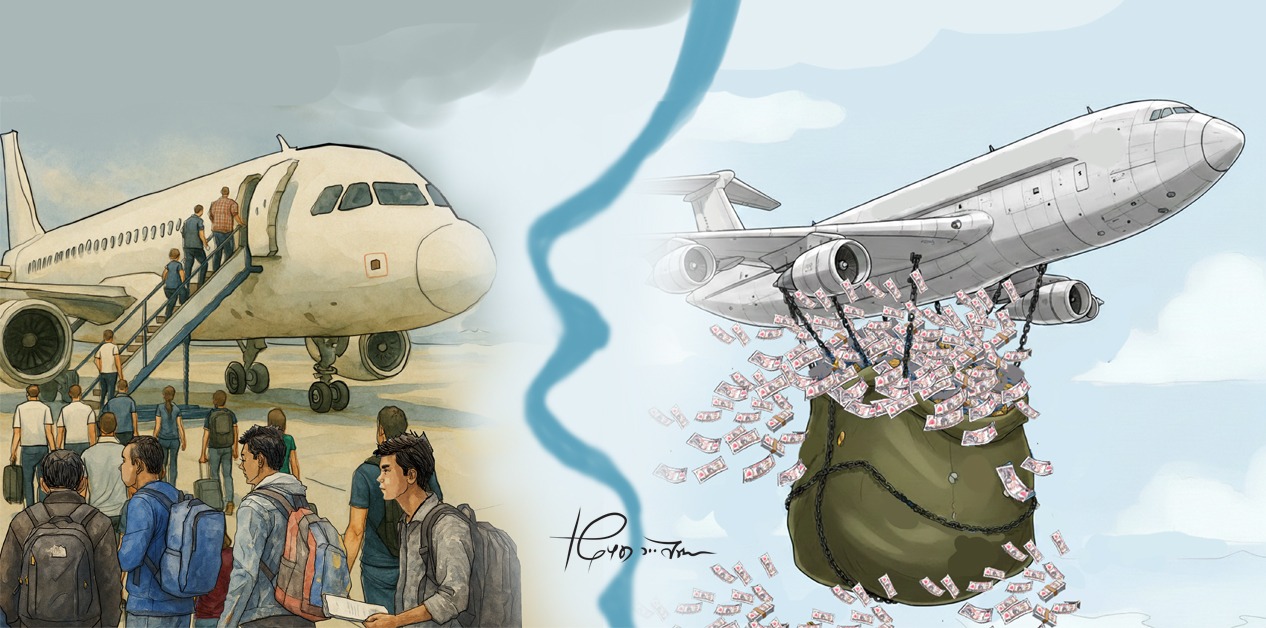
KATHMANDU: A total of 27 foreign airline companies are operating international flights from and to the Tribhuvan International Airport (TIA). These airlines conduct business worth more than Rs 150 billion annually. According to data received from the Civil Aviation Authority of Nepal (CAAN), in 2024, as many as 26 foreign airline companies providing air services through TIA (excluding SpiceJet Airlines, which began flights only from 2025) earned a total of USD 1,139,408,789. When converted into Nepali currency, this amounts to Rs 153.82 billion (Rs 153,820,186,515).
On January 1, 2024, the exchange rate was Rs 133.44 per US dollar, and on December 31 it was Rs 137.17. Using the average exchange rate of Rs 135 per US dollar, the foreign airlines’ income earned in US dollars has been converted into Nepali rupees.
In Nepal, a total of 30 airline companies – 27 foreign and 3 domestic – are operating international flights. These airlines fly to 28 international destinations across different countries. According to CAAN Information Officer Gyanendra Bhul, flights from Nepal operate to eight destinations in South Asia, seven in the Gulf region, four in Southeast Asia, eight in East Asia, and one destination in Europe.
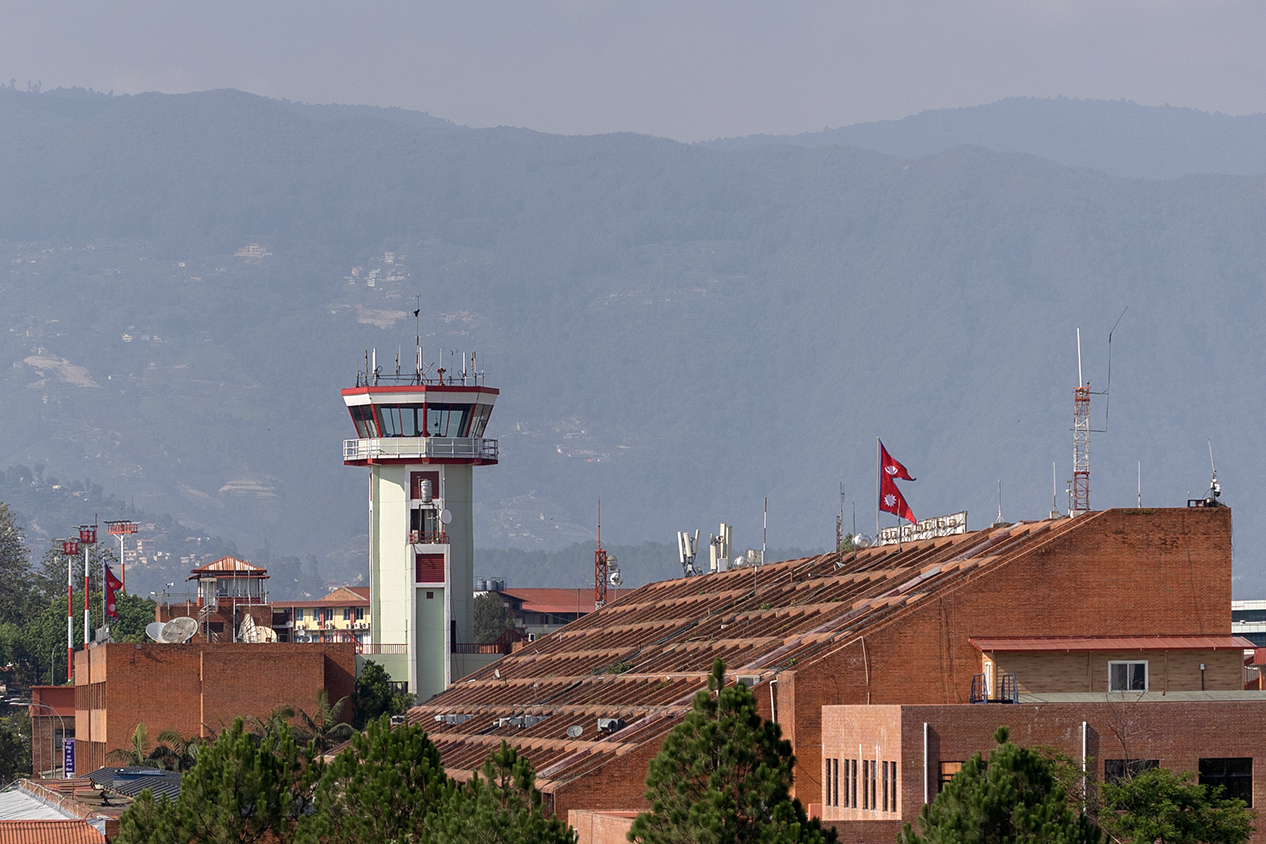
Tribhuvan International Airport/ Photo: Bikram Rai
Foreign airlines earn more than Rs 150 billion by providing flight services to passengers arriving in Nepal from abroad and departing from Nepal. This figure does not include income from cargo services. If cargo earnings were added, the total income of foreign airlines operating in Nepal would be even higher.
Former Acting Director General of CAAN, Rajkumar Chhetri, says that the growth in business of foreign airlines operating international flights from Nepal also benefits the country. Having served for a long time as General Manager of TIA, Chhetri says, “The more foreign airlines come, the greater the benefits. The country earns revenue from landing and parking fees, ground handling, and fuel sales. It also contributes to tourism promotion.”
Among the foreign airlines operating in Nepal, Qatar Airways is the largest revenue earner. The airline has received approval from CAAN to operate four weekly flights (28 flights per month) on the Doha–Kathmandu–Doha route. In 2024, Qatar Airways served 596,050 passengers on direct Doha–Kathmandu–Doha flights and earned USD 368,817,600 from ticket sales alone. Converted at an exchange rate of Rs 135 per US dollar, this equals Rs 49.79 billion (Rs 49,790,376,000). That year, Qatar Airways operated 1,199 flights on this route.
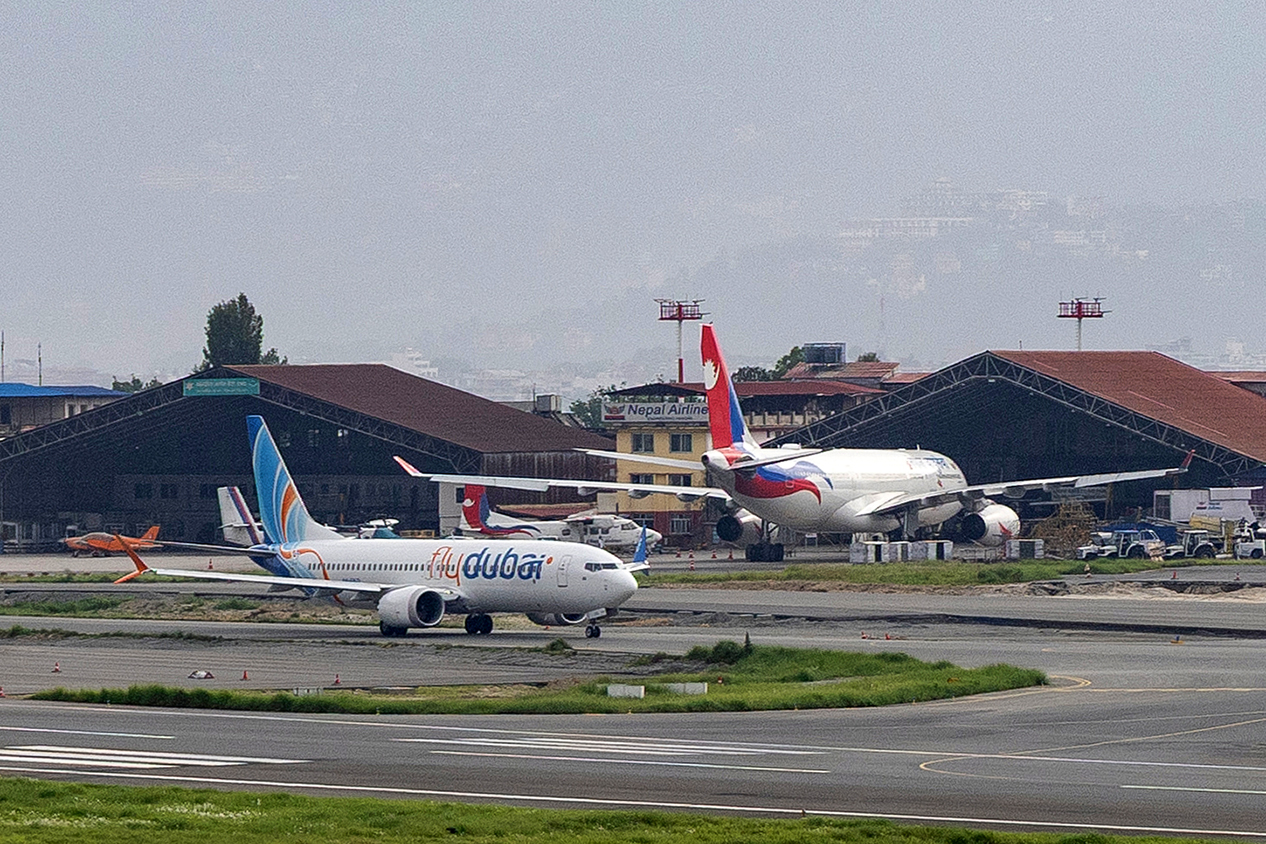
A Flydubai aircraft at Tribhuvan International Airport. Photo: Bikram Rai.
The majority of Qatar Airways’ passengers are Nepalis traveling abroad for foreign employment and returning home.
Turkish Airlines ranks second among airlines with large business volumes in Nepal. Operating direct flights from Istanbul to Kathmandu, Turkish Airlines conducted 206 flights in 2024, serving 98,753 passengers. From ticket sales, the airline earned Rs 15.38 billion (Rs 15,381,400,000). Turkish Airlines has received approval to operate one flight daily except Fridays. It connects Nepal with Europe through air travel.
According to CAAN, airlines from China and India provide the highest number of international air services to Nepal. China’s Air China, China Eastern, China Southern, and Sichuan Airlines operate flights to Nepal. Among them, Sichuan Airlines conducts the largest volume of business, earning Rs 4.39 billion (Rs 4,392,563,000) in 2024 alone. Together, the four Chinese airlines conducted business worth Rs 13.30 billion (Rs 13,300,161,000) in one year and served 252,637 passengers.
Four Indian airline companies also operate international flights from Nepal. According to CAAN, Air India, IndiGo Aviation, Air India Express, and SpiceJet are providing air services. Among these, Air India has the largest business volume in Nepal. Indian airlines connecting Nepal and India earned Rs 10.12 billion (Rs 10,129,100,000) in 2024.
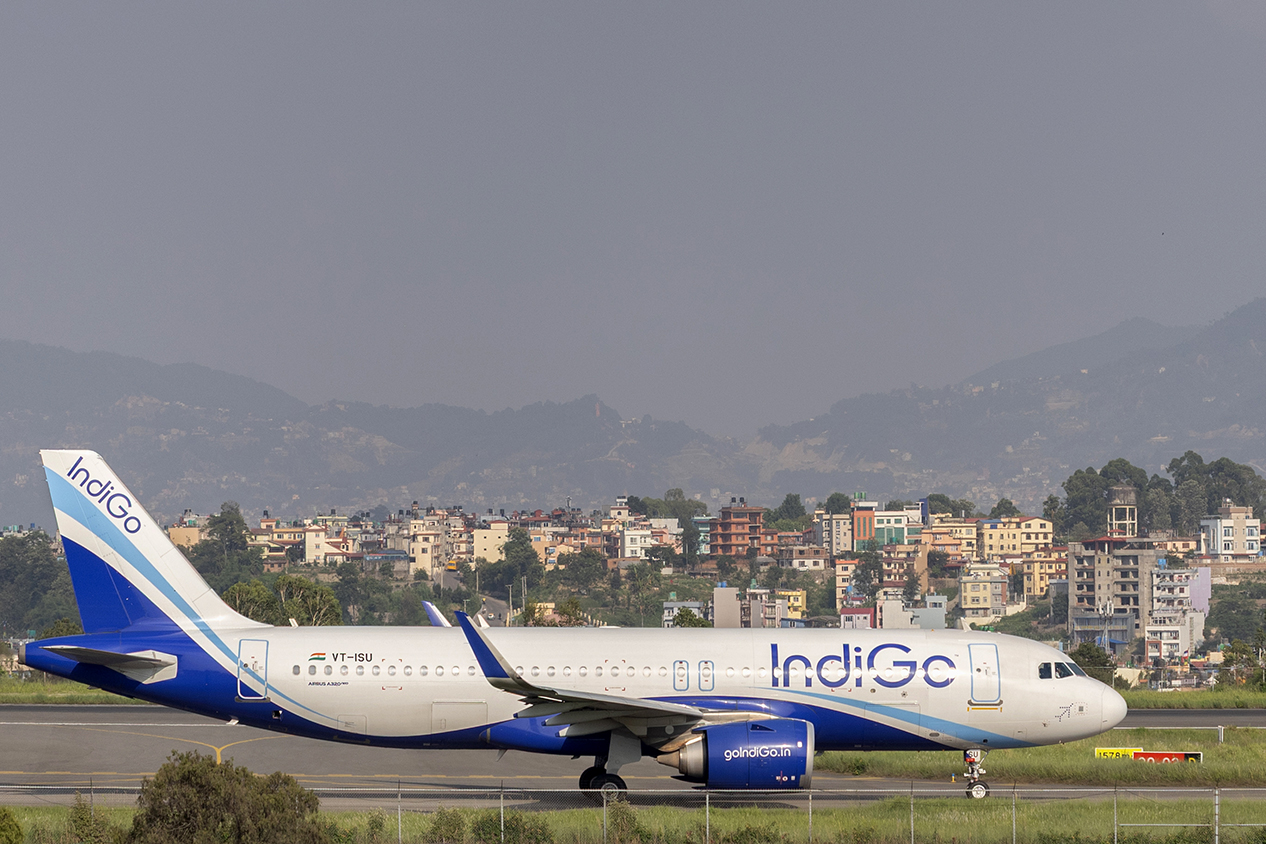
An aircraft of the Indian company IndiGo. Photo: Bikram Rai
Airlines from the United Arab Emirates (UAE), such as Air Arabia, Air Arabia Abu Dhabi, and flydubai, are also operating international air services in Nepal. For all these airlines, Nepalis traveling abroad for foreign employment and returning home constitute the main passenger base.
Air Arabia operates on the Sharjah–Kathmandu–Sharjah route, Air Arabia Abu Dhabi on Abu Dhabi–Kathmandu–Abu Dhabi, and flydubai on Dubai–Kathmandu–Dubai.
Air Arabia Abu Dhabi operates A320 and A321 aircraft, flying two daily flights every day of the week on the Abu Dhabi–Kathmandu–Abu Dhabi route. Air Arabia also uses A320 and A321 aircraft and operates 42 weekly flights on the Sharjah–Kathmandu–Sharjah route.
Three airline companies from Thailand are providing international air services in Nepal. Thailand’s Thai AirAsia, Thai Airways, and Thai Lion Air are operating flights. Thai AirAsia is flying an A320 aircraft with a seating capacity of 180 on the Bangkok–Kathmandu–Bangkok route. This aircraft arrives in Nepal and departs every day.
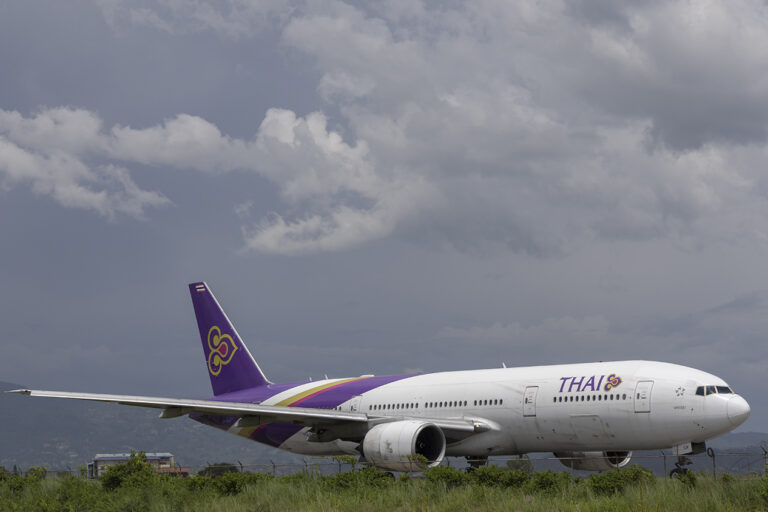
Thai Airways aircraft. Photo: Bikram Rai
According to CAAN, two international airlines each from Malaysia, Bhutan, and Kuwait are providing services in Nepal. The Bhutanese international airlines operating in Nepal are Druk Air and Bhutan Airlines. Kuwait’s Jazeera Airways and Kuwait Airways, as well as Malaysia Airlines, are also operating flights from the TIA.
Airlines from Qatar (Qatar Airways), Singapore (Singapore Airlines), South Korea (Korean Air), Sri Lanka (SriLankan Airlines), Bangladesh (Biman Bangladesh Airlines), and Hong Kong (Cathay Pacific Airways) are also providing international air services in Nepal.
Nepali airlines such as Nepal Airlines, Himalaya Airlines, and Buddha Air, are operating flights to various foreign destinations. The national flag carrier Nepal Airlines is flying to 10 international destinations. The private-sector Himalaya Airlines is flying to 11 international destinations. Buddha Air, which dominates the domestic aviation market, operates international flights only on the Kathmandu–Kolkata route.
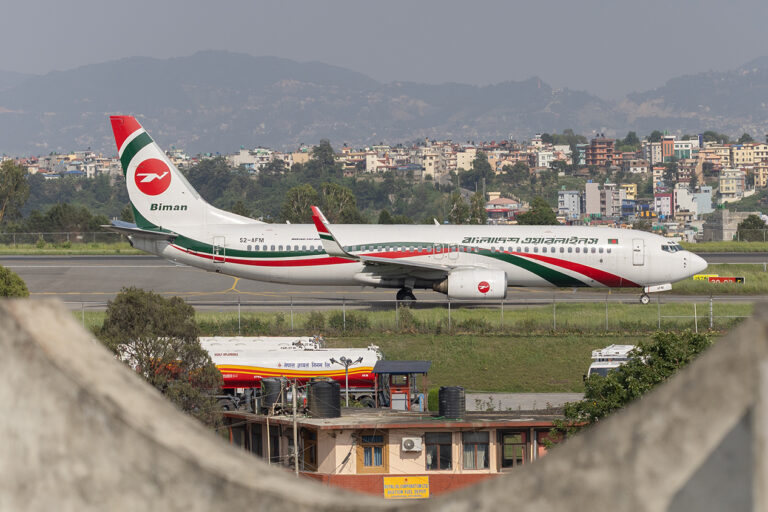
Airplane Bangladesh. Photo: Bikram Rai
According to data from the Marketing Department of Nepal Airlines, during the first four months (mid-July to mid-November 2025) of the current fiscal year 2025/26, the airline earned approximately Rs 5.9 billion from international flights. Nepal Airlines Corporation, which operates Nepal Airlines, earned Rs 5.96 billion (Rs 5.9611 billion) from domestic and international flights during that period. The corporation also earns revenue by providing ground handling services at the TIA; however, this income is not included in the stated figures.
Former Managing Director of the corporation, Sugatratna Kansakar, says that because Nepal’s national flag carrier has failed to establish a strong presence, the money Nepal could have earned is being taken away by foreign airlines.
“All airlines consider Kathmandu a good route. They want to fly here because earnings from Nepal are good,” he says. “If Nepali airlines had been able to establish a strong presence in international flights, Nepal could have earned the money that foreign airlines are taking away.”
But they do not pay taxes
Although foreign airlines operating in Nepal earn substantial income by carrying passengers, they have not paid the taxes they are required to pay to the Government of Nepal. Section 70 of the Income Tax Act, 2058 (2001) provides for a 5 percent tax on passengers carried from Nepal. Similarly, a 2 percent tax is imposed on international air transportation originating from Nepal. However, during the two fiscal years 2079/80 (2022/23) and 2080/81 (2023/24), foreign airlines failed to pay a total of Rs 2.572 billion (Rs 2,572,109,000) in these combined taxes.
The 61st Annual Report of the Office of the Auditor General states that two airlines operating flights to China and one airline each operating flights to Ankara and Kuwait failed to pay Rs 256.581 million in taxes, along with applicable fees and interest, in fiscal year 2022/23, and therefore require investigation. Similarly, in fiscal year 2023/24, the report notes that 13 foreign airlines must have Rs 2.315528 billion in taxes, fees, and interest recovered.
The Auditor General’s report states that taxes were calculated only up to the first destination of flights, and that taxes should be assessed and collected after also studying data of passengers who purchased tickets for connecting flights. However, the report does not clearly disclose which foreign airlines have failed to pay taxes.
For fiscal year 2023/24, the report mentions that one airline each operating flights to Saudi Arabia, Singapore, Dubai, Kuwait, Turkey, Oman, Sri Lanka, and Hong Kong, and two airlines each operating flights to Malaysia and Bhutan, did not pay taxes.
From Nepal, Singapore Airlines operates flights to Singapore, flydubai to Dubai, Kuwait Airways to Kuwait, Turkish Airlines to Turkey, and SriLankan Airlines to Sri Lanka. From Kathmandu to Malaysia, Batik Air and Malaysia Airlines are operating flights.
Lack of interest in Pokhara and Bhairahawa
Foreign airline companies earn substantial revenue from takeoffs and landings at the TIA in Kathmandu, but they have shown little interest in operating services from Nepal’s other two international airports.
According to CAAN data, approximately 4.9 million passengers use international air services from Nepal annually. In the first 11 months of 2025 (January to November), 4,111,981 passengers used air services. In 2024, the number of international air passengers was 4,928,925.
In the first 11 months of 2025, various airlines conducted 28,472 international takeoffs and landings from Nepal – 14,237 departures and 14,235 arrivals. Of these, 28,251 were from the TIA, while only 221 international movements took place at Gautam Buddha International Airport in Bhairahawa, according to CAAN data. During that period, Pokhara Regional International Airport saw only charter flights by China’s Sichuan Airlines.
Former Acting Director General of CAAN, Rajkumar Chhetri, says the main reason foreign airlines are unwilling to operate from Pokhara and Gautam Buddha International Airports is that Nepal itself cannot supply enough passengers.
“About 75 percent of passengers traveling abroad from Nepal are labor migrants. They must come to Kathmandu to complete all procedures. Once people are already in Kathmandu, they won’t go to Pokhara or Bhairahawa just to board a flight,” he says.
On the other hand, he adds that neighboring India also does not want regular flights from Pokhara and Bhairahawa.
“India has not provided air routes that would allow foreign airlines to fly directly from Gorakhpur to Bhairahawa or Pokhara. Instead, they must fly from Gorakhpur to Simara and then to Pokhara or Bhairahawa. This requires an additional 20 to 25 minutes of flight time, which significantly increases airline operating costs,” Chhetri explains.