Kathmandu
Thursday, June 18, 2026





Service recipients frustrated by foul-smelling toilets and disorderly garbage and dilapidated Items at government offices
KATHMANDU: Have you ever visited the Transport Management Office located at Ekantakuna in Lalitpur?
If you have, there’s probably no need to say much more. If you haven’t, then please be cautious.
After reaching the transport office, which is almost always crowded with service recipients, it can take hours to get your work done. In such a situation, the main problem faced by service seekers is the stench from the toilets.
Outside the building of the Driving License Branch of the office, there is a chaotic toilet. It is difficult even to enter due to the unbearable stench. The sharp smell spreads well beyond the toilet itself. Broken tiles are piled up in one corner inside the toilet. On top of that, packets of gutkha have been thrown around, and stains from spitting gutkha and paan are scattered everywhere. Service recipients who come to the office are tormented by the toilet’s foul odor.
Phanindra Katuwal from Imadol was standing in front of the toilet last Tuesday, complaining to a friend, “It takes the whole day just to get one task done, and the filth and stench here have given me a headache.”
There are three transport office buildings standing in a row there. The condition of the toilets in all three buildings is equally miserable – an overwhelming stench the moment one enters, and garbage piled up haphazardly. Upon entering ‘Block A’ of the office, one can see garbage piled up in a corner. At every level, beside the staircases, old items have been stacked, creating an unpleasant sight.
In the third building, sacks filled with garbage have been placed right outside the main entrance. Under the staircase on the ground floor, broken items are piled up. On the upper floor, heaps of old files have been stored. The toilet located at the back of this building is impossible to enter due to the stench. Inside the toilet, gutkha packets have been thrown everywhere.

Toilet in the secluded corner of the Transportation Management Office
Binay Shrestha from Lalitpur, who had gone there to transfer ownership of a vehicle, asks with frustration, “You have to hold your nose to use the toilet, and the moment you enter the office your eyes fall on piles of garbage. Why are private offices neat and tidy while government offices are filthy everywhere?”
The condition of government offices that see heavy crowds of service recipients is chaotic and foul-smelling everywhere. On the same Tuesday, when visiting the Land Reform and Revenue Office at Dillibazar, the condition of its toilets was similarly poor. The toilets on every floor had not been properly cleaned. As soon as one entered, a strong stench spread, forcing people to cover their noses and mouths.
Because of the indiscriminate littering, the office had even posted a notice inside the toilet. It read, “Do not spit indiscriminately after consuming tobacco, khaini, pan parag, or gutkha. Let us demonstrate civility.” However, right below the notice, stains from gutkha and paan spitting were clearly visible.
Such notices are not limited to the toilets; similar notices are posted on the office walls as well. These notices show that service recipients and users are also responsible for making office premises dirty and foul-smelling. However, the offices themselves do not appear to be paying attention to cleaning. This is despite the fact that government offices have designated sanitation staff.
Dron Paudel, Information Officer at the Land Reform and Revenue Office, Dillibazar, says they are trying their best to maintain cleanliness. He states, “Because there is a large crowd of people, the cleanliness may not be as good as desired, but we have tried our best to keep it clean.”
Section 5 of the Solid Waste Management Act, 2068 (2011) states that any individual, institution, or body must minimize the waste generated during any activity or operation as much as possible. Clause 5(2) states, “It shall be the duty of every person, institution, and body to arrange for the disposal or reuse of waste that can be disposed of within its area, and to reduce the quantity of waste by disposing only of the remaining waste.”
However, most government offices have not complied with this duty mandated by law. Upon entering toward the Office of the Company Registrar from the main road at Tripureshwar in Kathmandu, it feels as if one has reached a dumping site. When visiting government offices in Tripureshwar last Monday, scenes included flies buzzing around garbage in some places, and piles of old furniture and dilapidated vehicles in others.

Garbage piled up in the premises of the Investor Protection Fund Secretariat
In the pothole-filled alley leading to the Company Registrar’s Office, materials such as pipes are piled up in the middle of the road. Moving further ahead, disorderly waste can be seen on both sides. Upon entering the Secretariat of the Investor Protection Fund under the Company Registrar’s office, one has to hold one’s nose. Near the entrance, plastic, paper, and other types of waste are piled up. There is a similar heap of garbage right outside the main door of the office.
Rakesh Karki from Budhanilkantha was standing in line on Monday near that pile of garbage, holding his nose, to submit a payment. He said, “There is garbage scattered everywhere outside, and the same stench when you go to the toilet. You only come to government offices if you absolutely have to; otherwise, it’s frustrating.”
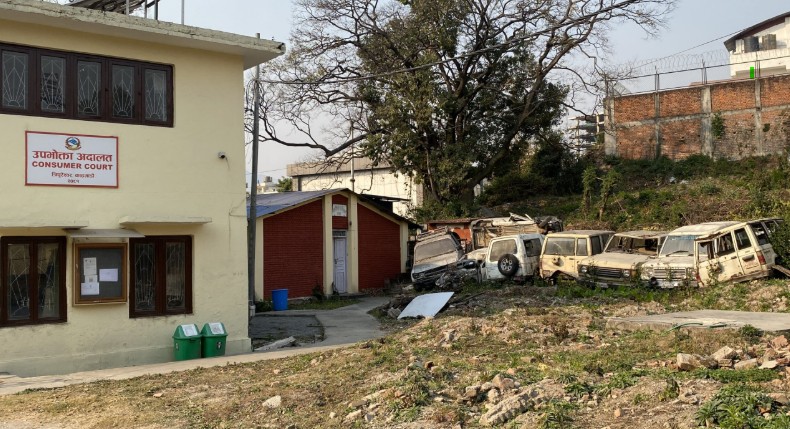
On the premises of the Consumer Court located nearby, piles of dilapidated vehicles are visible from afar. Seven junk vehicles stacked like a dumping site have completely ruined the appearance of the Consumer Court. The condition of the toilets at the Company Registrar’s Office is also poor. In this office, which sees a large number of service recipients, the toilets are foul-smelling.
The Micro, Cottage, and Small Industries Promotion Center located directly in front of the Company Registrar’s Office is not particularly crowded, but proper waste management is lacking there as well. Old wood and plastic are piled up in the office alley. Garbage is even set on fire outside the office. Burning plastic waste openly like this pollutes the environment and affects people’s respiratory health.

Old vehicles and furniture piled up at the office of the Industrial Business Promotion Agency
There is, however, an interesting notice written on the wall of the Department of Industry building in Tripureshwar: “Please wash your hands with soap and water before entering the office.”
While the notice suggests attention to cleanliness inside the office, the condition outside the building is exactly the opposite. In the parking area, a vehicle burned during the Gen-Z protests lies overturned. Nearby are piles of rusted iron pieces, plastic bottles, and other waste. Some garbage has been kept in sacks beside the building. Next to it is a heap of burnt iron racks.
The office of the Industrial Business Development Institute located near the Department of Industry is surrounded by piles of garbage. The first floor of one of its buildings is filled with damaged vehicles and broken chairs and tables.
Under the staircase of the main office of Kathmandu Upatyaka Khanepani Limited (Kathmandu Valley Water Supply Limited) on Tripureshwar Road, old tires, iron, aluminum, and wooden materials are piled up. One room of the office is also filled with similar old items and waste. Such scenes of garbage piled up in and around government offices are visible everywhere.
Even though government offices have employees assigned for cleaning, why are office premises and toilets not clean and tidy? Why is there garbage everywhere, unpleasant sights, and foul smells?
Babu Ram Ghimire, Information Officer at the Ministry of Forests and Environment, acknowledges that even though there are sanitation workers, they have to be repeatedly instructed to do their jobs. He says, “Users themselves also do not pay attention to cleanliness. Unless everyone becomes conscious, it is difficult to maintain clean toilets.”
According to him, in most government offices, old infrastructure is another reason for problems related to toilet and sewer cleaning. A similar problem was recently seen in the ministry’s own toilets. He explains that poor drainage systems also make cleaning difficult.
Ghimire says that preparations are underway to initiate the auction process for old vehicles and furniture piled up on government office premises, and a committee has already been formed for this purpose. According to him, delays occur because the legal process for auctioning such materials is lengthy.
Hospitals are no different
Not only crowded government offices and industrial areas, but government hospitals are also in a similar condition – dirty and foul-smelling. Hospitals, which should be the most sensitive about waste management, are found to have garbage piled up everywhere inside. Toilets are equally foul-smelling. When visiting Bir Hospital last Monday, waste management appeared disorderly.
Inside the hospital’s old building, there is a counter of Nabil Bank. Service recipients were standing in line at the counter to collect receipts. Right beside it, an open garbage container had been placed. Plastic bags filled with waste were piled directly on the floor. The hospital toilets were foul-smelling, and water was flowing continuously from broken taps.

Garbage kept near the bank counter inside Bir Hospital
Near the hospital’s Medical Intensive Care Unit (MICU), iron stands labeled “biodegradable waste” and “non-biodegradable waste” were placed. However, there were no dustbins inside them. Nearby, broken chairs were piled up. Damaged tables, chairs, and machines were scattered haphazardly everywhere.
Right in front of the main entrance of the hospital’s new building, items were piled up and covered with plastic sheets. The toilets in the new building appear neat at first glance, but due to a lack of regular cleaning, they are foul-smelling.
Similar to Bir Hospital, the condition of Tribhuvan University Teaching Hospital in Maharajgunj is also the same. The toilets in most hospitals are foul-smelling. It is difficult for patients and caretakers even to enter them. Krishna Kumar Tamang, who was getting his father treated at Bir Hospital, says that when hospitals themselves are so dirty, caretakers end up falling sick as well. He says, “At first, the filth and stench here made me feel sick too. Maybe it’s because there are so many people, but it doesn’t seem like much attention is paid to cleanliness.”
On December 7, 2022, Kathmandu Metropolitan City gave a 35-day ultimatum to government and private offices to manage waste on their premises. The metropolitan notice stated that scattered old equipment and other types of waste had degraded the overall beauty of the city. However, offices did not pay attention even to this notice.

Materials dumped at the Department of Industries, Tripureshwor premises
If even government offices under the metropolitan authority have failed to properly manage waste, offices not under its jurisdiction have not followed government policies and rules either.
The government’s National Waste Management Policy has set strategies to reduce environmental pollution caused by waste and its negative impacts on public health, and to increase citizens’ responsibility in waste management by running awareness programs on waste segregation, reduction, and disposal. However, government policy and strategy exist on one side, while actual practice is on the other.
Although Section 6 of the Solid Waste Management Act, 2068 (2011) mandates that waste be segregated at the source and transported to collection centers by the individual, institution, or body that produces it, government offices have not complied with this provision.
Not only is waste piled up indiscriminately in government offices and cleanliness neglected, but waste management practices themselves are also poor. The Office of the Auditor General has also raised questions on this issue.
The Auditor General’s 62nd Annual Report, 2082 (2025), pointed out that waste from the Balaju, Bhaktapur, and Patan industrial estates was disposed of through private companies without segregation.
The problem of indiscriminate waste piling and foul-smelling toilets is not limited to Kathmandu; it can be seen in government offices across the country. Public complaints regarding toilet cleanliness in government offices and schools have even reached the Office of the Prime Minister and Council of Ministers and the “Hello Government” grievance system.

Garbage in the Department of Industries Tripureshwor premises
After receiving many such complaints, the Education and Human Resource Development Center under the Ministry of Education, Science and Technology issued a circular on 24 January 2025 to education and coordination units in all 77 districts, instructing them to pay attention to cleanliness and to implement sanitation and hygiene standards.
In 2075 (2018/19), the Ministry of Forests and Environment declared the Nepal Healthy Environment Mega Campaign with the goal of controlling dust, smoke, and plastic pollution and increasing greenery. However, this declaration also remained limited to slogans.
Senior Advocate Padam Bahadur Shrestha filed a writ petition at the Supreme Court on August 2, 2020 against the practice of piling up old motorcycles, vehicles, and furniture in government offices. He stated that such negligently stored materials create serious chemical hazards and negatively affect the environment, that legal provisions regarding proper utilization or auction of such assets have not been followed, and that this causes financial loss to tax and revenue paid by citizens.
In that case, the Supreme Court ruled in his favor on September 8. Although the Supreme Court directed government offices to systematically manage or auction piled-up materials, there has been little initiative to implement the ruling.
Senior Advocate Shrestha says that the number of dilapidated vehicles piled up in government offices across the country exceeds 10,000. He states, “Old vehicles, chairs, and tables are increasing pollution on the one hand, and on the other, there is misuse of taxpayers’ money. The state needs to take this issue seriously.”