Kathmandu
Saturday, July 25, 2026





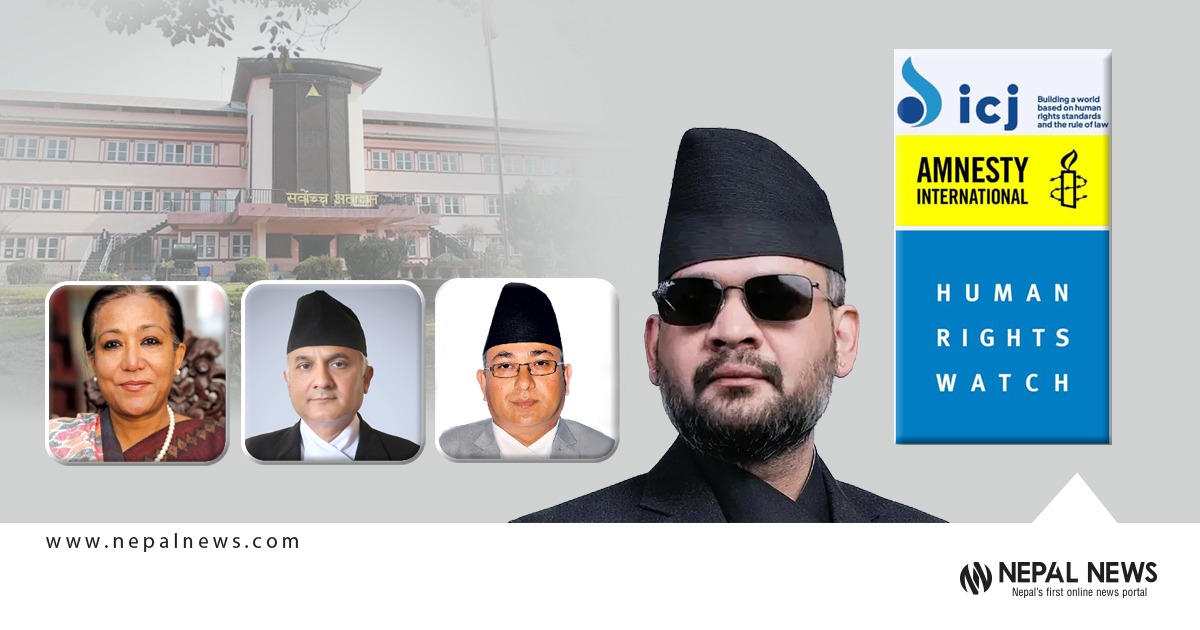
Attorney General Sabita Bhandari’s deliberate attempt to bend the existing law to benefit Rabi Lamichhane has come under public scrutiny for mocking the notion of rule of law

KATHMANDU: The Office of the Attorney General – and the Attorney General Sabita Bhandari herself – are in the limelight, albeit for the wrong reasons. The decision by Attorney General Bhandari to amend the charges against Rabi Lamichhane, chairman of the Rastriya Swatantra Party (RSP), in cases involving organized crime and money laundering, has courted controversy. In fact, it has sent shockwaves across Nepal’s legal fraternity.
On the surface, it seemed to be a technical, even procedural, matter. The prosecutors would be trying to retain the case of cooperative fraud and drop the decidedly more serious charges of money laundering and organized crime against Lamichhane, one of the prominent new political faces. However, when attorneys started examining the decision, and when the media began posing a very simple, and altogether awkward, question: “why only Rabi Lamichhane?” the affair blew up beyond the confines of a single individual.
Yes, initially, it looked like a selective prosecution, but in no time, it began to mushroom into a wholesale judgment meant to encompass all 44 suspected individuals whose names appeared on one consolidated charge sheet.
In the attempt to seek insight into the question of unequal treatment, the Office of the Attorney General found itself broadening the very situation it had hoped to contain.
The case itself is not a small one. On 23 December 2024, a charge sheet was filed at the Kaski District Court naming 44 people and seven companies as accused of cooperative fraud, organized crime, and money laundering, which are crimes that fall within the most severe level of criminal conduct in Nepali law.
Rabi Lamichhane was one among these accused. The charge sheet did not isolate him; it treated all defendants as part of a single factual and legal narrative. Prosecutors alleged that cooperative funds had been misappropriated, routed through corporate accounts, and subsequently laundered – conduct that, if proven, would attract stringent penalties and place the accused beyond the reach of compromise or settlement.
This legal framing mattered. Under Nepal’s Muluki Criminal Procedure Code (2017), money laundering and organized crime are not merely serious crimes; they are explicitly listed among offences that cannot be withdrawn. Nepal’s parliament deliberately created a “negative list” under Section 116 of the Code, insulating these crimes from political or executive discretion.
The controversy
Against this backdrop, Attorney General Sabita Bhandari approved a decision on January 14, authorizing district prosecutors in five jurisdictions – Kaski, Kathmandu, Rupandehi, Parsa, and Chitwan – to seek amendment of charges against Lamichhane. The approval, Bhandari argued, relied on Section 36 of the Code, which allows amendment of a charge sheet when new evidence emerges that necessitates revising earlier claims.
It was never explained what new evidence had emerged. The effect of the decision, however, was unmistakable: the removal of money laundering and organized crime charges against Lamichhane, while retaining cooperative fraud allegations.
The timing, too, raised eyebrows. With just 49 days remaining before parliamentary elections, the amendment would clear a crucial legal hurdle. Under Nepali law, a lawmaker who faces trial on organized crime or money laundering charges, remains suspended even if elected. Removing those charges would reopen Lamichhane’s path back to parliament.
Otherwise, under the present circumstances, Lamichhane won’t be able to enter parliament even if he wins from his electoral constituency in the upcoming March 5 elections.
The legal problem was not subtle. Section 36 permits amendment of charges, but it does not override Section 116 which prevents any amendment of certain specified charges including money laundering and organized crime. Lawyers argue that the two provisions must be read together. Where parliament has explicitly prohibited withdrawal of certain offences, no procedural mechanism – however creatively framed – can be used to achieve the same result indirectly.
Senior advocates have described the move as “a textbook example of doing indirectly what the law forbids directly.” In their view, Section 36 exists primarily to add charges when new evidence surfaces, not to erase charges that the legislature has declared untouchable.
According to legal experts, once a money laundering or organized crime case reaches court, the only institution empowered to exonerate an accused is the court itself. Any executive attempt to pre-empt that judicial function undermines the separation of powers.
If the legal reasoning was questionable, the optics were even worse. The consolidated charge sheet named 44 defendants.
Yet the Attorney General’s initial decision addressed only Lamichhane. When confronted with this inconsistency, Attorney General Bhandari reportedly said she had “not thought about the others yet,” adding that amendments could be made later if errors were found.
That remark proved pivotal. What followed was not a retreat from the original decision, but its expansion. To avoid the appearance of singling out one politically powerful accused, the Office of the Attorney General proceeded to approve amendments affecting all 44 defendants. In trying to resolve a question of equality, it effectively enlarged the scope of legal deviation.
From selective leniency to systemic overreach
This shift transformed the controversy. The issue was no longer whether Lamichhane was receiving special treatment, but whether the Attorney General had assumed powers that the law explicitly denies.
Money laundering and organized crime cases do not allow for compromise. Victims’ willingness to accept restitution, cited by the Attorney General as a justification, has no bearing on these offences. The law permits settlement in cooperative fraud cases only after depositors are fully compensated. It does not allow such considerations to erase allegations of laundering illicit proceeds.
By extending amendments to all accused, the Attorney General’s Office widened the legal consequences. Instead of one contested intervention, Nepal now faces the prospect of an entire category of crimes being diluted through prosecutorial discretion.
However, what makes the episode even more troubling is that it fits an emerging pattern. In recent years, successive Attorneys General have exercised their constitutional authority to halt prosecutions in high-profile cases such as passport misuse, fertility clinic scandals, alleged document forgery, and even the long-dormant Rautahat bomb blast case.
For example, this is not the first time that the Attorney General’s Office has tried to “favor” Lamichhane. In March 2023, then-Attorney General Dinmani Pokharel decided not to pursue prosecution against Lamichhane for obtaining and holding a Nepali passport while also possessing a US passport.
Misuse of passport by providing false information is a punishable offense under the Passport Act in Nepal. But Lamichhane proved to be “lucky”.
The police and government prosecutors had investigated the matter, but the Attorney General’s Office concluded that Lamichhane had not misused the passport and therefore did not file charges on behalf of the government.
Similarly, in late 2025, the Attorney General’s Office under Sabita Bhandari took a highly controversial step of deciding not to prosecute individuals allegedly involved in an illegal egg extraction and trade scheme linked to IVF clinics, despite a formal investigation by the Central Investigation Bureau (CIB) of Nepal Police recommending charges. In this case, operators of the Hope Fertility & Diagnostic Clinic and Angel Fertility Clinic were implicated in taking eggs from minors and selling them, according to CIB findings.
Likewise, during the tenure of former Attorney General Ramesh Badal, the Office decided in 2021/22 not to pursue charges in a performance appraisal forgery case involving former Deputy Inspector General of Police (DIG) Nawaraj Silwal, who had also served as a Member of Parliament. The decision was made even after the Supreme Court had ordered investigation into alleged forgery, which some legal analysts argued amounted to shielding a powerful individual rather than ensuring justice.
One of the most controversial historical examples of prosecutorial inaction came from the Rautahat bomb blast case in 2008. The then Attorney General Yagya Murti Banjade formally endorsed the decision not to proceed with the prosecution, even though police and local prosecutors had earlier filed charges. Banjade’s office justified the decision by claiming it was uncertain whether the deaths were caused by criminal intent or that victims existed. This conclusion drew sharp criticism for undermining the initial investigation. Human rights defenders and legal commentators have since pointed to this as a major instance of institutional failure to pursue justice in a politically sensitive terrorist incident.
There are several other examples of similar inaction by the Office of the Attorney General. Each of these decisions was defended as lawful discretion. Collectively, however, they have eroded public confidence in the neutrality of criminal prosecution.
The Supreme Court has increasingly been forced to intervene, questioning whether prosecutorial “independence” has mutated into unreviewable power.
The Constitution grants the Attorney General authority to decide whether the state will prosecute. But that authority was never intended to override statutory prohibitions enacted by parliament. When discretion collides with explicit legislative intent, the rule of law demands restraint.
The rule of law, or its shadow
Perhaps most revealing is what happened behind closed doors. Officials within the Attorney General’s Office reportedly cautioned against approving the amendments. Both written and oral advice warned that the evidence presented by Lamichhane did not negate the core allegations of money laundering. The fact that a complainant denied filing a complaint, or that parliamentary committees found limited evidence of direct involvement, did not establish lawful origin of funds.
Yet those warnings were set aside.
The most enduring consequence of the decision may not lie in this particular case, but in the precedent it sets. If money laundering charges can be neutralized through “amendment,” then the negative list under Section 116 of the Code becomes meaningless. If equality before law is invoked only after selective leniency is exposed, equality itself becomes a procedural afterthought.
The danger is not merely legal; it is institutional. When prosecutorial power expands unchecked, courts are left to clean up decisions that should never have been taken. Justice becomes reactive rather than principled.
At its core, the Lamichhane controversy is not about guilt or innocence. That question belongs to the courts. It is about whether Nepal’s legal system applies the same rules to everyone – the so-called powerful and the ordinary citizens – alike.
The rule of law does not mean outcomes must be harsh. It means procedures must be fair, transparent, and consistent. When laws are bent to accommodate power, they eventually break for those without it.
As Nepal approaches another election, the country faces a quieter but more fundamental choice: whether laws will remain binding constraints on authority, or merely tools to be adjusted when inconvenient.
In that choice lies the difference between a system governed by law and one governed by discretion.