Kathmandu
Tuesday, July 28, 2026





Out of the 165 first-past-the-post seats, 32 are in Madhes, which also has 20 percent of the voters. Which party will win the race?
Kurta, over it a juwari coat, pajama trousers, and a gamchha draped over the shoulder.
When the Rastriya Swatantra Party (RSP) launched its election campaign on January 19 from Janakpur, the capital of Madhes Province, party chair Rabi Lamichhane was joined by senior leader Balen Shah, who appeared in attire reflecting Madhesi identity.
Shah, the former mayor of Kathmandu Metropolitan City whom the RSP has projected as its prime ministerial candidate, addressed the crowd in Maithili, calling himself a “son of Madhes.” He urged people to go to Kathmandu only for leisure, not to demand rights, assuring them that all rights would now be available within the province itself.
Through his clothing, speech style, and references to easier access to state services, Balen tried his best to establish a sense of belonging and win over Madhesi voters.
What is interesting is that although he is contesting against CPN (UML) Chairman KP Sharma Oli in Jhapa Constituency No. 5, he received his election ticket in Janakpur itself.
Given the intense interest and discussion surrounding his contest with Oli, why did Balen enter Madhes first instead of starting from his own constituency? And why did the RSP deploy such a popular figure, who stunned everyone by winning Kathmandu mayor as an independent, specifically in Madhes?
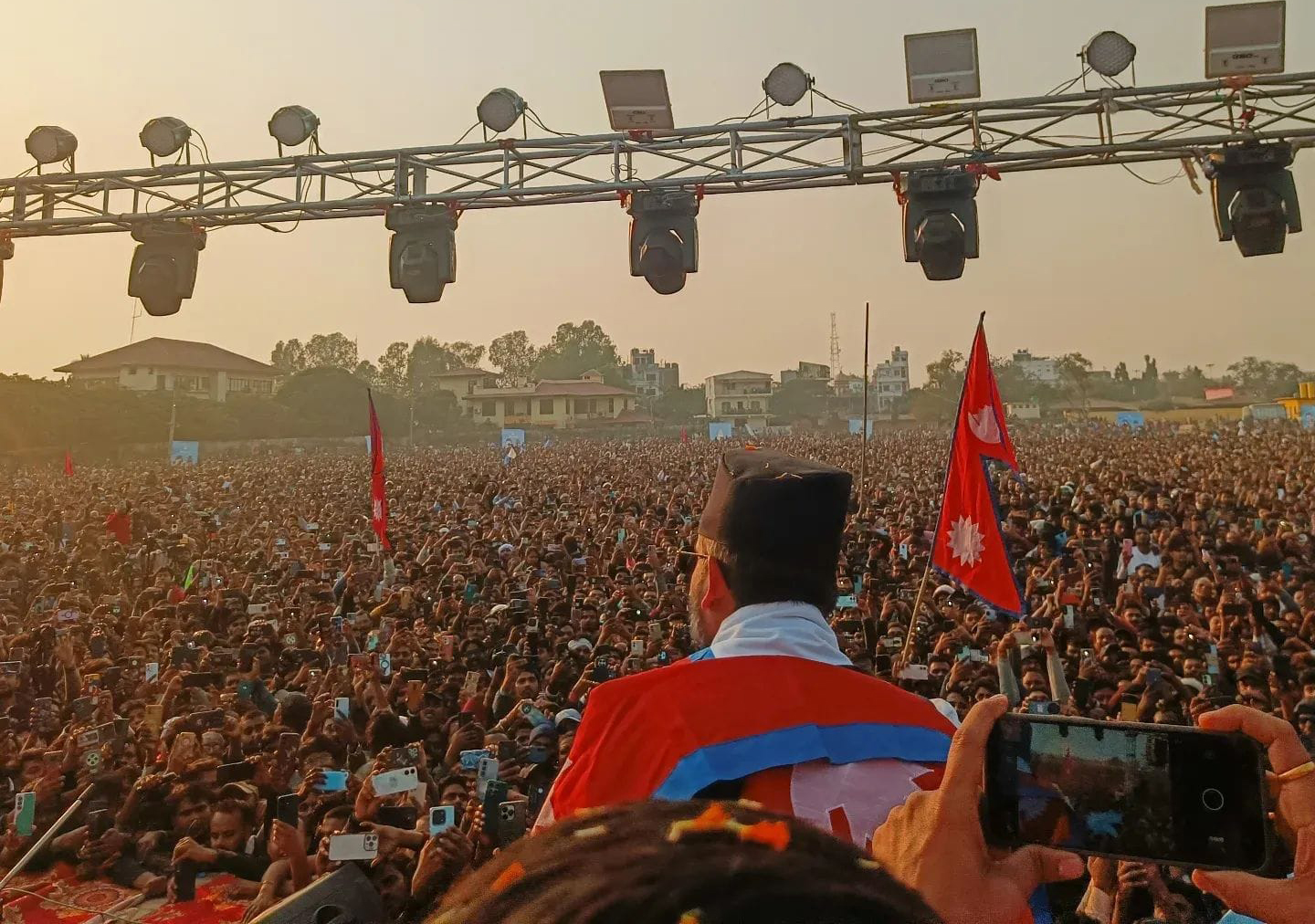
Balen Shah delivering a speech during an RSP electoral gathering. Photo: Balen Secretariat
The answer lies in the decisive role Madhes plays in electoral politics. As in the past, Madhes remains crucial for parties seeking to establish themselves at the center through elections, and thus political attention is focused there. Of the 165 first-past-the-post constituencies in the House of Representatives, 32 are in Madhes Province. The RSP believes that performing well in Madhes could make it the largest party in the country.
For this reason, the party organized a grand rally in Janakpur to attract Madhesi public opinion through Balen, whose ancestral home lies in Madhes (Ekdara Rural Municipality of Mahottari), who is popular among the youth, and who is often called an “invisible hero” of the Gen-Z movement. In Madhes Province, the RSP has widely circulated the slogan and pamphlets reading, “This time, a Balen government.”
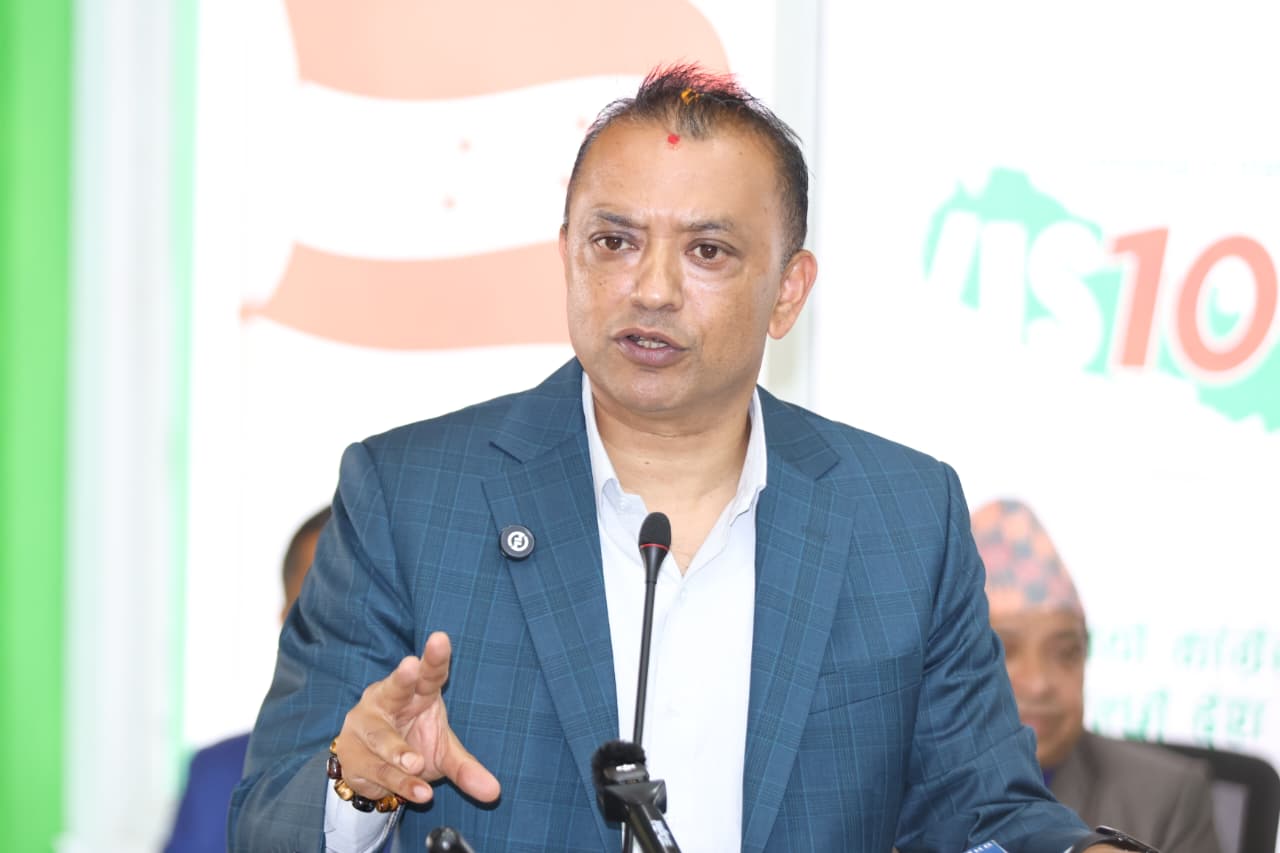
Like the RSP, both new and old political parties appear Madhes-focused ahead of the upcoming election. Nepali Congress President Gagan Kumar Thapa, projected as the party’s prime ministerial candidate, is contesting from Madhes this time. After winning consecutively from Kathmandu Constituency No. 4 in three elections since the 2013 Constituent Assembly election, he is now running from Sarlahi-4. The Nepali Congress is aiming to reclaim the influence it once had in Madhes.
Gagan is not alone. This time, the chairs of eight political parties are contesting elections from Madhes. They are CK Raut, chair of the Janamat Party (Saptari-2); Upendra Yadav, chair of the Janata Samajwadi Party (Saptari-3); Mohammad Rizwan Ansari, chairman of the Federal Socialist Party (Mahottari-3); Rajendra Mahato, chairman of the Rastriya Mukti Party (Sarlahi-2); Prabhu Sah, chair of the Aam Janata Party (Rautahat-3); Samim Miya Ansari, chair of the Rastriya Nirman Party (Bara-4); and Surendra Khadka (former IGP), chair of the Samunnat Nepal Party (Bara-4).
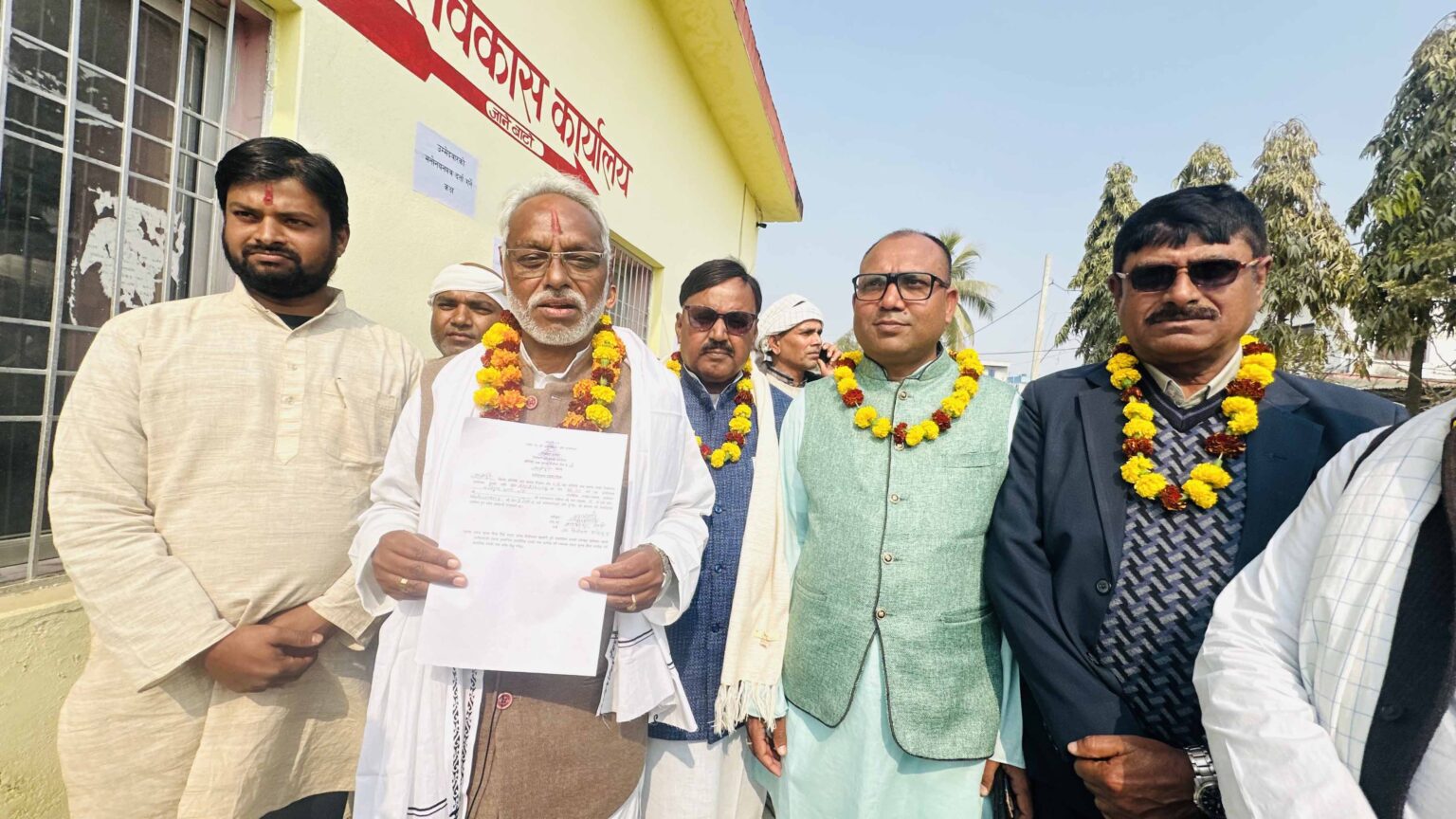
Rajendra Mahato after registering his nomination for the House of Representatives election. Photo: RSS
Similarly, Nepal Sadbhawana Party Chair Anil Kumar Jha is contesting from Rautahat-1 on a Nepali Congress ticket. Likewise, CPN Co-coordinator and former prime minister Madhav Kumar Nepal is contesting from Rautahat-1, while former deputy prime ministers Bimalendra Nidhi and Narayan Kaji Shrestha are candidates from Dhanusha-3 and Sarlahi-3, respectively.
For these 32 seats, 1,045 candidates are in the electoral fray. Among the eight districts of Madhes Province, there are 105 candidates in Saptari, 139 in Siraha, 158 in Dhanusha, 143 in Mahottari, 139 in Sarlahi, 143 in Rautahat, 112 in Bara, and 106 in Parsa. For the election scheduled on 5 March, 3,484 candidates have filed nominations nationwide under the first-past-the-post system, of which 30 percent are from Madhes Province. In other words, three out of every ten candidates nationwide are from Madhes, highlighting its importance and attraction in electoral politics.
Of the total voters nationwide, 19.24 percent are in Madhes Province. According to the Election Commission, Nepal has 18,903,689 voters in total, of whom 3,636,414 are in Madhes. This is the second-largest voter population after Bagmati Province.
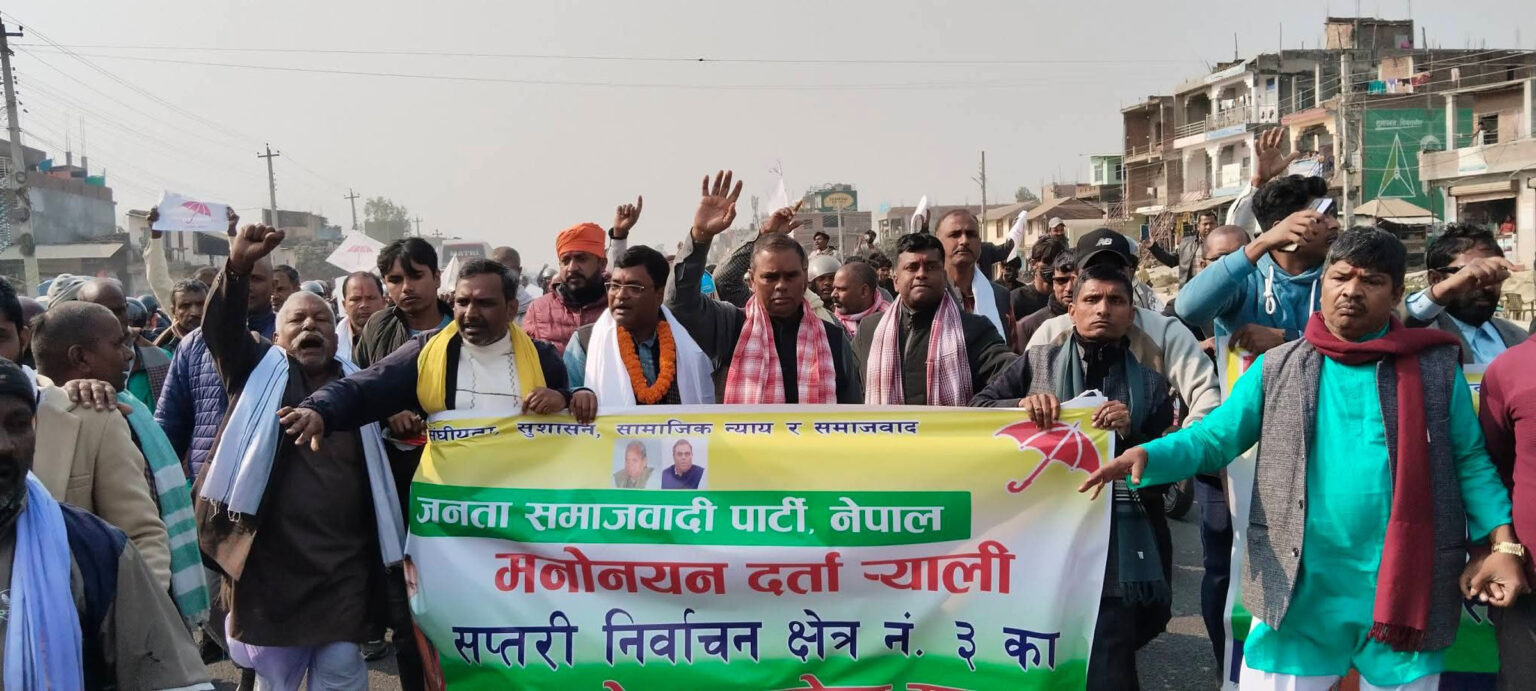
JSP Nepal Chair Upendra Yadav on his way to register nomination
Janakpur-based political analyst Roshan Janakpuri says that Madhes is important in national politics both in terms of the number of seats won in the House of Representatives and the political message it sends. “There are 32 first-past-the-post seats in Madhes, and because the voter population is large, it also contributes significantly to proportional representation. This is why Madhes plays a decisive role in national politics,” he says.
NC Dominance Before Madhes Movement
Until the Madhes Movement that erupted after the promulgation of the Interim Constitution in 2007, Nepali Congress (NC) dominated the core areas of Madhes. While the UML had influence in settlements along the East-West Mahendra Highway populated by migrants from the hills, the NC maintained strong control in the densely populated areas along the Hulaki Highway.
In the 1991 general election following the restoration of multiparty democracy, the NC won 80 percent (29 seats) of the 37 constituencies that now fall within Madhes Province. Nationwide, Congress won 110 seats. In Dhanusha and Mahottari (five constituencies each) and Parsa (four constituencies), the NC won all seats. It also won three of five in Saptari, four of five in Siraha, four of five in Sarlahi, three of four in Rautahat, and one of four in Bara.
At that time, UML won only five seats—three in Bara and one each in Saptari and Rautahat. Nepal Sadbhavana Party, United People’s Front, and CPN (Manandhar) won one seat each.
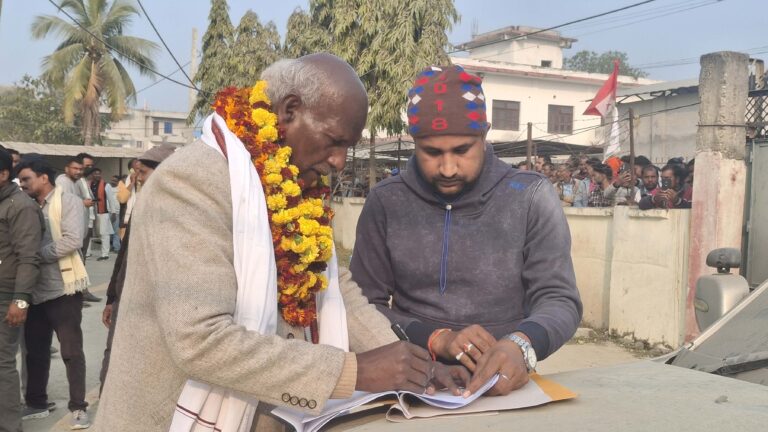
Nepali Communist Party candidate Mahindra Raya Yadav during the registration of his candidacy from Constituency No. 2 of Sarlahi. Photo Courtesy: RSS
Before the 1994 mid-term election, constituency boundaries were redrawn, reducing one seat in Mahottari and leaving Madhes with 36 constituencies. In the mid-term election, the NC failed to retain its earlier dominance, winning only 20 of 36 seats. UML won nine seats, RPP four, Sadbhawana Party two, and one seat went to an independent candidate.
In the 1999 election, the NC won an absolute majority nationwide with 111 seats and secured victory in 20 Madhes constituencies. UML increased its tally to 10 seats, while RPP won four and Sadbhawana Party two.
A changed landscape after Madhes Movement
After the 2006 People’s Movement, the Interim Constitution was promulgated on 15 January 2007. Dissatisfaction with the constitution sparked a Madhes uprising, led by the Madhesi Janadhikar Forum under the demand for identity-based federalism, provincial autonomy, and the right to self-determination. The movement sidelined traditional parties like the NC and UML in Madhes, instead establishing the Forum and its chair Upendra Yadav.
To capitalize on the political space created after the Madhes Movement, another party emerged in 2007—the Terai Madhes Loktantrik Party (TMLP). Formed under the leadership of Mahantha Thakur after leaving the NC, the party included leaders from the NC, UML, and RPP.
In the first Constituent Assembly election of 2008, the Maoists—who had transitioned from armed insurgency to peaceful politics—emerged as the largest party, winning 120 first-past-the-post and 100 proportional representation seats nationwide. In Madhes, however, the Madhesi Janadhikar Forum became the largest party, winning 30 seats including 16 directly elected ones.
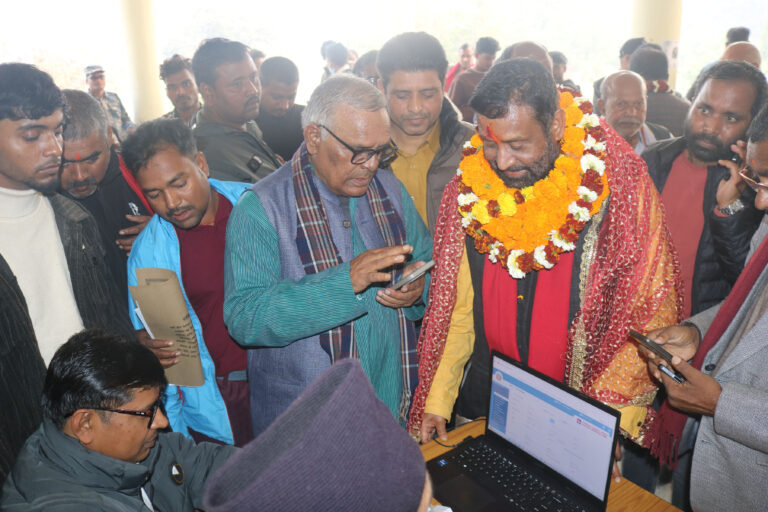
Nepali Congress leader Bimalendra Nidhi during nomination registration
In proportional representation voting, the Forum received more votes in Madhes than traditional parties. Of the 678,327 proportional votes it received nationwide, more than half came from the eight Madhes districts—378,132 votes.
In proportional representation voting from Madhes, the NC came second with 329,719 votes, followed by UML with 316,719 votes.
The Maoists received 3,144,204 proportional votes nationwide but only 276,716 from Madhes. Similarly, of the 338,930 proportional votes won by TMLP nationwide, 240,256 came from Madhes districts.
Due to the Madhes Movement, in the 2008 election the Madhesi Janadhikar Forum won 16 seats out of the 48 constituencies in Madhes under the first-past-the-post system. As the Forum emerged as a decisive force in Madhes politics, other traditional parties weakened. While the Maoists became the largest party nationwide, they were reduced to just six seats in Madhes. Nepali Congress won nine seats, UML and the Terai Madhes Loktantrik Party (TMLP) won five seats each, the Sadbhavana Party won four, independent candidates won two, and the United People’s Front won one seat.
In the 2013 Constituent Assembly election, Nepali Congress and UML improved their vote share nationwide, including in Madhes, emerging as the first and second largest parties respectively. The Maoists slipped to third position. Madhes-based parties weakened due to internal divisions.
Out of the 240 constituencies nationwide, Nepali Congress won 105 seats with support from 21 Madhes constituencies. Similarly, UML won 91 seats, including 14 from Madhes. In Madhes, the Maoists won eight seats, while TMLP, Terai Madhes Sadbhavana Party, the Madhesi Janadhikar Forum–Democratic led by Bijay Gachchhadar, and the Sadbhavana Party won one seat each. Upendra Yadav’s Madhesi Janadhikar Forum—which had won 16 seats in Madhes in the 2008 election—was reduced to zero seats. From the Forum, however, two candidates were elected under the first-past-the-post system from Sunsari-5 and Kapilvastu-5, and 13 were elected through proportional representation to the second Constituent Assembly.
Elections after promulgation of constitution
Amid disagreement from Madhes-based parties, the Constitution was promulgated on 20 September 2015. This triggered a massive movement across the Terai–Madhes. Its clear impact was visible in the 2017 House of Representatives election, as Madhes voters became resentful toward Kathmandu-centric major parties. Even though UML and Maoist Center contested the election as a left alliance, they failed to perform well in Madhes.
Out of the 165 constituencies nationwide under the first-past-the-post system, UML won 80 seats but secured victory in only two constituencies in Madhes. The Maoist Center, which won 36 seats nationwide, was limited to just five seats in Madhes. Nepali Congress won 23 seats in total, including six from Madhes.
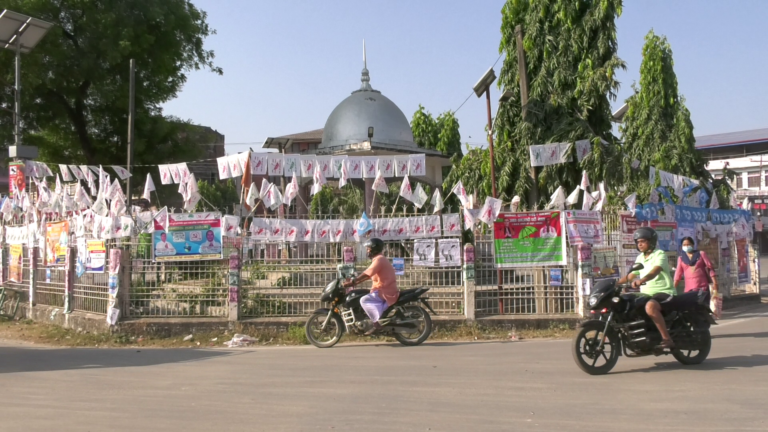
Campaign posters, flags and banners from different parties blanket Gajendra Chowk, the heart of Rajbiraj, ahead of the polls
Meanwhile, election results showed that Madhes voters trusted Madhes-based parties for raising regional issues. The Federal Socialist Forum Nepal and the Rastriya Janata Party (RJP), which contested as an electoral alliance, won 19 out of 32 constituencies in Madhes. RJP won 10 seats, while the Forum won nine.
In proportional representation voting, Nepali Congress received the highest number of votes from Madhes, securing 415,341 votes. RJP came second with 348,251 votes, followed by the Federal Socialist Forum with 300,107 votes. UML received 3,173,494 proportional votes nationwide, but only 274,093 of those came from Madhes.
The 2022 House of Representatives election
In the 2022 election, UML and Nepali Congress improved their position in Madhes, emerging as the first and second largest parties in the province. UML won nine direct seats, while the NC won seven. The Janata Samajwadi Party (JSP, formerly Federal Socialist Forum) won six seats, the Loktantrik Samajwadi Party (LSP) won three, independent candidates won three, CPN (Unified Socialist) won two, and the Maoist Center and Janamat Party won one seat each.
Although UML and NC saw a decline in their vote share nationwide, they achieved slight improvements in both direct and proportional results in Madhes. In proportional representation, NC received 434,971 votes from Madhes. Compared to the previous election, while NC’s proportional votes declined by seven percent nationwide, they increased by nearly five percent in Madhes. Similarly, UML’s proportional votes declined by five percent nationwide but increased by 35 percent in Madhes, where it received 371,709 votes. JSP secured 298,744 votes.
The Loktantrik Samajwadi Party, which received 109,390 proportional votes, failed to qualify as a national party.
To be recognized as a national party, a party must win at least one direct seat and secure more than three percent of valid proportional votes nationwide—criteria LSP failed to meet in proportional representation.
Primarily due to power hunger and power-centric politics, Madhes-based parties have seen their support base erode even within Madhes and have continued to decline in successive elections. Despite claiming to represent Madhes and Madhesi people, these parties failed to remain united, repeatedly choosing splits and fragmentation while drifting away from core Madhes issues. This fractured trajectory of Madhes-centric parties has contributed to repeated cycles of hung parliaments and political instability.
Though small in number, these parties have often played the role of “kingmakers” due to their decisive seats in parliament. When no single party—or even a two-party alliance—secures a clear majority, coalition governments become inevitable. In such situations, smaller parties often engage in power-driven bargaining, withdrawing and extending support strategically, thereby contributing to political instability.
Emergence of new forces and the current election
In the 2022 election, the Janamat Party led by CK Raut—who abandoned separatist movements to enter parliamentary politics—emerged as a significant force in Madhes Province. By crossing the three-percent threshold, the party established itself as a national party. Winning one direct seat, Janamat Party secured 296,448 proportional votes from Madhes. Raut defeated Upendra Yadav in Saptari-2. Nationwide, five parties—including NC, Maoist Center, and Unified Socialist—formed an electoral alliance, while in Madhes, UML allied with JSP and LSP.
For the first time since the promulgation of the new constitution, political parties are contesting the election independently, without alliances. In this election, traditional parties are campaigning to improve their standing in Madhes. With the election taking place after the Gen-Z movement, parties have adopted different strategies.
In the 2022 election, the Rastriya Swatantra Party (RSP), which performed strongly in urban and semi-urban areas, fared poorly in Madhes. It failed to win any direct seats in the province and received only 72,935 proportional votes across the eight Madhes districts. Learning from past results, RSP is now attempting to expand its influence in Madhes. As part of this strategy, it has highlighted former Kathmandu mayor Balen Shah’s popularity and Madhesi identity. By projecting Shah as a prime ministerial candidate, RSP aims to energize voters.
According to sociologist Birendra Prasad Sah, an associate professor at Thakur Ram Multiple Campus in Birgunj, the impact of projecting Balen as a prime ministerial candidate—along with the new political situation that developed after the special convention within Nepali Congress—will be visible in the Madhes election. “Balen has created tremors in Madhes politics.
In my three decades of observing Madhes elections, I have never seen such intense electoral fervor,” he says. “On the other hand, Gagan Thapa becoming Nepali Congress president has energized party ranks.”
However, Sah notes that although Madhes youth are enthusiastic about Balen being projected as prime minister, it is difficult to say how many votes RSP can actually pull due to its weak organizational presence in the region. Internal sabotage within the NC and RSP’s lack of grassroots structure could influence election outcomes. “Even if NC supporters walk together, they may not vote together—this pattern seen in the past will likely reappear in some constituencies,” he says. “RSP could also face difficulties due to its past stance on federalism.”
Caste dynamics in Madhes politics
One of the most important factors influencing election results in Madhes is caste composition. The largest caste group in Madhes Province is the Yadav community. According to the 2021 National Census, Yadavs constitute 15.2 percent of the total population of Madhes. Muslims are the second-largest group at 12.9 percent. After that, the populations of Tharu, Teli, and other non-Dalit groups, as well as Madhesi Dalits, are also significant.
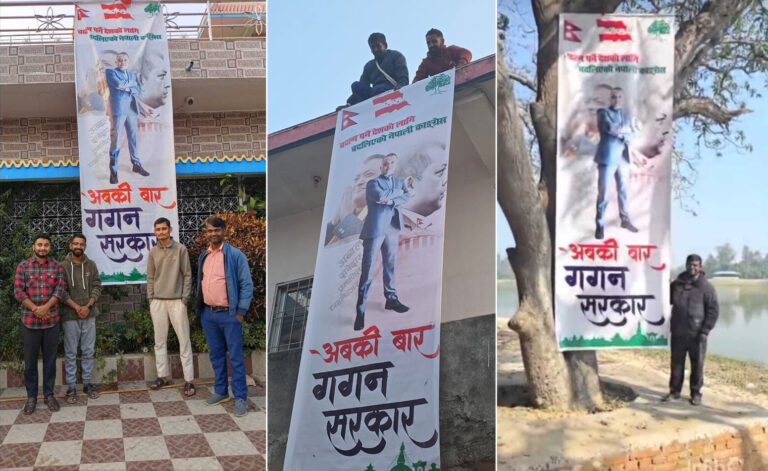
Life size poster of Gagan Thapa, the President of Nepali Congress, ahead of the upcoming polls. Photo Courtesy: Social Media
Journalist and activist Bhola Paswan says, “Economically well-off and politically active communities like the Teli, Sudi, and Haluwai have considerable influence in Madhes politics. Their inclination appears to be toward Balen.”
Former vice-chair of the Madhes Province Policy and Planning Commission, Sohan Sah, says the upcoming election is taking place not so much in pursuit of solutions to national problems but amid anger, revenge sentiment, and negativity. “People are angry due to the human losses during the Gen-Z movement. In this situation, with Balen contesting against then-prime minister KP Sharma Oli, Madhes voters are attracted,” he says. “Gagan Thapa played a role in changing leadership within the NC by embracing the sentiments of the Gen-Z movement, which helped with damage control and has boosted morale among grassroots NC workers.”