Kathmandu
Thursday, June 25, 2026





From laborers to celebrities to heads of state, jeans have evolved into the world’s most beloved garments, tracing a unique and revealing journey in Nepal
Purani jeans aur guitar
Mohalle ki woh chhat aur mere yaar…
This pop song by Pakistani singer Ali Haider takes many Nepalis straight back to the 1990s. Along with old friends, it also evokes memories of old jeans.
As the song suggests, intimacy and jeans are much alike – the older they are, the more beloved they feel.
One of those who carefully preserves old jeans until they are nothing but patches is writer and professor Abhi Subedi. Likely among the first generation of Nepalis to wear jeans, he is also a witness to the time when jeans were just entering Nepal.
Recalling his early encounters with jeans, he says, “Almost all of my hippie friends wore jeans. It was something you wore even when it was dirty and torn. But it wasn’t easily available in Nepal.”
In the beginning, youths in Kathmandu got the chance to wear jeans that hippies had already worn and discarded, exchanged for cash, or left behind as collateral because they couldn’t pay.
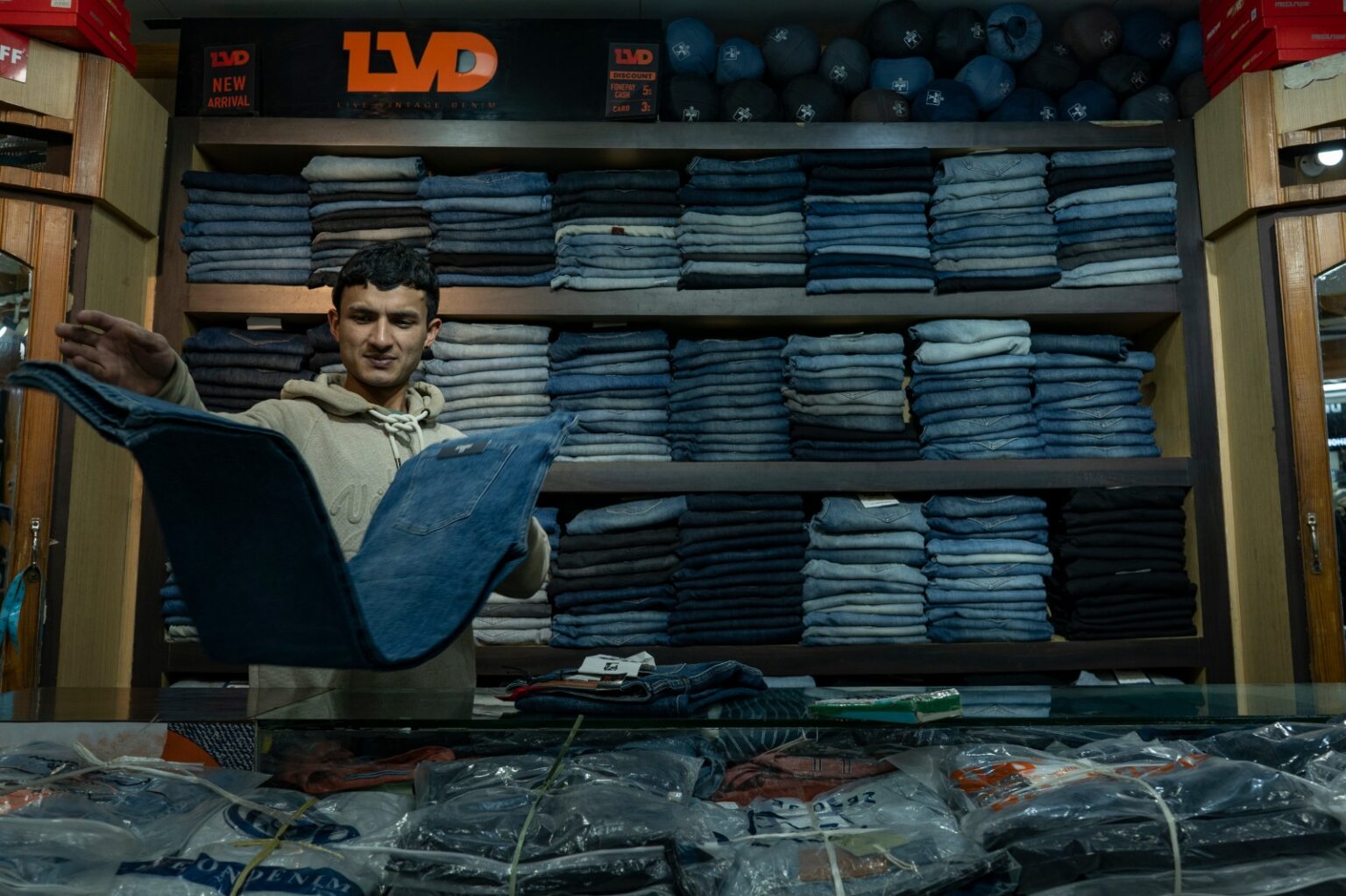
A New Road merchant shows jeans to a customer. Photo by Vikram Rai.
In Suitably Modern, a book by Mark Liechty, who has researched tourism, middle-class culture, and modernity in Nepal, the arrival of jeans in Nepal is discussed. According to the book, jeans entered Kathmandu along with foreign tourists. Youthful tourists, including hippies who arrived in the late 1960s and early 1970s, played a major role.
According to Liechty, “Before that, the few Western tourists who came to Kathmandu were mostly middle-aged, wealthy people who stayed confined to a handful of expensive hotels.”
The younger tourists roamed the streets freely and began mingling with the city. Interested in local art and culture, these youth groups sparked curiosity among Nepali youths toward Western lifestyles, music, literature, and clothing. Jeans also became a medium through which Western and Nepali youths recognized and related to each other.
Professor Subedi, now 80 years old, was a young man in the early 1970s. One day, he heard that jeans had arrived at Muncha House in New Road. He recalls buying his first pair of jeans there along with poet Ramesh Shrestha and another friend.
“I wore those jeans a lot. They would get dirty. I’d wash them, let them dry, and wear them again. They even had pockets on the knees. I kept them until they were nothing but patches,” he adds. “Later, more jeans started coming in. You’d see people here and there walking around in jeans.”
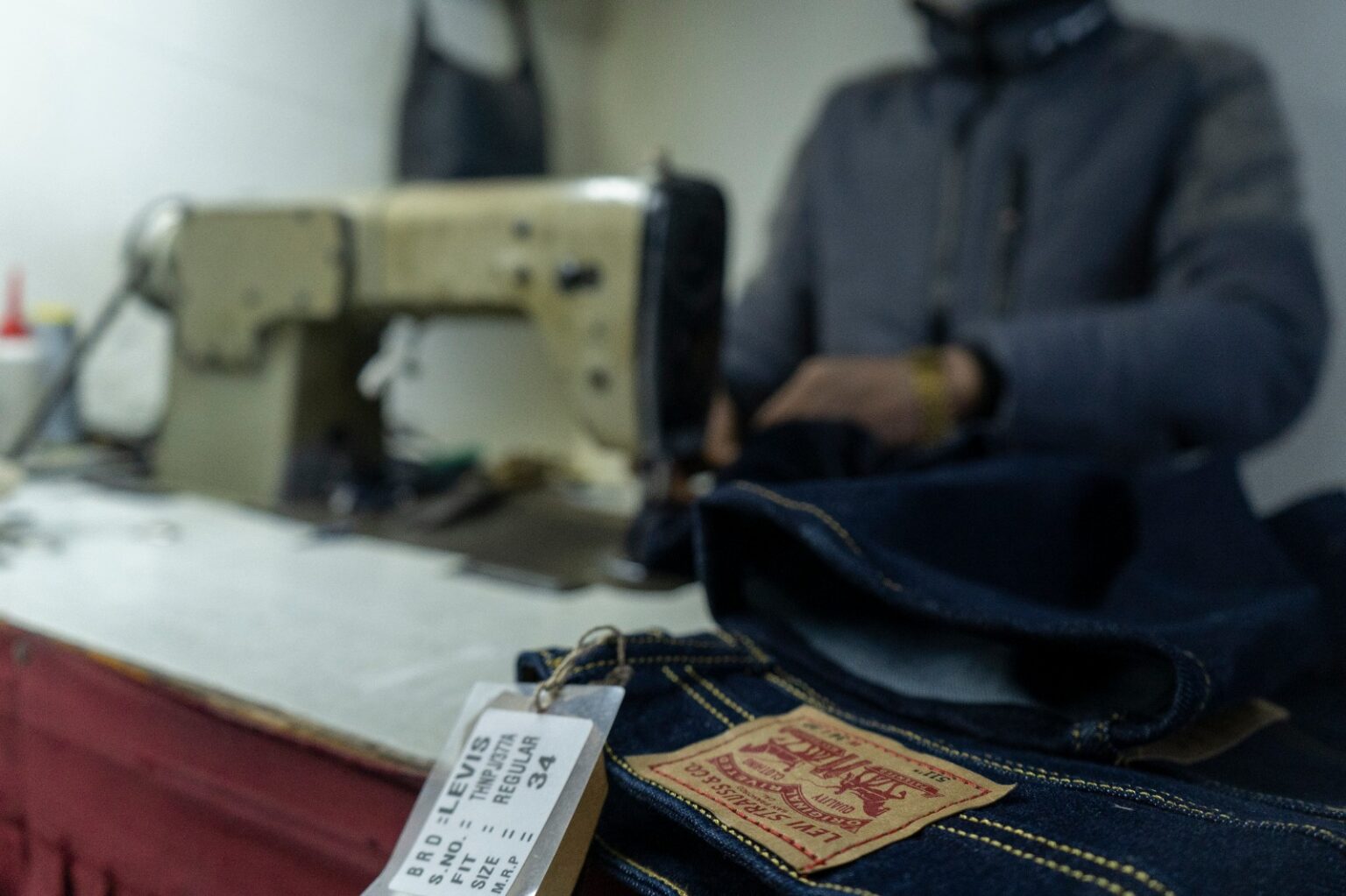
Levi’s jeans being altered. Photo: Vikram Rai
Basant Thapa, who had tasted foreign films at the British camp in Dharan as early as the mid-1960s, says that until the early 1970s, he saw jeans in Dharan only in those foreign films. In his experience, ready-made clothing hadn’t yet become common at that time; people wore clothes stitched by tailors.
After watching actors in Western and cowboy films wearing jeans, he and his friends had a strong desire to wear them. Though they had memorized the name Levi’s and felt that even wearing rubber slippers made one feel agile, jeans had not yet become something ordinary people could wear.
Jeans were not inaccessible only in Nepal. Youth groups in many parts of the world desired jeans, but they simply weren’t available. Thapa realized this when he went to the Soviet Union for studies around 1972/73.
“I was roaming around Moscow looking for jeans. At that time, people in the Soviet Union themselves were desperate for jeans and would do anything for them,” Thapa says. “They weren’t produced there, nor were they imported. When I searched at the Kremlin Department Store, I only found fabric that looked like jeans, so I bought that and returned.”
About four years later, he went searching for jeans in modern stores in Calcutta (now Kolkata). There too, he found only jeans-like fabric, not actual jeans. This makes it clear that until before the late 1970s jeans had not yet reached the common people.
Fashion choreographer Prashant Tamrakar, who grew up hearing countless stories of Freak Street and hippies, calls himself part of the post-hippie generation. According to him, his generation did not have to face the same difficulties as the previous one. After first wearing Hada jeans and later Levi’s, he says that by the mid-1980s., jeans had started becoming available in Kathmandu, even if only in limited quantities.
“The fashion after the era of bell-bottoms and block-heel shoes shifted toward denim jeans,” Tamrakar says. He also witnessed the huge influence of Rocky jeans. “After Sanjay Dutt’s film Rocky, denim jeans that went up to the waist and even above became extremely popular.”
Born and raised in Kathmandu, Saguna Shah says that the word ‘jeans’ instantly takes her back to her childhood and the Rocky jeans she wore back then.
“My oldest relationship with jeans must be the overalls I wore as a child,” she says. “They were usually worn below the waist, had a pocket up to the chest, and straps over the shoulders. It felt strange wearing them. Maybe because there were four of us – two sisters and our uncle’s two daughters – and they wanted to avoid fights over clothes, they bought similar outfits for all of us. The overalls were shared by everyone.”
At first, jeans came through foreigners, but later jhiti-guntha traders (small-scale personal importers) expanded their reach.
In the past, when the government was restrictive toward foreign goods, it allowed people to bring in certain items under the jhiti-guntha privilege. As a result, many goods started coming in from Bangkok or Hong Kong. Eight or ten big traders would band together, stuffing clothes under clothes and over clothes, returning overloaded.
“There used to be crowds of traders in the toilets at Bangkok airport,” Thapa recalls what he saw when he visited Bangkok. “They would change clothes and hide goods there. You wouldn’t even get a turn to use the restroom!”
According to him, there was huge trade in jeans and many other items. Even Indian markets were supplied by foreign goods brought from Nepal, with many items illegally crossing into India.
Krishna Prasad Parajuli, who has been active in the ready-made garment trade since 1990, says that at the time, people were allowed to bring in only up to 30 kilograms of goods. So even though jeans entered Nepal, supply was far less than demand. Jeans that entered in installments did not become widely accessible until much later.
According to Parajuli, after the political change of 1990, and especially when large quantities of goods began entering through the Chinese border, jeans started becoming easily available in Nepal.
Rajendra Khadgi, who bought his first pair of jeans at Bhrikutimandap 30 years ago, was among those who brought jeans from Bangkok to sell in 1998. At that time, he says, imports from China had not yet begun.
“Later, when imports from China started, jeans became cheaper and far more widespread,” he says.
Jeans that entered gradually are now spread from cities to villages over the past two to three decades. Once an inaccessible and expensive item, jeans have now become affordable and available according to budget. Jeans are no longer just clothing; they have become a lifestyle.
In a society where even men wearing jeans were once considered wayward, jeans have now become the most comfortable outfit for both women and men. Writer Shah says, “It’s this comfort that made jeans my favorite outfit forever. Perhaps this is the main reason many people wear jeans.”
Because they are comfortable, jeans feel familiar whether they are slim or skinny, grunge or baggy. Even when torn, cut, or dyed, they still look familiar. Durability and comfort have become their defining features.
Writer Thapa says, “There are no barriers left. They’ve crossed all boundaries and reached every village. Jeans have erased borders in a way that other clothing perhaps hasn’t.”
Indeed, there was once a clear divide between men’s and women’s clothing. With the spread of pants, that gap narrowed. Because jeans are a unisex garment, their jackets, pants, and shorts can now be worn by both men and women alike.
Prashant Tamrakar, who once modeled on the ramp wearing jeans paired with a daura, describes jeans as something that “fits anywhere, with anything.”
“Even when worn as casually as an everyday garment, jeans feel new every single time you put them on,” says Professor Subedi. Perhaps the ability to feel fresh in any appearance is one of jeans’ greatest qualities. Whether new or old, faded or torn, in any form or look, their appeal and usefulness never diminish. These very traits have made jeans the most widely preferred garment in the world.
Even today, jeans are not considered formal attire. Some top athletes have even faced disciplinary action for wearing jeans. The International Chess Federation once declared world chess champion Magnus Carlsen ineligible for a competition simply because he wore jeans.
Writer Thapa considers the very fact that jeans symbolize informality to be their greatest strength.
But the most remarkable feature of jeans lies in the purpose behind their invention. Jeans were not born from a search for stylish clothing; they are the product of a quest for durable fabric. Their use began as sturdy workwear for cowhands and mine workers. In Europe too, strong fabrics were used by fishermen and laborers working at sea or in mines. In their modern form, however, jeans were introduced in 1873 by Jacob Davis and Levi Strauss. With metal rivets and strong stitching, these garments were primarily aimed at workers in the United States who constantly faced the problem of their clothes tearing.
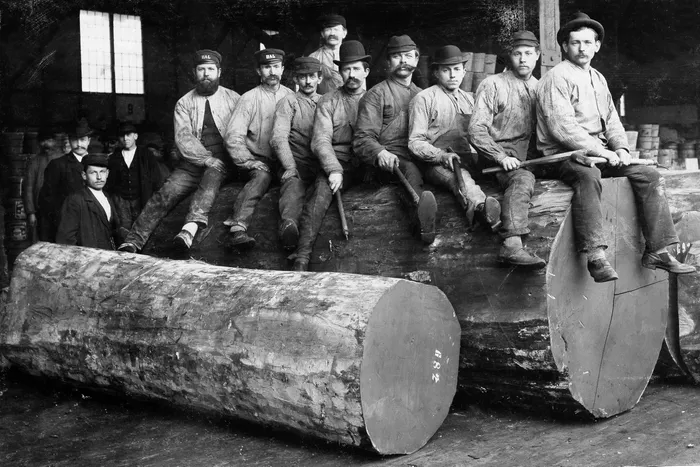
Workers wearing jeans. Photo source: The Cut.com.
After the discovery of gold mines in America, thousands undertook grueling journeys from east to west in search of gold. While panning for gold, they had to kneel in rivers and sift sand, which required extremely strong clothing. Referring to the many stories written about this context, writer Thapa says, “Jeans were invented precisely to meet that need. Naturally, they were made for laborers. Fashion was not part of the equation.”
In a striking coincidence, jeans, originally made for laborers in America, were later popularized by the country’s presidents themselves. Among US presidents known for wearing jeans at the White House and in public places are Jimmy Carter, George H. W. Bush, Barack Obama, and Ronald Reagan.
Such moments certainly influenced the acceptance of jeans. But their spread was also driven by newspapers, music, cinema, celebrities, and advertising.
Take the example of The Wild One (1953), starring Marlon Brando. Playing a character with a “bad boy” image, Brando wore jeans in the film and successfully transformed them from workers’ clothing into a symbol that challenged social norms. The film’s success made jeans so popular that American schools were forced to ban them.
Even before Brando, John Wayne had already transformed jeans from laborers’ wear into the clothing of ordinary people – and actors – through Western and cowboy films.
The music and fashion of the 1950s and 1960s gave symbolic voice to issues of change and freedom. This came to be known as counterculture fashion. From rock and roll, punk, pop, rock, heavy metal, R&B to rap, music and jeans have complemented each other. Artists and bands such as Elvis Presley, The Rolling Stones, Michael Jackson, Madonna, Nirvana, Guns N’ Roses, Pink Floyd, Michael Learns to Rock, and many others contributed in one way or another to making jeans a part of fashion. Celebrities were also extensively used in advertising jeans.
Whether it was Amitabh Bachchan and Dharmendra in the iconic Indian film Sholay, or Shiv Shrestha in the Nepali film Chino, jeans pants and jackets were used as the most fashionable attire of their time. This ongoing process of jeans giving identity and gaining identity continues around the world.
This influence reaches every generation. Shah says, “When I was about 11 years old, punk culture dominated among my elder uncle’s and aunt’s children, and we imitated it a lot. Just like English films and music, jeans also influenced us simply by watching and absorbing.”
Choreographer Tamrakar considers Kathmandu itself a fashion city. Based on his upbringing, he regards the 1990s as the peak era of jeans fashion. He grew up listening to Guns N’ Roses, Wham!, Metallica, Michael Jackson, and rock music, and to him, from that period to the present, music, jeans, and fashion have always seemed to move together.
Shah still keeps two pairs of jeans once worn by her mother.
Now having adopted the new trend of baggy jeans, she claims to have worn almost every kind of jeans. She has a particular fondness for ripped (grunge) jeans. “My eyes go straight to ripped jeans,” she says.
Businessman Parajuli once made a deal with his parents while preparing for his SLC exams four decades ago: if he passed, they had to buy him jeans. He passed, and his wish was fulfilled.
Growing up in the Pokhara market area, he was fascinated by the jeans worn by foreign tourists. He recalls, “Later, when I went to college, I used to walk around with a scarf hanging from the back pocket of those jeans. Since I was the only one wearing jeans in class, I felt like everyone was staring at me.” According to him, even by the time he completed his bachelor’s degree in thee early 1990., the number of people wearing jeans was still very small.
Even today, jeans remain his favorite outfit. Having been involved in the ready-made garment business for 25 years, he says he is eager to wear the latest trend—baggy jeans.

November Jeans Pants at a shop on New Road. Photo: Vikram Rai
No matter whether jeans entered Nepali life through fashion, tourism, or visual media, what arrived as a foreign face has now blended into Nepali colors and lifestyle.
Some entrepreneurs who have witnessed this transformation are now producing Nepali jeans themselves. Brands launched with official trademarks include Level Premium Jeans, Bharjeans, LVD, November Jeans, Yak & Mack, Chino, among others. Since denim fabric is not produced in Nepal, it is imported from India and China, says Sanjib Shrestha, founder of Bharjeans. He also notes that most machines used are Chinese. “But since production happens in Nepal, Nepalis get employment,” he says.
Earlier, even jeans made in Nepal were sold under foreign brand names. Efforts to establish homegrown brands have increased over the past two decades, says Rajendra Khadgi, founder of November Jeans. He named the brand after the month he was born.
According to Parajuli, founder of Level Premium, Nepali entrepreneurs began seriously thinking about producing Nepali jeans around 2010.

Artist Nazir Hussain with Level Premium Jeans. Photo source: Level Premium’s social media
“At a time when ‘Nepali’ meant low price and doubt, we started making jeans,” he says. “Now times have changed. Customer trust in Nepali brands has increased.”
This trust appears to have driven significant growth in the Nepali jeans market. Entrepreneur Shrestha says, “Earlier, Chinese products dominated the jeans market in Nepal. Now the situation has changed. Nepali jeans are displacing Chinese ones. You could almost say imports of jeans from China have stopped.”
Not all groups producing Nepali-brand jeans have been successful. Some open and shut down frequently. The number of well-established Nepali brands is still small. According to Parajuli, even among them, not all have been able to produce jeans labeled ‘Made in Nepal’ yet. At present, Parajuli’s Level Premium Jeans has expanded as far as Dubai and Qatar.
The journey from foreign to domestic jeans is also tied to Nepali identity. Entrepreneurs Parajuli, Shrestha, and Khadgi all say, “How long will we keep selling others’ jeans? We entered Nepali jeans production with the vision of building our own brands and creating jobs in our own country.”