Kathmandu
Tuesday, June 16, 2026





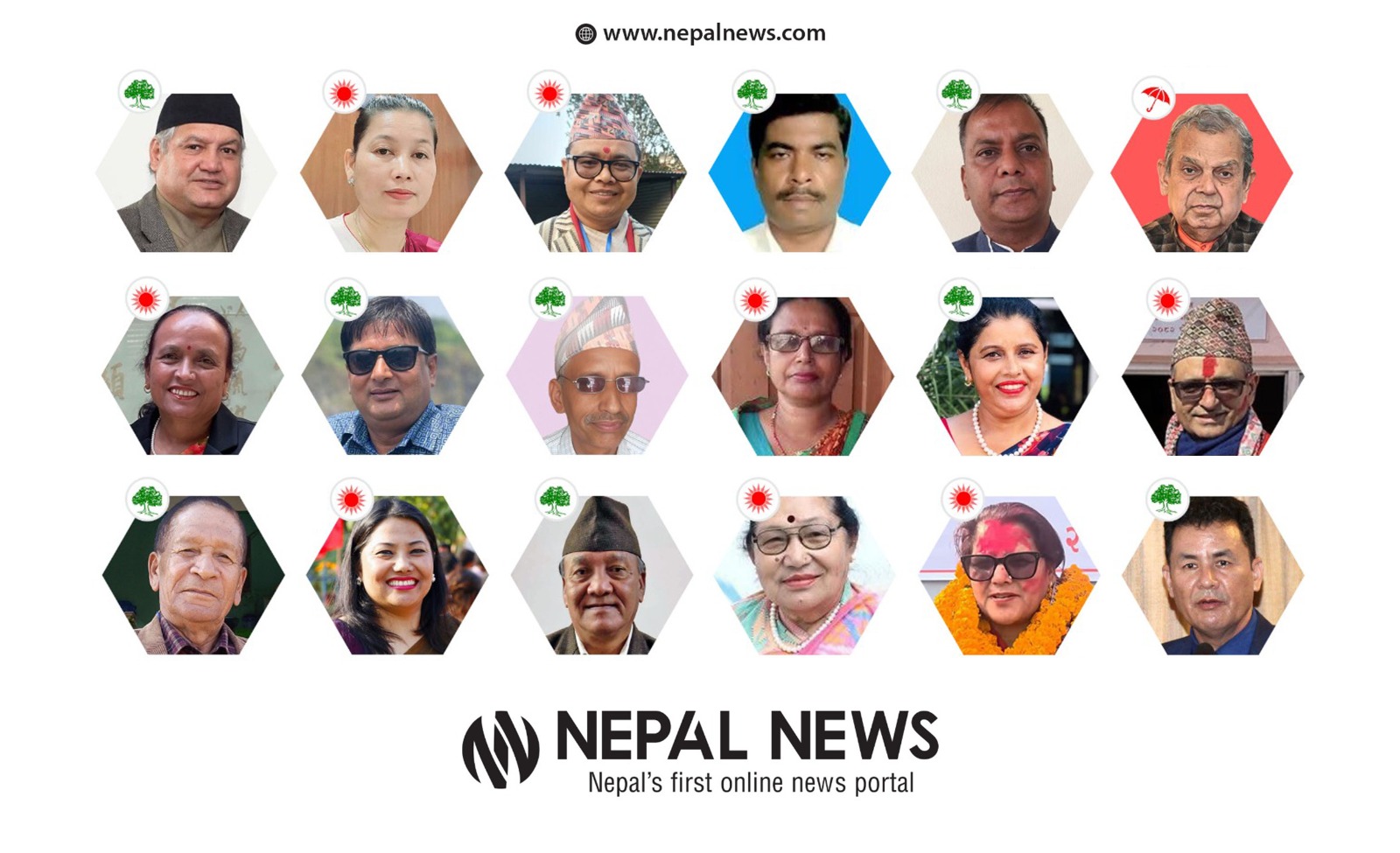
KATHMANDU: Eighteen new members—an eclectic mix of seasoned politicians and emerging leaders—have secured seats in Nepal’s National Assembly, reshaping the composition of the country’s upper house representation.
The elections, held on Sunday (January 25), filled 18 of the 19 seats set to fall vacant when current terms expire on March 4. Major parties—the Nepali Congress, CPN-UML, and the Loktantrik Samajwadi Party (LSP)—fielded joint candidates, while the Nepali Communist Party (NCP) chose to contest alone. The results were unambiguous: every winning candidate emerged from the coordinated slate, reinforcing the decisive role of electoral alliances in the National Assembly’s indirect voting system.
Unlike the House of Representatives, the National Assembly is elected not by the public but by an electoral college composed of provincial and local representatives. In total, 550 provincial assembly members and 1,506 local-level officials across Nepal’s seven provinces—including 753 chiefs and deputy chiefs—cast their votes, making the contest as much a test of party discipline as of grassroots influence.
The newly elected members will assume office on March 05, 2026 at a moment when the upper house is increasingly central to legislative bargaining and constitutional oversight. Among those elected are four veteran politicians who previously served in the House of Representatives, bringing parliamentary experience to a chamber designed to provide continuity, restraint, and long-term perspective in Nepal’s federal system. Here is everything you need to know about the National Assembly of Nepal:
Which party has how many seats in the National Assembly now?
After the latest National Assembly elections, the Nepali Congress has emerged as the largest party in the upper house with 25 seats, overtaking the Nepal Communist Party (NCP), which now holds 18 seats and stands in second place. The CPN-UML ranks third with 11 seats, followed by Janata Samajbadi Party (JSP) Nepal with three seats and Rastriya Janamorcha with one seat, while one member—Ram Narayan Bidari—serves as a nominated member. Although the NCP had been the largest force in the National Assembly, it failed to win a single seat in this election after contesting alone against the Congress–UML alliance, resulting in the loss of eight seats from its previous strength of 26, leaving it with 18 members drawn from the Maoist Centre and the CPN (Unified Socialist). The UML, which won eight seats on Sunday under the alliance arrangement, managed to retain its third position. Meanwhile, 19 members—including eight from the UML, three each from the Nepali Congress, Maoist Centre and CPN (Unified Socialist), two from JSP Nepal, and one nominated member—are set to retire on March 4, marking a significant reshuffle in the National Assembly’s political balance.
Who won the National Assembly elections in Nepal?
The National Assembly elections concluded on Sunday with a voter turnout of 95.68 percent, though voters from the Rastriya Prajatantra Party (RPP) abstained. In Koshi Province, Sunil Bahadur Thapa of the Nepali Congress was elected unopposed, while Roshani Meche and Som Nath Portel of the CPN-UML also won seats. In Madhesh Province, Dharmendra Paswan and Ranjit Karna from the Nepali Congress, Mahantha Thakur of the Loktantrik Samajwadi Party, and Rekha Kumari Jha of the CPN-UML were elected. Bagmati Province elected Gita Devkota of the Nepali Congress and Prem Prasad Dangal of the CPN-UML, while Gandaki Province chose Samjhana Devkota from the CPN-UML and Jagat Timilsina from the Nepali Congress. In Lumbini Province, Basudev Jangali and Chandra Bahadur KC of the Nepali Congress and Ram Kumari Jhakri of the CPN-UML secured seats. Karnali Province elected Lalit Jung Shahi of the Nepali Congress and Meena Singh Rakhal of the CPN-UML, and in the Far West Province, Leela Kumari Bhandari of the CPN-UML and Khamma Bahadur Khati of the Nepali Congress won. These results largely reflect the success of the alliance between the Nepali Congress, CPN-UML, and the Loktantrik Samajwadi Party in this election.
How are National Assembly members elected in Nepal?
National Assembly members are elected through an electoral college system, not by direct public vote. Each of Nepal’s seven provinces elects eight members, making a total of 56 elected members. The electoral college in each province consists of provincial assembly members and chairpersons/mayors and vice-chairpersons/deputy mayors of local governments within that province. Under the weighted voting system prescribed by law, each provincial assembly member’s vote carries a weight of 48, while each local-level chief or deputy chief’s vote carries a weight of 18, ensuring a balance between provincial and local representation in the selection of National Assembly members.
What is the election procedure for the National Assembly in Nepal?
The National Assembly has 59 members, of which 56 are elected and 3 are nominated by the Government of Nepal with presidential approval. Each of the seven provinces elects eight members through an electoral college consisting of provincial assembly members and chairpersons/mayors and vice-chairpersons/deputy mayors of local bodies. In this system, each provincial assembly member’s vote carries a weight of 48, while each local-level chief or deputy chief’s vote carries a weight of 18.
To ensure inclusivity, of the eight members from each province, three must be women, one must be from the Dalit community, and one must be a person with a disability or from a minority community. Electors cast four separate ballots: one for the three open seats, one for the three female seats, one for the Dalit seat, and one for the disabled or minority seat. The three open seats and three female seats are filled using the single transferable vote (STV) system, while the Dalit and disabled/minority seats are filled through a first-past-the-post (FPTP) system. This procedure balances proportional representation, inclusivity, and fairness in the upper house of Nepal’s Federal Parliament.
Is the new Congress leadership continuing the previous alliance?
Yes. The Congress–UML alliance has been carried forward under the new leadership and proved decisive in the National Assembly elections. Outgoing Congress President Sher Bahadur Deuba had formally endorsed the alliance with the UML before handing over leadership to newly elected President Gagan Thapa. After the Election Commission announced the final results, the Congress held its special general convention under Thapa’s leadership, where the decision to continue the alliance was reaffirmed in line with earlier commitments, ensuring continuity in the party’s electoral and parliamentary strategy.
Who were the contenders in the National Assembly election?
The contest featured candidates from all major parties across Nepal’s seven provinces. The CPN-UML fielded the largest slate, nominating Guru Baral, Sumitra Bhandari, and Sonam Gyaljen Sherpa from Province 1; Asarfi Yadav and Bina Shah from Madhesh Province; Gopal Shakya and Nirkumari Kunwar Darlami from Bagmati; Punya Prasad Poudel, Lila Pokhrel Thanet, and Arjun Sunam from Gandaki; Ram Dayal Gupta, Bharati Khanal, and Krishna Bahadur Sunar from Lumbini; Chudamani Sharma, Ganga Thapa Mahat, and Padam Bahadur Majhi from Karnali; and Dilliraj Bhatta, Santosh Kumari Sharma, and Naresh Bishwakarma from Sudurpaschim. The Nepali Congress nominated Gopal Basnet from Province 1, Krishna Prasad Poudel from Bagmati, Kamala Panta from Gandaki, Yubaraj Sharma from Lumbini, Durga Kumari Gurung from Karnali, and Narayandutta Mishra from Sudurpaschim. The Maoist Centre fielded Urmila Aryal from Madhesh Province (woman), Suresh Ale Magar from Gandaki (others category), Bharat Sunar (Dalit), Nar Bahadur Bista from Karnali (differently-abled), and Jagat Parki (Dalit) from Sudurpaschim. The CPN (Unified Socialist) nominated Jayanti Rai (woman) from Province 1, Goma Timilsina (woman) from Bagmati, Rajya Laxmi Gaire (woman) from Lumbini, Udaya Bohora (open) from Karnali, and Madan Kumari Shah (woman) from Sudurpaschim. The Janata Samajbadi Party (JSP) fielded Hemraj Rai (minority) from Province 1 and Khalid Siddiki (open) from Madhesh Province, while Rastriya Janamorcha nominated Tul Bahadur Bishwakarma (Dalit) from Lumbini.
What are the qualifications to be a member of the National Assembly in Nepal?
To be eligible for the National Assembly, a person must meet the criteria set out in Article 87 of the Constitution and the National Assembly Member Election Act, 2017. A candidate must be a citizen of Nepal, at least 35 years old on the date of nomination, and registered on the voter list. They must not have been convicted of a criminal offense involving moral turpitude, not be disqualified by any federal law, and must not hold any office of profit at the time of election.
What is the National Assembly in Nepal?
The National Assembly (Rastriya Sabha) is the upper house of Nepal’s Federal Parliament, with the House of Representatives serving as the lower house. Its composition, powers, and functions are defined under Parts 8 and 9 of the Constitution of Nepal. The Assembly has 59 members in total: 56 are elected, with eight members from each of Nepal’s seven provinces chosen by an electoral college comprising provincial assembly members and local-level chiefs and deputy chiefs, while three members are nominated by the President on the recommendation of the government.
The Constitution envisions the National Assembly as a permanent house, designed to ensure provincial representation, maintain a balance of power within the federal system, and promote legislative continuity, efficiency, and stability. It plays a key role in strengthening inclusive and democratic governance by guaranteeing representation of marginalized communities. From each province, the electoral system mandates the selection of at least three women, one Dalit, and one person with a disability or from a minority community, making the National Assembly central to constitutional inclusion and long-term federal governance in Nepal.
What is the history of the National Assembly in Nepal?
The National Assembly was first established under the Constitution of the Kingdom of Nepal, 1990, which replaced the old Panchayat system with a bicameral parliament. This first iteration of the National Assembly was dissolved on 15 January 2007 and replaced by a unicameral Interim Legislature. After two Constituent Assembly elections, which also functioned as the legislative parliament, the current Constitution of Nepal, promulgated on 20 September 2015, reintroduced the National Assembly as the upper house of the federal parliament, cementing its role in Nepal’s federal democratic system.