Kathmandu
Friday, June 19, 2026





Foreign coach, local struggles: Women’s cricket still finding its feet
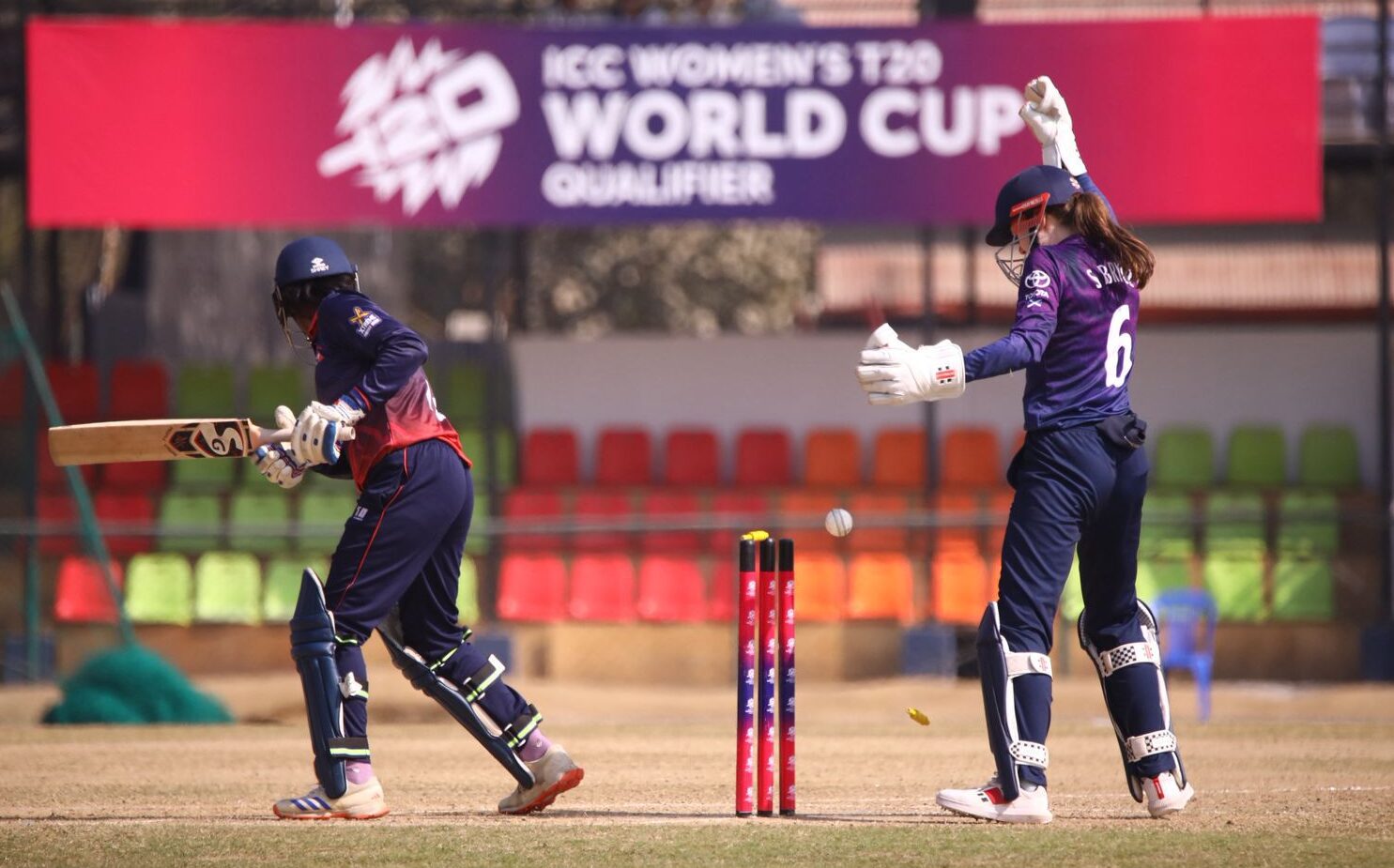
KATHMANDU: “Bringing in a foreign coach is a delayed necessity. Our batting is on the rise, and with the added expertise of a dedicated coach, the women’s team would see a massive surge in both hype and results.”
This was the statement made by Indu Barma, captain of the national women’s cricket team, 11 months ago.
At that time, Indu’s statement was considered natural. The national women’s team, which stepped into international cricket in 2007, had not been able to secure a permanent foreign coach. Although former Indian national player Devika Palshikar was brought in on August 6, 2023, she remained in the role for only one month (from August 6 to September 8). The direct impact of this was visible in the team’s structure, strategy, fitness, and mental preparation.
On November 10, 2023, former national player Manoj Katwal took charge of the team. Some misunderstandings arose within the team regarding fitness and overall performance. However, under Katwal’s coaching, the Nepali women’s team made history after nine months by securing a place in the ICC Women’s T20 Global Qualifier for the first time.
After qualifying for the Global Qualifier, the Cricket Association of Nepal (CAN) appointed Indian coach Harshal Patel as the head coach one month ago. It seemed that the demands of players, including Indu, had finally been met.
However, when Patel took over, the team had neither sufficient time nor international preparation for player testing. The results were clear. In the Global Qualifier held on home soil for the first time, Nepal was eliminated during the group stage. Aside from defeating Zimbabwe, the weakest team in the tournament, the overall performance did not meet expectations.
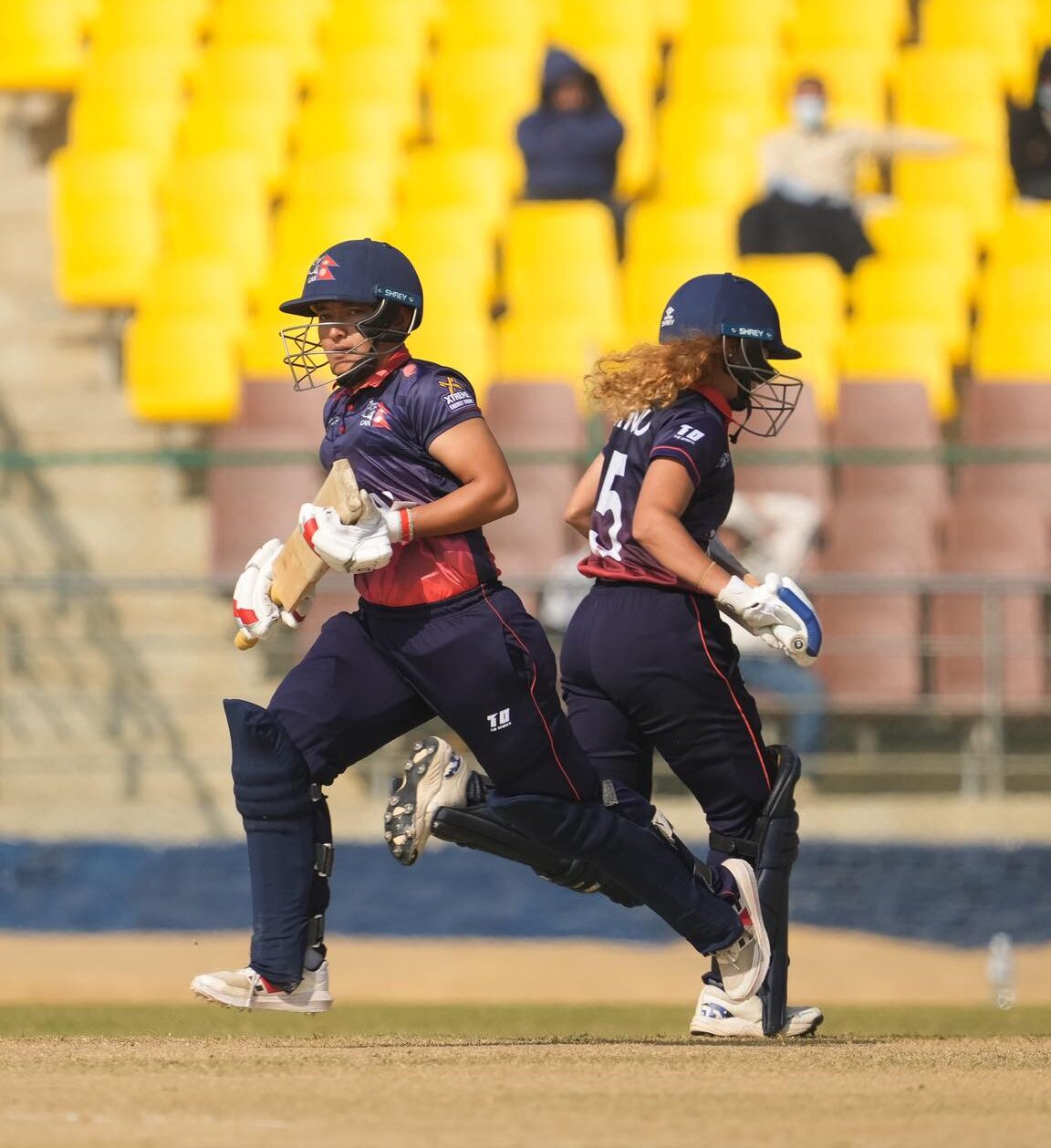
Samjhana Khadka (left) and Bindu Rawal during the match against Scotland. Photo Courtesy: CAN
“Competing at this level was a first for us, providing a great learning opportunity. Winning against Zimbabwe and falling just two runs short against the Netherlands highlights our potential, but we must now focus on the many areas where we need to improve,” notes former vice-captain Sita Rana Magar.
No visible improvement
Nepal has played a total of 37 international matches over the last 28 months. Excluding two matches cancelled due to rain, Manoj Katwal was the head coach for 25 out of 35 matches, in which the national team recorded only 11 wins.
More importantly, those victories were mostly limited to teams of Nepal’s own level or those considered relatively weaker, such as Thailand, Uganda, Hong Kong, Bahrain, the United Arab Emirates, and Malaysia.
Being limited to wins only against teams of similar caliber and failing to present competitive play against stronger teams raised questions about the long-term development plan of Nepali cricket. Against this backdrop, keeping in mind the desires of the players and the necessity of international competition, CAN entrusted Harshal Patel with the responsibility of head coach for two years, with the goal of building a team capable of competing against stronger opponents.
Patel, who rose to prominence in 2019 after leading Thailand to their first-ever World Cup, prioritized fitness over technical drills in bowling and batting upon his arrival in Nepal. He argued that Nepal already possessed a high-quality spin attack, reliable medium-pacers, and an improved batting lineup. However, this assumption ultimately proved to be a fatal miscalculation.
While emphasizing fitness, neither the batting nor the bowling could leave an impact during the T20 Global Qualifier. Furthermore, there was no sign of improvement even in fitness. Aside from reaching 139 runs while chasing a target of 141 against the Netherlands and securing a 6-wicket win against the relatively weaker Test nation Zimbabwe, Nepal achieved little.
The team, which suffered a humiliating 8-wicket defeat against Thailand in the first match, was bundled out for just 68 runs against Scotland in a must-win final match. Aside from Puja’s winning innings of 52 runs against Zimbabwe and Bindu Rawal’s 41 runs against Thailand, the Nepali players’ batting failed to fire. Even in bowling, the praiseworthy performance claimed by Patel was not seen, nor did the strategy to keep opponents under pressure appear effective.
“A lot of improvement is needed in fielding. There are no players who can handle and play in batting partnerships,” says another all-rounder and former captain, Rubina Chhetri Belbase.
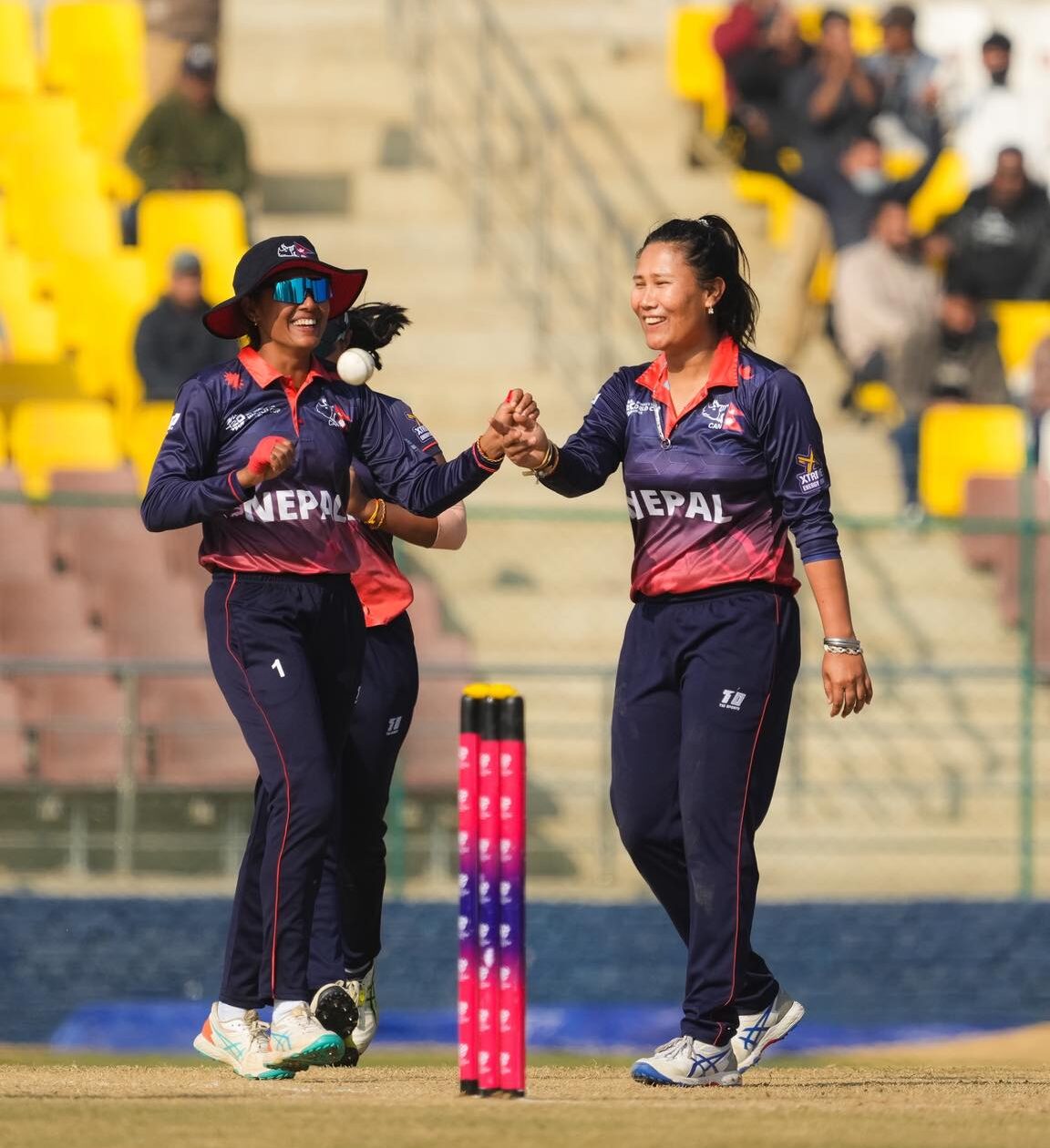
Indu Barma (left) and Rubina Chhetri (right). Photo Courtesy: CAN
In fact, even in the practice matches the national team played before the Global Qualifier, no signs of improvement were visible. Although they crossed the 150-run mark in some matches against a medium-level team like the United States, Nepal was limited to weak batting performances against stronger teams like Ireland and Thailand. This trend continued in the Global Qualifier.
‘Time for transition’
The national women’s team is currently in a state of transition. Experienced all-rounders Rubina and Sita are nearing retirement. Previously, in place of Neri Thapa, Apsari Begam, Jyoti Pandey, Ashmina Karmacharya, and Kritika Marasini, new players like Puja Mahato, Riya Sharma, Manisha Upadhaya, and Samjhana Khadka have been playing.
According to Rubina, although new players performed well in some matches, they have not been able to find their rhythm. “New players have not had enough opportunities to play. For this reason, supporters must remain patient for some time,” she says.
CAN has recently been organizing more tournaments for the women’s team than the men’s team, claiming to uplift the level of women’s cricket. Women players are scheduled to play the Premier Cup, a series with Kuwait, and two international series this year. The U-19 women’s team will also tour Bhutan and Malaysia. They will play a tri-series with Kuwait, Malaysia, and some other teams.
However, it is not as if such busy schedules did not exist before. In the past 2.5 years, the national team played a tri-series at home against the Netherlands and Thailand. They also played a quadrangular series in Uganda with the host team, Namibia, and Hong Kong. Similarly, the team prepared for the Global Qualifier by playing a 5-match series against Malaysia last October.
In 18 matches across these series, they secured one win each against Thailand, Namibia, Hong Kong, and Uganda. Against Malaysia, they extracted the highest result of three wins. The team appears under pressure for failing to deliver results not only in series meant for International Cricket Council (ICC) and Asian Cricket Council (ACC) preparation but also in the main tournaments themselves.
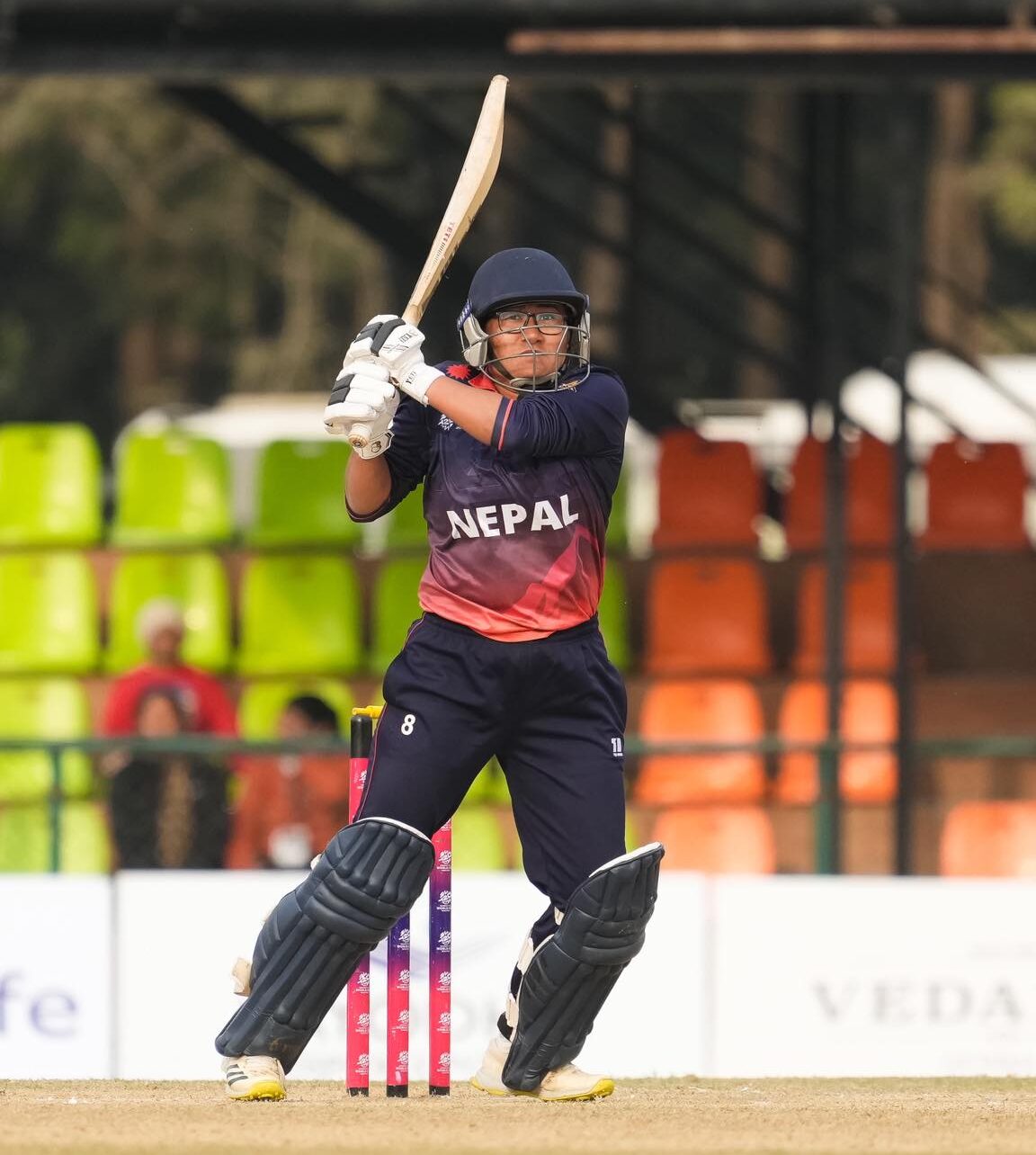
Sita Rana Magar. Photo Courtesy: CAN
“As CAN scales up investment, the demand for fast results is expected, but we don’t go out there to lose; it takes time to translate that support into consistent performance on the field,” Rubina further added.
Fundamental gaps in performance
It is not that domestic coaches have failed to give good results to the Nepali team previously. During the tenures of coaches like Jagat Tamata, Binod Das, Neera Rajopadhyay, and Samson Jung Thapa, the team achieved significant improvements and some historical successes despite limited resources and challenges. This clarifies that it is not a lack of capability in domestic coaches. However, CAN is focused on achieving success through foreign coaches.
Former coach Thapa states that generally, the experience, international perspective, and professional discipline of foreign coaches from test nations are useful. However, he argues that an environment must be created to gain returns according to the investment. “For technical areas like bowling, batting, and fielding, Nepali assistant coaches have to be kept. On one hand, this provides continuous support to the team, and on the other, domestic coaches also get the opportunity to learn modern coaching methods,” he says.
In modern cricket, the role of a head coach is like that of a school principal. The principal oversees the overall management and direction of the school. However, the responsibility for direct improvement in students’ skills and abilities lies with the subject teachers. Similarly, in a cricket team, the head coach looks at the overall strategy. Therefore, specialist coaches for batting, bowling, and fielding are essential. But currently, all these responsibilities rest on the shoulders of head coach Patel.
From a technical perspective, the men’s team has many players capable of hitting fours and sixes. There are plenty of examples where Sandeep Lamichhane, Sompal Kami, and Karan KC have won matches from the lower order. However, even in the top- and middle-order players of the women’s team, that level of batting capability does not yet seem developed. Former coach Thapa says that even the basic ability to move the game forward by taking ‘singles and doubles’ is not seen in the women’s team. He says that because of this, one must still wait for women’s cricket to bring expected results.
“Bringing a foreign coach does not yield results immediately. It takes time for the coach to identify potential players, develop them, and teach technical skills. At least two to three years must be given to a new coach,” says Thapa.