Kathmandu
Sunday, June 14, 2026





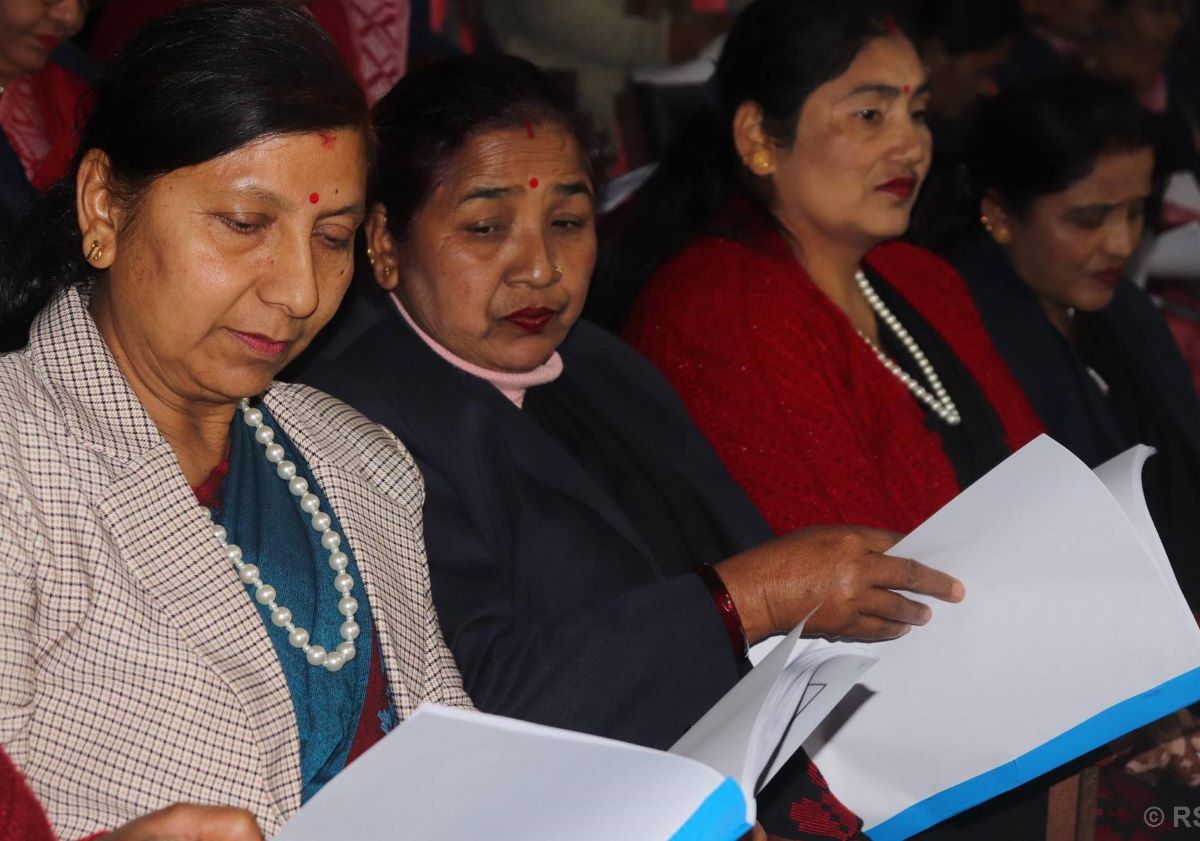
Ramchandra Rayamajhi/RSS
PALPA: “We were determined to serve citizens when we joined the local government in our respective capacities as local people’s representatives, but to our dismay, women are not given any specific roles in the team,” complained Manju Ranapal of Tansen Municipality–1. She said women’s voices are largely excluded from ward offices and the municipality.
According to the women representatives, when they try to speak in meetings and gatherings, male members often dominate and suppress their voices. “They tell us that we (women leaders) have no executive rights at the local level,” she said. Ranapal represents Dalit women in local leadership.
Like other women members, she said she is practically limited to witnessing budget and law presentations and endorsing them. Due to such discrimination, Dalit representatives have been prevented from delivering in the interests of their communities. De facto discrimination, institutional hurdles, and budgetary constraints have restricted their ability to make a meaningful impact.
Another Dalit member, Manju BK, shared similar experiences. Elected three years ago as a local representative under the Dalit women quota, she said her initial hope, expectations, and encouragement gradually turned into disappointment. “A positive working environment, clear responsibilities, and adequate budgets are necessary to translate this opportunity into real delivery,” she said.
Dalit woman representative Susmita Gahatraj from Tansen–6 said her role at the local level is largely confined to attending ward executive committee meetings and visiting activities in the locality. “We only carry out the roles assigned by the ward chair. In the beginning, it even felt awkward to introduce myself at public gatherings and programs,” she said.
Basundhara Damai, the Dalit woman member from Tansen–13, said locals frequently ask her about ward plans and budgets. However, she has no access to the budget formulation process or decision-making related to planning.
“Our voters ask for plans, but we have nothing to deliver. We have been deprived of roles and responsibilities in the real sense,” she said.
She added that it was painful to realize her representation at the local level had brought no tangible benefit to her community.
Meena Pariyar of Tansen–7 echoed similar concerns, saying women’s voices remain in the shadows. “We are denied meaningful roles and responsibilities,” she said.
Although the Local Government Operation Act clearly defines the duties, responsibilities, and rights of ward committees, women representatives particularly Dalit women are denied these roles in practice.
Under the Act, ward committees are responsible for plan formulation, monitoring, data updating and protection, engagement in local-level development, regulation of development activities within the ward, and oversight of consumer committees. The law mandates ward committees to allocate roles and responsibilities among members.
However, in practice, women representatives are largely confined to observing local affairs, excluded from decision-making and implementation.
Mayor Santosh Lal Shrestha, however, claimed that the municipality has ensured meaningful participation of women, including Dalit members, in decision-making processes. Ward Chair of Tansen Municipality–6, Sagarman Maharjan, also said that all members, regardless of gender, are informed about ward activities from plan selection to budget formulation. “We allocate work proportionately and carry out activities through consultation with all members,” he said.
Despite these claims, human rights activist Santabeer Baral highlighted the lack of meaningful participation of Dalit women in local government, despite legal guarantees. He said Dalit women continue to face de facto exclusion in local governance. Baral stressed the need to address this gap by promoting women’s empowerment and encouraging them to claim their roles and voices.
‘We are capable of taking leadership’
Women representatives said they are capable of taking leadership roles if they are trusted and given responsibilities.
“We women members are competent to make sound decisions and implement them, but we are not heard. We have demanded leadership roles, such as coordinators of thematic committees, but these have not been provided,” said Sabita Bhattarai, a woman member from Tansen–2.
“If given the opportunity, we will deliver our best, perhaps even better than our male counterparts, but we continue to be sidelined from roles and responsibilities,” said executive member Manju BK.
Of the 73-member elected municipal board, 33 are women, including the Deputy Mayor. From 14 wards, a total of 28 women elected under women and Dalit women categories serve as representatives. The municipal board has elected one Dalit woman as an executive member.
Among the 33 women representatives, eight are from the Khas Arya community, eight from ethnic communities, and 17 from the Dalit community.