Kathmandu
Monday, July 13, 2026





Former cricketers suggest planning to beat England and West Indies—not Scotland or Italy
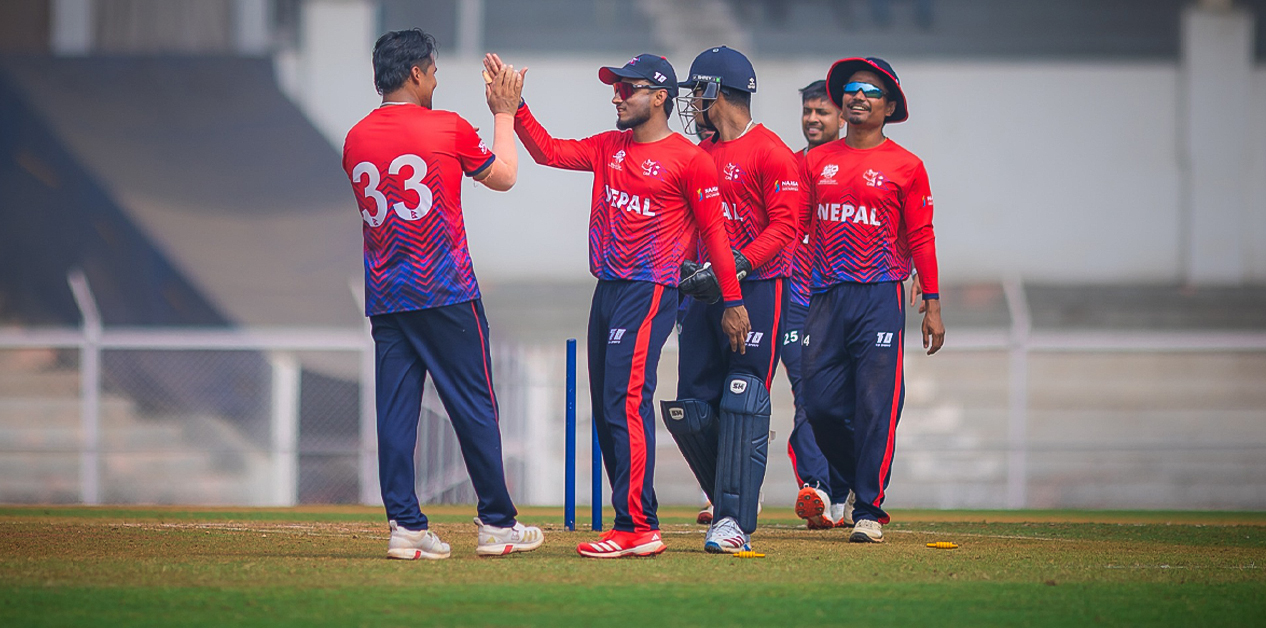
Group C of the ICC T20 World Cup 2026 schedule is no longer an ordinary group. With Bangladesh’s unexpected exit and Scotland’s entry, the group has turned into a kind of laboratory where the balance of power has visibly shifted.
Earlier, with two-time world champions West Indies and England alongside Bangladesh, Italy, and Nepal, this group had been labeled a “group of death”—one where even big teams could suffer surprise defeats against relatively weaker sides. That situation has now changed.
With Test nation Bangladesh out of the tournament, the gap between the remaining teams has narrowed. For Nepal, this has created both pressure and opportunity. By ranking, history, and experience, Scotland is a weaker side than Bangladesh, says Nepal captain Rohit Kumar Paudel.
“We have been playing Scotland. We know their strengths and weaknesses,” Paudel says from Mumbai.
A timely opportunity
After the Bangladesh Cricket Board (BCB) refused to play in India citing security concerns, the International Cricket Council (ICC) decided to include Scotland in the World Cup.
Scotland had failed to secure a World Cup berth after losing to Italy by 12 runs and to Jersey by one wicket in the European qualifiers. However, the dispute between India and Bangladesh paved the way for Scotland’s direct entry into the tournament. On January 4, the Bangladesh government informed the ICC through the BCB that it would not permit the team to travel to India. For nearly three weeks, the BCB held discussions with the ICC, requesting that its matches be moved to a neutral venue—similar to Pakistan’s case—citing security concerns.
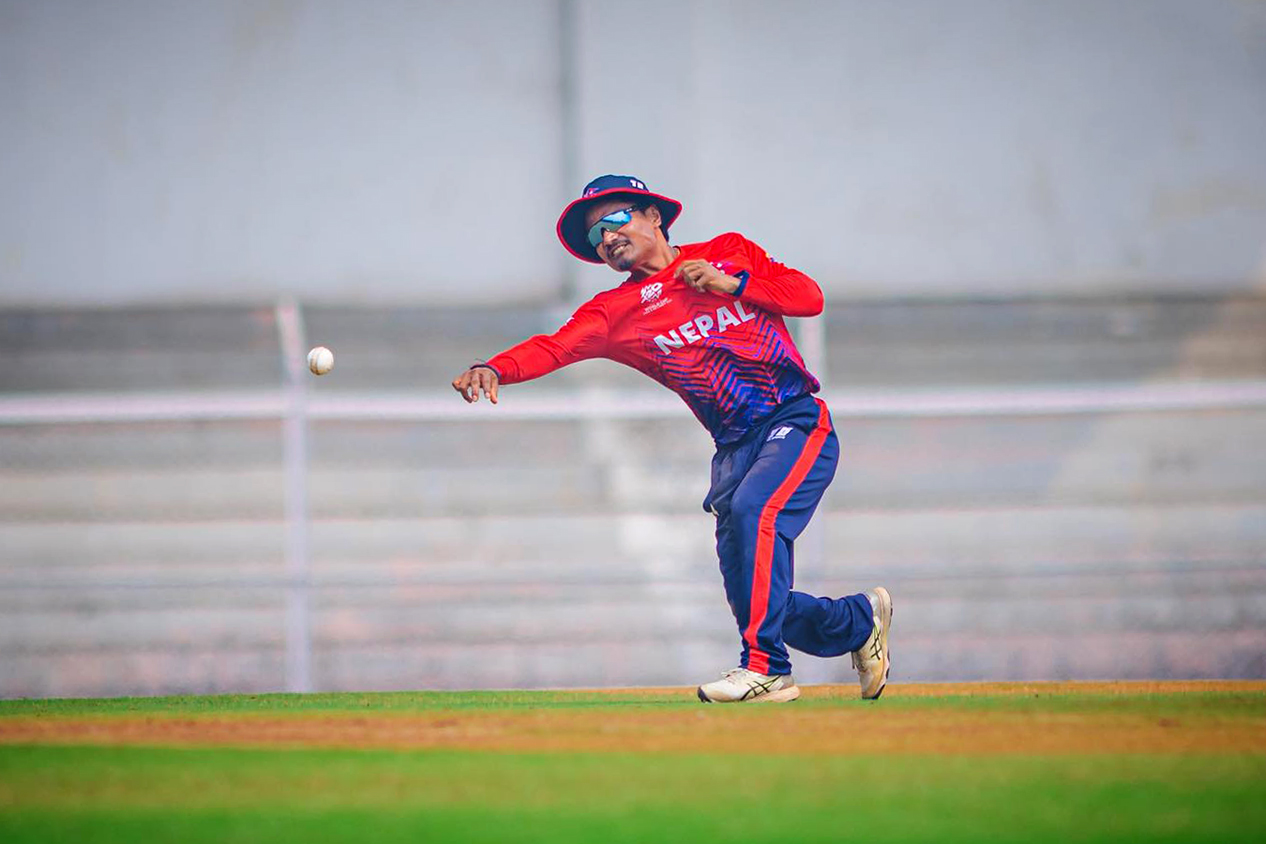
The captain of the Nepali team throwing the ball during a practice match against MCA 11. Photo: CAN
These concerns were largely linked to an issue involving star pacer Mustafizur Rahman. On January 3, the Board of Control for Cricket in India (BCCI) instructed IPL franchise Kolkata Knight Riders to “release” Rahman without explanation, triggering the controversy. While the BCCI did not officially state a reason, it was widely reported that the decision was influenced by violence against the Hindu community in Bangladesh.
Since then, the BCB repeatedly maintained that security was paramount and that it could not send the team amid any risk. BCB President Aminul Islam cited last year’s Champions Trophy, where India’s matches in Pakistan were shifted to Dubai, as a precedent, urging the ICC to move Bangladesh’s matches to a neutral venue as well. However, the ICC insisted there was no security threat in India and asked Bangladesh to play there.
The BCB wanted to take the issue to the ICC’s dispute resolution committee. The ICC, however, said that venues had already been finalized, there was no security risk, and relocating matches would involve additional logistical costs. It therefore decided to replace Bangladesh with Scotland. The ICC stated: “Mustafizur’s issue concerns a domestic league. It has no direct bearing on the security or participation in an ICC event.”
Nepal’s history
For Nepal, England and Italy are entirely new opponents in Group C. Nepal have never faced England in any format. Nepal have, however, played Italy twice—in 2005 and 2010. In their first encounter during the 2005 ICC World Cup Qualifier, Nepal secured an 88-run victory. Five years later, in Division Four, Nepal again won by five wickets. Both matches, however, were 50-over games.
The other two teams, West Indies and Scotland, are familiar opponents for Nepal.
“Italy recently beat Ireland. Scotland are in very good form in the League 2 cycle,” says former cricketer Dipendra Chaudhary. “That said, the positive side is that there is one fewer Test nation in the group.”
In the ICC Cricket World Cup League 2—used as the qualification pathway for the 2027 ODI World Cup to be jointly hosted by South Africa, Zimbabwe, and Namibia—Scotland are second with 30 points from 24 matches. Nepal, having played 20 matches, are seventh with 12 points.
Scotland are also considered stronger than Nepal in T20 internationals. The two sides have faced each other only twice in the T20I format. They first met during Nepal’s League 2 tour of Scotland, under the ICC’s policy of giving associate nations regular exposure in the shortest format. Nepal won the first match in Glasgow on June 17, 2025, by two wickets, but lost the second by 34 runs.
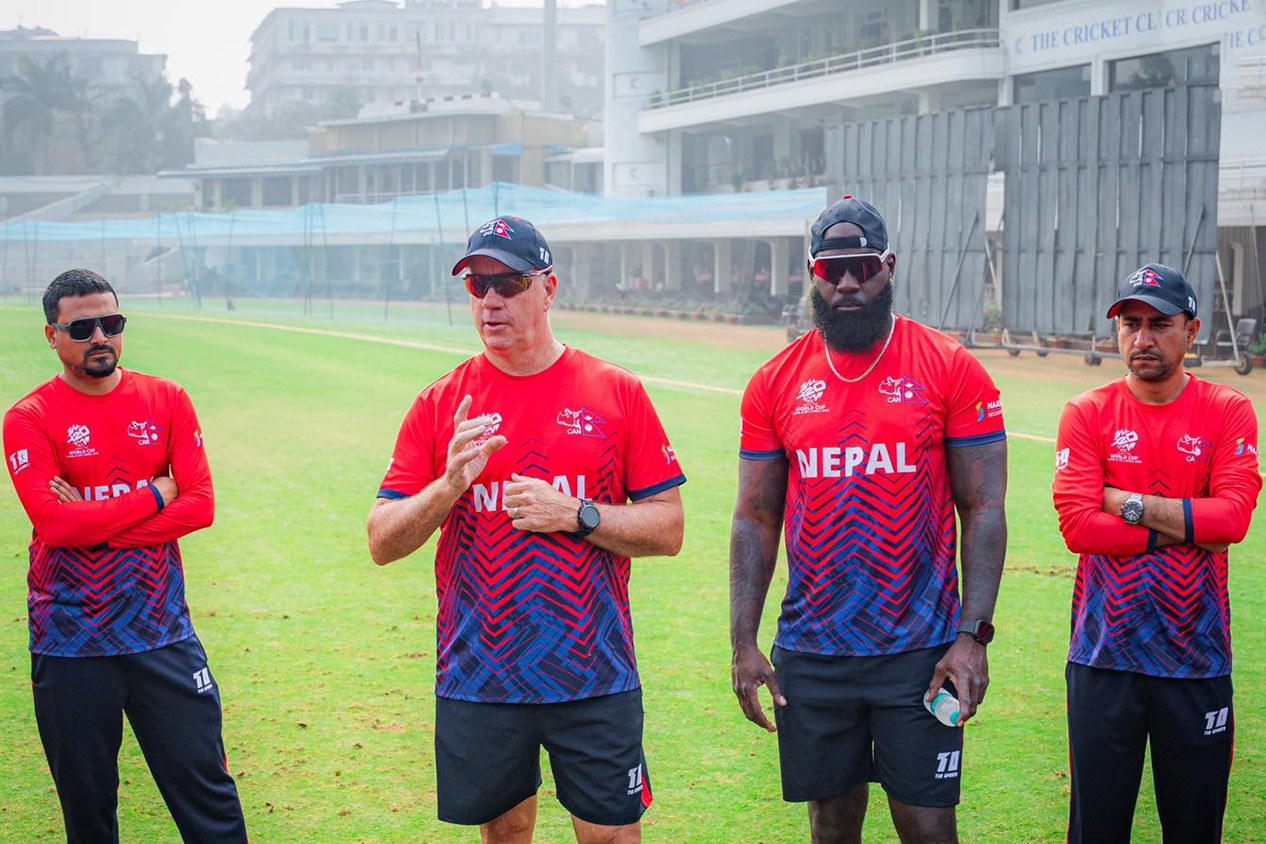
Head coach Stuart Law briefing the Nepali team on strategy. Photo: CAN
Nepal played a three-match T20I series against West Indies in September last year in the UAE, winning the series 2–1. Nepal registered wins by 90 and 19 runs in the first two matches but lost the final game by 101 runs.
This time, Scotland have announced a World Cup squad with several changes, while West Indies are fielding a new and stronger lineup, retaining only Jason Holder and Akeal Hosein from the previous setup.
How strong are Nepal’s chances?
The biggest uncertainty for Nepal at present is the pitch and playing conditions. Nepal will play all four group matches at Wankhede Stadium, which is generally considered a flat batting surface. However, the nature of the pitch there can change.
A similar situation occurred on February 2 last year, when India scored 247 runs against England—the highest-ever total at Wankhede. Yet, England were bowled out for just 97 while chasing 248.
Chaudhary cautions against getting carried away by assumptions about the pitch.
“Only the curator knows how the pitch will behave. In ICC tournaments, full control over pitch preparation lies with them. Since the soil is changed every two years, it’s impossible to say in advance what kind of pitch it will be,” he says.
Associate-nation pitches are generally prepared flat, which helps teams accustomed to such conditions. Nepal benefited from this in Sharjah during the series against West Indies, winning two of three matches. In those games, pacers took seven wickets and spinners took ten. However, in the final match, neither pacers nor spinners were effective, and Nepal lost by 10 wickets.
West Indies, meanwhile, are known for power hitting and long sixes—qualities that helped them win World Cups in 2012 and 2016. They also possess high-speed fast bowlers.
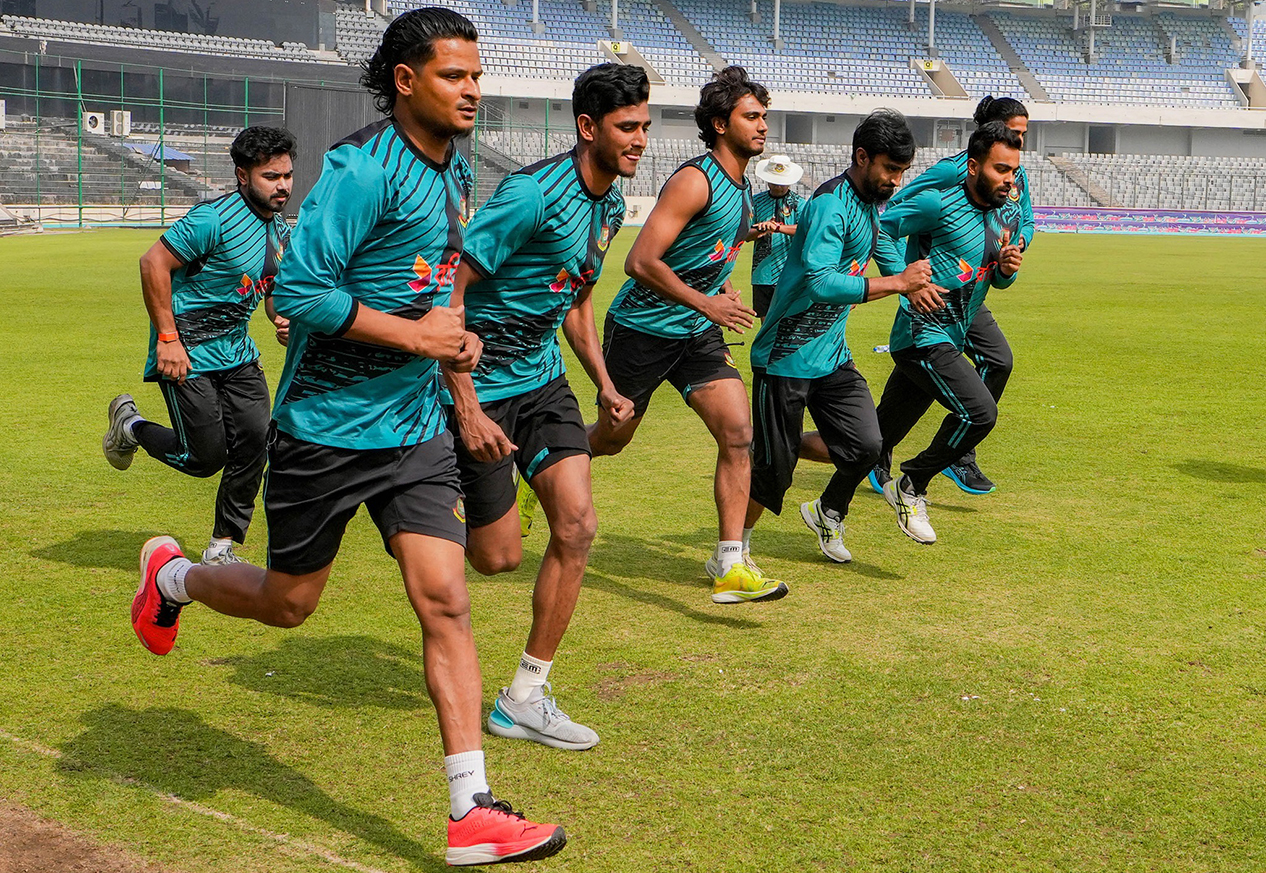
The Bangladeshi team, which refused to play in the World Cup, taking part in regular training. Photo: BCB
“Even if the pitch is flat, Nepal are at a disadvantage. If it’s bouncy, that’s also a problem because Nepal don’t have genuinely high-pace bowlers,” says Chaudhary.
Nepal’s head coach Stuart Law has included Sompal Kami, Karan KC, and Nandan Yadav in the World Cup squad, with all-rounder Gulshan Kumar Jha also supporting the team’s pace attack. However, none of them consistently bowl at 140 km/h.
On the other hand, Sompal and Karan have been playing continuously for nearly a decade—something considered rare in world cricket. Due to the Cricket Association of Nepal’s failure to develop bench strength and a proper development squad, these two have remained automatic selections. This will be Sompal’s third World Cup and Karan’s second. Yet, neither has found rhythm in recent World Cups.
In the 2024 World Cup held in the USA and West Indies, Kushal Bhurtel and Dipendra Singh Airee delivered standout bowling performances. Dipendra finished the tournament with the most wickets (six), Kushal took four, Rohit Paudel two, and Sandeep Lamichhane two. Pacers Sompal Kami took two wickets, Avinash Bohara one, while Karan went wicket-less.
Against South Africa, whom Nepal restricted to 115 runs, Kushal took four wickets and Dipendra three. Sandeep, however, missed that match due to visa issues.
“Cricket is not like football. In football, you can score one goal and defend to win. That doesn’t work in cricket. No matter how many runs you score, without bowling you cannot be considered strong,” says former cricketer and bowler Sanjam Regmi.
Under ICC rules, only the top two teams from each group advance to the next round. Therefore, Regmi argues, Bangladesh’s absence has actually made things easier for powerhouses like England and West Indies. Bangladesh are well-versed in Asian conditions and could have challenged even those teams.
West Indies, meanwhile, remain extremely dangerous in the T20 format with their explosive, fireworks-style play.
“There is a world of difference between playing ICC tournaments and bilateral series. In a series, you can lose one match and still make a comeback. In a World Cup, one loss puts immense mental pressure on a team,” Regmi says. “T20 cricket is a game of momentum, so the right balance between experienced and young players is crucial.”
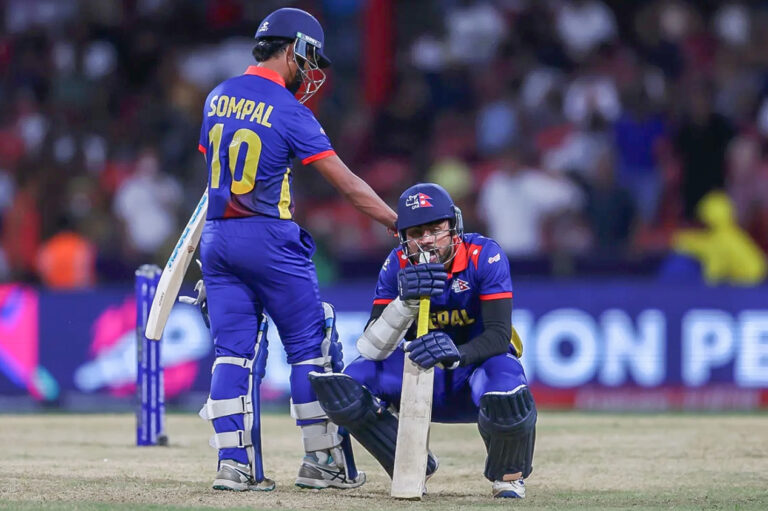
Sompal Kami (jersey number 10) consoling Gulsan after the defeat to South Africa in the World Cup. Photo: ICC
As Regmi notes, in the last World Cup Nepal lost to South Africa by just one run. Yet, the experienced bowling of South Africa’s Tabraiz Shamsi turned the game, taking four wickets. Nepal were 99/4 in 17.3 overs, needing just 15 more runs, but lost three more wickets. In the end, one run was needed to force a Super Over, but Gulshan was run out, and Nepal missed a historic victory.
“Who knows—maybe Nepal can challenge Italy and Scotland the way they challenged South Africa? But if Nepal are to reach the Super Eight, it won’t be by celebrating the presence of associate nations. They will need nothing short of miraculous performances against the other two teams,” Regmi concludes.