Kathmandu
Wednesday, July 15, 2026





From heavyweight clashes to first-time contenders, all five constituencies in the district in eastern Nepal are reshaping the country’s electoral narrative.
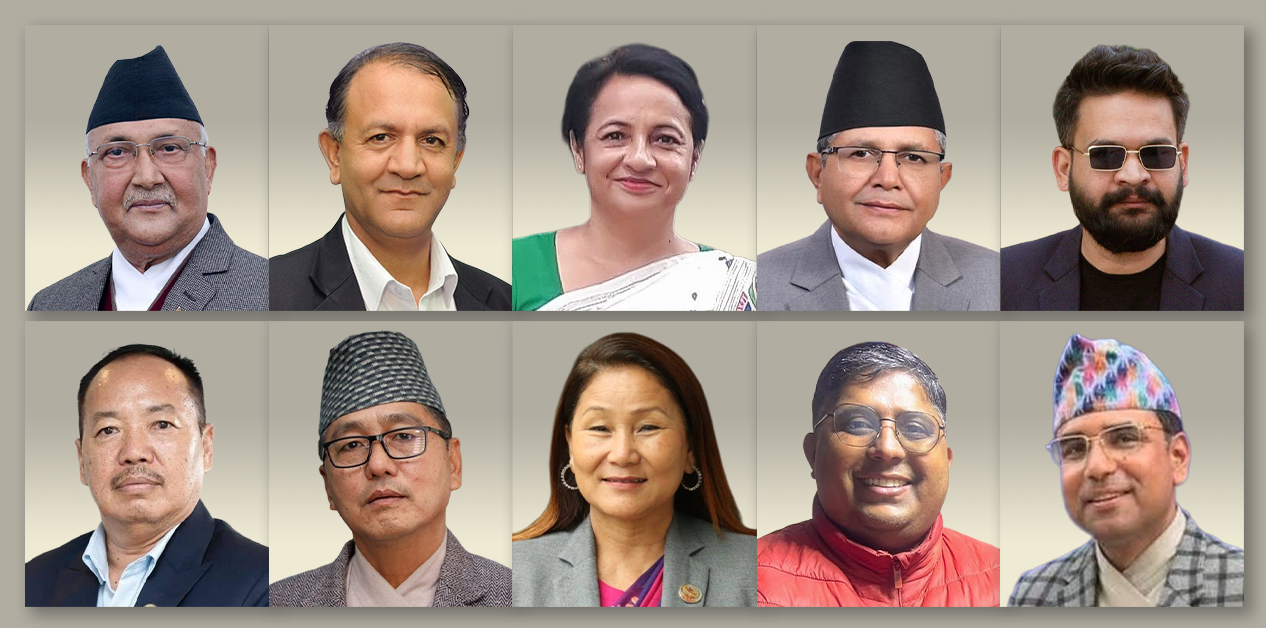
JHAPA: With the House of Representatives election scheduled for March 5, excitement has surged in Jhapa, the border district of eastern Nepal. A total of 90 candidates have entered the race across Jhapa’s five constituencies, including 17 independent candidates.
According to the District Election Office, Jhapa–5 has attracted the highest number of candidates. A total of 24 candidates, including CPN (UML) Chairman and former Prime Minister KP Sharma Oli and senior Rastriya Swatantra Party (RSP) leader Balendra Shah (Balen), are contesting from this constituency.
The fewest nominations—15 candidates—have been filed in Jhapa–1. Jhapa–2 has 18 candidates, Jhapa–3 has 17, and Jhapa–4 has 16.
The district has 713,537 voters in total, of whom 50,226 are new voters. Altogether, 285 polling stations have been designated across Jhapa.
Jhapa–1: Dangi’s entry makes it a three-way contest
After Nepali Congress Vice President Bishwa Prakash Sharma, who won the 2022 election with 39,624 votes, announced that he would not contest this time, Jhapa–1 has naturally seen a search for new faces. Sharma had defeated UML’s Agni Prasad Kharel, who secured 25,349 votes.
This time, the Nepali Congress has fielded district vice president Keshav Raj Pandey, while the UML has nominated Ram Chandra Upreti.
Former lawmaker Nisha Dangi from the Rastriya Swatantra Party, Ashesh Ghimire from the Nepali Communist Party (NCP), and Kewal Ram Rai from the Shram Sanskriti Party, led by Harka Sampang, are in the electoral fray.
For Dangi, the youngest proportional-representation lawmaker in the dissolved House of Representatives, this is her first direct election. Her presence has clearly pushed Jhapa–1 into a triangular contest.
Jhapa–1 has 131,067 voters.
Jhapa–2: A ‘heavyweight’ showdown
Among Jhapa’s five constituencies, Jhapa–2 has witnessed the most intense local political activity. Here, former Speaker of the House Devraj Ghimire and former Deputy Speaker Indira Rana Magar are facing each other in a direct contest. Ghimire is contesting from the UML, while Rana Magar is the RSP candidate.
Although both are vying to become MPs for a second term, only one of them will make it to the next Parliament.
Considered a close confidant of UML Chair Oli, Ghimire won the 2022 election with 28,716 votes. His nearest rival then, advocate Bhadra Prasad Nepal (Swagat), secured 26,455 votes. Nepal is once again in the fray, this time from the Rastriya Prajatantra Party (RPP).
Former MP Sarita Prasain is contesting from the Nepali Congress, while former minister Dharmashila Chapagain is the NCP candidate. Chapagain had won from this constituency in 2008.
The presence of well-known advocate Yubaraj Sangraula as an independent candidate has added further intrigue to the contest. Both RSP’s Rana Magar and Nepali Congress’ Prasain are contesting a direct election for the first time.
This constituency has 147,522 voters, including 13,431 new voters.
Jhapa–3: Lingden’s challenge without an alliance
In Jhapa–3, regarded as the stronghold of RPP Chair Rajendra Lingden, the UML–RPP electoral alliance has broken down this time. The UML has fielded Hari Rajbanshi against Lingden, while the Nepali Congress has nominated Rajendra Ghimire and the NCP has put forward Dilliraj Ghimire (Hikmat).
RSP candidate Prakash Pathak is also contesting for the second time. In the previous election, he secured 3,461 votes, finishing third.
In the last election, Nepali Congress candidate Krishna Prasad Sitaula, who had contested independently, secured 37,386 votes.
With 140,857 voters, this constituency is expected to witness a triangular contest. A total of 9,400 new voters have been added here.
Jhapa–4: Efforts to breach the UML stronghold
Regarded as the ‘red fort’ of the UML, Jhapa–4 has 16 candidates. UML’s Lal Prasad Sawa Limbu is aiming for a hat-trick victory, while Nepali Congress district president Deuman Thebe has challenged him for the third consecutive time.
In the 2022 election, Sawa won with 29,315 votes, while Thebe was limited to 22,448 votes. In the same election, RSP’s Shambhu Prasad Dhakal emerged as a third force with 14,069 votes. Dhakal is again in the race this time.
This constituency has 130,712 voters.
Jhapa–5: Oli and Balen on test
The contest between UML Chair KP Sharma Oli and RSP senior leader Balen in Jhapa–5 has drawn nationwide attention. This constituency is being viewed less as a routine contest and more as a battle of prestige.
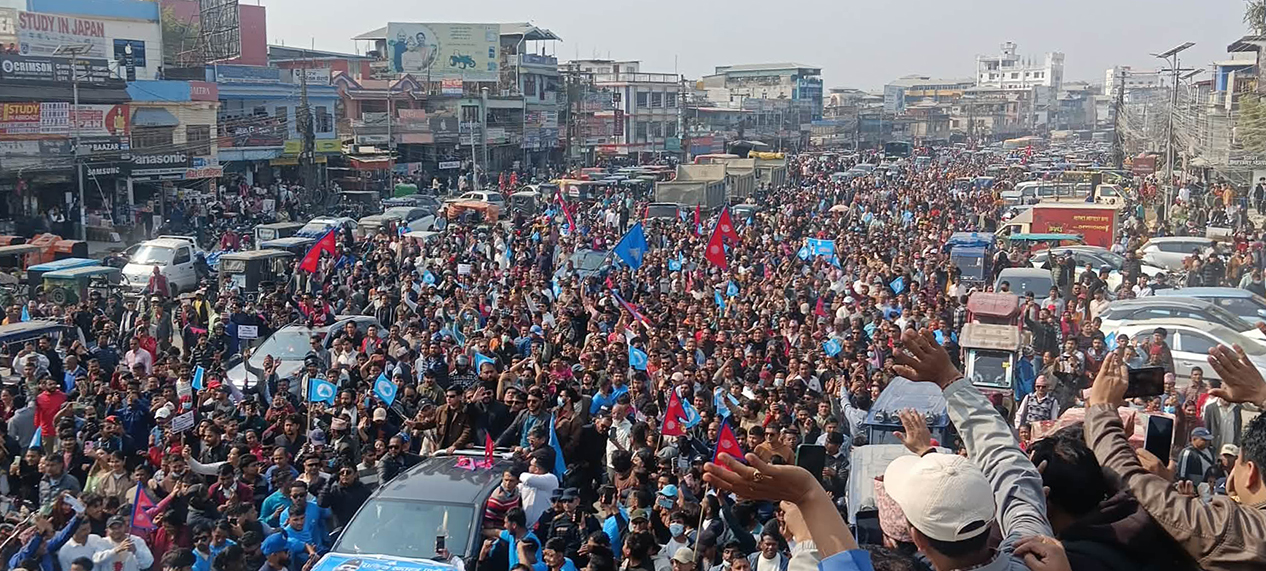
Scene observed when senior leader of the Rastriya Swatantra Party, Balen Shah, arrived at Damak Chowk on 20 Jan to file his candidacy from Jhapa–5. Photo: Bibek Gautam
In the 2022 election, Oli secured victory with 52,319 votes. His rivals—Nepali Congress’s Khagendra Adhikari and RSP’s Suresh Kumar Pokharel—received 23,743 and 11,759 votes, respectively.
Amid the intense focus on Oli and Balen, other candidates have been overshadowed; however, the Nepali Congress has fielded Mandhara Chimariya as its candidate this time.
This constituency, which comprises four local government units, has 163,379 voters. Of them, 9,090 are new voters.
Overall, across all five constituencies of Jhapa, a fierce contest has emerged between the traditional political forces and newly rising parties.