Kathmandu
Thursday, June 25, 2026





The SSF drags its feet even in implementing a Supreme Court mandamus, refusing to refund the employees
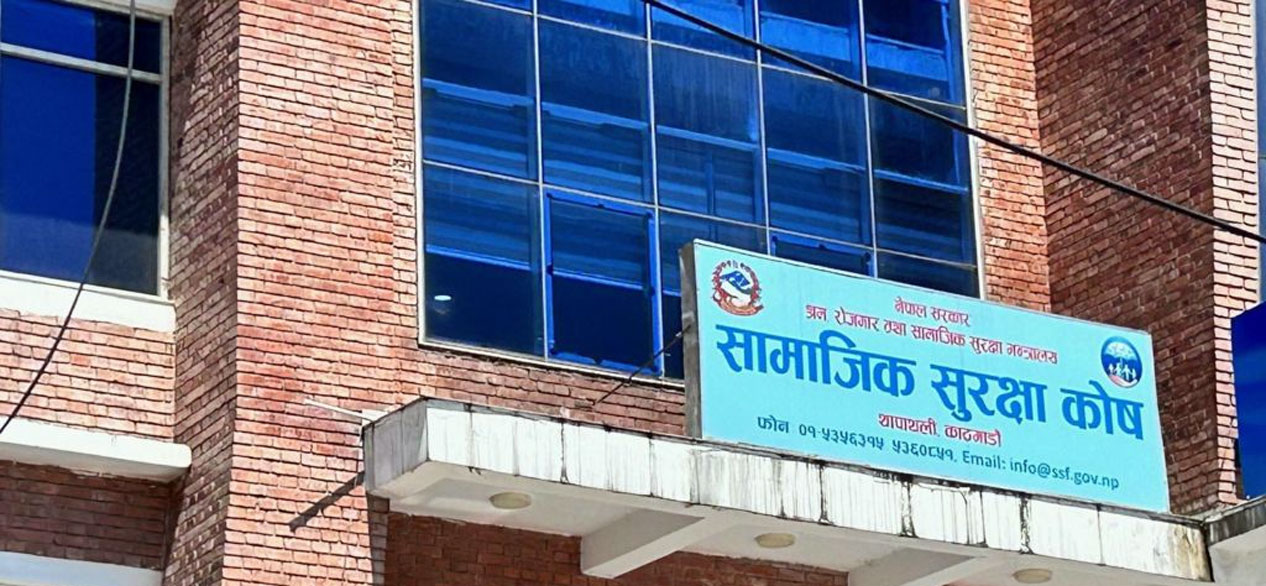
KATHMANDU: The Social Security Fund (SSF) has been reluctant to refund the money deposited by employers and workers. Even though six months have passed after the Supreme Court (SC) ordered the refund of the employer’s contribution, the SSF has yet to return the money.
The SSF has refused to refund the money of 117 employees who were working at the United States Agency for International Development (USAID).
USAID projects in Nepal were shut down starting March 25, 2025, following a decision by US President Donald Trump. After the projects were closed, Nepali employees working there also lost their jobs.
Among those who lost their jobs, workers who had been enrolled in the SSF before the Nepali month of Shrawan 2078 BS (16 July 2021) have received the money deposited in the Fund. However, the money of 137 employees who joined the Fund after that period has been withheld.
Out of those whose money has been withheld, 35 individuals submitted applications to the SSF seeking a refund of the amount they were entitled to under the rules. However, the Fund refused to refund the money, citing a provision in the Social Security Scheme Operation Procedure that allows refunds only to workers who have reached the age of 60 and have contributed for at least 180 months. Following this refusal, 35 individuals filed a writ petition at the Supreme Court on 4 July 2025, demanding payment of all the money deposited in the Fund.
A month later, on 13 August, a joint bench of Justices Til Prasad Shrestha and Sunil Kumar Pokharel issued a mandamus order directing the SSF to pay the deposited amount.
Despite this, the Fund has still not implemented the SC’s verdict. Even after the apex court’s decision, the SSF has continued to withhold payments owed to 117 Nepali workers who lost their jobs at USAID.
The Supreme Court order states that provisions included in the Social Security Scheme Operation Procedure conflict with Section 57 of the Contribution-Based Social Security Act, 2017. Section 57 of the Act states that social security participation is voluntary. It reads: “If any person does not wish to receive any benefit under social security or wishes to relinquish a benefit already received, such person may voluntarily choose not to receive or may relinquish such benefit.” However, contrary to this legal provision, the operational procedure was drafted in a way that prevents the refund of money before reaching the age of 60.
The Supreme Court order states that “failure to provide the amount deposited by the petitioners and employers in the Fund, along with benefits earned from such deposits, would have an adverse impact on the petitioners.”
In its verdict, the SC has stated: “It appears that a certain amount was regularly deducted from remuneration and additional contributions were made by the employer in accordance with the law. As the employer institution no longer exists and employment has already been lost, it does not appear possible to continue depositing funds. The requirements of 60 years of age and 180 months of contribution under the procedure do not appear applicable in the case of these petitioners.”
Advocate Gopal Datt Pandey says the SSF has defied the implementation of the Supreme Court verdict. “There is absolutely no basis for withholding the money deposited by employers and workers in the Fund. According to the Supreme Court’s decision, the Fund cannot withhold workers’ money,” he said. “Preventing former USAID employees from receiving the money they deposited while working is outright injustice.”
He added that the procedure formulated by the SSF contradicts both the Constitution and the Fund’s own Act.
The SSF sent a letter to the Supreme Court on 16 December 2025, stating that it could not implement the verdict without receiving the full text of the decision.
Subsequently, the Supreme Court corresponded with the SSF, instructing it to treat the summary decision as the full verdict because the case file had been destroyed in a fire.
Even after that, the money deposited in the Fund has not been paid, says Jagdish Lohani, a former USAID employee. “We have gone to court to claim the money we ourselves deposited, obtained a verdict, and even after running from office to office, the Social Security Fund still hasn’t returned it,” he said. “The Fund has not only kept dangling promises that it will pay us but has also ignored the court’s order.”
Social Security Fund Executive Director Kabi Raj Adhikari, however, says the implementation of the Supreme Court verdict is underway. “The Supreme Court’s order is in the process of being implemented. I had given a timeline of another 10–15 days. It has been delayed because internal office procedures need to be completed,” he told Nepal News.