Kathmandu
Sunday, July 12, 2026





A detailed geological report puts the Jaljale methane gas reserve at 80.7 billion cubic meters - down from the earlier estimate of 112 billion - clearing the way for well testing and second-phase exploration
KATHMANDU: A detailed study has shown that the methane gas reserve located at Jaljale in Bhairabi Rural Municipality–1 of Dailekh is 32 billion cubic meters less than initially estimated. While the preliminary study had estimated 112 billion cubic meters of methane gas in the Jaljale area, the final report concludes that the reserve contains only 80.7 billion cubic meters of gas.
Exploration carried out with the financial and technical assistance of the China Geological Survey, under the Chinese government, had earlier confirmed the presence of methane gas reserves in the Jaljale area. However, the final report submitted to the Department of Mines and Geology after a detailed study states that the volume of gas is lower than previously estimated.
According to experts, it is not unusual for detailed studies to show a different volume of gas than initial estimates during the early phase of exploration. After the preliminary report on gas exploration in Dailekh was released, the then chief of the Petroleum Exploration Project under the Department of Mines and Geology,Dinesh Kumar Napit, had told Nepal News last Asar (mid-June to mid-July) that the gas volume could increase or decrease once the detailed report was completed. Napit is currently the Director General of the department.
The Petroleum Exploration Project’s current chief, Dharma Raj Khadka, says the department is studying the final report it has received.
“The final report shows that the volume of gas stored is lower than initially estimated,” he says, “From a global perspective, the gas reserve found in Nepal is of a medium size.”
The China Geological Survey submitted the final report to the department on 7 November 2025.
According to Khadka, the gas reserve found in the Jaljale area is of a non-conventional type. Petroleum reserves in Gulf countries, by contrast, are conventional in nature.
In conventional reserves, gas is found within relatively soft rock formations, making extraction easier with simpler technology. In non-conventional reserves, however, gas is trapped within hard rock formations, requiring advanced technology for extraction.
In Chaitra 2072 BS (mid-March to mid-April 2016), Nepal and China reached an agreement to cooperate in petroleum exploration and extraction. In Magh 2075 BS (mid-January to mid-February 2019), the Government of Nepal decided to entrust the China Geological Survey with the task of conducting a detailed petroleum exploration in Dailekh. Accordingly, in the next year (2076 BS), the Department of Mines and Geology and the Chinese institution signed an agreement worth Rs 2.40 billion for financial and technical assistance to carry out exploration in Dailekh.
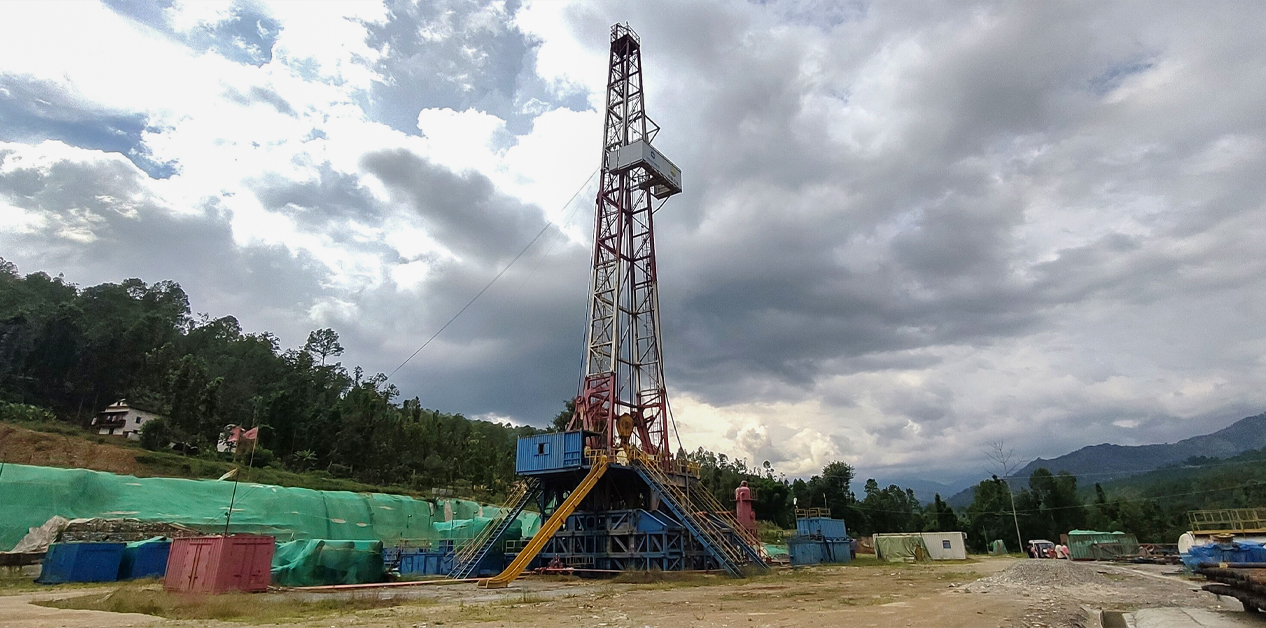
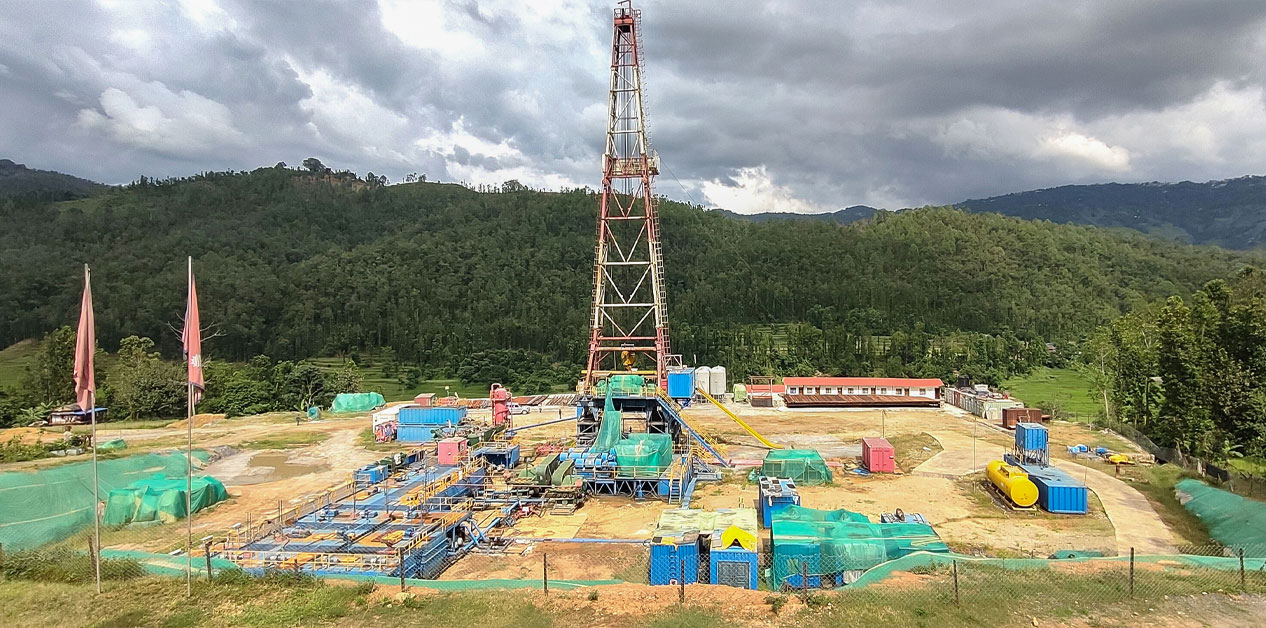
Area in Jaljale, Bhairavi Rural Municipality–1, Dailekh, where a petroleum exploration project is being carried out. Exploration conducted with the support of the Chinese government has confirmed the presence of a large reserve of natural gas in the area. Photo: Ratna Shrestha / RSS
A team of technical experts from the China Geological Survey began exploration work in various parts of Dailekh on 1 July 2019. Drilling was carried out by technicians from Xibu Drilling Engineering of China. The work was disrupted for some time due to the COVID-19 pandemic. The preliminary report released last Asar (mid-June to mid-July 2025), which provided a rough estimate of the methane gas reserve, had generated considerable enthusiasm.
With the final exploration report now completed, Khadka says the second phase of work can begin. “We will now assess how much of the gas reserve can be extracted technically, for which well testing will be conducted,” he says, “Only after that will studies related to commercial production be carried out.”
It is not technically possible to extract all the gas stored in a reservoir. Moving from test production to commercial production requires crossing several stages. “If the second phase of work is completed and everything proceeds as planned without any obstacles, commercial production could begin within five to eight years,” says Khadka. Officials have, however, said that test production itself can be carried out within three months. However, it is estimated that preparations for test production may take up to one year.
Nepal imported liquefied petroleum gas (LPG) worth Rs 27 billion during the first six months of the current fiscal year—from mid-July 2025 to mid-January 2026. In the previous fiscal year, gas imports amounted to Rs 57.15 billion. Petroleum products rank at the top among the goods Nepal imports.
The methane gas discovered in Dailekh is said to be suitable primarily for cooking, generating electricity, operating industries, and running automobiles.
It is the same methane gas that, in foreign countries, is supplied directly to household kitchens through pipelines.
For exploration purposes, drilling to a depth of 4,013 meters was carried out in the Jaljale area of Dailekh. Stratified samples collected from layers believed to have gas potential were sent to China for laboratory testing.
Of the four locations in Dailekh considered potential gas-bearing sites, drilling was conducted at only one. Following the first-phase report, the way has now been cleared to proceed with the second phase of work, says Khadka, chief of the Petroleum Exploration Project f the department.
Nepal has also requested China for financial and technical assistance for the second phase of exploration. The Chinese government has not yet given an official response on this matter. The estimated cost for the second phase is Rs 700 million.
So far, the expenses incurred for gas exploration have been borne by the Chinese government. However, the construction of access roads to the site and land acquisition were carried out by the Government of Nepal itself. In the Jaljale area, 45 ropanis of land were acquired for drilling.