Kathmandu
Sunday, July 19, 2026





UML faces the challenge of defending its strongholds in the province
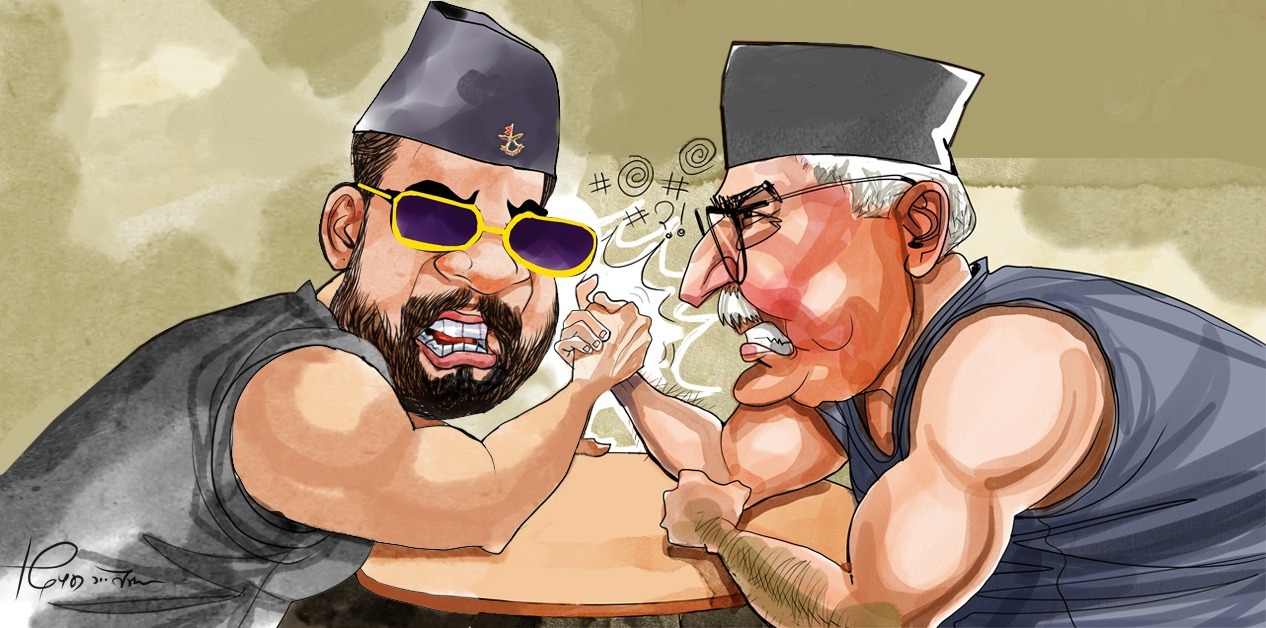
Since 1991, CPN (UML) Chairman KP Oli has contested seven elections from various electoral constituencies of Jhapa district, where Damak bazar is located. Except for one occasion, Oli has won continuously. Because of his strong party organization and political influence, elections in these constituencies rarely drew much attention in the past. He was seen as virtually unbeatable, winning with ease. As a result, his constituency seldom became newsworthy nationwide, carrying no more weight than just another electoral seat.
This time, however, Jhapa Constituency No. 5 has become a focal point of nationwide interest and discussion. It is at the very center of election-related news.
The electoral contest has become exciting—and challenging for Oli—after Balendra Shah (Balen), a youth icon and former mayor of Kathmandu Metropolitan City, arrived in the constituency to challenge former Prime Minister Oli in the upcoming House of Representatives election.
However, the challenge Oli faces in Jhapa-5 is not due solely to Balen’s candidacy as a senior leader of the Rastriya Swatantra Party (RSP). More broadly, the competition unfolding amid a changed political context has placed Oli in a serious electoral test.
First, Oli, who was Prime Minister during the Gen-Z revolt in which young protesters lost their lives, continues to carry the blame for those incidents. In contrast, Balen has cultivated an image aligned with the sentiments of the youth following the Gen-Z revolt and has received the backing of a large segment that was active during that protest.
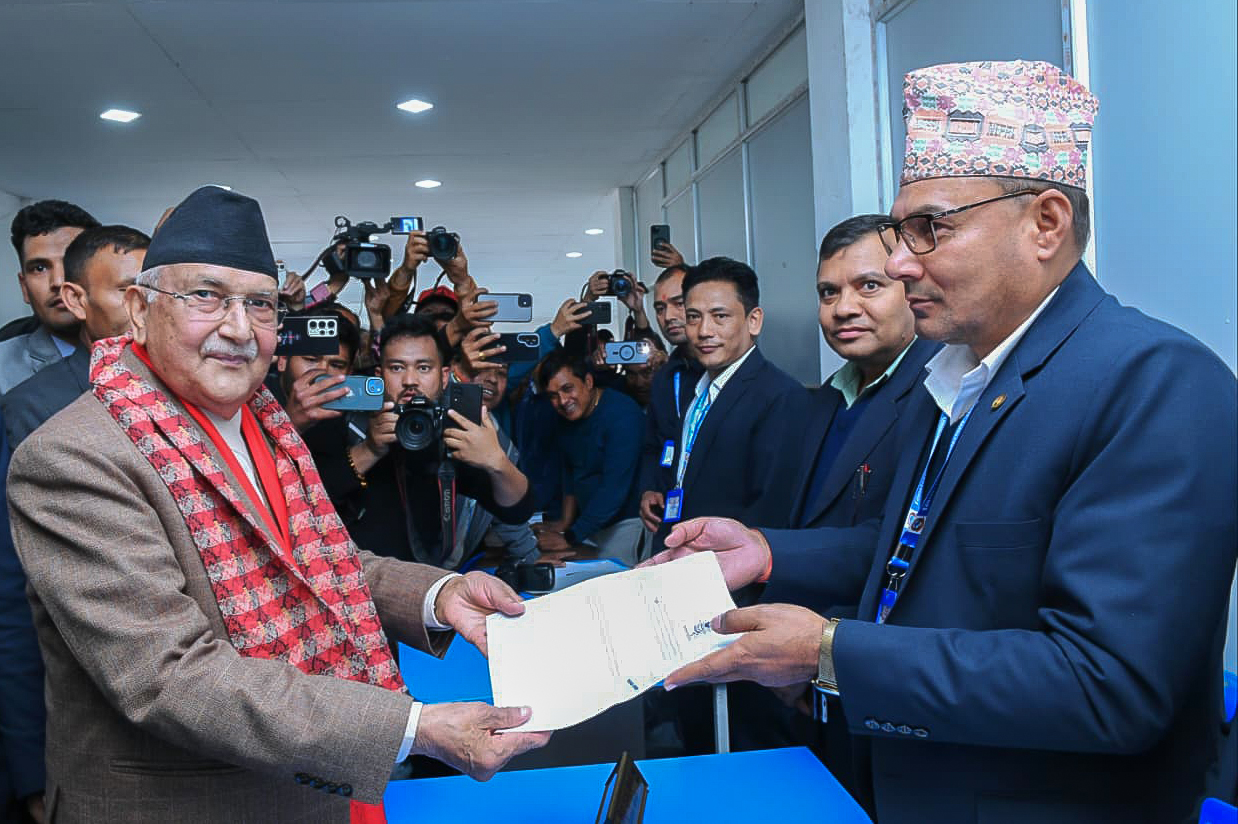
KP Sharma Oli registering his candidacy from Jhapa-5. Photo: Oli’s Secretariat.
Second, unlike previous elections where Oli benefited from electoral alliances and cooperation with other parties, he is contesting this time without any alliance in his constituency. As a result, votes may be divided among candidates from parties that previously did not field candidates in Jhapa-5. Additionally, the presence of alternative political forces and independent candidates, along with changing voter psychology and youth preferences, could significantly alter past vote calculations. At the same time, since the 11th General Convention of the UML, Oli’s once-unquestioned dominance within his own party has weakened, with dissenting factions openly emerging.
Despite repeatedly hoisting the victory flag in past elections, Oli’s own statements increasingly reveal that he now feels insecure in his traditional stronghold. Whereas in earlier elections he would campaign by setting agendas, this time he appears to be spending more time criticizing rival candidates and related issues rather than directly addressing voters with his own vision. Balen, for his part, has been holding Oli responsible—as head of government—for the incidents of 8 and 9 September 2025.
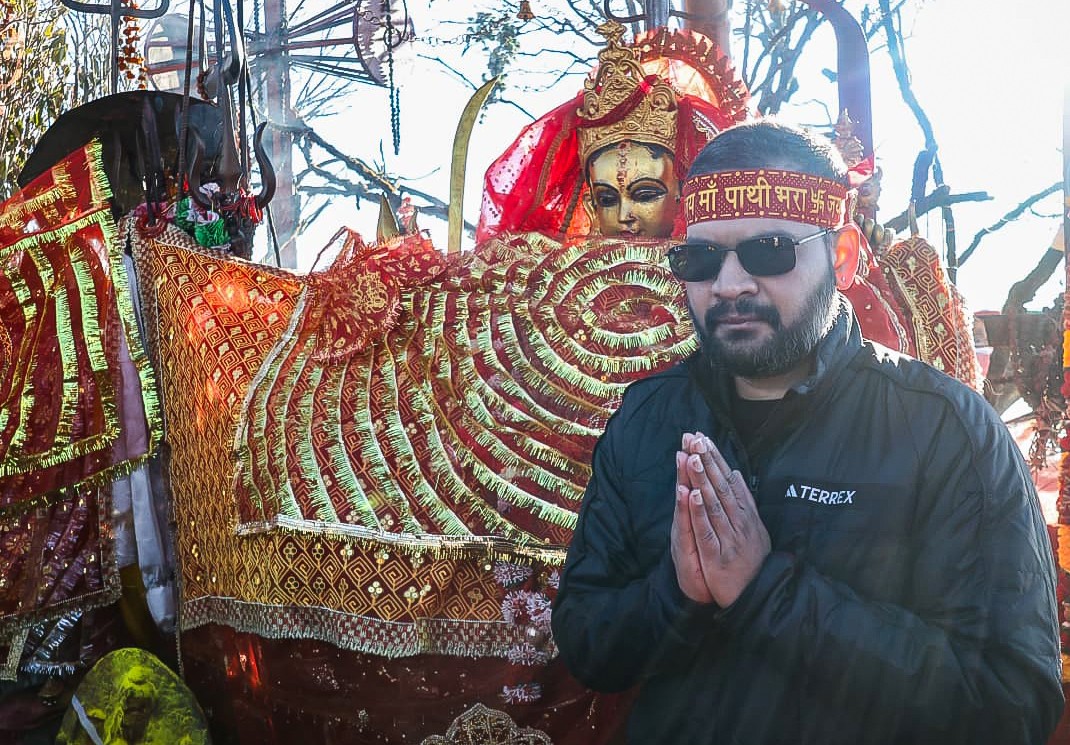
Senior leader of the Rastriya Swatantra Party (RSP), Balen Shah, visiting the sacred Pathibhara Temple in Taplejung.
Photo: Balen’s Secretariat.
Representing traditional political forces, Oli, and Balen—who rose to power locally as an independent candidate—have been at odds since their respective tenures as Prime Minister and Mayor of Kathmandu Metropolitan City. Balen often clashed with party-affiliated representatives and the federal government when they interfered in municipal affairs, while Oli reportedly found it intolerable that a local government head showed little deference to party leaders and the central government.
Their rivalry between the two previously surfaced informally through social media posts and speeches. Now, it has formally entered the electoral arena. Balen’s decision to resign as mayor and travel to Jhapa, Oli’s “home turf”, and tour across Koshi Province has sent ripples throughout the entire province. This could significantly influence public opinion in the region.
By challenging Oli in Jhapa itself, Balen appears intent on sending a strong message. This is because districts within Koshi Province, including Jhapa, have historically played a crucial role in establishing UML as a major national political force. Since 1991, except for the first Constituent Assembly election in 2008, the UML has consistently performed well in Koshi Province. In the elections of 2048 BS (1991), 2051 BS (1994), 2056 BS (1999), 2070 BS (2013), 2074 BS (2017), and 2079 BS (2022), UML secured the highest number of seats in districts under Koshi Province.
While campaigning across the country for the RSP, Balen has adopted a strategy that places him in direct opposition to Oli. In doing so, he is not only confronting Oli but also attempting to win the trust of various communities for votes.
On 4 February 2026, Balen visited Khuwalung, a sacred site of the Kirat community located in the Sapta Koshi River. During the visit, he described Khuwalung as a holy site of the Kirat people and a symbol of the civilization of all Nepalis. Khuwalung is the very rock that then-Prime Minister Oli had declared on 20 February 2021 should be broken for obstructing water transportation—an announcement that angered believers.
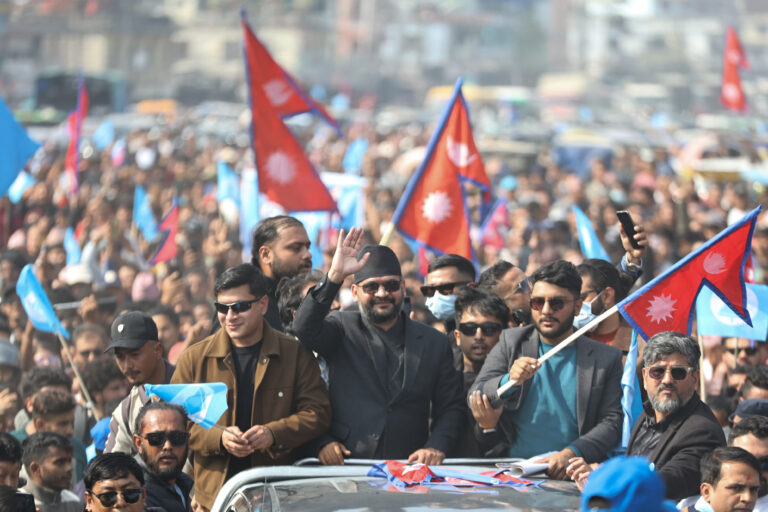
Senior leader of the Rastriya Swatantra Party, Balendra Shah (Balen), heading to file his nomination from Jhapa-5.
Photo: Nepal Photo Library.
On 23 January 2026, Balen visited the Mukkumlung or Pathibhara temple in Taplejung, a cultural heritage site of the Limbu community, and offered prayers. Critics commented that he was trying to increase votes by appealing to religious sentiments. However, his visit to Pathibhara during his eastern hill tour also appears to signal a strategic response to Oli and an effort to attract dissatisfied public opinion. This is because, during Oli’s tenure as Prime Minister, the government forcibly pushed for the construction of a cable car in the Pathibhara area despite strong local opposition and protests, even deploying security forces. The Limbu community protested, arguing that a cable car at Mukkumlung would destroy their sacred site and spiritual center, while environmentalists warned of ecological damage.
Due to these backgrounds and recent developments, Oli’s journey toward entering Parliament for the seventh time has become uncertain—not only in his own home constituency but across the entire Koshi Province. The shifting political landscape and the surge of alternative political forces could put UML in difficulty throughout the province. This has created a challenge for UML to defend its strongholds in a region where it has historically won the most constituencies.
Identity politics vs. traditional and new forces
According to political scientist Krishna Pokharel, districts within Koshi Province have played a vital role in establishing UML in national politics. Therefore, UML faces heavy pressure to secure strong electoral results in this region.
However, Pokharel believes that new political parties could become obstacles to UML’s attempt to replicate past successes in Koshi this time. Although identity-based groups have raised identity issues in the province, they have failed to translate those issues into electoral gains—an opportunity that Pokharel believes new parties may exploit. “Even though identity-based groups are dissatisfied in this region, they have not been able to develop agendas that include all communities. Therefore, this time, the main challenge for UML appears to come from new political parties,” he says.
The impact of new political parties in Koshi Province had already been visible to some extent in the 2022 AD election. Formed just four months before the polls, the Rastriya Swatantra Party (RSP) secured a notable share of votes from urban areas of the province in that election. In the high–voter-population districts of Jhapa, Morang, and Sunsari, RSP emerged as the third-largest party in the proportional representation category, behind UML and the Nepali Congress. UML received the highest votes in Jhapa and Sunsari, while the Nepali Congress topped Morang. In the first-past-the-post race, RSP candidate Goma Tamang lost Sunsari-1 by a margin of just 453 votes.
Political scientist Pokharel says that after Balen’s candidacy in Jhapa-5, its ripple effects are being felt in other parts of Koshi as well. “During Balen’s visits to eastern districts, there has been noticeable public interest,” he says.
Even though the House of Representatives elected in 2022 has been dissolved, UML remains the leading political force in Koshi Province. Based on the 2022 local and provincial assembly elections, UML is the largest party in the province. In the 93-member Provincial Assembly, UML holds 40 seats, and the provincial government is led by UML Central Secretary Hikmat Kumar Karki.
In this election, identity-based groups may also add to UML’s discomfort in Koshi. The reason lies in UML’s opposition to identity-based naming during the naming of Province No. 1. When various naming options were debated in the Provincial Assembly, UML stood firmly against names reflecting ethnic identity.
On 1 March 2023, the Provincial Assembly passed—by a two-thirds majority—a proposal to name the province “Koshi.” After the UML-led provincial government adopted “Koshi” in the name of shared identity, various indigenous groups protested. Although lawmakers from the ruling UML, then–CPN (Maoist Center), Rastriya Prajatantra Party (RPP), and the main opposition Nepali Congress all voted in favor of the name Koshi, the protests were directed mainly at UML because the chief minister was from the party.
Identity-rights activists staged demonstrations across different parts of the province against the naming and repeatedly disrupted UML programs.
To break that resistance, UML launched the “Jhula Ghat–Chiwa Bhanjyang Commitment Journey for Prosperity” campaign in November 2023. Although framed around prosperity, the primary objective of the campaign was to remove obstacles the party was facing in the eastern hills.
Among identity activists, there is a strong perception that UML—and especially Chairperson Oli—has been rigid and illiberal on identity issues. Both before the province was named and after the name was endorsed by the assembly, Oli remained at the forefront of actions that angered identity groups. Before the decision, he publicly argued that “Koshi” was an appropriate name; after it was passed, he ignored protests demanding its repeal and took a firm stance that the naming would not be reversed.
In the three years since 2022, Nepal’s political landscape has seen major upheavals. Following the Gen Z revolt of 8 and 9 September 2025, which ousted Oli from power and led to the dissolution of the House of Representatives, elections are now scheduled for March 5 this year. Even though UML held its general convention last December after the Gen-Z revolt, the party failed to address the causes of the movement or the demands raised. This came despite immense pressure on UML to transform itself, as the protests and the deaths of young demonstrators occurred while Oli himself was in power.
Ignoring the sentiments of the youth movement—which called for senior leaders to step aside and for leadership renewal—UML re-elected Oli as party chair for a third term at the general convention. Other office-bearers elected were also his close allies. Author Niroj Kattel says, “There is lingering anger among a section of people because the UML convention did nothing to address the demands raised by the Gen-Z rebellion.”
Similarly, the rise of new political forces and the politics of identity have emerged as key issues in this election. “In Koshi, those shifting toward RSP appear to come mostly from the Nepali Congress, while among indigenous communities aligning with Harka Sampang, many have roots in leftist politics,” Kattel says. Harka Raj Rai (Harka Sampang), who won the mayoral race in Dharan Sub-Metropolitan City—once considered a leftist stronghold—as an independent in the 2022 election, has resigned from office and formed the Shram Sanskriti Party. He is contesting from Sunsari-1, a constituency once won in 1991 by UML Chairperson Manmohan Adhikari.
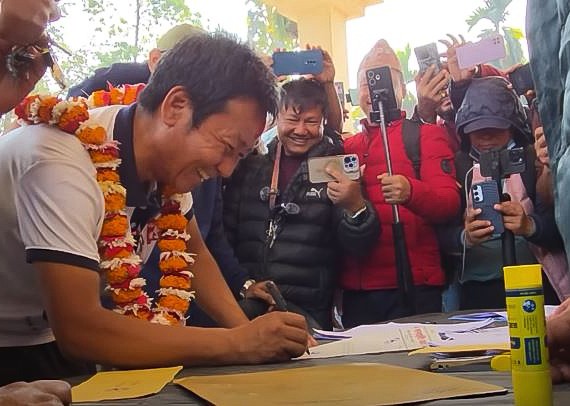
Chairman of the Shram Sanskriti Party, Harkaraj Rai (Sampang), filing his candidacy from Sunsari Constituency No. 1. Photo: Social media
For the election scheduled on March 5, Koshi Province has a total of 495 candidates—404 from 41 political parties and 91 independents. Morang and Sunsari have the highest number of candidates, with 110 each. In Morang’s six constituencies, there are 85 party candidates and 25 independents, while Sunsari’s four constituencies have 72 party candidates and 38 independents. Solukhumbu has the fewest candidates, with just 12.
In constituencies across Koshi Province, several party chairs are contesting alongside UML Chair KP Sharma Oli. These include RPP Chair Rajendra Lingden (Jhapa-3), Shram Sanskriti Party Chair Harka Raj Rai (Sunsari-1), Mongol National Organization Chair Buddhalal Meche (Ilam-1), and Nepal Shramdan Sanskriti Party Chair Krishna Kumar Rai (Sankhuwasabha).
After Bagmati and Madhesh, Koshi Province has the third-largest number of voters in the country, making it crucial for both direct and proportional representation elections. Of the country’s 165 House of Representatives constituencies, Koshi accounts for 17 percent of the seats and 19 percent of total voters.
With changed political conditions, the presence of alternative parties, and evolving voter psychology, there is keen interest in what kind of results will emerge this time in Koshi—long considered a UML stronghold. Analyst Keshav Dahal says, “There is a direct confrontation over UML’s stance on identity. Winning in Koshi is important for UML if it wants to establish that its position is correct.”
Of Koshi’s 28 constituencies, Morang has six, Jhapa five, and Sunsari four. Ilam and Udayapur have two each, while Taplejung, Panchthar, Dhankuta, Tehrathum, Bhojpur, Sankhuwasabha, Solukhumbu, Khotang, and Okhaldhunga each have one constituency.
The country’s lowest point, Kachankawal, and the world’s highest peak, Mount Everest, both lie within this province.
Accounting for the past
After the political change of 1990, UML made a strong start in parliamentary politics in the 1991 House of Representatives election. Winning 69 out of 205 constituencies nationwide, UML emerged as the main opposition party. The strong electoral performance of the communists became international news at the time. UML leader Madan Bhandari, who defeated interim Prime Minister and Nepali Congress President Krishna Prasad Bhattarai in Kathmandu, was interviewed immediately after the election by the American magazine Newsweek. The interview was published under the headline “In Nepal Karl Marx lives.”
When UML won 69 seats nationwide in the 1991 election, it secured 30 of the 39 constituencies that now fall within the districts of Koshi Province. The Nepali Congress, which achieved a single-party majority with 110 seats at the time, won only nine constituencies in Koshi Province districts. Of those, it captured six seats in the Tarai districts of Sunsari and Morang, and in the hills, two seats in Okhaldhunga and one in Solukhumbu. In the then-Mechi Zone, UML won all 12 constituencies.
In the midterm election of 1994, UML emerged as the largest party nationwide by winning 88 seats, including 23 in the Koshi region.
The Nepali Congress slightly improved its performance in Koshi compared to the previous election, winning 14 of the region’s 39 seats. The Rastriya Prajatantra Party (RPP) won two seats in this region.
In the 1999 elections, the Nepali Congress breached some of UML’s strongholds. The Nepali Congress became the largest party by winning 20 seats in Koshi. Due in part to the effects of party splits that affected several eastern districts, UML was reduced to 17 seats. The RPP and the Nepal Sadbhavana Party won one seat each.
Except for the first Constituent Assembly election, the eastern hill districts have largely remained UML strongholds. However, in the first Constituent Assembly election of 2008, the CPN (Maoist)—which had only recently abandoned armed rebellion and entered peaceful politics—generated a nationwide wave that broke UML’s dominance in Koshi. In that election, the Maoists emerged as the largest party nationwide by winning 120 of the 240 first-past-the-post seats, and they captured 22 of the 44 constituencies in the Koshi region. UML was reduced to eight seats and the Nepali Congress to seven, while the Madhesi Jana Adhikar Forum, which had emerged from the Madhesh movement, won seven seats in Morang and Sunsari.
In the 2008 election, the Maoists also became the largest party in the proportional representation category, surpassing 52 other parties. In the districts now within Koshi Province, out of a total of 1,943,619 valid proportional votes cast, the Maoists secured about 26.5 percent (514,719 votes). UML received 464,305 votes, while the Nepali Congress placed third with 451,027 votes.
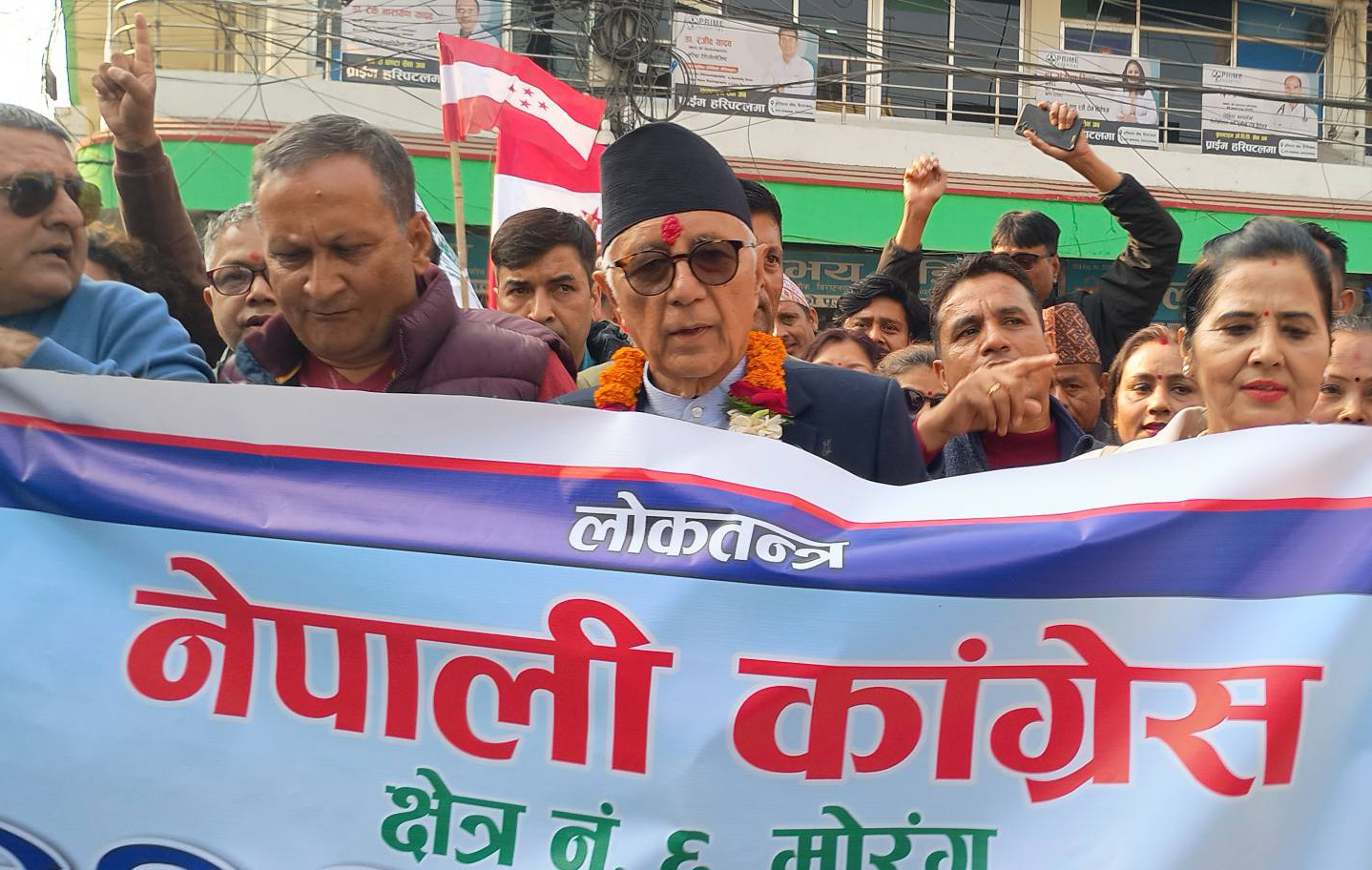
Shekhar Koirala filing his nomination from Morang-6. Photo: Social media
By the time of the second Constituent Assembly election in 2013, the political tide had turned. The UML and the Nepali Congress succeeded in regaining their earlier grip in Koshi. In the direct election category, UML won 23 seats and the Nepali Congress won 17 of the region’s 44 constituencies. Following disputes over ethnic identity after the dissolution of the first Constituent Assembly, many indigenous UML leaders—most of them established figures from the eastern hills—had left the party. The Maoists, who had won half of Koshi’s constituencies in the first Constituent Assembly election, were reduced to just one seat in 2013. The RPP, the Madhesi Jana Adhikar Forum, and the Madhesi Jana Adhikar Forum–Loktantrik each won one seat in the region.
After the promulgation of the new constitution, UML and the Maoists formed an alliance for the first election held in 2017. In the Koshi region, UML won 17 seats under the first-past-the-post system, while its alliance partner, the Maoists, secured five seats. The RPP, which had electoral cooperation with UML in Jhapa, also won one seat. In Jhapa Constituency No. 3, RPP Chair Rajendra Lingden defeated influential Nepali Congress leader Krishna Prasad Sitaula. The Nepali Congress was reduced to five seats.
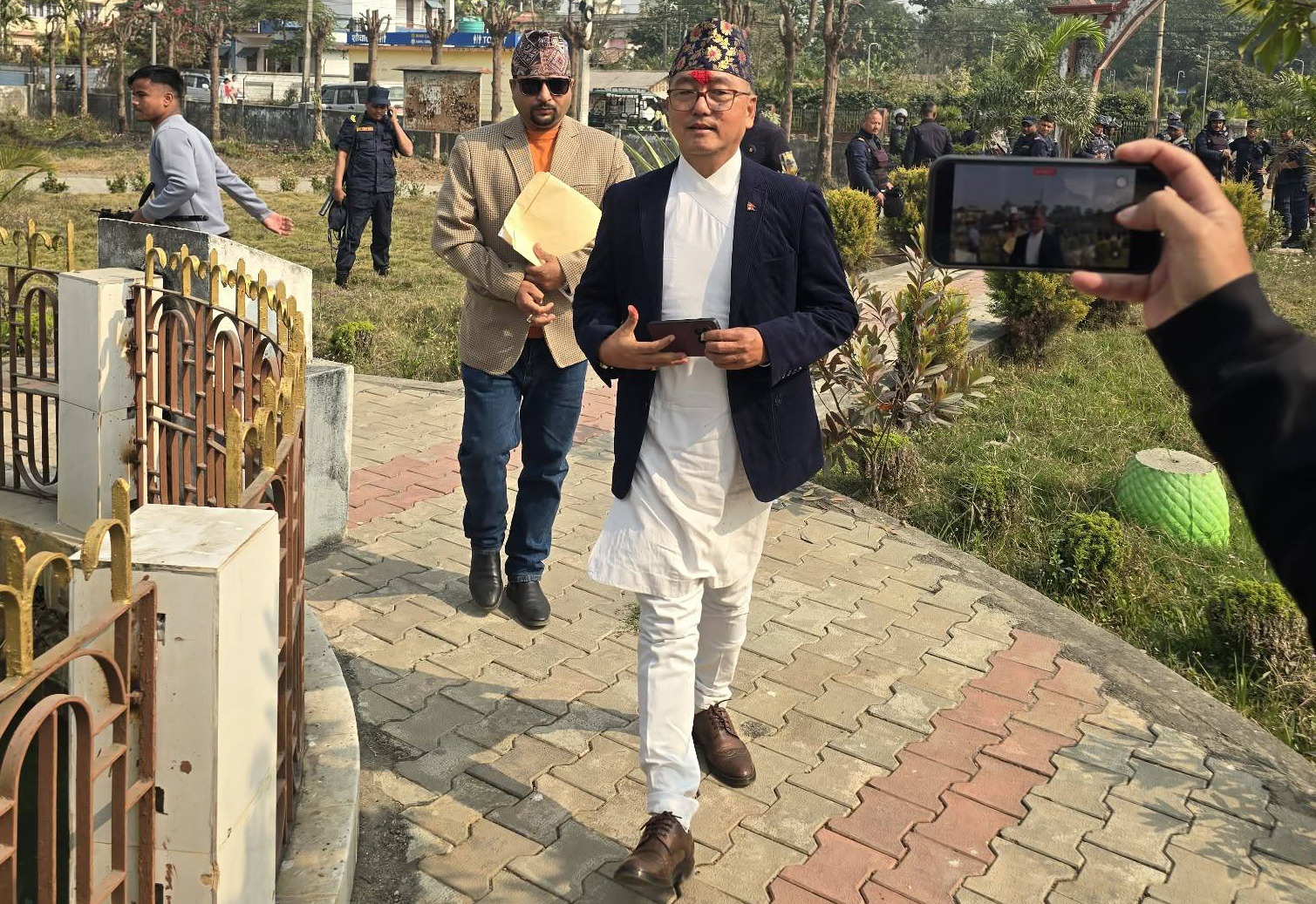
Chairman of the Rastriya Prajatantra Party, Rajendra Lingden, filing his nomination from Jhapa-3.
Photo: Rajendra Lingden’s Facebook
In the 2022 election, five parties—including the Nepali Congress, Maoist Center, and CPN (Unified Socialist)—formed an alliance. Even so, UML managed to retain its influence in Koshi Province in the House of Representatives election. UML won 13 of Koshi’s 28 constituencies directly and secured 44 seats nationwide. The Nepali Congress won nine seats in Koshi, the Maoist Center three, while RPP, an independent candidate, and the Janata Samajwadi Party won one seat each.
In the provincial assembly election held the same year, UML emerged as the largest party in Koshi, winning 40 seats in the 93-member Provincial Assembly.
Following the death of UML lawmaker Subas Nembang, a by-election was held in Ilam district on 27 April 2024. UML retained the seat. Although identity-based groups fielded Dakendra Singh Thegim as their candidate in this indigenous-majority area, the UML candidate—representing a party opposed to identity-based politics—won the election. Subas Nembang’s son, Suhang, was elected.
Koshi’s political significance
Although Koshi Province ranks third among provinces in terms of both the number of direct House of Representatives seats (28) and voter population, it has long remained the political center of both the Nepali Congress and UML. Since the restoration of democracy in 1990, most leaders of the Nepali Congress and UML who governed the country for long periods have hailed from districts within Koshi Province. The majority of UML leaders who rise to the top of the party also come from this province. Until Maoist leader Pushpa Kamal Dahal entered national politics through armed rebellion, political dominance rested with the Nepali Congress and UML—centered primarily in Jhapa and Morang.
Analyst Dahal argues that while Kathmandu may be the administrative capital, Koshi Province is Nepal’s political capital. “Koshi is the center of both Nepali Congress and communist politics,” he says, “The Koirala family dominated the Nepali Congress, and the Jhapa influence was strong in UML. The ideological and organizational emergence of UML itself originated in Koshi.”
The UML was born in the Koshi region. In 2028 BS (1971 AD), a small group of youths in Jhapa carried out violent activities under the slogan of eliminating class enemies—an episode known as the Jhapa Uprising. This group later became the Coordination Center of All Nepal Communist Revolutionaries. On 26 December 1977, the CPN (Marxist–Leninist) was formed. During the Panchayat era, UML operated underground politics and expanded its influence among students and youth, eventually developing into a national political force. Until the 1991 parliamentary election, UML’s influence was stronger in the eastern region than in other parts of the country.
Before the beginning of the 1990-decade, communist regimes collapsed one after another in Eastern Europe, weakening the global communist movement. Yet in stark contrast, Nepal witnessed the rise of a communist party through parliamentary elections.
Continuing this historical trajectory, the question in the upcoming election is whether UML will once again defend its stronghold in Koshi and let the “sunshine through,” or whether changed political circumstances will produce a different outcome. That answer will ultimately be determined by the influence of competing parties and the judgment of the voters.