Kathmandu
Monday, July 13, 2026





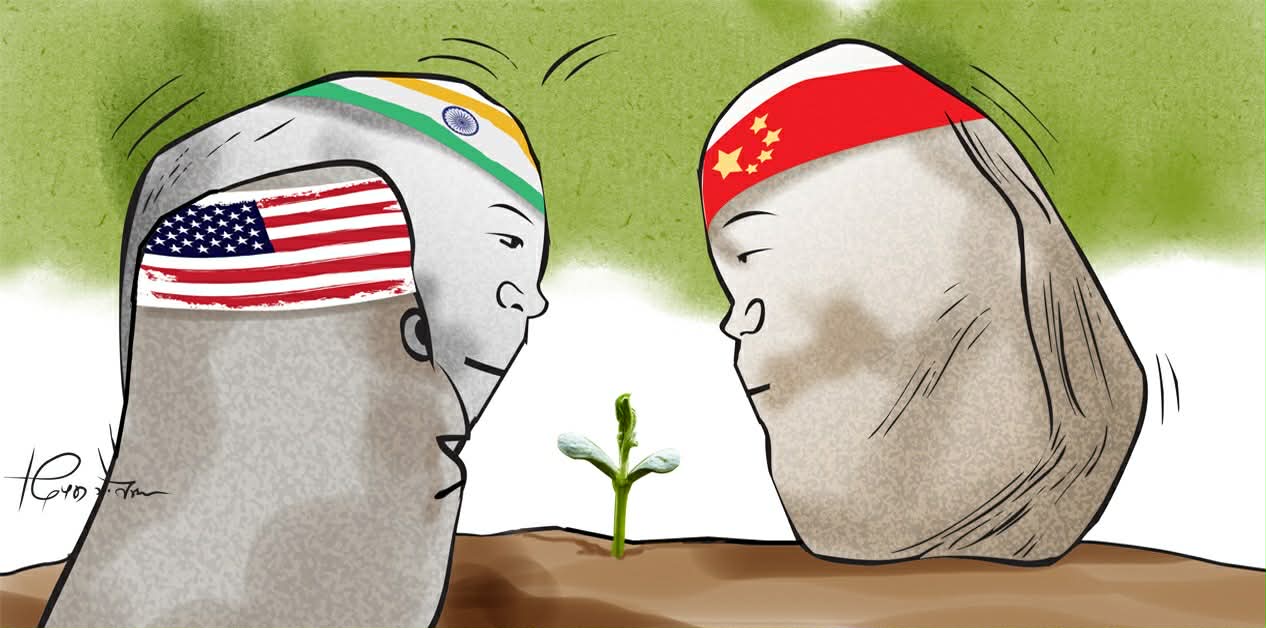
KATHMANDU: If one is to believe veteran Nepali leftist leader Chitra Bahadur KC, a clean figure in Nepali politics, then the answer to this question is an explicit ‘Yes’. In a recent interview given to Jana Aastha, a popular weekly tabloid in Nepal, KC, well-known for speaking his mind and making bold statements in no uncertain terms, says, “Prithvi Narayan Shah said ‘Nepal is a yam between two boulders’. However, Nepal is no longer a yam between just two boulders. The USA joined India and China and Nepal has become a yam between three boulders.”
Great King Prithvi’s memorable description of Nepal as a “a yam between two boulders”, meaning a fragile wedge between two giant neighbors, India and China, held true for over two centuries and the image created by the king’s ‘divine counsel’ guided the Nepali strategy which was to never allow itself to be crushed by either boulder- always seeking balance; always maximizing autonomy.
But nearly two and a half centuries later, this old metaphor is being challenged – not just by India and China, but by another distant but increasingly impactful player: the United States of America.
The story of US–Nepal relations began soon after Nepal’s unbroken sovereignty emerged in the 20th century. The US has had a long and continuous presence in Nepal, ever since the two countries established diplomatic relations on 25 April 1947. That made the US the second country after the UK with which Kathmandu formalized ties.
The US Embassy in Kathmandu was opened in August 1959 – nearly a year before China’s embassy was established, signifying an early American diplomatic investment in Nepal’s development and political trajectory.
Over the decades, however, the US’s engagement in Nepal has taken multiple shapes.
Development assistance
Things started with development assistance. Since as early as the 1950s, American aid has supported infrastructure, health, education, governance, and economic reform in Nepal. This includes malaria eradication programs that helped transform the Terai region, making it safer for settlement and agriculture. The US also played a significant role in critical post-earthquake reconstruction after the devastating 2015 quake. The US military and humanitarian personnel carried out reconstruction work and provided relief and logistics under initiatives such as ‘Operation Sahayogi Haat’.
Most recently came the Millennium Challenge Corporation (MCC), the most talked-about US development assistance. Unlike routine aid, the MCC represents direct American developmental strategy, which, according to critics, also carries a geopolitical dimension. The ‘USD 500 million MCC compact’, signed in 2017 and ratified only in 2022 after fierce debate in Nepal, is divided between road infrastructure, electricity transmission, and economy-enabling projects. Although political conflict delayed implementation, the MCC, for many, remains a major symbol of deep US engagement.
The US also played a significant role in critical post-earthquake reconstruction after the devastating 2015 quake. The US military and humanitarian personnel carried out reconstruction work and provided relief and logistics under initiatives such as ‘Operation Sahayogi Haat’.
However, critics and some scholars alike, note that the MCC does more than build power lines: it positions Nepal within US strategic interests in South Asia by diversifying Nepal’s foreign partnerships and reducing reliance on India and China, reflecting deliberate geopolitical calculus that is foreign to the old “yam between two boulders” script.
The United States has channeled hundreds of millions of dollars through USAID and US-supported democracy and governance programs, including substantial investment in governance, media, civic, and electoral strengthening.
This kind of investment, particularly in civil society and governance ecosystems, is usually only pursued where a foreign power senses geopolitical importance.
A Himalayan pivot: US influence beyond aid
For Nepalis, American involvement has long felt cultural and developmental. Students travel to US universities in large numbers, Nepali diaspora communities, numbering in the hundreds of thousands, cultivate cross-border people-to-people ties, and US Peace Corps volunteers have long worked in Nepal’s education and food security sectors, according to Nepal’s Ministry of Foreign Affairs.
Yet in the past decade, particularly after Nepal’s 2015 earthquake and amid intensifying India-China competition in South Asia, the US presence expanded beyond ‘soft diplomacy’ into more overt forms of “policy influence and strategic visibility”.
This shift is visible on three broad fronts. One is civil society and political space. The US approach to governance which involves funding NGOs, democracy advocacy groups, and civic engagement programs has lately become controversial among Nepali observers. While proponents claim it enhances accountability and transparency, critics argue it inadvertently (or intentionally) skews internal political debates, empowering actors that align with Western democratic norms over traditional structures. This dynamic is part of why debates around the MCC became deeply political within Nepal, with opposing parties framing MCC supporters as “overly influenced by foreign powers.”
The second front is geopolitical signaling in South Asia. Globally, US strategic analysts see South Asia as a critical arena in geopolitical competition, particularly between the US-led Western bloc and China’s Belt and Road Initiative. Nepal’s geographic position – sandwiched between China and India – gives it potential leverage. American policy frameworks often frame Nepal not just as a remote mountain nation but as a “strategic pivot point” in broader Indo-Pacific security paradigms.
For example, in analysis by international think tanks and foreign policy journals, Nepal’s internal political events and power alignments are increasingly discussed within the context of “major power rivalry involving the US, China, and India”. A research report titled ‘Major Power Rivalry and Domestic Politics in South Asia’ by Paul Staniland, published on the Carnegie Endowment for International Peace website on July 14, 2025, says there has been a shift from viewing Nepal solely as India–China diplomatic balancing.
The third front is the perceptions of political influence. Perhaps the most contentious sign of American influence is the argument, which is hotly debated and far from conclusively proven, that the US had a role, direct or indirect, in shaping or fueling recent street movements in Nepal.
During last year’s dramatic Gen Z protests on September 8 and 9, characterized by mass youth mobilization and an ultimately forced resignation of Prime Minister KP Sharma Oli, accusations of involvement by America were high in Nepali and regional discourse.
While such claims remain contested and are not confirmed by mainstream diplomatic sources, their very existence signals a perception among significant segments of Nepalis that US influence is no longer confined to benign development but extends into political shaping.
As if to further reinforce this narrative, during Gen Z protests The Morning News reported that Nepali diaspora groups in the United States organized solidarity vigils, drawing global attention, showing how transnational social networks connected to the US can shape narratives about Nepal’s domestic politics.
Nepal on the path to become another Ukraine?
The visibly more active and assertive role being played by America in Nepal, particularly during recent times, is now beginning to unsettle the balance between India and China, which Nepal has skillfully developed and nurtured all along. No longer is it a simple balancing act between India and China. It is fast transforming into more a triangular challenge as a new third force, however unwittingly, is beginning to emerge, and it is the US. America has emerged as a key player not through geography but through influence alone.
During last year’s dramatic Gen Z protests on September 8 and 9, characterized by mass youth mobilization and an ultimately forced resignation of Prime Minister KP Sharma Oli, accusations of involvement by America were high in Nepali and regional discourse.
The increased foothold of America has the potential to change the power geometry in the region in reference to Nepal. This change, by all odds, would not be taken in stride by either India or China, as both have invested decades in making their respective footholds in the region.
New Delhi, which regards Nepal as an integral part of its perimeter of security and its civilizational space, will be loathe to give way to external forces with global ambitions. Similarly, China, whose perception of Nepal is strategic, given its significance for Tibet, and its ambitious infrastructure projects, including the Belt and Road Initiative, will not cede ground to the USA. An assertive US presence therefore does not simply add another partner for Nepal; it potentially intensifies competition among all three powers.
The danger lies not in engagement itself, but in unmanaged rivalry. If Nepal becomes a site where competing strategic interests collide, the risk grows that the “yam” may be crushed, not necessarily by one “boulder”, but by the pressure of all three.
After all, for a growing section of Nepali society, the fear that Nepal could become “another Ukraine” does not arise from alarmism alone; it is rooted in a reading of recent history and Nepal’s own evolving geopolitical environment. Ukraine, in popular discourse, is no longer seen merely as a European tragedy; it is increasingly seen as a cautionary tale of what happens when a strategically located country becomes the arena for competing great-power interests.
In Nepal’s case, the analogy resonates because, as outlined earlier, the country is no longer engaged in a simple India–China balance.
The visible deepening of US engagement has introduced a third vector of influence into an already sensitive regional equation. This sounds similar to the initial stages of Ukraine’s conundrum, with increasing Western engagement as a positive cooperation and reform push, running up against long-held security and geopolitical interests of the neighboring powers that refuse to let go of their sphere of influence.
This is fostered by the way in which political developments in the country are seen in relation to foreign factors too. Just like the way the internal affairs of Ukraine, such as the protests, political alignments, and governance, were connected to matters like the geopolitical crisis, large sections of Nepali citizens have come to perceive the protests, the political and social movements in the country as being aided by foreign factors. They view the reforms in the way the government is run with mistrust, suspecting that they are being controlled by foreign forces.
Whether these assumptions or viewpoints are empirically verifiable is almost secondary. What matters is the assumption that domestic politics in Nepal has become permeable to global geopolitics. The implication is that, in a country with limited economic and military capacity to absorb sustained external pressure, increased competition among the US, India, and China might eventually whittle down strategic autonomy and harden external alignments, turning Nepal from a balancing actor into a contested space. That was precisely the condition that turned Ukraine from a sovereign state pursuing multiple partnerships into a front line of great-power confrontation.
The myth, the reality, and the debate
So, has the USA really become Nepal’s “third boulder”? The answer depends on perspective, mainly empirical, geopolitical, and perceptual.
Let’s try to find an answer to the above question empirically. On tangible metrics such as aid volume, infrastructure investment, educational and cultural exchange, governance programming, and strategic dialogues, American engagement in Nepal has unquestionably grown. Historically, the US was a distant friend; now it is one of Nepal’s “most significant development partners” with deep diplomatic, economic, and civil society links.
The US presence in Nepal now has clear geopolitical meaning and message. Against the Indo-China shadow, the US presence means Nepal no longer exists in a purely bilateral India–China framework. American policymakers clearly regard Nepal as a relevant node in South Asia and the Indo-Pacific strategy. The MCC, USAID governance programs, and political interest from Washington (including Congressional engagement via Nepal Caucuses) all point to the US having real strategic stake in Nepal’s direction.
During the Gen Z protests, for example, theories about US involvement circulated widely, building on leaked claims about US-linked training funds for youth activists. Several ministers in the interim government formed after the violent protests face the charge of having some form of American connection. Even where direct evidence is lacking, the perception of American leverage – whether in politics, media, or youth movements – shapes the way many Nepalis interpret their own political upheavals.
According to Nepal Journals Online, all this is mirrored in some academic critique arguing that Nepal–US relations suffer from “ambivalence”, rooted in asymmetries of power, differing conceptions of equality in partnerships, and concerns that Nepal’s sovereign priorities may be overshadowed by foreign interests.
The implication is that, in a country with limited economic and military capacity to absorb sustained external pressure, increased competition among the US, India, and China might eventually whittle down strategic autonomy and harden external alignments, turning Nepal from a balancing actor into a contested space.
Yet the analogy of the “third boulder” also carries a warning. Just as past Nepali leaders feared being crushed between India and China, Nepal today risks being pressured by competing external influences, now with the United States joining the regional game.
This shift challenges King Prithvi Narayan Shah’s old counsel. Nepal is no longer just a yam between two boulders but ‘a mountain nation navigating a landscape of multiple global power vectors’.
In the end, whether the US is a protector, partner, influence, or pressure will largely depend on how Nepali leaders and society manage this relationship in the years ahead; not as passive recipients, but as active architects of Nepal’s sovereign destiny.
Meanwhile, it is not without reason that sayings like ‘Don’t leave the door open to thieves’ exist even today. By now our bureaucrats, policymakers and politicians – both old and new ones alike – are supposed to understand the intentions of all countries that matter to us, including the US, India and China. Their intentions are not always evil. But experience has shown that their intentions are not always pure and pious, either. So, we must learn when to keep our doors shut!
As Benjamin Franklin, one of America’s founding fathers and creators of its Declaration of Independence, once famously said, “An ounce of prevention is worth a pound of cure.”