Kathmandu
Tuesday, July 14, 2026





Erosion of public support leaves Madhesh-based parties insecure in their own geography
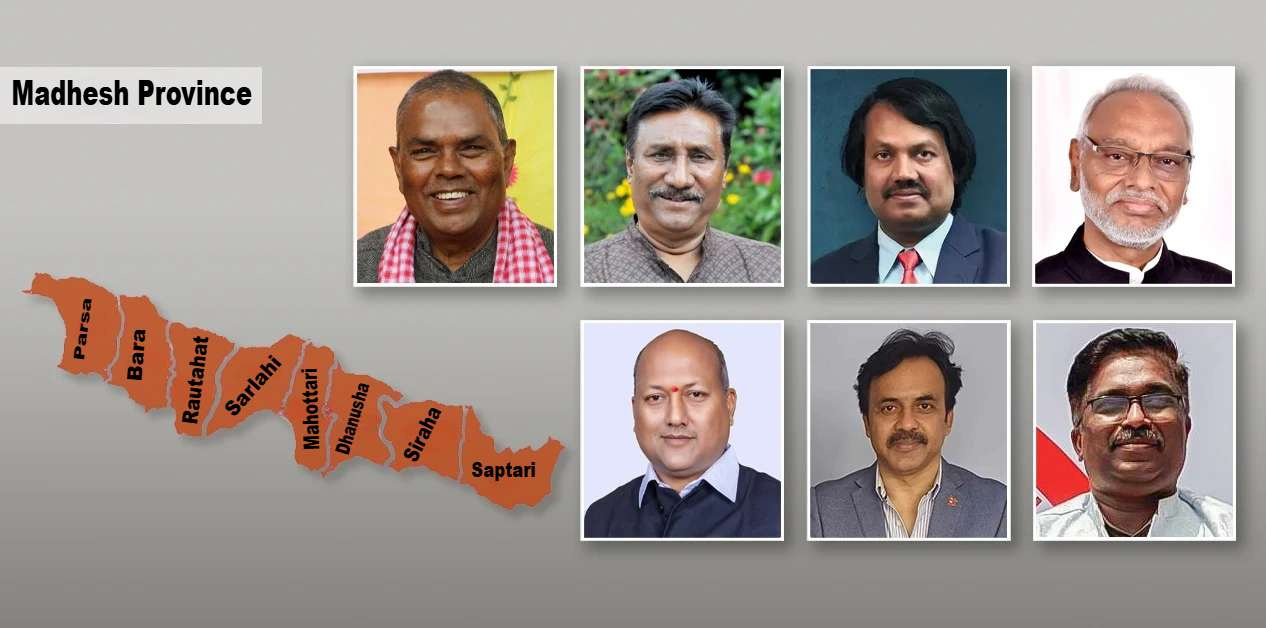
With political parties and independent candidates intensifying their campaigns for the House of Representatives election, the electoral temperature in Madhesh Province has risen. In the election being held amid changed circumstances after the Gen-Z revolt, new parties are challenging traditional forces, and young candidates are competing head-to-head with veteran leaders. Unlike the past, when even major parties contested elections through alliances, this time most are in the field independently. All these factors have made the electoral contest in Madhesh particularly interesting.
New parties and independent candidates have put forward the slogan of breaking the “syndicate” of old parties. The traditional parties, on the other hand, are seeking votes in the name of protecting the political system, the constitution, and the republic.
Madhesh Province has eight districts, each divided into four constituencies, making a total of 32 constituencies. Across the province, there are 1,027 candidates contesting the direct election system, of whom 554 are independent candidates. The total number of eligible voters in the province is 3,636,414.
In the province, stiff competition is expected mainly among the Nepali Congress, CPN (UML), Nepali Communist Party (NCP), Janata Samajwadi Party (JSP) Nepal, and the Rastriya Swatantra Party (RSP). Traditional parties like the Nepali Congress and UML want to regain the ground they have lost in Madhesh, while new forces such as RSP and Ujyalo Nepal Party face the challenge of establishing themselves in the province.
Caught between these old and new parties are the Madhesh-centric parties. Due to continuous splits and fragmentation, these parties—already shrinking within Madhesh—are struggling to protect their base areas. Parties that once claimed to be the real and transformative force of Madhesh politics have been pushed into a defensive position by the changed political situation after the Gen-Z rebellion. On the one hand, their election activities do not appear strong; on the other, they lack clear agendas.
Already weakened by internal splits and power-centric politics, Madhesh-centric parties have seen their support base steadily erode. Multiple factors have now left them insecure in the election. The new political landscape, the impact of leadership change in the Nepali Congress through a special general convention, and the enthusiasm among Madheshi youth after RSP nominated Balen Shah as its prime ministerial candidate have pushed these parties to the margins.
According to Madhesh affairs expert Bharat Bimal Yadav, who was involved for a long time in Madhesh-centric parties, the public distrust toward their leadership has turned into outright frustration after the Gen-Z movement. “The way Madhesh-centric parties pursued power-focused politics in the past damaged their image among Madheshi people,” he says, adding, “The distrust toward their leadership increased further after the Gen-Z movement, and now the Balen factor has pushed them into a defensive position.”
He adds that Madheshi people now view leaders of Madhesh-centric parties and Kathmandu-centric major parties in the same light.
The added pressure of a new wave
Madhesh-centric parties traditionally raised issues such as poverty, illiteracy, underdevelopment in Madhesh, and neglect by the Kathmandu-based state. However, due to hung parliaments, these smaller parties frequently became decisive players in forming and toppling governments, and they fully exploited this advantage. Even if it meant splitting parties or changing alliances, they repeatedly entered government. But when they failed to deliver on Madhesh issues, they became infamous locally for trading Madheshi rights and interests for power.
Already facing distrust in their own geography, they now find themselves fighting for survival due to newly developed circumstances. After RSP put forward former Kathmandu Metropolitan City mayor Balen Shah as its prime ministerial candidate, a wave of excitement spread among Madheshi youth. At an assembly organized by RSP in Janakpurdham, the provincial capital, on 19 January 2026 (the day before candidate registration), all attention was focused on Balen.
Although Balen’s ancestral home is in Mahottari and he is a candidate from Jhapa Constituency No. 5, he has been branded as a “son of Madhesh.” His popularity in Madhesh is such that the slogan “This time, Balen government” has spread widely in villages and towns. This has strengthened the pro-RSP wave in Madhesh through Balen.
When people were frustrated with old parties and familiar faces, Balen rose to prominence after winning the 2022 local elections as an independent candidate. His victory as a young independent leader in the federal capital energized many by demonstrating the political potential of the younger generation. Media personality Rabi Lamichhane went on to form a party under the banner of “swatantra” (independent),” which entered the 2022 House of Representatives election after just a few months of preparation. RSP won 21 seats – both direct and proportional – shaking national politics.
Although Balen’s ancestral home is in Mahottari and he is a candidate from Jhapa Constituency No. 5, he has been branded as a “son of Madhesh.”
That earlier RSP wave, combined with Balen’s entry into party politics, has once again stirred Madhesh. This has unsettled not only traditional parties but also Madhesh-centric ones. Instead of presenting their agendas to voters, leaders of these parties are increasingly attacking Balen in their campaign speeches, showing how the “Balen factor” has become a challenge to their electoral politics.
Meanwhile, in the Nepali Congress, where demands for party restructuring and leadership change intensified after the Gen-Z movement, a special general convention brought new office-bearers under the leadership of Gagan Kumar Thapa. This change may help revive the Nepali Congress’ declining support in Madhesh. Gagan himself has left Kathmandu-4, which he had been winning in past elections, to contest from Sarlahi-4 in Madhesh Province.
The popularity of Gagan and Bishwa Prakash Sharma among youth, and their role in leadership change within the Nepali Congress, has attracted some Madheshi youth toward the party. RSP’s campaign materials often feature photos of Balen and Rabi alongside local candidates, while Nepali Congress campaign materials prominently display images of Gagan and Bishwa Prakash. With these two parties positioning themselves as agents of change, Madhesh-centric parties are under pressure in their own strongholds. They appear more suspicious of Balen than of Gagan.
JSP Nepal General Secretary Ram Kumar Sharma says there is concern that RSP – having previously shown insufficient commitment to federalism – might use Madheshi votes only to later oppose federalism and Madhesh.
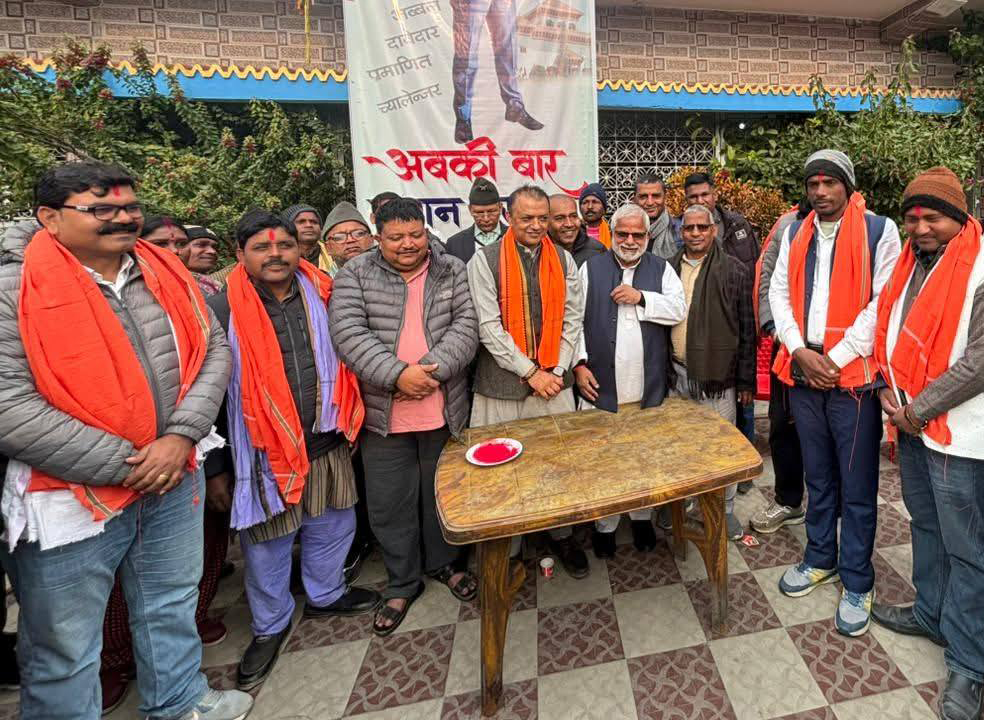
Nepali Congress President Gagan Kumar Thapa with party supporters and cadres in Sarlahi-4
Former vice-chairperson of the Madhesh Province Policy and Planning Commission, Sohan Sah, comments that Madhesh-centric parties present themselves differently when in power versus in opposition, and that the lack of leadership development has prevented them from even preserving their existing support. “These parties failed to develop leadership capable of winning Madhesh’s hope and trust,” he says, adding, “As a result, despair has spread among Madheshi youth.”
Gagan himself has left Kathmandu-4, which he had been winning in past elections, to contest from Sarlahi-4 in Madhesh Province.
Several examples show how fearful Madhesh-centric party leaders are of entering the electoral battlefield. Even Mahantha Thakur, who is considered an idealistic leader, a longtime politician, and a multiple-time MP and minister, could not feel confident about facing Madheshi voters this time. On the eve of the election, he merged his Loktantrik Samajwadi Party into JSP. Even after party unification, Mahantha did not dare to contest a direct election. Instead, he chose a safer route to power. In the National Assembly election held on January 25, he became a candidate from an alliance of JSP, Nepali Congress, UML, and Janamat Party—and was elected as a lawmaker.
The last two elections and the current one
In the 2017 House of Representatives election, the Federal Socialist Forum Nepal and the Rastriya Janata Party (RJP) won 19 out of the 32 constituencies in Madhesh through the first-past-the-post system. Of the two parties contesting in alliance, RJP won 10 seats and the Forum won nine. After the promulgation of the new constitution in 2015, dissatisfaction that had grown in Madhesh was directed against Kathmandu-centric major parties in the 2017 election, allowing Madhesh-centric parties to reap the benefits.
In the remaining 13 constituencies of Madhesh, the Nepali Congress won six seats, the Maoist Center won five, and the UML won two. In that election, the UML and the Maoist Center had formed an alliance.
However, in the 2022 election, the UML and the Nepali Congress improved their positions in Madhesh, pushing Madhesh-centric parties behind. Out of the 32 constituencies, the UML won nine seats and the Nepali Congress won seven. Likewise, JSP (formerly the Federal Socialist Forum) won six seats, the Loktantrik Samajwadi Party (LSP) won three, independent candidates won three, CPN (Unified Socialist) won two, and the Maoist Center and the Janamat Party won one seat each. In that election, a five-party alliance, including the Nepali Congress, Maoist Center, Unified Socialist, and Rastriya Janamorcha, contested nationwide, while in Madhesh Province the UML formed alliances with JSP and LSP.
Of the 32 candidates who won in the 2022 election, 28 are contesting again in the upcoming election. Some of them had won previously from one party and are now contesting after switching parties. Some have changed their constituencies altogether.
Among those not contesting this time, some have given tickets to their relatives in their constituencies. In Saptari-1, where Nawal Kishor Sah Sudi won in 2022 from JSP Nepal, his son Sumit Kumar is contesting this time from the Swabhiman Party. Similarly, Upendra Yadav, who had lost to Janamat Party chair CK Raut by more than double the votes in Saptari-2 in 2022, is contesting this time from Saptari-3. In the 2023 House of Representatives by-election, Upendra was elected from Bara-2 as the joint candidate of a five-party alliance. That seat had fallen vacant after Ram Sahaya Prasad Yadav of JSP Nepal became Vice President.
Among those not contesting this time, some have given tickets to their relatives in their constituencies.
Likewise, Raj Kishor Yadav of JSP Nepal, who was elected from Siraha-2, has changed constituencies this time and is contesting from Siraha-4. In Siraha-4, UML’s Dharmanath Prasad Sah, Nepali Congress’ Chandrakala Kumari Yadav, CPN’s Ajay Shankar Nayak, and RSP’s Tapeshwar Yadav are also candidates. Dharmanath had left the CPN and joined the UML just one day before filing his nomination. Birendra Mahato, who was elected from JSP in the 2022 election, has switched parties this time and is contesting as a Janamat Party candidate.
In Mahottari-3, where Mahantha Thakur won in the 2022 election, his daughter Minakshi Thakur is contesting this time from JSP. Similarly, Ram Krishna Yadav, who was elected from Dhanusha-2 on a Nepali Congress ticket in 2022, did not receive a ticket this time; instead, Dinesh Parsaila has been nominated. Amresh Kumar Singh, who was elected as an independent candidate from Sarlahi-4, has joined RSP this time and is contesting from the same party.
Kiran Kumar Sah, who won as an independent from Rautahat-2 in the previous election, is contesting this time from the NCP. Prabhu Sah, who had won as an independent from Rautahat-3 in the last election, has formed his own party – Aam Janata Party – and entered the race under its banner. Likewise, Pradeep Yadav, who had earlier won from Parsa-1 as a JSP candidate, has switched parties and is contesting this time from the UML.
Constituencies with interesting contests
In the election scheduled for March 5, intense and interesting contests are expected in several constituencies of Madhesh Province.
In Sarlahi-4, Amresh Kumar Singh, who was elected in the past two elections, is being challenged by Nepali Congress President Gagan Thapa. As the Nepali Congress’ prime ministerial candidate, Gagan’s victory or defeat will be a matter of prestige for a party that claims to have regained strength, and it will also test public confidence in his leadership. Meanwhile, Amresh is optimistic about his chances, citing Balen Shah’s entry into RSP and the wave seen in Madhesh.
In Saptari-2, Janamat Party chair CK Raut, who won the previous election, is surrounded by challenges from his former colleagues. Satish Kumar Singh, who was elected to the provincial assembly from Janamat Party in 2022 and even became Chief Minister of Madhesh Province, has resigned from the provincial assembly and is contesting in this constituency from the Swabhiman Party. Similarly, Sharad Singh Yadav, who left Janamat Party to form the Jan Adhikar Party, is also a candidate in Saptari-2.
In Mahottari-2, Sharat Singh Bhandari, who has won repeatedly from this constituency, is once again contesting from JSP Nepal. His main competitor there will be Nepali Congress candidate Kiran Kumari Yadav, who is the niece of Nepal’s first President Ram Baran Yadav and the co-in-law of former President Bidya Devi Bhandari.
Julie Kumari Mahato, who won from the UML in Dhanusha-3 in the 2022 election, and Raghubir Mahaseth, who was elected from Dhanusha-4, are both contesting again from the same constituencies.
Likewise, in Sarlahi-2, two traditional rivals are once again facing each other. Mahendra Raya Yadav is contesting from the Nepali Communist Party, while Rajendra Mahato is a candidate from the Rastriya Mukti Party. In the 2022 House of Representatives election, Yadav defeated Mahato in the same constituency. In the 2017 election, however, Mahato had left his Sarlahi-4 constituency to contest from Dhanusha-3 and was elected. Along with Yadav and Mahato, Sarlahi-2 has 31 candidates, including UML’s Nageshwar Sah, Nepali Congress’ Saroj Kumar, RSP’s Rabin Mahato, and JSP’s Bharat Chaudhary.
Julie Kumari Mahato, who won from the UML in Dhanusha-3 in the 2022 election, and Raghubir Mahaseth, who was elected from Dhanusha-4, are both contesting again from the same constituencies. Julie is being challenged by Nepali Congress’ Bimalendra Nidhi and RSP’s Manish Jha. Similarly, Mahaseth faces competition from Nepali Congress’ Mahendra Yadav, NCP’s Sanjay Kumar Mahato, and RSP’s Rajkishor Mahato.
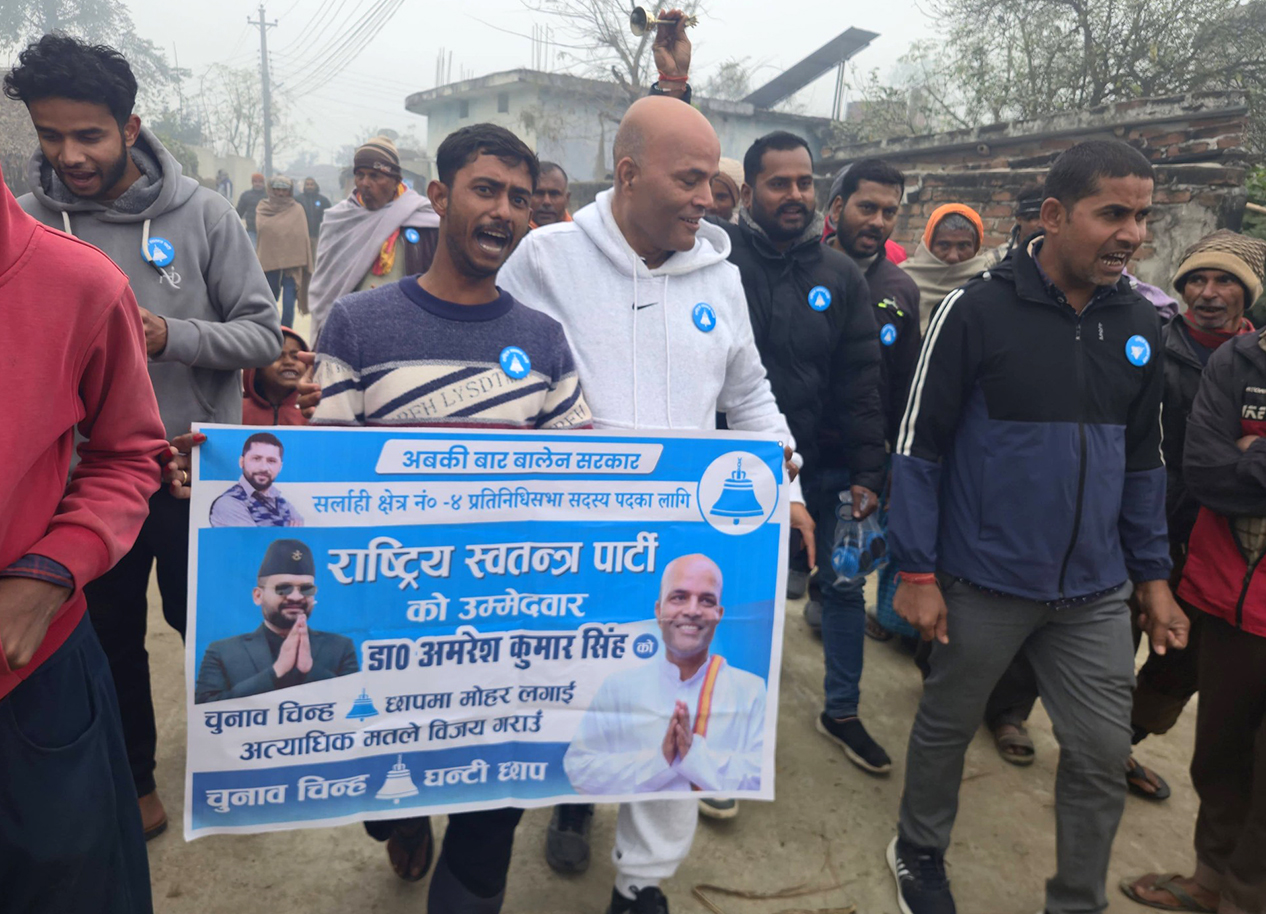
RSP candidate Amresh Kumar Singh during a door-to-door campaign
In Sarlahi-3, Narayan Kaji Shrestha of the NCP has entered the electoral race after resigning from the National Assembly. In the same constituency, Hari Upreti of the UML, who was elected as an MP in 2022, is also contesting again. RSP’s Nagendra Jha is another contender in this race.
Meanwhile, in Rautahat-1, NCP Co-chair Madhav Nepal is a candidate. In this constituency, the UML has fielded former Gaur Municipality mayor Ajay Gupta, while the Nepali Congress has nominated Anil Kumar Jha. Jha, who began his political career in Madhesh-centric parties, is contesting from the Nepali Congress in search of better chances of victory.