Kathmandu
Monday, February 16, 2026





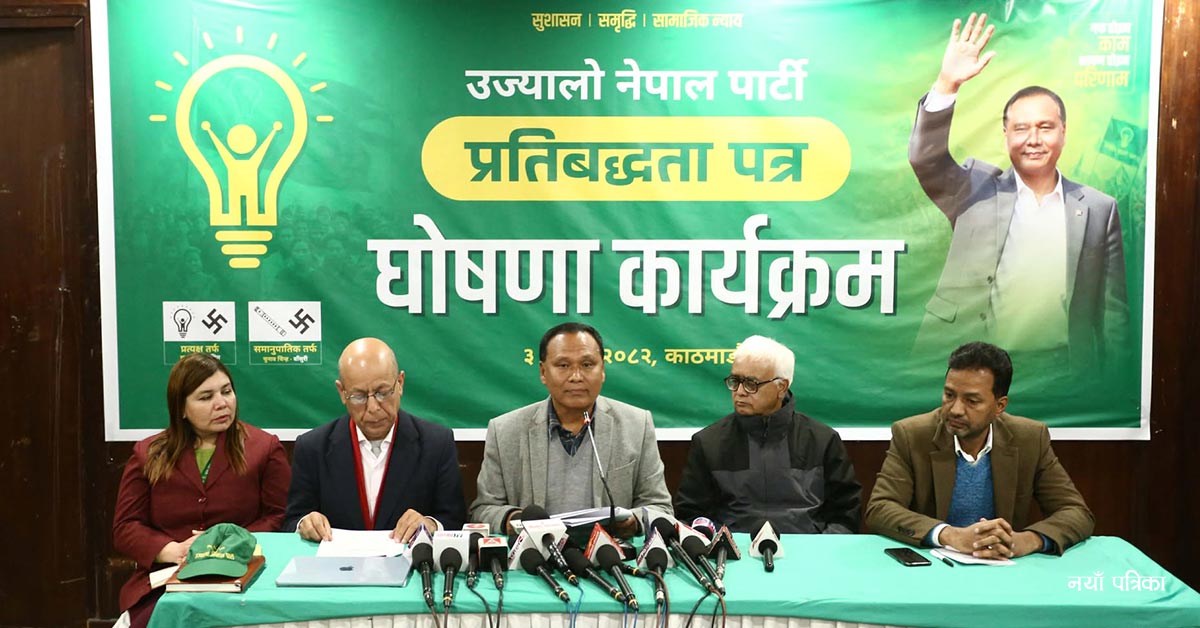
KATHMANDU: The Ujyalo Nepal Party has unveiled a nine-page election manifesto outlining an ambitious vision for Nepal’s future. Framed as a “commitment document,” it combines a welfare-oriented approach with a liberal economic framework, advocating a socialism-inspired model that balances the roles of the state, private sector, cooperatives, and communities to drive growth, prosperity, and social justice.
Economic self-reliance is central, with a focus on mobilising domestic capital, attracting foreign investment, and developing large-scale hydropower to meet domestic demand, boost electricity exports, and fund national development.
The party also proposes structural reforms: supporting a directly elected Chief Minister and non-partisan local elections to strengthen accountability and reduce partisan influence at the provincial and local levels.
Social protection remains a key priority, with citizens’ rights to food, shelter, education, and health enshrined as state obligations. Health commitments include free treatment, expanded mental-health services, and specialist care at the local level, aligning economic ambition with human development.
What structural reforms does the Ujyalo Nepal Party propose for the state?
The party proposes a comprehensive downsizing and rationalization of legislative and executive structures. At the federal level, the House of Representatives would be reduced from 275 members to 201, while provincial assemblies would be cut from 550 to 330 members. This reduction is framed as a cost-saving measure, designed to reduce the financial burden of governance without compromising legislative functionality.
At the executive level, the party plans to streamline ministries: federal ministries would be capped at 15 members and provincial ministries at 5–7 members, eliminating positions of state ministers and assistant ministers. The objective is to create leaner, more efficient governments that are easier to manage and hold accountable, while reducing redundancy and bureaucratic overhead.
The Ujyalo Nepal Party emphasizes systematic monitoring of government performance. The manifesto includes a commitment to release annual progress reports on the implementation of policy and governance promises. These reports will allow citizens to directly evaluate the effectiveness of both federal and provincial governments. Combined with the proposed leaner institutional structure, this mechanism is designed to improve transparency, reinforce accountability, and encourage responsible governance.
Why does the party support a directly elected Chief Minister and non-partisan local elections?
The proposal aims to strengthen accountability and executive stability by giving citizens direct authority to choose their provincial leader. A directly elected Chief Minister would have a clear public mandate, making leadership more transparent and responsive. Non-partisan local elections are intended to reduce excessive political competition at the grassroots level and refocus local governance on service delivery rather than party rivalry. Historically, Nepal has conducted non-partisan local elections, making this approach both familiar and feasible. Together, these reforms seek to balance democratic legitimacy with practical governance.
What is the overall rationale behind these government reforms agendas?
The manifesto frames these reforms as necessary for good governance, fiscal prudence, and social justice. By reducing the size of legislative and executive bodies, limiting ministerial positions, and introducing directly elected provincial leadership, the party aims to create a state that is efficient, accountable, and responsive to citizens. The approach balances cost reduction with the need for political stability, institutional effectiveness, and public trust. It reflects a vision of a state that is streamlined, financially sustainable, and capable of delivering consistent governance across federal and provincial levels.
What are the Ujyalo Nepal party’s overall economic growth targets?
The Ujyalo Nepal Party has set ambitious macroeconomic goals to transform Nepal into an upper-middle-income country by 2035. The party aims for a gross domestic product (GDP) of $70 billion by 2030 and $111 billion by 2035. To achieve this, the manifesto emphasizes accelerating construction, entrepreneurship, and industrial growth. Over the next five years, 4.5 million new constructions are expected annually, reflecting both urban development and job creation, while unsecured startup loans of up to NPR 9 million will be made available to young entrepreneurs to stimulate innovation and domestic investment.
What is the main economic vision of the Ujyalo Nepal Party’s election manifesto?
The core vision of the Ujyalo Nepal Party’s election manifesto is to make Nepal economically prosperous by fully utilizing its water resources and energy potential. The party believes that electricity generation, distribution, and export—especially through hydropower—should be the backbone of national development. Instead of relying heavily on imports or remittances, the party proposes building a strong domestic economy powered by clean energy. By linking energy development with employment, public investment, and social welfare, the manifesto frames hydropower not just as an infrastructure project, but as a long-term national strategy for inclusive growth and sustainability.
Which sectors are prioritized for growth and export expansion?
The manifesto identifies hydropower, herbs, cement, tourism, and IT as priority sectors, with the aim of expanding exports to $10 billion by 2030 and $20 billion by 2035. Hydropower, in particular, is positioned as a cornerstone for domestic energy needs and regional trade, complementing efforts to modernize agriculture and industrial output. In agriculture, reforms include modernized subsidy systems, a target of 50 percent organic production, and a cost-plus procurement approach to increase farmer incomes. By integrating these sectors strategically, the party seeks to create a diversified economic base capable of sustaining long-term growth.
How does the manifesto aim to develop the energy sector?
Energy is central to the party’s economic strategy. The manifesto pledges to produce 12,000 megawatts of hydroelectric power by 2030 and 25,000 megawatts by 2035, positioning Nepal as a regional energy supplier. Electricity exports to India, Bangladesh, and China are projected to generate annual revenues of five billion dollars. The party’s vision is to use hydropower not just for domestic consumption but as a source of foreign exchange, infrastructure financing, and industrial development, transforming energy into a central pillar of national prosperity.
What is the economic logic behind the the National Prosperity Fund?
The party aims to meet domestic demand while generating exportable surplus. Increasing per capita electricity consumption supports industrial growth, digital infrastructure, and improved living standards. Allocating 15 percent of export revenue to a National Prosperity Fund ensures that energy earnings are reinvested into rural infrastructure and poverty alleviation rather than absorbed into general spending. This creates a direct link between national resources and inclusive development outcomes.
What is the Ujyalo Nepal Party’s election manifesto “1,000 Share Campaign” and why is it important?
The “1,000 Share Campaign” is designed to make ordinary citizens direct stakeholders in Nepal’s hydropower development. Under this plan, every household will be eligible to receive at least 1,000 shares of hydropower projects at the primary issue price. To ensure inclusiveness, poor families will be supported through subsidized loans so they can also purchase shares. Additionally, workers involved in building hydropower projects will be allowed to convert their labor into shares, giving them ownership in the projects they help construct. This approach aims to democratize investment, reduce inequality, and ensure that profits from natural resources benefit the public rather than a small group of investors.
How will hydropower revenue be used for public welfare and national development?
The Ujyalo Nepal Party’s election manifesto proposes two major public funds to channel hydropower income into social and economic development. First, 20 percent of the revenue from hydropower projects—after they are transferred to the government following 30 years of power purchase agreements—will be deposited into a “People’s Hydropower Fund.” This fund will be used specifically for education, healthcare, and job creation. Second, 15 percent of income earned from electricity exports will go into a “National Prosperity Fund,” which will focus on rural infrastructure development and poverty alleviation. Together, these funds aim to ensure that energy profits translate into tangible improvements in people’s daily lives.
What are the long-term energy, irrigation, and environmental goals?
In the medium term, the party aims to produce 12,000 megawatts of electricity by 2030 and increase per capita annual electricity consumption to 800 kilowatt-hours, with a strong focus on exporting surplus energy. In the long term, the targets rise to 25,000 megawatts by 2035 and 40,000 megawatts by 2045, with the explicit goal of establishing Nepal as a carbon-neutral nation. Alongside energy, the manifesto places heavy emphasis on irrigation: expanding surface irrigation to 300,000 hectares within five years, adding groundwater irrigation to another 300,000 hectares in the Tarai–Madhesh region, and extending lift-based, electricity-powered irrigation to 200,000 hectares in hill and mountain areas. Major river diversion projects are also planned to support both irrigation and energy generation. Overall, the strategy integrates energy, agriculture, employment, and environmental sustainability into a single development model.
What initiatives are proposed for youth employment and entrepreneurship?
The party aims to significantly boost employment by creating opportunities for both skilled and entrepreneurial youth. Through a combination of self-employment campaigns, low-interest loans, and startup grants, young people will be encouraged to become active participants in economic development. Employment fairs will be held across all provinces for youth aged 16–35, complemented by free skill training programs to prepare them for both local and international markets. In addition, mentorship programs tied to non-interest loans from the Entrepreneurship Fund will facilitate the creation of one million jobs over five years. The manifesto also envisions a Youth Parliament with 101 members to nurture leadership and civic participation among young Nepalis, ensuring that the next generation is equipped with both practical skills and governance experience.
How does the manifesto envision infrastructure, urban development, and economic growth?
The Ujyalo Nepal Party presents an integrated vision linking infrastructure, urban planning, education, agriculture, transport, and tourism as pillars of sustainable economic growth. Over the next five years, the party plans to construct extensive road networks—including blacktop, gravel, and new tracks—while developing railways and inland waterways to improve regional connectivity and reduce transportation costs. Smart city initiatives are central to urban planning, integrating digital technology, real-time monitoring, and climate-adaptive designs to enhance governance, service delivery, and livability.
Tourism is positioned as a strategic growth engine, with the party targeting five million foreign visitors annually by 2035. By emphasizing religious, spiritual, health, educational, and adventure tourism, combined with boutique airports showcasing Nepal’s cultural diversity, the manifesto aims to generate revenue, create employment, and leverage the country’s natural and cultural assets for long-term development.
Education and agriculture are closely linked to this growth strategy. Paid vocational internships at the Plus Two level are intended to prepare students for the labor market, reducing skill mismatches and strengthening human capital. Targeted agricultural electricity subsidies and direct cash transfers boost productivity efficiently, while streamlined development laws and infrastructure investments create an environment conducive to business, entrepreneurship, and foreign investment. Collectively, these measures reflect a coordinated approach to economic growth, marrying urban modernization, sectoral development, and social inclusion under a single strategic framework.
How are skill development and citizen participation addressed?
To complement employment and entrepreneurship initiatives, the party envisions broad-based skill development programs for citizens under 40, aiming to create 1.5 million jobs annually. These programs are designed to equip youth with practical skills, foster innovation, and promote productive participation in the economy. By linking economic growth with capacity-building, the manifesto seeks to create an environment where citizens can actively engage in production, entrepreneurship, and community development, reinforcing a self-reliant, digitally enabled economy.
What is the overall health vision outlined in the manifesto?
The manifesto presents healthcare as a guaranteed public service and a fundamental right, not a benefit dependent on income or location. Through the Free Health Service Campaign, the party aims to ensure that all citizens can receive treatment without financial burden at designated government health institutions. This vision directly addresses the reality that many people delay or avoid treatment due to cost, which often worsens health outcomes. By removing user fees at public facilities, the party seeks to build a more inclusive and preventive healthcare system where early treatment becomes the norm rather than the exception.
The Free Health Service Campaign aims to guarantee healthcare as a fundamental right rather than a privilege based on income. Under this policy, every citizen will be able to receive free treatment from a designated government health facility, ensuring that no one is denied care because they cannot afford it. The party’s central goal is to eliminate financial barriers that force families to delay or avoid treatment, often leading to preventable complications or deaths. By making public healthcare universally accessible, the campaign seeks to create a more equitable health system where basic medical services are guaranteed for all citizens.
To address long-standing gaps in rural and remote healthcare access, the manifesto proposes the use of mobile clinics and telemedicine services. Mobile clinics will physically reach underserved communities, providing basic diagnosis, treatment, and referrals without requiring patients to travel long distances. Telemedicine will connect patients in remote areas with doctors and specialists through digital platforms, allowing for consultations, follow-ups, and medical guidance. Together, these approaches aim to reduce geographic inequality in healthcare delivery and ensure timely medical support even in hard-to-reach regions.
The party places strong emphasis on women’s and children’s health, particularly addressing malnutrition. Targeted programs will focus on improving nutrition, conducting regular health checkups, and ensuring access to essential medicines and treatment. These measures are intended to reduce child mortality rates and improve maternal health outcomes by preventing complications before they become life-threatening. The approach combines preventive care with early intervention, recognizing that long-term national health outcomes depend heavily on the well-being of mothers and children.
What does it mean to develop Nepal as an IT hub, and how does the plan work?
Developing Nepal as an IT hub means positioning the country as a regional center for digital innovation, technology services, and high-skilled employment. The manifesto outlines this transformation through a structured approach: establishing a NPR 10 billion startup fund to support new and growing tech companies, creating IT parks in all seven provinces, and offering tax incentives to reduce barriers for startups and investors. By decentralizing IT infrastructure beyond Kathmandu, the plan aims to spread economic opportunities across provinces. Training 600,000 youths in coding, artificial intelligence, and cybersecurity over five years directly addresses skills gaps and prepares the workforce for global digital markets, reducing youth unemployment and dependency on foreign labor migration.
How does the manifesto propose to use digital systems to control corruption and improve accountability?
The manifesto places digital transparency at the center of its anti-corruption strategy. Mandatory annual online asset declarations for elected representatives and public officials are intended to create a permanent, searchable public record that can be independently reviewed. This reduces opportunities for hiding unexplained wealth and shifts accountability from discretionary oversight to system-based monitoring. Complementing this, the proposed Data Protection Act, Cybersecurity Act, and AI-related policies aim to ensure that transparency does not come at the cost of privacy or data misuse. Secure use of blockchain technology is meant to make public records and transactions tamper-resistant, strengthening trust in public institutions. Together, these measures seek to replace opaque processes with verifiable digital governance.
The whistleblower reward system is designed to turn corruption reporting into a high-impact civic responsibility. By offering 5 percent of court-verified fines to informants, the policy creates a strong incentive to expose corruption while increasing fear and deterrence among corrupt officials. Because rewards are tied to judicial outcomes, the system avoids misuse and encourages credible reporting. This approach strengthens transparency without expanding bureaucratic oversight.
What are smart cities and digital infrastructure expected to achieve by 2040?
Smart cities are envisioned as urban centers that use technology to improve mobility, safety, service delivery, and environmental sustainability. By integrating IoT systems, IT-based traffic management, real-time data monitoring, and climate-adaptive planning, the proposed 13 smart cities aim to reduce congestion, manage resources efficiently, and improve quality of life. Supporting infrastructure such as a mega data center and integrated disaster early-warning systems strengthens national resilience by enabling real-time decision-making during emergencies. These initiatives position digital infrastructure as a foundation for long-term urban and economic development.