Kathmandu
Wednesday, July 15, 2026





Deadly collusion between government employees, foreign employment entrepreneurs, and middlemen under the cover of visit visas
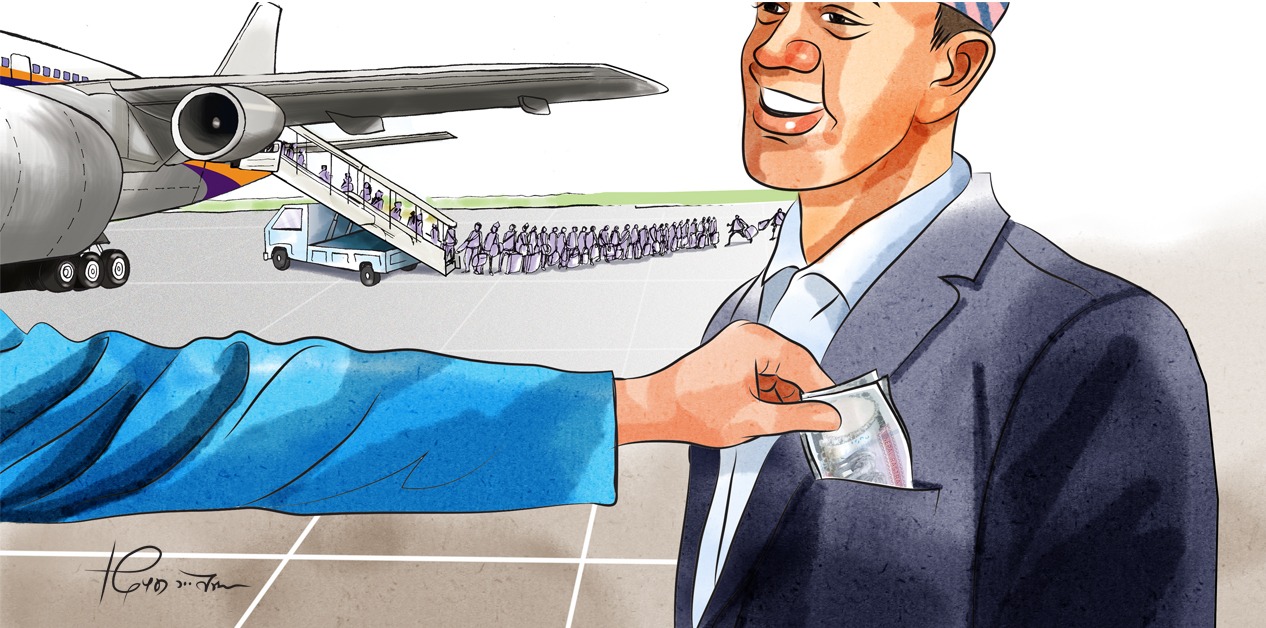
– The invisible collusion between government employees and foreign employment entrepreneurs in the misuse of visit visas has still not been controlled. The use of fake labor approvals and fake visas has not been completely discouraged. Incidents of fraud and irregularities related to foreign employment have not decreased.
– Networks of middlemen are active both within the country and abroad. A network involving employees, foreign employment entrepreneurs, educational consultants, travel agencies, airline companies, and intermediaries is engaged in human trafficking. This network is extracting large sums of money.
– Those who travel under visit visas for employment purposes often fall victim to labor exploitation and fraud and become involved in illegal work. They are deprived of health insurance, and when problems arise, they cannot access legal remedies or relief. Living illegally forces them to face punishment, family breakdown, and in some cases death – serious social consequences.
– Government agencies have failed to coordinate effectively to control such irregularities. There is no uniformity in information collection among security agencies, and regulatory bodies including the Department of Foreign Employment have weak regulatory capacity. The inability to control irregularities seen in immigration reflects the failure of government bodies.
These distortions in the country’s immigration sector were identified by the “High-Level Study and Investigation Committee Formed to Resolve Long-Standing Problems Related to Immigration and Visit Visas.”
Even though the misuse of visit visas became widespread, the report of the high-level investigation committee formed by the government remains confidential. However, according to a copy of the report obtained unofficially by Nepal News, there appears to be undeclared collusion between government employees and foreign employment entrepreneurs in corrupting the immigration sector and misusing visit visas. For example, there is evidence of collusion between officials and business operators to send Nepali citizens abroad as domestic workers or for other purposes using visit visas.
The investigation revealed that fake documents such as fraudulent labor approvals and visas are still being produced through the alliance of employees and business operators. The government has not been able to completely discourage this practice. Because of this trend, fraud and irregularities in foreign employment have not decreased.
Despite evidence of employee involvement in visit visa misuse, the government has not taken action against immigration officials. It has become common to lure job-seeking youth with promises and send them abroad on visit visas without labor approval. Government investigations concluded that networks ranging from government employees to private companies are actively collecting money from youths seeking foreign employment. Middlemen lure villagers with promises of jobs abroad through visit visas and take them to foreign employment agents. Fake documents are then prepared for them. Educational consultancies and travel agencies have also been found involved in this work. Fraud in the name of visit visas is also carried out with the collusion of airline companies and middlemen abroad.
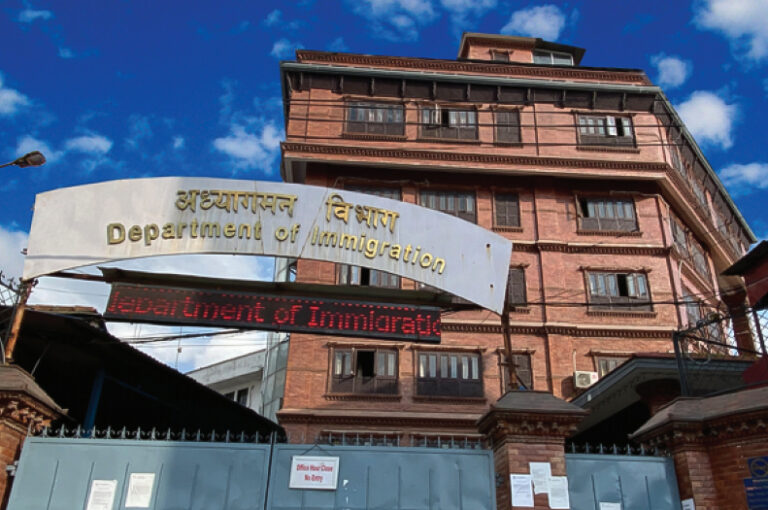
Department of Immigration. Photo: Department’s website
In fact, it has been found that networks of human traffickers are involved under the cover of visit visas, collecting large amounts of money. These networks collect more money than legally allowed from people going for foreign employment through informal channels.
In the fake visit visa case, on J22 May 2025, the Commission for the Investigation of Abuse of Authority conducted a raid at the immigration office of Tribhuvan International Airport. During that operation, the then immigration officer at the airport, Tirtha Raj Bhattarai, was arrested. At that time, then Home Minister Ramesh Lekhak was also accused of involvement in the visit visa case. To investigate the matter, on 23 June 2025, the government formed a nine-member high-level study and investigation committee under the coordination of former Chief Secretary Shanker Das Bairagi.
Government failure
The failure to control visit visa misuse is due to negligence and weaknesses among immigration, security agencies, and other government bodies. For example, at the immigration office of Tribhuvan International Airport, at least 135 immigration officers are required daily to operate 45 desks across three shifts. However, only 121 positions exist. A government investigation revealed that because some employees gain improper benefits, the Ministry of Home Affairs repeatedly transfers certain staff back to immigration postings.
Similarly, due to a shortage of technical staff capable of verifying the authenticity of passports and other documents, equipment at immigration offices is not fully utilized. There is not even an approved position for a data officer in the staffing structure. Policy, legal, and institutional distortions within immigration administration are equally severe. Due to managerial weaknesses, service delivery is ineffective. Even though standards exist for staff deployment, the problem is that they are not implemented.
The Civil Aviation Authority of Nepal (CAAN) has also been unable to control undesirable activities of airline companies, according to the investigation team. Airlines book tickets beyond the limits set by the International Civil Aviation Organization (ICAO), leaving passengers stranded. This disrupts immigration operations. Even when travel agencies show a lack of professional integrity, effective monitoring and punishment of wrongdoers have not been carried out.
Irregularities in fake visit visas also show the failure of regulatory bodies. According to the Foreign Employment Act, 2007, only licensed institutions are allowed to hold the passports of individuals seeking foreign employment. However, middlemen lure people with various promises, bypass labor approval, and keep the passports of citizens traveling on visit visas. Even though such activities are operating openly, the Department of Foreign Employment has remained a mute spectator.
The Civil Aviation Authority of Nepal (CAAN) has also been unable to control undesirable activities of airline companies, according to the investigation team. Airlines book tickets beyond the limits set by the International Civil Aviation Organization (ICAO), leaving passengers stranded. This disrupts immigration operations.
In fact, the department receives a large number of complaints related to foreign employment every day. Yet it has failed to take action against individuals and agencies involved in wrongdoing. The investigation committee concluded that the department has not been able to fairly evaluate the performance of foreign employment agencies, reward those who perform well, and punish those who perform poorly. The government has not only failed to monitor foreign employment agencies, but the Ministry of Education, Science, and Technology has also not monitored educational consultancy institutions so far. After the implementation of federalism in the country, some provinces have begun issuing licenses to educational consultancy institutions, which has further created confusion in their regulation.
Various bodies have been defined as regulatory authorities to make immigration management, foreign employment management, and overall airport management effective. There are also oversight bodies meant to check whether the actions of relevant agencies comply with the law. Even so, regulation has not been effective. The high-level investigation committee report states: “Government agencies are often accused of exercising more control than regulation.”
The committee claims that the roles of all relevant bodies – the Ministry of Home Affairs, Ministry of Labor and Employment, Ministry of Foreign Affairs, Ministry of Tourism and Civil Aviation, Ministry of Education, Science and Technology, police administration, and airport administration – have appeared weak in preventing irregularities in foreign employment. Not only that, the role of Nepali diplomatic missions abroad has also appeared suspicious in the misuse of visit visas.
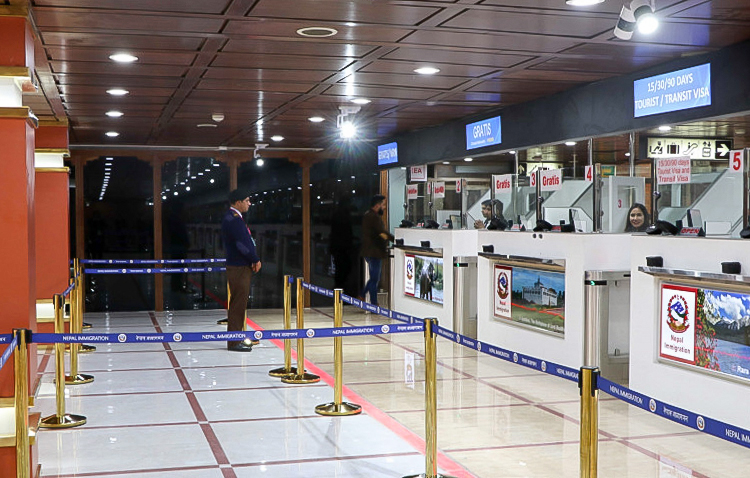
The Immigration Office at TIA. Photo: TIA website
There are 110 offices/rooms on the airport premises connected to immigration. Among them, 31 belong to security units and other government agencies. However, due to lack of coordination among these bodies, immigration itself has become a center of irregularities. Although civil aviation security regulations provide for an International Airport Security Committee to coordinate among these agencies, it has not been effective. The committee is chaired by the chief of the civil aviation office and includes heads of security agencies stationed at the airport, the chief of the Nepali Army’s engineering department, and airline company chiefs as members. Yet the committee itself has become inactive.
Benefit to middlemen
There are various legal provisions related to visit visas. The Ministry of Home Affairs and the Department of Immigration also issue different procedures and circulars from time to time. However, such circulars and decisions sometimes make immigration stricter and at other times more lenient. For example, a ministerial decision issued on 12 November 2019 and a circular issued by the Department of Immigration on 24 January 2021 made immigration stricter. Likewise, the Home Ministry directive of 24 January 2022, the Procedures for Managing Departure Permission on Tourist Visas, 2079 (2022), and the Tourist Visa Procedures, 2080 (2024) also imposed stricter conditions on those traveling on visit visas.
On 24 January 2024, then Deputy Prime Minister and Home Minister Narayan Kaji Shrestha issued criteria that relaxed visit visa provisions. The criteria required a passport valid for at least six months, entry permission for the destination country, a round-trip air ticket, proof of hotel booking or proof of relationship if staying with relatives. In addition, visit visa holders had to show proof of exchanging at least 500 US dollars in cash or sponsorship proof, along with a six-point self-declaration requirement for travel on visit visas to the UAE, Bahrain, Kuwait, Qatar, Oman, and Saudi Arabia. This standard was more lenient than the provisions in the 2080 (2024) procedures governing departure permission on tourist visas.
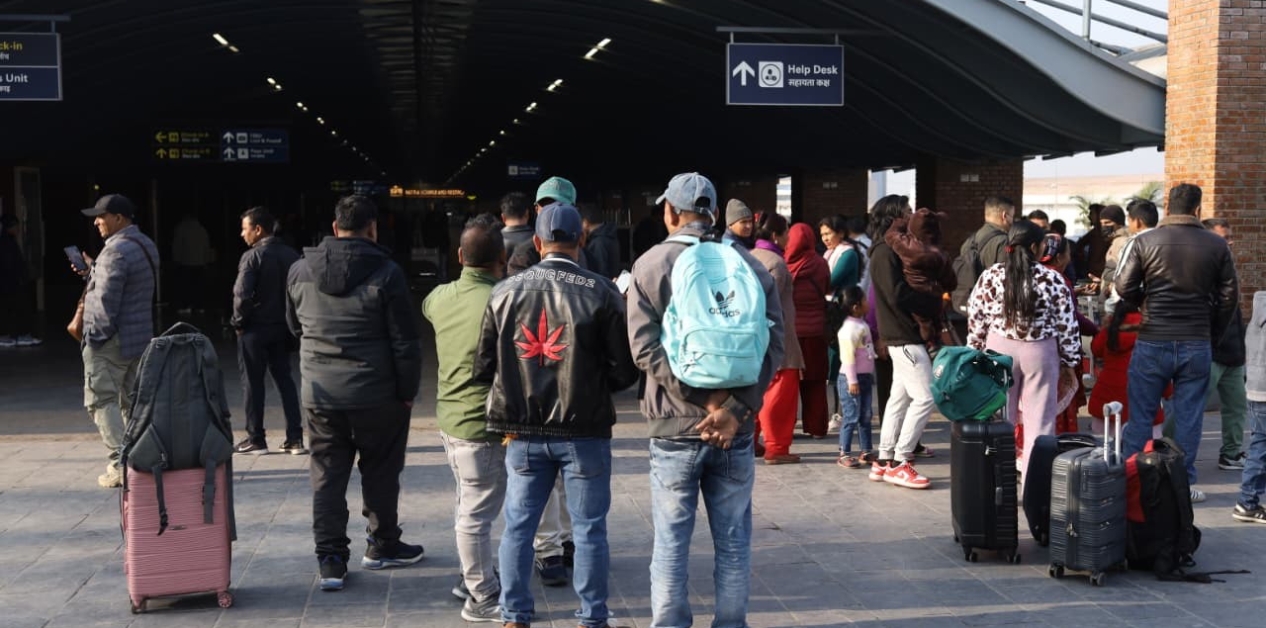
After this standard came into effect, 274,399 Nepalis traveled abroad on visit visas in 2024, a 34% increase compared to the previous year. On average, 743 people left daily on visit visas that year – the highest in history. Because the standards issued during Shrestha’s tenure were more relaxed than earlier ones, they were widely misused.
As the trend of visit visa misuse increases, government investigations have pointed out the risk of expansion of the informal economy. In a 2024 mutual evaluation on money laundering conducted by the Asia Pacific Group (APG) under the Financial Action Task Force (FATF), Nepal has already been placed on the grey list. In such a situation, if the state does not seriously discourage practices that promote the informal economy, the risk of Nepal being blacklisted in the future on money-laundering issues could increase.
As many as 274,399 Nepalis traveled abroad on visit visas in 2024, a 34% increase compared to the previous year. On average, 743 people left daily on visit visas that year – the highest in history.
Tikarām Dhakal, director and spokesperson of the Department of Immigration, says that the department has already begun reforms after taking seriously the problems highlighted by the high-level investigation committee report. According to him, since the earlier six-point criteria for visit visas had increased problems, reform began by changing those standards. Previously, the criteria required a round-trip ticket, but now only a ticket to the destination is sufficient. Likewise, the requirement to show proof of hotel booking has also been removed.
Similarly, the provision requiring visit visa travelers to have 500 US dollars or equivalent foreign currency has now been removed. “We have started implementing the suggestions received for reforms. Institutional, procedural, and technical aspects will gradually improve,” Dhakal says.
Not only now, but in 2078 (2021), the government had also formed a task force to find solutions to problems arising from visit visas. The report of that government task force had recommended policy reforms, investment in technology, and effective regulation to eliminate irregularities in the immigration sector. However, those recommendations were shelved.
The report of the current high-level investigation committee has also presented important suggestions to stop and correct irregularities in immigration. To end long-standing problems in immigration, the government must implement the committee’s recommendations. This issue should also become an important election agenda for political parties currently engaged in parliamentary elections. However, at present, parties remain silent about the visit visa scandal that had once shaken the country during the governments of KP Sharma Oli and Pushpa Kamal Dahal before the Gen-Z movement.