Kathmandu
Monday, July 13, 2026





Can mere elections, which are being held two years before the schedule, provide a sustainable solution to our national problems without consensus among all sides?
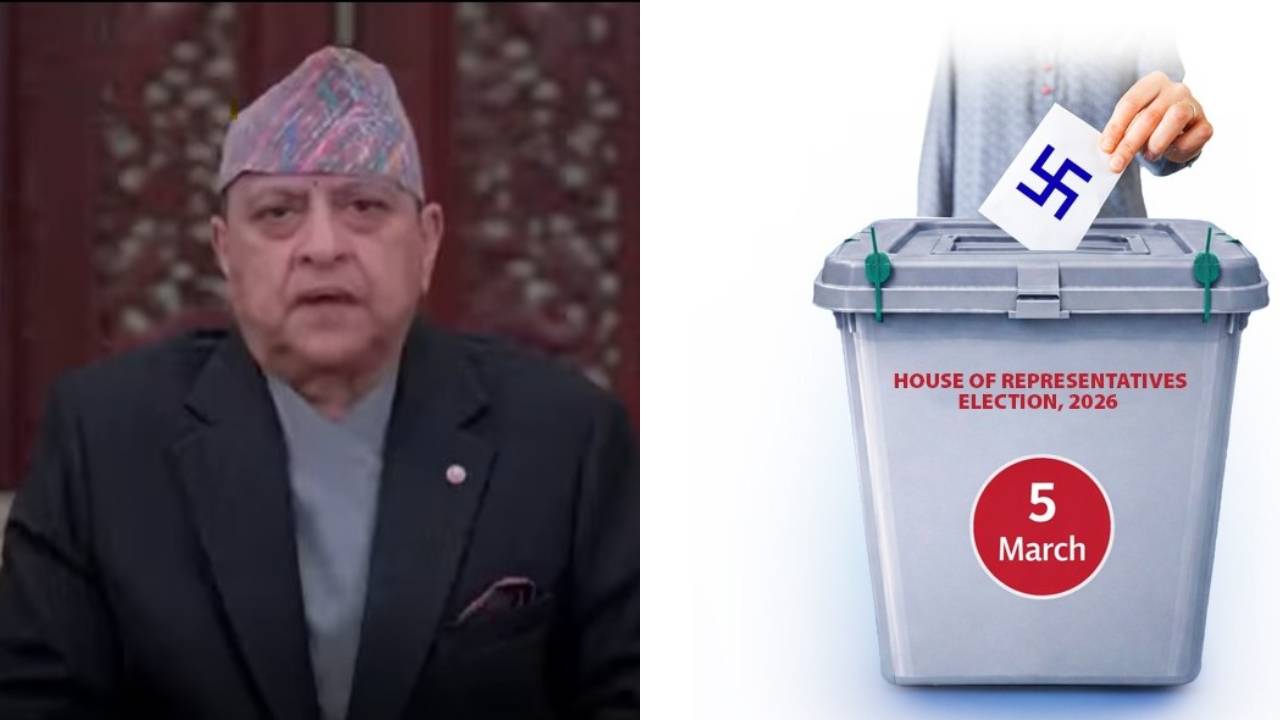
KATHMANDU: As Nepal celebrates its 76th Democracy Day and with only two weeks left until the election scheduled for March 5 by the interim government, the video message issued by former King Gyanendra Bir Bikram Shah yesterday has sparked a new debate. Two of his main questions are: Can the upcoming elections provide a solution to all the problems facing the country? And what have we, Nepal and Nepalis, gained from the so many changes in the country’s recent history?
These questions cannot be easily dismissed. Rather than dismissing the former king’s message as a purely pro-monarchy statement, it seems necessary to delve deeper into the questions raised in it. Because the very essence of democracy is self-examination.
In the last 35 years, Nepal has experienced elections many times, including in 1991, 1994, 1999, 2008, 2013, 2017, 2022. Parliaments were formed, dissolved, re-elected. Governments were formed, toppled, and formed again. But political stability could not be institutionalized.
Political scientist Prof Krishna Khanal has mentioned in various interviews in the past: “There is a tendency in Nepal to consider the electoral process as the final destination of democracy, whereas democracy is manifested in institutional culture, accountability, and good governance.” So, needless to say, if there is no institutional stability and policy continuity, then elections alone cannot provide a miraculous solution.
As the former king said, “Although periodic elections are a natural process in a democracy, it is appropriate to go to elections only after solving national problems.” Looking at recent experience, dissatisfaction, distrust, and power struggles have not diminished even after the elections held so far.
Public anger and questions about the system
The ‘Gen Z’ revolt of last year had directly expressed anger at all three organs of the Nepali state – the executive, the legislature, and the judiciary. The arson attack on both private and government-provided presidential residence, which is considered a symbol of the republic, was not an ordinary incident. It was not just dissatisfaction with an individual; it was a sign of distrust in the system.
Political analyst Prof. Lokraj Baral had said in a television interview: “There are signs that the people’s patience is running out. If the system fails to deliver, disappointment with democracy will only increase.”
If people have weak faith in the system, elections alone cannot restore that faith. Instead, consensus among all on all crucial issues, reform, and credible leadership are needed.
Nepal’s biggest problem is not only the political structure, but also the economic structure. Every year, hundreds of thousands of young people are forced to go abroad for employment and education. According to the Department of Foreign Employment, the number of people receiving work permits in recent years is at a historic high. Can the March 5 election stop this perennial exodus of Nepalis?
Several economists have repeatedly emphasized: “Economic reform is not possible without political stability and policy continuity.” If government changes and instability continue after the upcoming elections, there will be a long-term impact on industry, investment, and job creation.
Therefore, elections themselves are not the solution; the solution is taking all powers – traditional as well as modern – into confidence, policy clarity, an investment-friendly environment, and a productive economy. If a government formed without consensus becomes unstable again, the economic crisis could deepen.
Geopolitical balance and potential post-election pressure
Nepal’s geopolitical reality is very sensitive. Situated between two great powers like India and China, Nepal claims to have always pursued a balanced foreign policy. However, in recent years, internal differences have flared up over issues such as the US MCC agreement, China’s BRI, Indo-Pacific strategy, border disputes, trade dependence and strategic partnerships.
Foreign policy expert Dr Dinesh Bhattarai once mentioned in an article: “Nepal’s foreign policy should be based on national consensus; otherwise, changing priorities with every change of government is a sign of instability.”
The country is currently in a very difficult geopolitical situation. It is clear that it is not in the interest of Nepal and Nepalis to please any third power by provoking or antagonizing their immediate neighbors, but the country seems to be heading in that direction. Some analysts are saying that the situation that will arise after the upcoming elections will accelerate this process even further.
The idea of “appeasing a third power by irritating neighbors” is a sensitive issue related to diplomatic balance and Nepal’s very existence as a nation. In recent memory, Nepal has already experienced the Indian blockade of 1989 and 2015 when the balance was lost. Now, according to some analysts, Nepal’s northern neighbor China is not happy about some recent developments in the country that the dragon considers to be anti-China and against Nepal’s officially stated one-China policy.
Therefore, analysts say that if a weak coalition government is formed after the election, the influence of external powers could increase further, as unstable governments are often forced to seek external support or balance.
If the election results are too divisive – which is going to be the case, most likely – there is a risk that foreign diplomatic balance will become a tool for “strategic bargaining” to sustain the government. This is why some analysts say that a minimum national consensus must first be built, especially on issues such as foreign policy and national security; then elections can provide stability.
Diplomats say that Nepal needs a national consensus to adopt a balanced foreign policy. If the coalition government remains weak after the election, the foreign policy could become even more unstable. The former king’s insistence on “our country first, our people first” seems meaningful in this context.
The former king said, “Our enemies are poverty and instability, but we have fostered a culture where one Nepali considers another Nepali as an enemy.” In recent years, identity, regionalism, and ideological polarization have increased division in society.
Socio-political scientist Dr Chandra Dev Bhatta has mentioned in an article: “Political competition in Nepal has tended towards mutual distrust and exclusion rather than healthy debate.” In such a situation, elections are likely to further increase polarization.
If the election results are disputed or the losing party does not accept the results, instability may recur. Therefore, the argument that a minimum national consensus is necessary before the elections seems strong.
Debate on the Constitution and reform
The current constitution of Nepal was promulgated in 2015. But since then, debates have been ongoing on republicanism, secularism, federalism, inclusiveness, judicial structure, electoral system, etc. Many parties have been demanding amendments.
If the basic disagreements persist, the same controversy will repeat itself in parliament and on the streets after the elections. As the former king said, “a system befitting the country’s geography and the nature of society” is necessary. This means that the constitution may need to be reviewed or improved in its implementation – which requires broad consensus.
Elections are an essential part of democracy, but that is not a sufficient condition. Good governance, transparency, political stability, judicial independence, corruption control – all these aspects are linked to institutional reform.
Nepal’s position on the global corruption perception index has not improved. Major scam cases have not been resolved in a timely manner. In such a situation, expecting elections alone to bring about improvement may be unrealistic.
Why does the former king’s argument seem to be relevant?
Rather than viewing the message of the former King from an emotional or political angle, the questions he raised should be taken analytically. He has not opposed the election; he has called for national consensus among all sides before the election.
Given the current situation in Nepal – political instability, economic challenges, youth exodus, geopolitical pressures, social polarization and questions over the system – the upcoming March 5 election seems unlikely to solve all these problems at once. If the election is held without an all-side consensus, clear policies, and a long-term vision, the outcome could be instability again.
This does not mean that the election must be stopped; but a minimum common agenda, national priorities, and mutual trust building are indispensable before the election. The essence of democracy is not just about voting, but also about consensus.
It is clear that the former king imagines a path forward grounded in a constitutional monarchy and multi-party democracy, where collaboration between the institution of monarchy and political parties plays a pivotal role. He appears to stress that amid Nepal’s ongoing political stalemate, a coordinated and cooperative effort between the institution of monarchy and party leaders is essential to overcome the impasse and steer the nation toward stable and lasting governance.
Ultimately, the question is: Do we want to just have elections, or build a stable and prosperous nation? If the answer is the latter, it will be difficult to move forward without consensus and introspection. This is the message that emerges from the former king’s statement, and a serious debate on this issue looks necessary.