Kathmandu
Wednesday, June 17, 2026





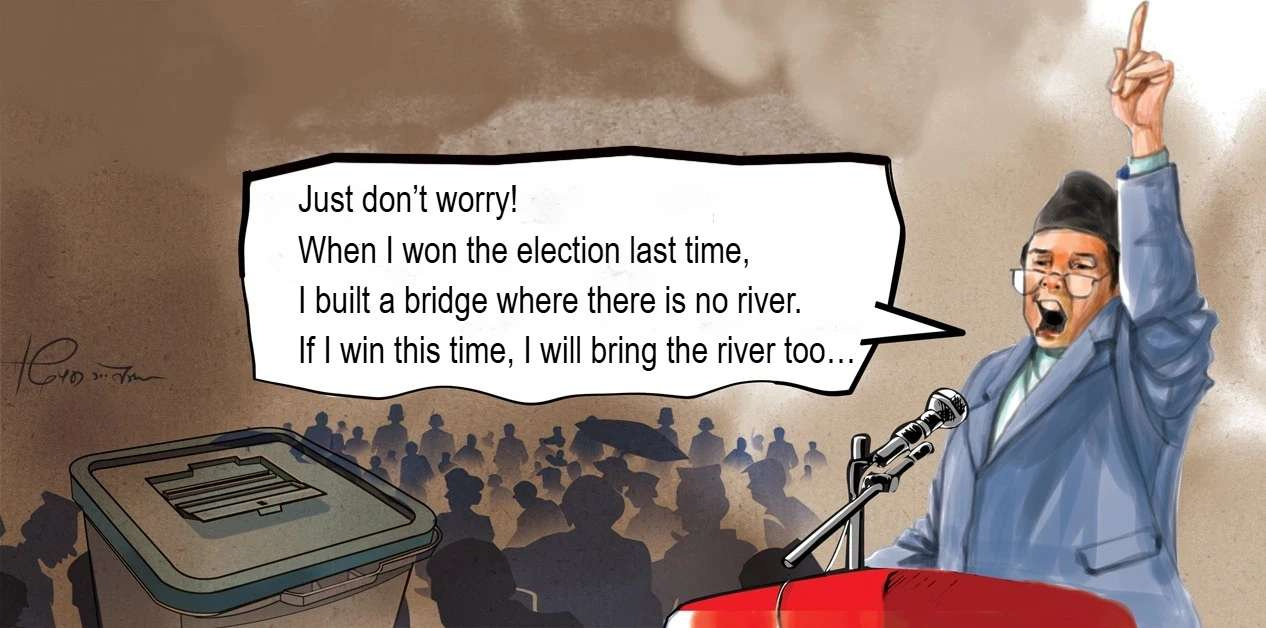
Although the Constitution clearly defines federal lawmakers’ roles as drafting legislation, overseeing government, and ensuring equitable policy, election hopefuls continue to court voters with promises of roads, bridges, and local projects - fueling misplaced expectations, budget distortions, and confusion over the true mandate of Parliament
KATHMANDU: On February 17, the chairperson of CPN (UML), KP Sharma Oli, unveiled a commitment document targeting the upcoming House of Representatives election, outlining development plans for Jhapa Constituency No. 5. Issued under the slogan “Prosperous Nepal, Happy Nepali National Destination,” the document contains four main points – good governance, corruption control, issues of nation and nationalism, and infrastructure. Under the infrastructure section, there is a long list of development and prosperity plans.
Some of these include: taking strong initiatives to complete all development projects that were allocated in fiscal year 2025/26 but are currently stalled or incomplete; accelerating the process of providing land ownership certificates to landless Dalits, squatters, and unmanaged settlers; re-contracting and completing the Damak–Chisapani–Rabi Road; and completing the unfinished Mai River bridge under the Postal Highway project.
Feeling pressure in this election, former Prime Minister Oli has been concentrating his campaign in his home district of Jhapa, going door to door and distributing promises of development to voters. He is presenting blueprints for roads, bridges, embankments, market development, and more.
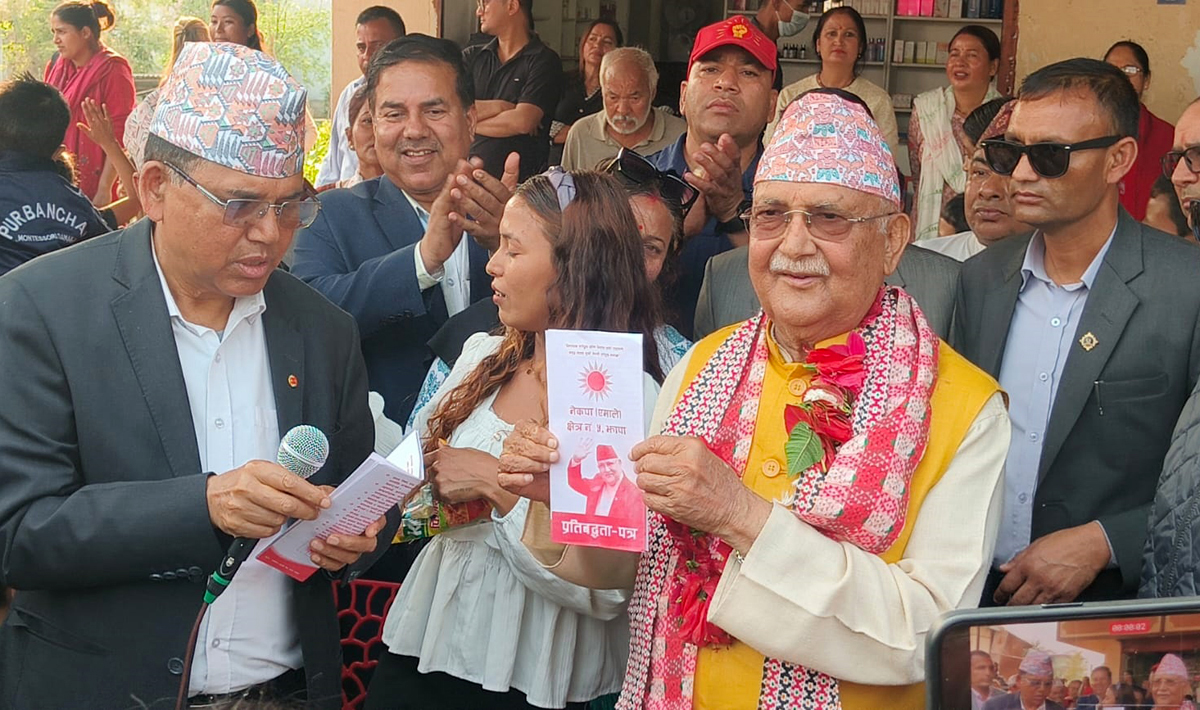
KP Sharma Oli unveiling his election commitment document in Jhapa-5. Photo: Oli’s Secretariat
Oli is not alone in showing voters dreams of development ahead of the election scheduled for March 5. Pushpa Kamal Dahal, coordinator of the Nepali Communist Party (NCP), has in recent days been campaigning in villages of Rukum East. On February 16, during a gathering in Maikot of Putha Uttarganga Rural Municipality-1, Dahal said he dreams of connecting Rukum East to the Chinese border with a blacktopped road. He stated, “My dream is to connect the Martyrs’ Highway coming from Dang through Sahartara to the Chinese border and pave it.”
On 27 January, Nepali Congress President Gagan Kumar Thapa visited an incomplete bridge over the Bagmati River in Sarlahi. Thapa, a candidate from Sarlahi-4, told voters on January 29 that he would devote all his strength to making his constituency exemplary. He said, “I have to work on education here, I have to work on health here, I have to work on agriculture here. I have to work on the fields here, on irrigation here.”
Stating that he would remain active in politics for the next 8–10 years, Thapa added, “I will make sure that Sarlahi Constituency No. 4 becomes known as the one that has done outstanding work. You can be assured of that.”
Similarly, Swarnim Wagle, vice-chair of the Rastriya Swatantra Party (RSP) and a candidate from Tanahun-1, has been promising to blacktop roads. He told voters, “It has been twenty years since the road from Kalimati to Kunsa was dug by an excavator. This is a historic road leading to Kathmandu. Because it has not been paved, people have had to endure dust. This happened due to political neglect and lack of state prioritization. I will deliver justice on this.”
Even while making such statements, Wagle has acknowledged that the role of a Member of the House of Representatives is not the same as that of a ward chairperson, mayor, or provincial lawmaker. He said, “Ward members, chairs, mayors, and provincial lawmakers can be met right in the courtyard. Federal MPs are sent to Kathmandu to work.”
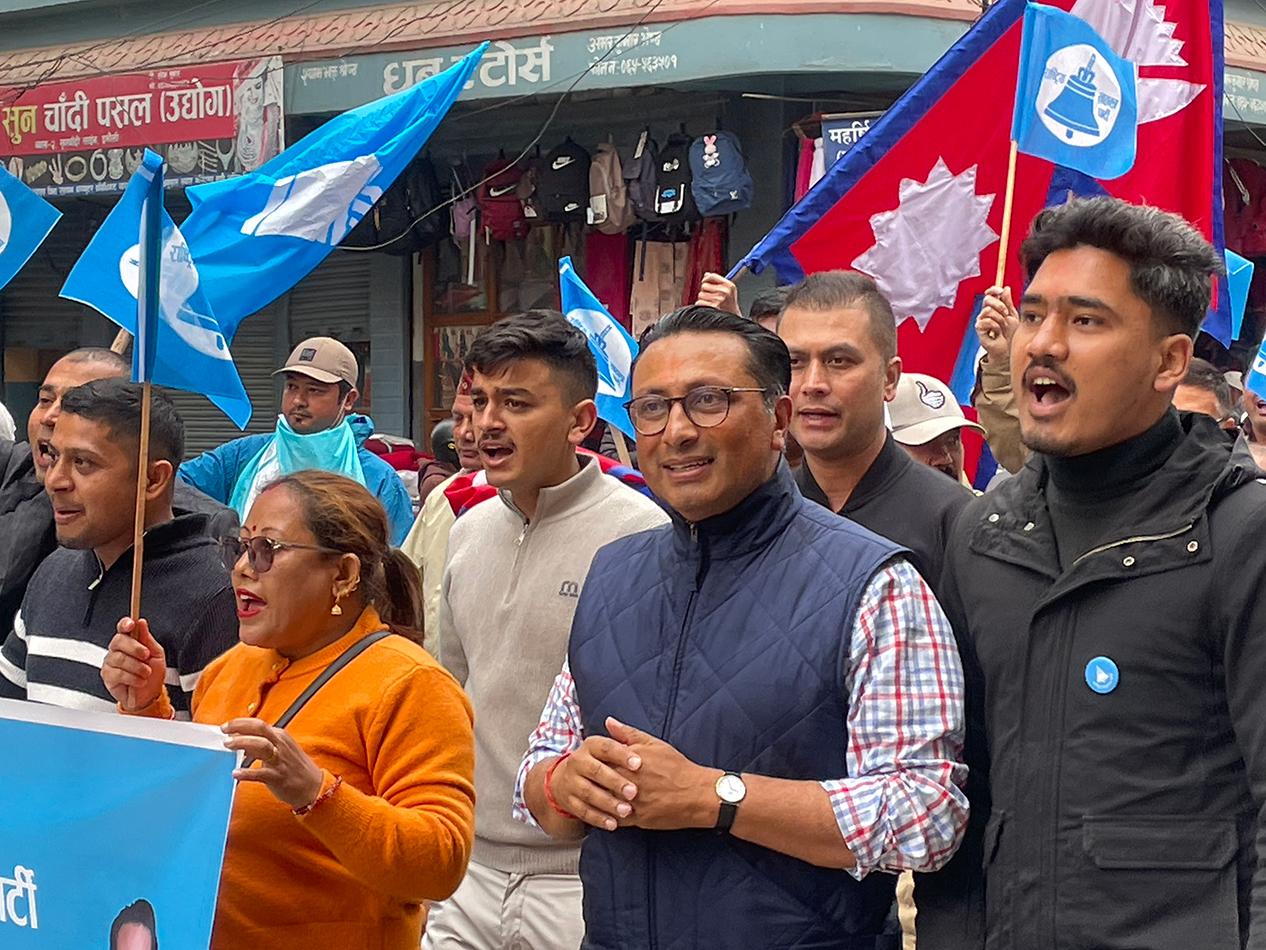
Swarnim Wagle, Vice Chair of the Rastriya Swatantra Party, during an election campaign in Damauli on February 16. Photo: Krishna Neupane / RSS
In Morang-2, Nepali Congress candidate Minendra Rijal posted a video on his Facebook page addressing voters in Rangeli and seeking their votes. In the video, Rijal says that if he is elected from Morang-2, the responsibility of building the bridge will be his. He also claimed during the campaign that the bridge was not built in the 2022 House of Representatives election because he was not allowed to contest.
In Kaski-2, UML candidate Rashmi Acharya has also been seeking votes by promising development. In a speech delivered in Pokhara on February 7, broadcast live on his Facebook page, he said, “There are places in Kaski-2 with abundant tourism potential. Currently, the average stay of a tourist visiting Pokhara is two days. If we can develop this area and increase the stay to four or six days, Pokhara’s income will double or triple. We will work accordingly.”
The primary role and responsibility of a Member of the House of Representatives is to make laws and ensure proportional distribution of development across the country through those laws. However, candidates for parliament continue to woo voters by distributing promises and dreams of development during election campaigns. This trend is evident again this time.
Observing the promises made by candidates during election campaigns, the Nepali proverb “talking one thing while carrying a load elsewhere” seems apt. Those contesting elections for the role of lawmaking and overseeing the implementation of laws are distributing development projects as an election-winning strategy. In doing so, they are sharing dreams – both feasible and infeasible.
Candidates are promising to build roads, bridges, schools, temples, and water taps if elected. Yet, these are not the responsibilities of a Member of the House of Representatives. The Constitution clearly outlines their five primary duties: forming the government through the House of Representatives, passing the government’s budget, overseeing the government’s work, debating and enacting laws based on bills introduced by the government, and conducting parliamentary hearings for appointments to constitutional bodies.
Those who seek to work in the House of Representatives are campaigning as if they will bring waves of development at the local level and act as “saviors” for all public problems. However, such claims do not fall within the constitutional scope of their duties, responsibilities, and authority. If existing policies and laws create obstacles to development work, it is the responsibility of MPs to initiate reforms. Their role is to raise citizens’ problems and grievances in Parliament and bring them to the government’s attention. But candidates have not explained how they plan to fulfill their roles as lawmakers. Instead, they are distributing miraculous dreams of transforming the country through development projects if elected.
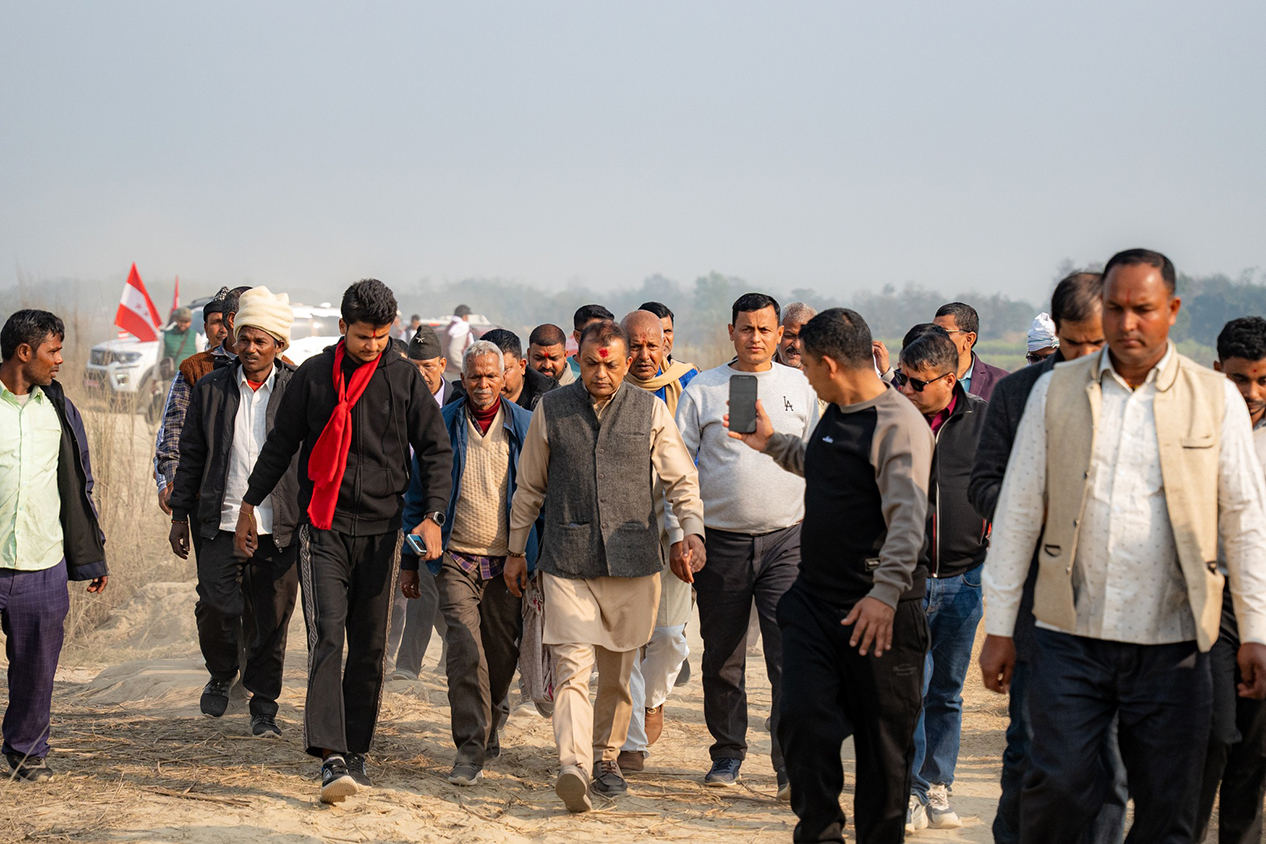
Nepali Congress President Gagan Kumar Thapa heading to inspect the stalled bridge over the Bagmati River in Sarlahi. Photo: Thapa’s Facebook page
Former minister and UML leader Bidhya Bhattarai says that instead of distributing promises of development, candidates should clearly explain their roles to voters. According to her, grand development rhetoric ultimately creates problems for the leaders themselves. She says, “The kinds of promises candidates are making today to win over voters – when those promises are not fulfilled tomorrow – they themselves will not be able to answer for what they said. As a result, the hope distributed today will turn into disappointment tomorrow.”
Bhattarai, who was elected to the House of Representatives from Kaski-2 in the 2019 by-election and again in 2022, says she did not make development promises during her campaign. “A Member of Parliament is meant to lead policy and make laws. As a representative of the people, the role is to raise citizens’ voices in Parliament and convey them to the government. When I went for election campaigning, I clearly said that bringing development projects is not my role; rather, I would raise my voice in Parliament for equitable development,” she says.
She observes that some individuals aspiring to represent the federal Parliament neither understand that an MP is not responsible for doing everything nor are they able to explain this to others. “There is a misconception that an elected representative does all the work, which is not correct. Representatives have a defined scope,” she says. “The House of Representatives is one organ of the state, and it must coordinate and collaborate with other organs. If a Member of the House of Representatives were to do the work of all levels, there would be no need for other bodies.”
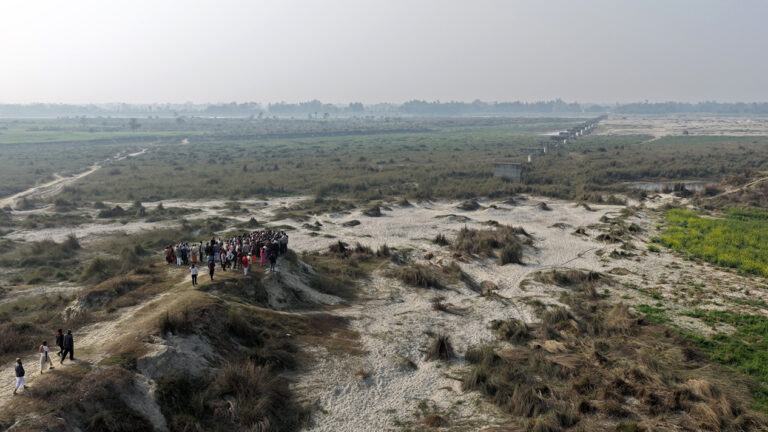
The stalled Bagmati Bridge in Sarlahi. Photo: Gagan Thapa’s Secretariat.
The Constitution clearly delineates the responsibilities of the federal, provincial, and local levels. Small and medium-scale development projects are to be implemented by local and provincial governments, while large projects fall under the responsibility of the federal government. Yet candidates present themselves before voters as if they alone will accomplish everything. Former National Assembly member and federalism and planning expert Khim Lal Devkota says, “Candidates in the House of Representatives elections are campaigning as if they themselves will carry out the work meant for local, provincial, and federal governments. They are asking for votes saying they will bring budgets for local roads, school buildings, bridges, and so on. This practice is wrong.”
Problems caused by draining the state coffers
Every year, when the federal government prepares the budget, there is a tendency among high-ranking officials and influential leaders to channel as much funding as possible into their own districts and constituencies. The Constitution envisions proportional and equitable distribution of state resources. Yet powerful leaders entrusted with implementing that Constitution often focus on placing projects and pouring budgets into their own areas in the run-up to elections. Prime ministers, ministers, and top party leaders, in particular, have been known to concentrate budgets in their constituencies and exert dominance over state funds. When their party is in government, they try to secure as many projects as possible for their electoral constituencies and then use those achievements to win re-election. This has been the prevailing practice.
According to former minister Bhattarai, this practice has led voters to expect development promises during elections, and candidates feel compelled to distribute such dreams. She says, “If an MP becomes a minister, they are not supposed to look after just one constituency. They should design and implement plans based on development indicators. Because limited individuals have exploited resources for election-focused development, others are also forced to make development promises.”
She argues that to correct this tendency, laws ensuring proportional and inclusive development are necessary. “Until laws guaranteeing proportional, inclusive, and socially just development are enacted, development will not be distributed equitably. MPs themselves must play that role,” she says.
The institutional beginning of distributing state funds for election-oriented development largely came through the Infrastructure Development Fund in the national budget, popularly known as the “MP Development Fund.” Under this scheme, Rs 60 million per constituency was allocated for MPs to spend on projects of their choice in their electoral constituencies. The program became controversial, as the funds were allegedly misused and distributed among party cadres in the name of development. In the fiscal year 2021/22 budget, then Finance Minister Bishnu Poudel scrapped the allocation under the MP Development Fund.
There had also been parliamentary objections that the fund discriminated among MPs of equal status. Only directly elected MPs were eligible for the Parliamentary Infrastructure Development Fund, while proportional representation MPs were excluded. Even after the fund for directly elected MPs was cut, lawmakers strongly lobbied during budget preparations to reinstate their authority to mobilize funds in their constituencies.
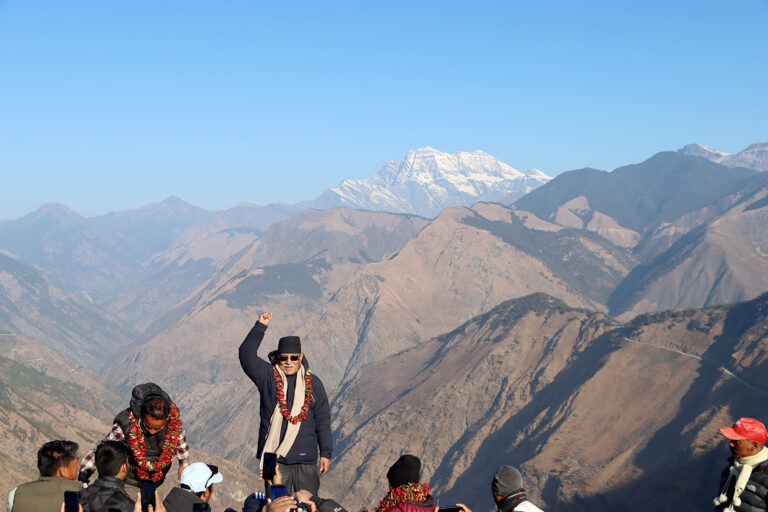
Pushpa Kamal Dahal, coordinator of the Nepali Communist Party, meeting voters in Putha Uttarganga Rural Municipality-13 of his constituency, Rukum (East), on February 16. Photo: Srijana Karki / RSS
As a result, in the fiscal year 2023/24 budget, then Finance Minister Prakash Sharan Mahat revived the MP Development Fund, allocating Rs 50 million per constituency. However, in a writ petition filed at the Supreme Court, the Court ruled that spending based on the personal discretion of select representatives was inconsistent with the concept of planned development and good governance, and halted the implementation of such budget allocations. Even while preparing the current fiscal year 2025/26 budget, MPs lobbied for discretionary spending authority in their constituencies. Unable to allocate funds directly due to the Supreme Court’s order, an indirect route was taken – channeling funds through the Ministry of Physical Infrastructure and Transport under the title of “Constituency Strategic Road Plans.”
Similarly, under the Ministry of Urban Development’s budget, constituency-focused allocations were made under programs such as Settlement Development, Integrated Urban Planning, and Road Infrastructure Development. The ministry prepared budgets centered on constituencies nationwide in the name of road improvements, settlement development, and local infrastructure.
Federalism and planning expert Devkota argues that the current system – where MPs can become ministers and concentrate budgets in their own constituencies – encourages candidates to make development promises in hopes of bringing funds when their party forms the government. Therefore, he says, the system itself needs reform. “There should be a constitutional provision preventing MPs from becoming ministers. That would help them focus on their designated roles,” he says. “The Constitution should also specify limits such as two terms as Prime Minister, three times as minister, and only two consecutive terms as an MP.”
When federal lawmakers act as development agents at the local level, it also affects the functioning of local governments. In seeking roles even in minor local activities for electoral gain, MPs often disrupt local governance. In cases where local governments and provincial MPs belong to different political parties, political conflict between them has also emerged.
Laxmi Devi Pandey, chairperson of the National Association of Rural Municipalities in Nepal, says regarding the problems caused when House of Representatives members bring small-scale projects to the local level: “As MPs insist on their presence even in minor works, it has created duplication, triplication, and disorder. We are telling them not to come carrying projects worth a few hundred thousand rupees but to focus on their assigned responsibilities.”
Pandey adds that if elected MPs to the House of Representatives enact good laws, development will follow nationwide. “Their role is to make laws. If good laws are made, development will also proceed effectively. There is confusion about federalism due to the failure to enact timely and robust laws,” she says.