Kathmandu
Tuesday, July 21, 2026





How has the embossed number plate project been stuck in a vicious cycle for a decade due to government forcefulness, public dissatisfaction, and various court orders?
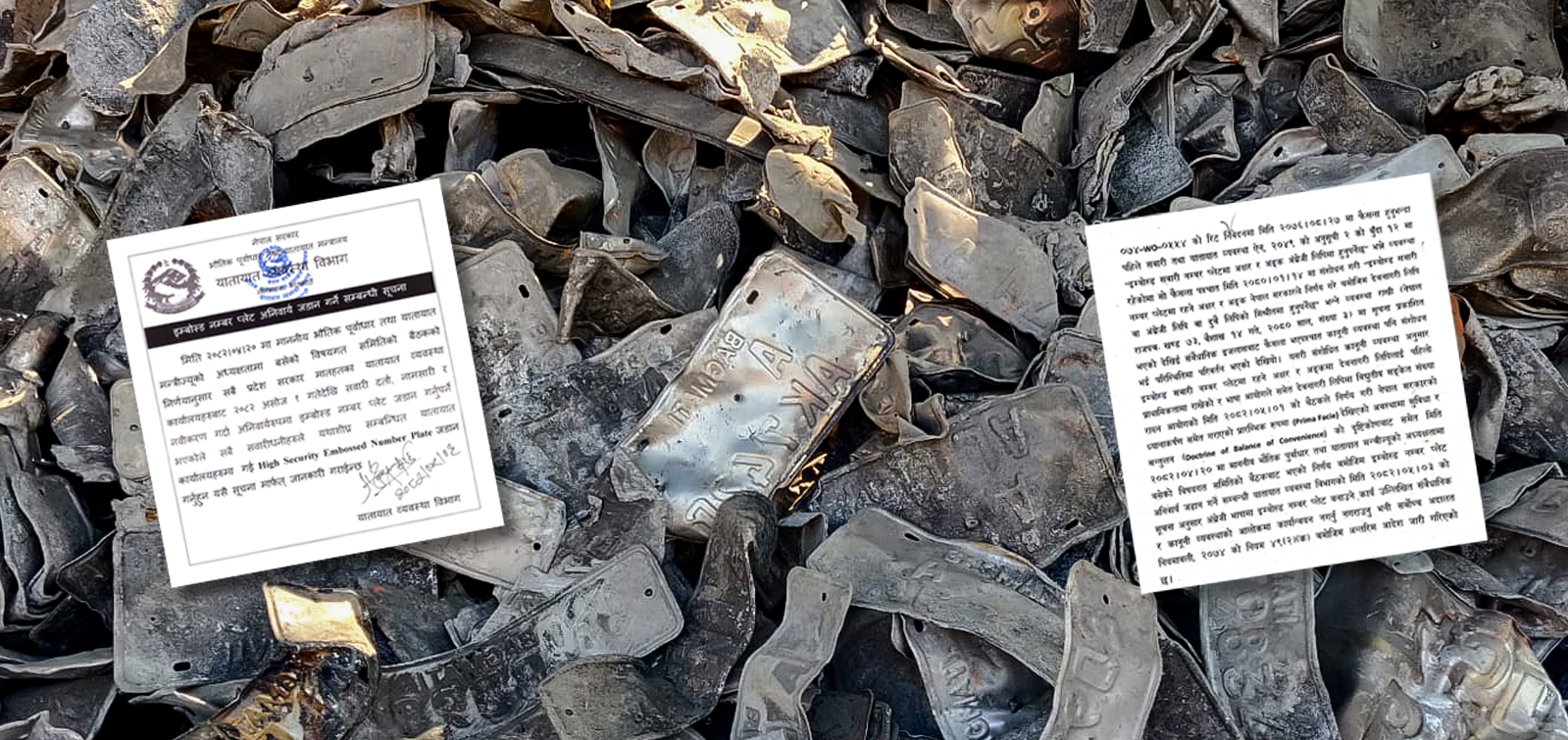
On 8 February 2026, the Supreme Court issued an interim order regarding embossed number plates for vehicles. This has added further confusion to an issue that has remained controversial and uncertain for the past 10 years due to disputes over language, installation fees, and complicated procedures.
Contradicting its own decision made six years ago, the Supreme Court has now issued an interim order not to use English on embossed number plates. While this opens the door to using the Devanagari script in line with widespread demands to include Nepali numerals and letters, it has also deepened the uncertainty. In its interim order, the apex court interpreted that, constitutionally, Nepali written in the Devanagari script is the official language for government business and therefore must be given first priority on embossed number plates.
Installation work has been halted after the embossed plate factory and the server containing vehicle owners’ data were burned during the Gen Z revolt on September 9 last year. The Department of Transport Management has kept the project suspended. It remains to be seen how the Supreme Court’s interim order will affect the project’s future. Since this is not a final verdict, questions remain: What will happen to the work already completed? What about the government’s investment in the contract process? What about vehicle owners who have already installed English-language plates? And what is the overall future of the embossed plate project?
Launched a decade ago with the primary objective of making vehicle monitoring and management more scientific, the embossed number plate project has become synonymous with controversy and confusion. Although concerns about privacy breaches were raised, the main issues have been the language dispute (English vs. Devanagari), high installation fees, and the hardship caused by the government’s forceful implementation without adequate time for compliance.
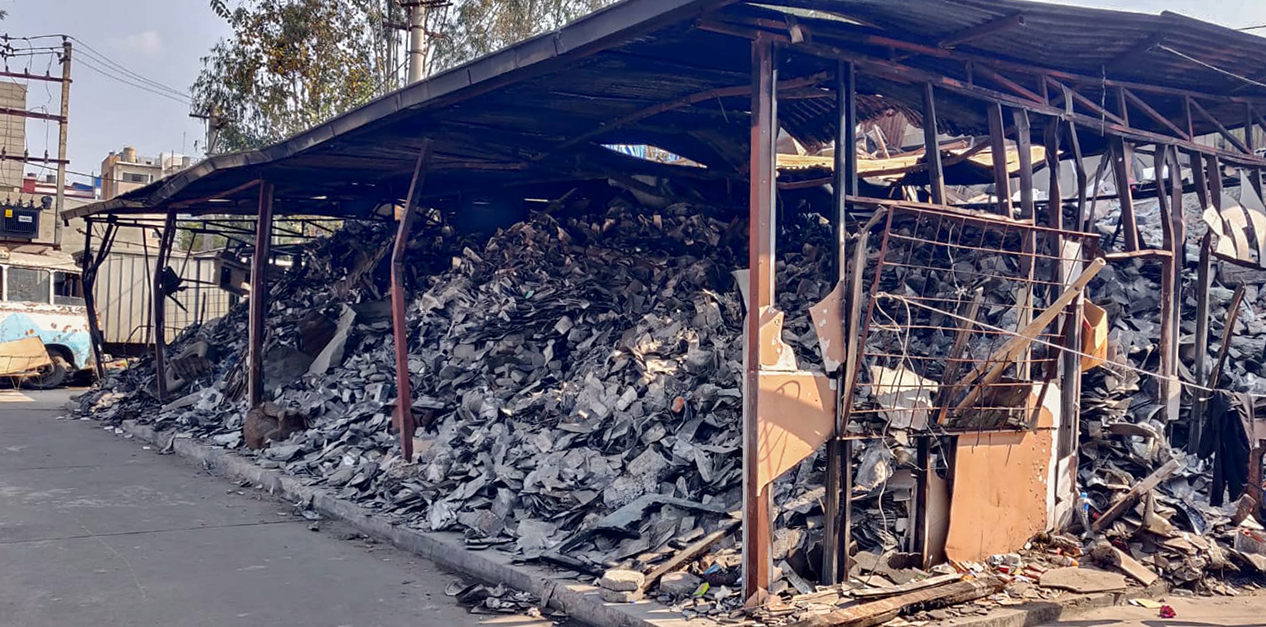
Embossed number plates burned during the arson attack on the Department of Transport Management premises on 9 September during the Gen Z movement. Photo: Bhasha Sharma
Although the agreement aimed to complete the work within five years, only about one percent has been completed in nine years of implementation. There are approximately 5.8 million vehicles in the country, from two-wheelers to four-wheelers. Of these, only about 80,000 vehicles have had embossed plates installed so far.
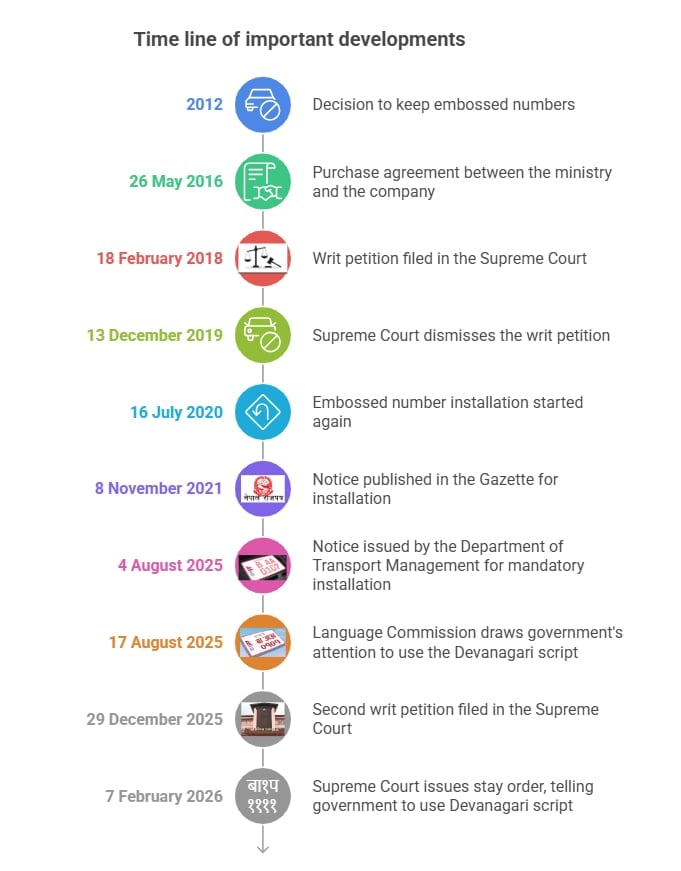
On 30 May 2016, a procurement agreement was signed between the Ministry of Physical Infrastructure and Transport, the Department of Transport Management, the U.S.-based company Decatur, and Bangladesh’s Tiger IT. The contract was worth 43.788 million US dollars (about NPR 4.78 billion), with the goal of installing embossed plates on 2.5 million vehicles by 2078 (2021) and handing over the printing factory in operational condition to the government. However, with only one percent completed, the project’s dire state is evident.
Force instead of persuasion
From the beginning, citizens were unhappy about being required to replace their existing number plates with expensive embossed ones. The complicated procedures at transport offices further added to public frustration. As a result, many vehicle owners effectively boycotted the government’s plan by simply ignoring it.
However, the government neither adequately explained the importance and necessity of embossed plates nor addressed complaints about fees and procedures. Having already signed a procurement contract with a foreign company, the government feared financial losses and wasted plates. Consequently, it adopted a forceful policy approach.
Installation fees are Rs 2,500 for motorcycles, Rs 2,900 for three-wheelers, Rs 3,200 for four-wheelers, and Rs 3,600 for heavy vehicles. Payment must be made at a bank before filling out the form. The department then sends the order for printing, and the relevant transport office installs the plate. The process requires standing in multiple lines across different sections, often taking an entire day.
The Auditor General’s 62nd Annual Report (2082 BS) also noted that high fees discouraged citizens. The report stated that “without ensuring benefits and returns from installation, setting fees higher than cost has discouraged service seekers from adopting embossed plates.”
Meanwhile, the use of English instead of Nepali script sparked continuous opposition from citizens and language advocates. The issue has reached the Supreme Court twice. In 2019, the Court ruled that English plates were permissible. However, in the recent interim order (February 8, 2026), it directed that English should not be used on the embossed number plates.
The Auditor General’s 62nd Annual Report (2082 BS) also noted that high fees discouraged citizens. The report stated that “without ensuring benefits and returns from installation, setting fees higher than cost has discouraged service seekers from adopting embossed plates.”
Since the beginning, there has been a demand to preserve the country’s original language and script. Transport Management Department Director Shreekant Yadav does not prefer calling it a controversy, instead calling it an “obstruction.” He says, “The department only implemented the government’s decision.” However, he admits the fees are expensive for citizens.
According to Yadav, Nepal’s embossed number plates are made of aluminum, retro-reflective, and stamped with raised letters and numbers meeting international standards. They include Nepal’s flag, a security hologram, and an RFID (Radio Frequency Identification Device) chip. Once installed, they cannot be altered or replaced with fake plates. “From a legal and security standpoint, embossed plates are very important but the government has failed to properly inform the public,” he says.
Such number plates contain a special chip that can be read by electronic devices, making them important for security purposes. That is why they are branded as “high security” number plates. The embossed number plate system was introduced under a plan to implement high-security plates aimed at preventing vehicle theft, curbing revenue evasion, controlling various criminal activities, and modernizing vehicle management in a more scientific way. When a vehicle fitted with an embossed plate passes through an RFID gate, the information is transmitted to a central server. This allows authorities to track the vehicle’s location in real time. As a result, vehicles can be effectively monitored, and even stolen vehicles can be traced and apprehended.
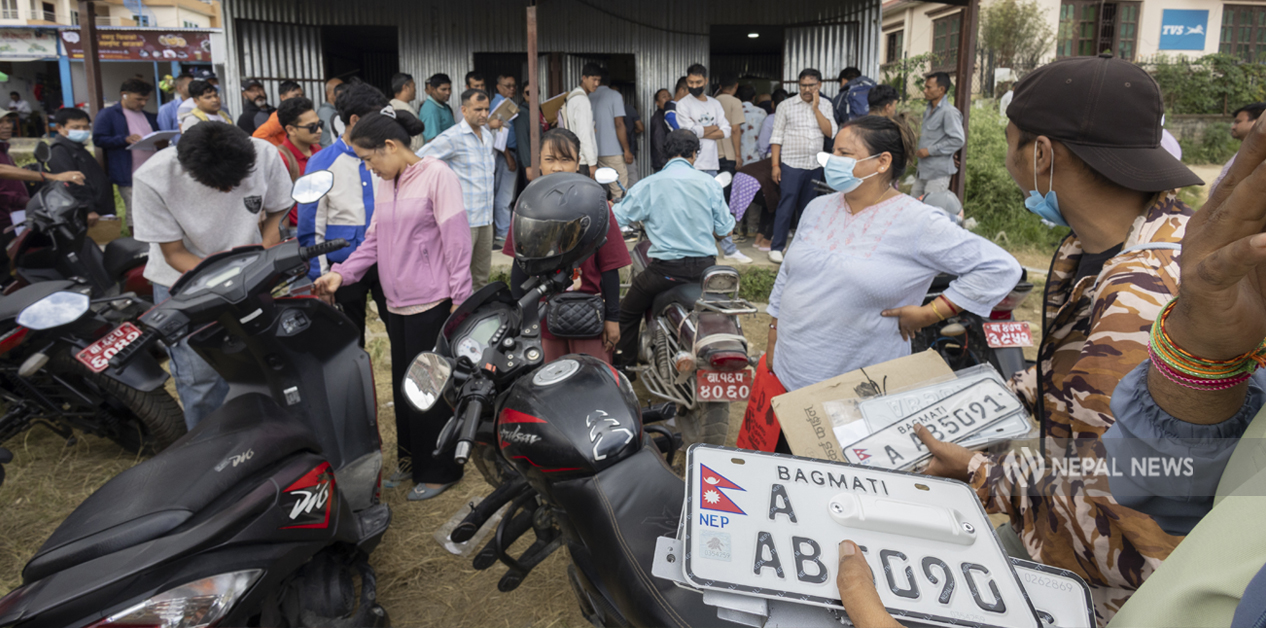
People at the Transport Office to install embossed number plates. Photo: Bikram Rai.
Since the company failed to complete the number plate installation work on time, its deadline has been extended twice. According to Ganeshman Singh Rai, Information Officer at the Department of Transport Management, after the first extension expired on 27 November 2025, the contract period was extended again by three years, pushing the deadline to 26 November 2028. The government has so far paid the company one billion rupees.
Since the project had already moved forward and public funds had been spent, the government continued to pressure vehicle owners to install the new number plates until the Gen-Z movement, rather than taking the approach of educating citizens and encouraging them to adopt the new technology voluntarily. On 19 August 2025, the Department of Transport Management issued a notice stating that, in accordance with a decision made by a sectoral committee meeting chaired by the Minister for Physical Infrastructure and Transport, embossed number plates would be mandatory from 17 September 2025. The notice further stated that embossed number plates would be compulsory during vehicle registration, ownership transfer, and renewal of registration certificates. Therefore, all vehicle owners were instructed to promptly visit transport offices under their respective provincial governments to install high-security embossed number plates.
Ironically, the government aggressively pushed installation without ensuring the necessary roadside technology to read these plates.
The notice created further distress. Vehicle owners who had previously ignored the scheme began flocking to transport offices, fearing penalties. Long queues formed daily. People complained of standing for hours at multiple counters just to install a single plate, fueling frustration and anger.
Because such complaints and frustrations from vehicle owners were raised only at an individual level, they did not strongly reach the government. However, on 25 August 2025, the Federation of Nepal National Transport Entrepreneurs issued a statement declaring that it would not participate in a program aimed solely at revenue collection through number plate installation. The federation also urged the Ministry of Transport to develop the necessary physical infrastructure and technology capable of reading the new plates.
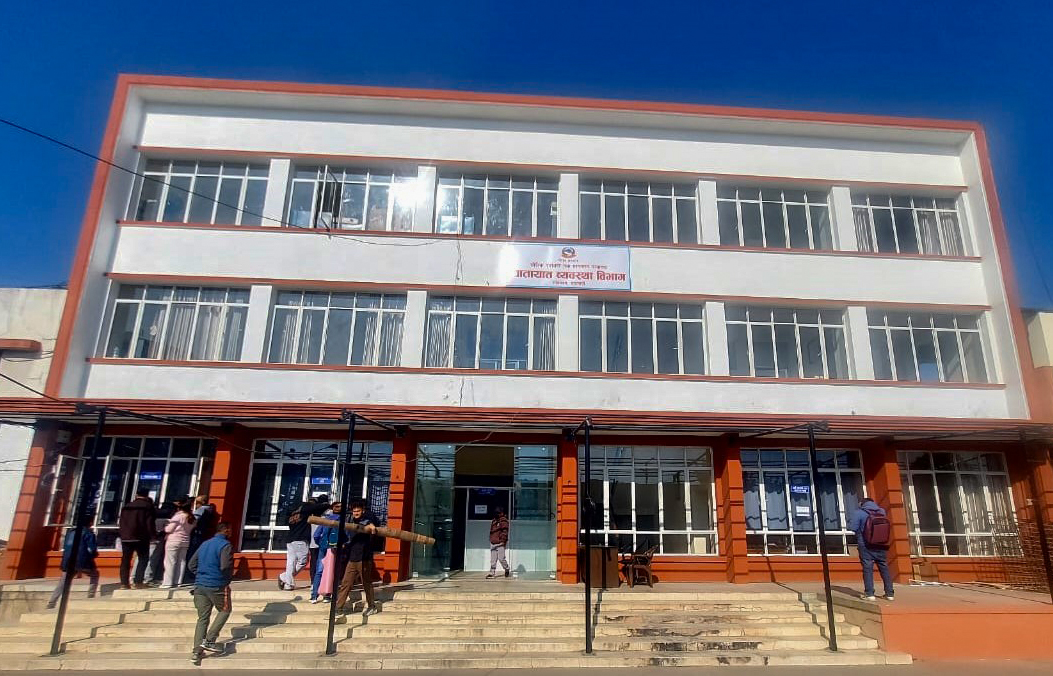
Office of the Department of Transport Management. Photo: Department’s website.
A project started without adequate preparation
The installation of embossed number plates began on 21 August 2017 through transport offices.
The idea of embossed number plates had already been mentioned in the annual budget of the Ministry of Physical Infrastructure and Transport during the 2069 BS (2012/13) government led by Baburam Bhattarai. Later, on 28 June 2015, during the government led by Sushil Koirala, a technical committee was formed under the coordination of then-Joint Secretary Rabindra Man Shrestha. The committee was tasked with calling for tenders for high-security number plates and holding discussions with stakeholders regarding RFID implementation.
The agreement was signed by then-Director General of the Department of Transport Management, Chandra Man Shrestha, and Michel Goffin on behalf of the supplier. The contract specified the “production, distribution, and IT infrastructure development for high-security embossed number plates.”
On 23 May 2016, the Department of Transport Management informed the supplier that the tender had been approved. On 27 July 2017, the government led by Sher Bahadur Deuba amended Schedule 2 of the Vehicle and Transport Management Act, 2049, under Section 178, by publishing a notice in the Gazette, thereby deciding to implement embossed number plates. Section 178 allows the Government of Nepal to make necessary amendments to the schedule through publication in the Nepal Gazette. This provision enables any government to introduce changes by gazette notification. However, the original Act itself was not amended to explicitly include embossed number plates. A draft of the “Vehicle and Transport Management Bill 2081 BS” had clearly mentioned embossed plates, but it never reached Parliament.
The Ministry’s notice regarding implementation was published in the Nepal Gazette on 8 November 2021. It stated that embossed plates would be mandatory for new registrations from 17 November 2021; for ownership transfers from 13 February 2022; and for registration renewals from 15 May 2022. However, the government failed to fully implement this plan.
On 23 May 2016, the Department of Transport Management informed the supplier that the tender had been approved. On 27 July 2017, the government led by Sher Bahadur Deuba amended Schedule 2 of the Vehicle and Transport Management Act, 2049, under Section 178, by publishing a notice in the Gazette, thereby deciding to implement embossed number plates.
Considering disputes over language and fees, the rush to distribute plates without installing necessary technology, and other issues, it appears the government moved ahead without sufficient preparation, consultation with stakeholders, or comprehensive planning.
Confusion increased by two different court orders
The Supreme Court’s two different rulings – one six years ago and another recently – have deepened the confusion.
When embossed plates were first introduced, rumors spread that the chip embedded in them would violate personal privacy. Based on such concerns, Bharat Kumar Basnet of Kathmandu Metropolitan City–3 filed a writ petition at the Supreme Court on 18 February 2018, seeking to halt the program. He demanded that the RFID chip not be used and that number plates be written in Devanagari script.
On 13 December 2019, the Constitutional Bench of the Supreme Court dismissed the petition, ruling that the chip could not be accessed from abroad and did not violate privacy. The Court also cited examples such as passports, licenses, and educational certificates, stating that using English on number plates did not undermine national sovereignty.
After around 5,000 embossed plates had been installed, another writ petition was filed raising concerns about privacy and the need to use Devanagari script. After the 2019 ruling dismissing the petition, installation in English continued from 16 July 2020.
However, while English-language embossed plates were being installed, a second writ petition was filed on 29 December 2025. On 8 February 2026, a joint bench of Justices Kumar Regmi and Mahesh Sharma Paudel issued an interim order directing that number plates must use Devanagari script. The Court interpreted that the amended law prioritizes writing letters and numbers in Devanagari. The interim order also halted implementation of the decision made on 5 August 2025 to make embossed plates mandatory.
On 17 August 2025, the Language Commission had also urged the government to use the Devanagari script on number plates.
New plates, same status
Currently, two types of number plates can be seen on the roads: traditional plates written in Nepali and embossed plates written in English letters and numbers. So far, about 80,000 vehicles, mostly government and some private vehicles, have installed embossed plates. However, these vehicles are not being monitored under the promised modern technology because the necessary system has not been fully set up. To monitor embossed vehicles, RFID gates were supposed to be installed. However, most of these entry gates remain unbuilt.
According to Transport Management Department Director Yadav, there is currently no practical difference between vehicles with embossed plates and those with traditional plates. He also said that the server was destroyed during the arson attack on September 9 last year during the Gen-Z movement, creating further problems.
The department also lacks a unified national database of vehicles. “Since federalism was implemented, records are maintained at the provincial level. A centralized and accurate database cannot be maintained until embossed plates are installed nationwide,” he says.
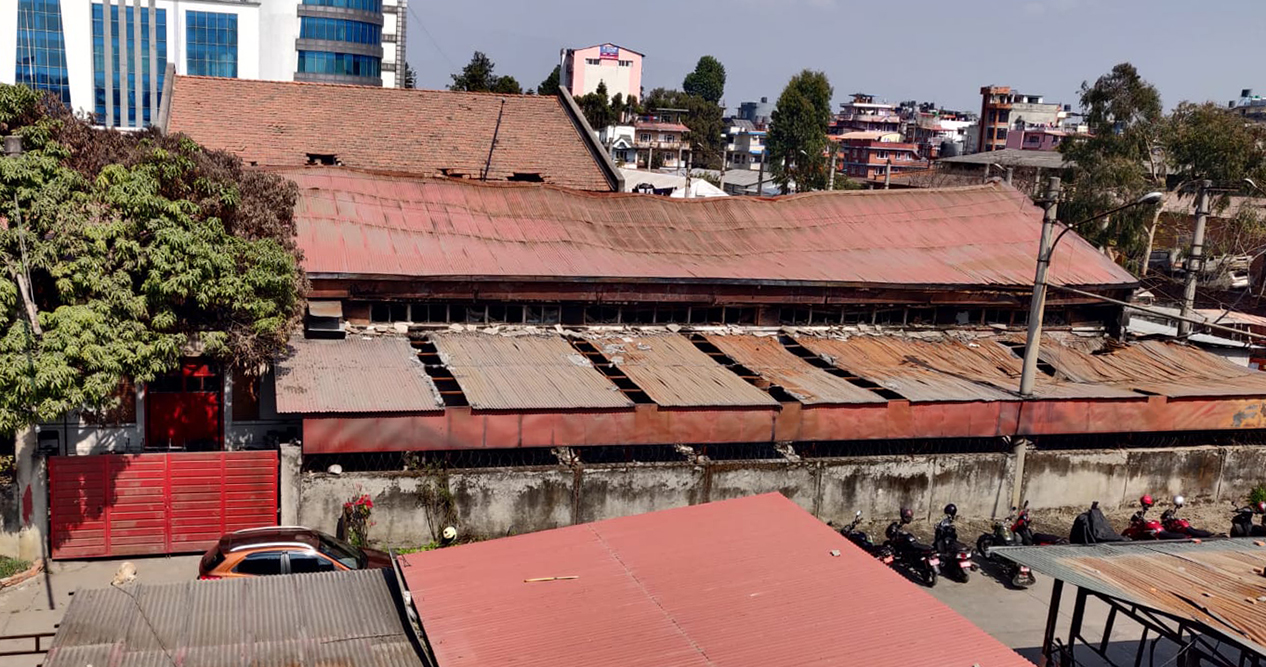
Embossed number plate printing factory in Minbhawan vandalized during the Gen Z protest. Photo: Bhasha Sharma.
The 23rd Annual Report (2082 BS) of Parliament’s Public Accounts Committee also mentioned audit irregularities raised by the Office of the Auditor General. It noted that although RFID gates were intended to monitor vehicles with embossed plates, they have not been constructed.
According to the procurement contract between the government and the contractor, 10 RFID gates were to be installed – five inside Kathmandu Valley and five outside. Additionally, 10 handheld devices were to be provided to traffic police for roadside monitoring. However, only two gates – at Nagarjun and Nagdhunga inside the valley – have been constructed so far.
A complaint alleging irregularities in the embossed plate project was filed with the Commission for the Investigation of Abuse of Authority. In March 2024, the Commission requested related files from the Department of Transport Management. When asked about the current status, spokesperson Suresh Neupane stated that investigations are confidential.
Amid strong public dissatisfaction and protest against the government’s forceful imposition of embossed plates, the factory became a target of arson during the Gen-Z movement. With the printing factory burned and the final court verdict pending, the Department of Transport Management is now waiting for the Supreme Court’s decision.
Senior Advocate Jyoti Baniya says the prolonged confusion over embossed plates will ultimately burden both the country and its citizens. “The longer this drags on, the more the government’s costs will increase. And when government costs increase, the burden ultimately falls on citizens,” he says. “Because the government failed to explain the value of embossed plates to the public, the dispute has dragged on. Now this knot must be untied.”