Kathmandu
Saturday, February 21, 2026





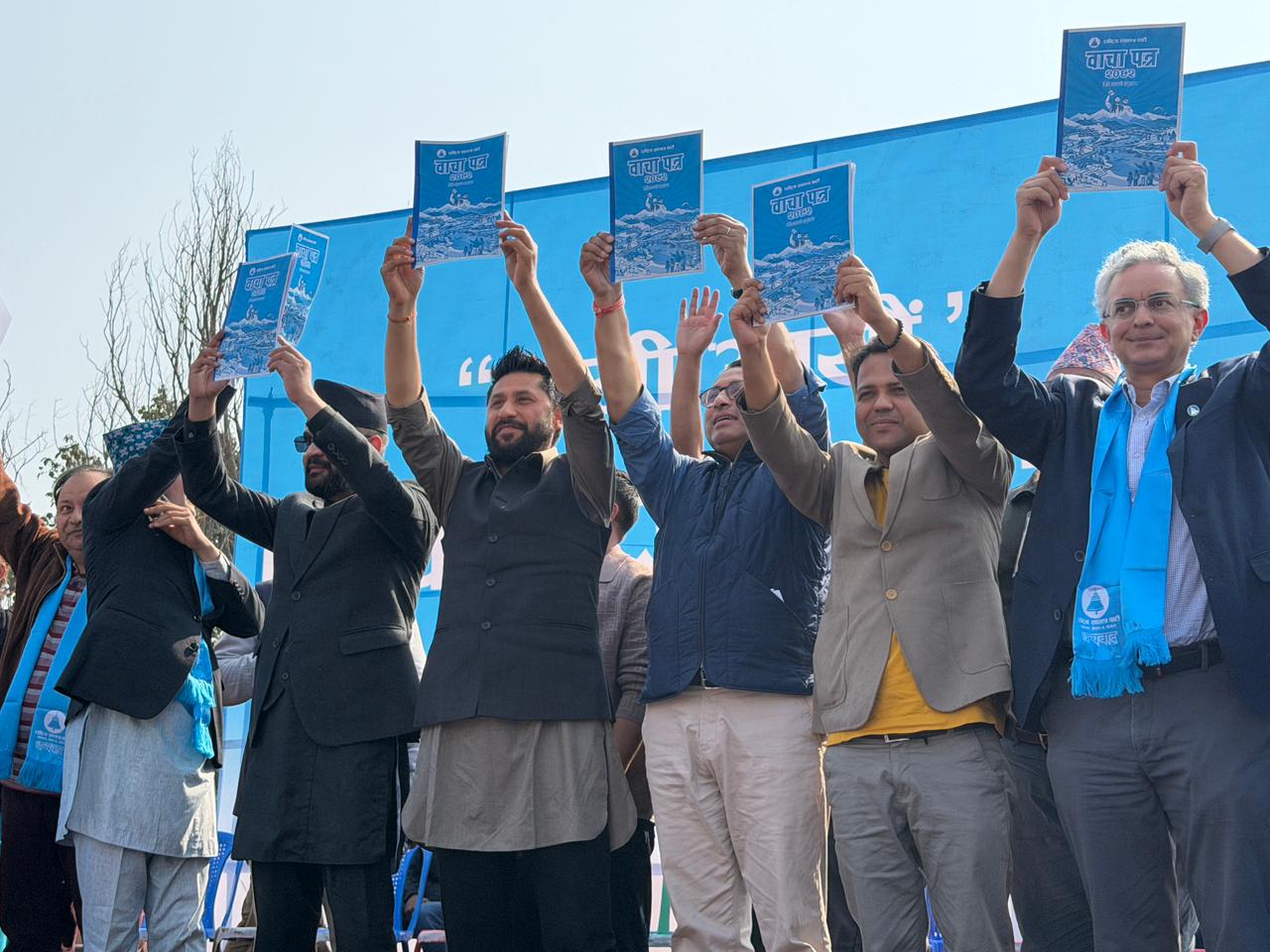
KATHMANDU: As Nepal gears up for the March 5 elections, the Rastriya Swatantra Party (RSP) has unveiled a 22-page manifesto outlining 100 policy commitments, promising sweeping reforms from governance to the economy. Dubbed the “Commitment Paper 2082” and anchored by the “100 Pillars of Policy Departure,” the document signals the party’s ambitious agenda to reshape administrative structures, boost productivity, and chart a bold course for Nepal’s future.
Framing a roadmap for government formation after March 05 and the forthcoming budget, RSP outlined plans for radical transformation in the national economy and governance structures. The manifesto emphasises productivity-led growth, institutional reform, and transparency, signalling the party’s intent to reshape Nepal’s economic and political landscape.
RSP has pledged to conditionally release cooperative and microfinance operators jailed for fraud while reforming the sector’s weak oversight. Nepal News takes a closer look at the Rastriya Swatantra Party (RSP) manifesto and breaks down its key promises and vision. Here is everything you need to know about the party’s plans, from its economic, foreign policy agenda and productivity-led growth strategies to reforms in governance, the judiciary, and political parties.
What is RSP’s manifesto on constitutional reform and national consensus-building?
Rastriya Swatantra Party (RSP) plans to initiate comprehensive constitutional reform immediately upon taking office. Within the first three months, the party will prepare a “Discussion Paper” to engage political stakeholders, experts, and the public, aiming to build broad national consensus on necessary amendments.
The core concepts RSP intends to propose include: a directly elected executive to strengthen accountability; a fully proportional parliament to ensure fair representation; a system in which Members of Parliament cannot simultaneously serve as ministers, maintaining separation of powers; non-partisan local governments to promote local democracy; and an improved provincial structure for effective governance and resource distribution.
What is RSP’s manifesto on judicial reform and institutional governance?
Rastriya Swatantra Party (RSP) aims to establish a judicial system based on meritocracy, transparency, and accountability, free from political influence and factional sharing. The party plans to end party-driven or “sharing-based” recommendations in appointments to the High Court and Supreme Court, replacing them with a competitive, merit-based selection process. Judges chosen on merit will be recommended to the Judicial Council, while ensuring constitutional provisions for reservation and inclusivity are fully respected.
To increase judicial transparency, RSP will explore the live broadcast of court proceedings, allowing citizens to witness hearings and hold the judiciary accountable.
In terms of institutional governance, RSP will amend key laws, including the CIAA Act, Constitutional Council Act, and Judicial Council Act, to strengthen the independence, clarity, and accountability of constitutional bodies. The party will clearly define the policy decision-making authority of the Cabinet to prevent legal loopholes or exploitation by interest groups. Furthermore, all bills will include a financial and regulatory impact analysis, ensuring that legislation is both effective and aligned with national interests.
What is RSP’s manifesto on political party reform?
Rastriya Swatantra Party (RSP) seeks to strengthen democracy, reduce corruption, and ensure leadership accountability through comprehensive political party reform. The party plans to provide annual grants to nationally recognized political parties based on the number of votes they receive, ensuring transparent public funding tied to electoral performance.
To prevent the concentration of power and the repeated re-election of the same individuals, RSP will amend the Political Parties Act and Election Act, closing loopholes that allow money misuse and political entrenchment. Leadership within political parties will also be time-bound, with party heads limited to two terms, promoting regular leadership transition, internal democracy, and renewal within parties.
What is RSP’s manifesto on foreign policy and diplomacy?
Rastriya Swatantra Party (RSP) places Nepal’s sovereignty, geographical integrity, and national interest above all else and adopts a policy of Balanced and Dynamic Diplomacy to turn shifting global geopolitics and the rise of neighboring powers into concrete opportunities for national development. Recognizing the strategic interests of neighboring countries and changes in the global power balance, RSP aims to safeguard Nepal’s interests by transforming the country from a “buffer state” into a “vibrant bridge” through trilateral economic cooperation, regional connectivity, and mutually beneficial partnerships.
RSP will renew development partnership models so Nepal can benefit from the rapid progress made by India over the past decade, particularly in digital public infrastructure, high-speed and high-quality physical infrastructure, economic formalization, balanced growth between manufacturing and services, and overall state capacity enhancement. At the same time, RSP will build structured partnership frameworks with China by mobilizing concessional finance for world-class infrastructure, adopting state-guided socio-economic development programs, and learning from effective inter-provincial competition models. Through this balanced approach, RSP seeks to ensure national interest while positioning Nepal as an active, confident, and development-oriented partner in the region.
What is RSP’s manifesto on economic growth, productivity, and structural transformation?
Rastriya Swatantra Party (RSP) places continuous productivity growth at the heart of Nepal’s economic transformation, emphasizing strong coordination between a risk-taking private sector and a transparent, facilitating public sector. The party envisions a system where the private sector leads job creation and investment, while the government acts as a regulator and facilitator, eliminating rent-seeking, policy exploitation, and bureaucratic obstacles. RSP recognizes that Nepal must harness its youth demographic dividend over the next 10–15 years to avoid falling into a low-income trap.
Under a social market economy, RSP will establish powerful, professional regulatory bodies free from political interference to curb cartels and unhealthy competition. Progress will be measured not only by income growth but also by job expansion, social harmony, and environmental balance, combining liberal economic policies with equitable redistribution via education, health, and social security.
RSP’s economic targets include repealing or improving laws that hinder business, reducing production costs, and maintaining an average annual growth rate of 7% for the next five years, aiming for a per capita income over $3,000 and a national economy nearing $100 billion within 5–7 years. Tax reforms will reduce burdens on citizens while safeguarding revenue, including adjustments for family expenses in income tax. The party will also study the fixed exchange rate with the Indian Rupee with international expertise.
To facilitate investment, RSP will implement a One-Stop Service Center for approvals covering land, forest, and environmental clearances, along with digital, fast, and free business registration. The Revenue Investigation Department will be replaced by professional chartered accountants to monitor revenue and control corruption. Public enterprises will be restructured—some merged, some moved to Public-Private Partnerships, others decentralized—while public projects will be executed in “Mission Mode” with fixed budgets, timelines, and accountability for project heads.
RSP will prioritize National Pride Projects, completing stalled projects within two years and introducing 10 new fast-track, diversified projects in areas like sports, research, and specialized healthcare. Financial regulation will strengthen supervision over cooperatives, microfinance, and non-banking sectors, linking them to the Credit Information Center to prevent over-indebtedness and predatory lending. Small depositors will be protected via an Integrated Savings Protection Fund, and predatory lending will be classified as an economic crime, with digital verification required for large transactions.
Capital markets will be reformed through restructuring of SEBON, NEPSE, and CDSC to allow private sector participation, introduce intraday trading, derivatives, and zero tolerance for insider trading. Investment will be expanded through pension funds, insurance, mutual funds, infrastructure bonds, and access for Non-Resident Nepalis (NRNs), alongside the creation of a commodity exchange under a Public Warehousing Act.
RSP emphasizes a borderless, knowledge-based economy, shifting from labor exports to service exports and IT-driven growth. The Information Technology sector will be declared a National Strategic Industry, with a goal to increase IT exports from $1.5 billion to $30 billion in 10 years, supported by an autonomous IT Promotion Board and Digital Parks in all seven provinces, making Nepal a competitive hub for innovation, digital services, and economic transformation.
What is RSP’s manifesto on energy development, consumption, and export?
Rastriya Swatantra Party (RSP) has set an ambitious goal of achieving 30,000 MW of installed electricity capacity within the next decade, positioning energy as a backbone of Nepal’s economic transformation. To fast-track projects, land acquisition and environmental clearance laws will be amended so that the Ministry of Energy can manage all approvals through a single-window service delivery system, replacing the current fragmented structure involving multiple ministries and departments. The government will also take full responsibility for security arrangements throughout hydropower project timelines.
To realize the objectives of the Energy Development Decade, RSP will introduce a new energy and water resources policy and create strong legal and institutional frameworks to encourage private sector participation across the entire energy value chain. This includes not only generation, but also battery storage, pump storage, technology-based storage systems, transmission, and distribution. The energy trade sector will be opened to private investment, generation licenses will be extended from 35 to 50 years, and legal provisions will enable electricity from solar power, rooftop solar systems, and agro-based solar farms to be sold to the national grid through net-metering. Additional incentives will promote solar farms on barren hill lands with irrigation access.
RSP will prioritize increasing domestic electricity consumption by ensuring land availability, expanding transmission lines, and modernizing distribution systems. Energy-intensive industries—such as steel, cement, herbal processing, data centers, and chemical fertilizer production—will be actively attracted. Electricity tariffs will be restructured, including a special household tariff, to encourage higher usage, with a clear target of raising per capita electricity consumption to 1,500 kWh by 2035.
What is RSP’s manifesto on building a digital economy and transforming Nepal into a technology-driven nation?
Rastriya Swatantra Party (RSP) envisions a comprehensive digital transformation that positions Nepal as a global hub for technology, innovation, and digital services. The party plans to invest heavily in data centers, cloud infrastructure, and high-speed connectivity, while adopting independent and secure digital systems through satellites and advanced technologies to reduce reliance on foreign platforms. Public procurement will prioritize software developed within Nepal, and the Nepal Postal Service will be modernized into a tech-friendly, multipurpose delivery hub capable of supporting e-commerce, logistics, and digital services.
RSP aims to make Nepal a digital-first nation by removing legal and technical hurdles for international payment gateways, fostering a cashless economy to improve transparency and reduce corruption. IT services and software exports will benefit from automatic cash incentives and full income tax exemptions for multiple years, encouraging startups and global competitiveness.
The party also plans to transform Nepal’s energy advantage into a technology export opportunity. Within five years, Nepal will evolve from an exporter of raw electricity to an exporter of Artificial Intelligence and computational power, using clean energy to run server farms and data centers. Instead of selling electricity alone, the country will sell high-value server processing time. A national cryptocurrency policy will be established in the first year, and pilot projects for crypto mining will be developed based on energy availability.
To harness global talent and opportunities, RSP will legally recognize remote work and cross-border service exports by amending the Labor Act. Banking and foreign exchange policies will be improved to facilitate payments for individuals working for foreign companies from Nepal. Additionally, the party will introduce digital nomad visas, co-working centers, and supportive infrastructure to attract international remote workers, positioning Nepal as a modern, innovation-driven economy with both domestic and global impact.
Why does the RSP manifesto propose reviewing Nepal’s fixed exchange rate with the Indian Rupee?
In point 23 of its manifesto, the Rastriya Swatantra Party (RSP) states: “While a fixed exchange rate with the Indian Rupee has been maintained for three decades, we will conduct a study and review of this system with the participation of distinguished international experts.” This makes RSP the first political party in Nepal to openly propose reviewing the long-standing pegged currency system. While the manifesto does not specify why the review is necessary or what alternatives may be considered, the move signals the party’s interest in examining the suitability of Nepal’s pegged system in the modern economic context.
Nepal has maintained a fixed exchange rate with the Indian Rupee since 1993, pegging 1 INR = 1.6 NPR, primarily to facilitate trade, remittances, and investment from India, its largest trading partner. Analysts highlight multiple advantages of this arrangement, including exchange rate stability, inflation control, and the facilitation of cross-border trade and investment. By minimizing currency fluctuations, the peg reduces transaction costs for businesses, lowers uncertainty for investors, and strengthens bilateral economic ties.
India is Nepal’s largest trading partner, accounting for over 64% of total trade, the main source of foreign investment, and the sole provider of trade transit for the landlocked nation.
A pegged currency system, also known as a fixed exchange rate, links a nation’s currency value to another currency or a basket of currencies, providing a predictable environment for international trade and investment. Maintaining the peg requires careful monetary management by the central bank to stabilize the money supply and inflation, contributing to a more stable macroeconomic environment-a factor that supports long-term growth, investor confidence, and economic planning.
What is RSP’s plan to modernize tourism services and strengthen mountain tourism safety?
Rastriya Swatantra Party (RSP) aims to modernize Nepal’s tourism sector by making it digital, safe, and globally competitive. A unified digital platform will be developed to integrate study permits, trekking permits, national parks, tourism offices, heritage sites, and all permit, ticket, and fee systems into a single interface. This reform will significantly reduce time, cost, and administrative burden for tourists while improving transparency and service quality.
RSP will introduce major reforms in mountain tourism safety and management, particularly in the Himalayan region. The region will be classified into three altitude categories from 6,000 to 8,000 meters, and modern technologies such as drones and digital monitoring systems will be deployed to strengthen safety, search, and rescue operations—especially for climbers above 6,000 meters.
Leveraging Nepal’s geographical advantage, RSP will also implement targeted policies to develop hill stations in mountainous areas located within 1.5 hours of the India–Nepal border, promoting short-stay tourism, regional connectivity, and local economic growth while diversifying Nepal’s tourism offerings beyond traditional destinations.
What is RSP’s plan for strengthening Nepal’s international airports and aviation infrastructure?
Rastriya Swatantra Party (RSP) aims to fully operationalize and strategically expand Nepal’s airport infrastructure to support tourism, trade, and economic growth. Pokhara International Airport and Gautam Buddha International Airport will be brought into full operation by making existing fee-exemption arrangements more effective, ensuring strong international marketing, and undertaking diplomatic initiatives with India to improve entry–exit arrangements and enable ILS (Instrument Landing System) operations.
The capacity of Tribhuvan International Airport will be increased, and the design of the already-prepared new international terminal will be promptly revised to accelerate construction. Looking to the future, RSP will develop plans for a new international airport based on in-depth studies of Nepal’s long-term market demand and global aviation trends, with construction planned for Nijgadh or another suitable alternative location.
To maximize economic impact, airports will be connected to major cities through road and rail networks, with financing managed through a balanced mix of public and private investment, ensuring sustainability, efficiency, and long-term national benefit.
What is RSP’s manifesto on civil aviation reform?
Rastriya Swatantra Party (RSP) is committed to comprehensive civil aviation reform to improve safety, governance, and global credibility. The party will separate regulatory functions and service delivery roles within the Civil Aviation Authority of Nepal by establishing independent bodies, ensuring transparency and eliminating conflicts of interest. To restore international confidence, aviation safety audits will be conducted by international audit teams, with the clear goal of removing Nepal from the global aviation blacklist.
RSP will also reform Nepal Airlines by fully freeing it from political influence and interference. Management and operational responsibility will be opened to experienced private-sector airline operators through competitive processes, while retaining 51 percent government ownership. Financial restructuring will be undertaken with private sector participation, followed by a long-term plan to list the airline on the stock exchange. At the same time, Nepal Airlines will be expanded through a lean, transparent, and corruption-free process, increasing flight capacity by acquiring additional aircraft through open competition and professional management.
What is RSP’s manifesto on investigating illegal wealth and ensuring accountability?
Rastriya Swatantra Party (RSP) is committed to transparency, accountability, and the rule of law in addressing the accumulation of illegal wealth by public officials. The party will conduct thorough, legal, and transparent investigations into the assets of individuals who have held significant public office since 2046 B.S. (1990).
Clear and standardized procedures will be established to identify assets that have been illegally acquired. Once proven, such assets will be effectively seized and nationalized, ensuring that the benefits of misappropriated wealth are returned to the state. Through this approach, RSP aims to deter corruption, uphold integrity in public office, and strengthen public trust in governance, sending a clear message that no one is above the law.
What is RSP’s manifesto on administrative reform and building a professional civil service?
Rastriya Swatantra Party (RSP) aims to transform Nepal’s administration into a professional, neutral, accountable, and efficient civil service. To achieve this, party-affiliated trade unions within government service will be abolished, ensuring that administrative work is free from political influence. The civil service will be modernized with a principle of “fewer people providing more service”, redistributing unnecessary manpower from central offices to frontline service delivery points. Allowances will be standardized, timely, and integrated into basic salaries, and a Civil Service Bill will institutionalize performance-based evaluation, promotions, and career development while legally ending party affiliation across all government positions.
To maintain stability and institutional memory, RSP will establish an Autonomous Transfer Board that ensures predictable transfers, keeping employees in their area of expertise for a minimum duration. Salaries will be revised to ensure a dignified standard of living for civil servants.
RSP will also drive a paperless administration, ending the traditional manual “Tippani” system and making decision-making tech-friendly. Process audits will reduce delays, with files automatically approved or officials held accountable if deadlines are missed. Key services—such as birth registration, social security, licenses, and business registration—will become digital, transparent, and accessible via platforms like tippani.gov.np and paripatra.gov.np, with legally mandated digital signatures to ensure efficiency, accountability, and citizen convenience.
What is RSP’s manifesto on agricultural transformation and productivity?
Rastriya Swatantra Party (RSP) aims to re-establish agriculture as a dignified and profitable profession, ensuring that farmers can achieve wealth through stable markets, transparent subsidies, and modern technology. Agriculture will be directly linked to national food and nutritional security, making it a cornerstone of sustainable development.
To strengthen domestic production, RSP will promote import substitution by negotiating trade agreements and providing tax and customs exemptions for industries that add value to agricultural products. Innovations in Fintech and Agritech will be expanded to improve access to finance, data, and modern farming solutions.
RSP will also optimize land use and productivity by reviewing land-use plans to utilize barren land effectively and promoting land pooling. Investments in irrigation, fertilizers, and mechanization will be prioritized to lower production costs and improve yields. The Nepal Agricultural Research Council (NARC) will be restructured to strengthen research, innovation, and support for farmers nationwide.
How does RSP view the role of the Nepali diaspora in national development?
Rastriya Swatantra Party (RSP) regards Nepalis living abroad as a central force for Nepal’s economic transformation and global influence. Guided by the principle “Once a Nepali, Always a Nepali,” the party recognizes the strong emotional and national bond of Non-Resident Nepalis and seeks to institutionalize their role in nation-building.
RSP supports voting rights for Nepalis abroad and stands in favor of dual citizenship in principle, with limited exceptions based on national interest. Long-standing administrative barriers related to property rights will be removed immediately to ensure dignity, security, and ease for the diaspora.
To mobilize diaspora capital, RSP will provide special legal protection, simplify access to foreign-currency (Dollar) accounts, and ensure clear legal provisions for the repatriation of returns, encouraging investment in large infrastructure, innovation, and productive sectors. Beyond financial contributions, RSP will establish a National Knowledge Bank to directly connect the expertise, skills, and technology of Nepalis abroad with Nepal’s education, health, and industrial development.
RSP also envisions Nepalis worldwide serving as Volunteer Ambassadors, promoting Nepal’s tourism, culture, and investment opportunities. Through the global spread of the Nepali language, art, and identity, the diaspora will strengthen Nepal’s soft power and enhance the country’s standing on the world stage.
What is RSP’s manifesto on border security?
Rastriya Swatantra Party (RSP) is committed to protecting Nepal’s geographical integrity while firmly controlling illegal activities in border areas. To achieve this, RSP will mobilize the Armed Police Force (APF) as a specialized Border Security Force, equipped with modern technology, adequate manpower, and strong physical infrastructure dedicated exclusively to border management.
Advanced systems such as night-vision cameras, drone surveillance, and digital entry–exit record mechanisms will be implemented at border checkpoints to effectively control smuggling, illegal trafficking, and cross-border crimes. Alongside strengthened security measures, RSP will pursue high-level diplomatic initiatives to permanently resolve border disputes and review old treaties and agreements through institutional dialogue based on facts and evidence, ensuring that national interests are protected through credible and sustainable solutions rather than sentiment alone.
What is RSP’s manifesto on addressing Dalit rights and ending caste-based discrimination?
Rastriya Swatantra Party (RSP) acknowledges that the Dalit community in Nepal has faced generations of injustice, exploitation, exclusion, and social stigma due to entrenched social structures, state laws, policies, and societal behavior. This historical discrimination has resulted in high and persistent poverty, prevented the community from developing its skills and potential, and slowed societal progress in technology and modernization.
RSP pledges that the new Head of Government will, in their first address, formally apologize on behalf of the Nepal State for the caste-based discrimination and exclusion endured by Dalit and other marginalized communities. Beyond symbolic gestures, the party will implement robust legal, policy, and institutional reforms to dismantle structural discrimination, promote social inclusion, and create equal opportunities for all, ensuring that marginalized communities are empowered to participate fully in Nepal’s development and modernization.