Kathmandu
Wednesday, July 15, 2026





As Lila Prasad Lohani recalls the fervor of 1959, this feature revisits Nepal’s first election, its stunning defeats, and the dramatic appeal by Tanka Prasad Acharya and Dr K.I. Singh to King Mahendra to halt the results over alleged rigging
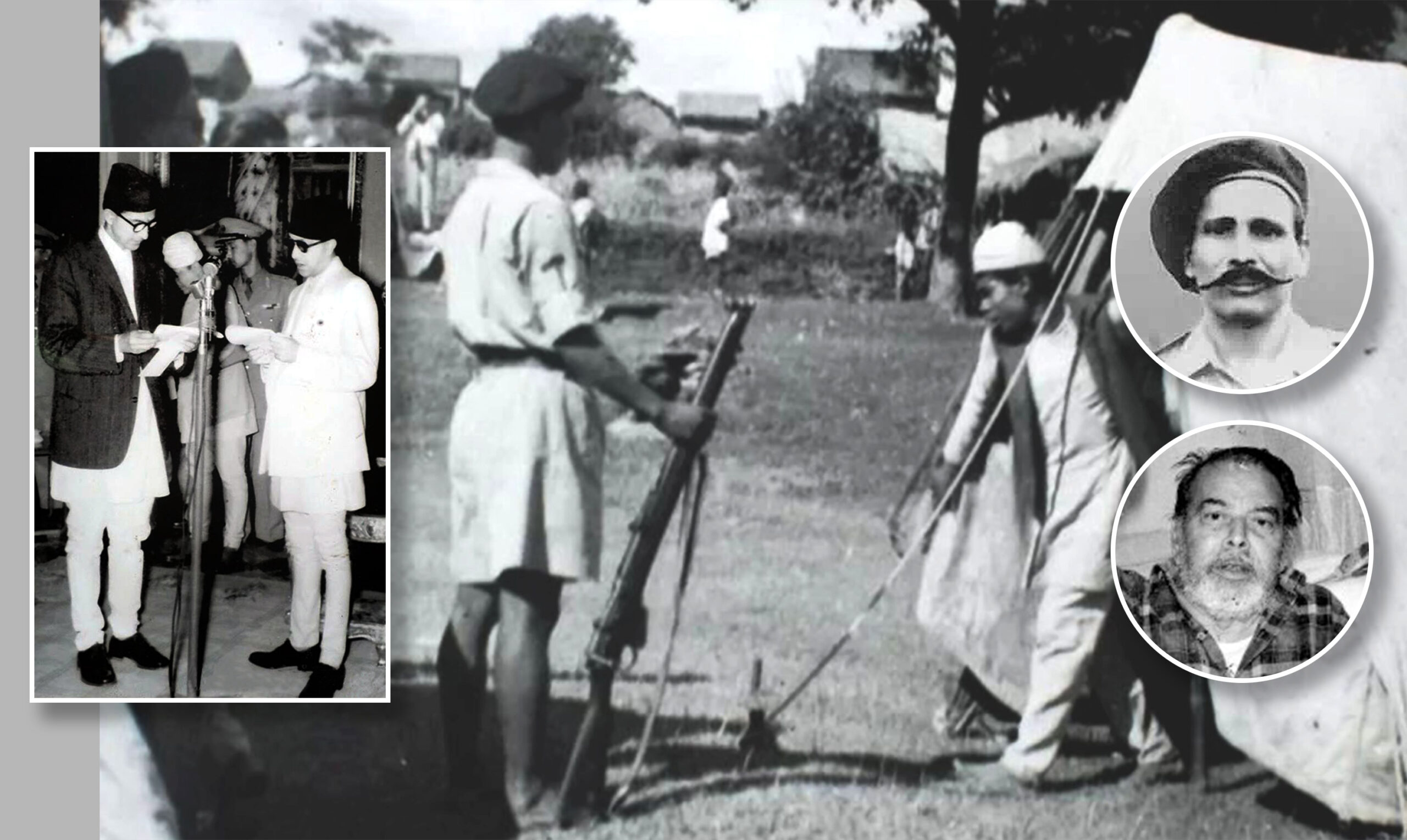
KATHMANDU: When talking about Nepal’s first general election, 102-year-old Lila Prasad Lohani still finds it entertaining. Having participated in the first election in 1959, which took 45 days to complete, he is among the few surviving candidates out of 786.
Lohani had filed his candidacy from the then Election Constituency Number 103, Pokhara South-East, from the Nepal Prajatantrik Mahasabha party led by Rangnath Sharma. However, he suffered a bitter defeat against Shree Bhadra Sharma of the Nepali Congress.
In Nepal’s first election, it was not just him; in the election where nine major political parties and 268 independent candidates stood besides the president of the Nepali Congress, Bishweshwar Prasad Koirala, popularly known as BP Koirala, the chairpersons of all parties were defeated.
BP Koirala was elected from the then Morang South-Biratnagar West Election Constituency Number 32. He received 9,579 votes. In this election, the Nepali Congress had fielded candidates in all 109 constituencies, in which it succeeded in forming a government with a two-thirds majority. Regarding other parties, the Chairman of the Nepal Rashtrabadi Gorkha Parishad party, Randhir Subba, was defeated in Dhankuta Election Constituency Number 26. The President of the Terai Congress, Vedanand Jha, in Siraha Constituency Number 39; the General Secretary of the Communist Party of Nepal, Keshar Jung Rayamajhi, in Palpa-93; the Chairman of Lohani’s own party, Nepal Prajatantrik Mahasabha, Rangnath Sharma, in Kathmandu-5; the then President of the Nepali Rastriya Congress, Dilli Raman Regmi, in Kathmandu-2; the Chairman of the Nepal Praja Parishad (Mishra group), Bhadrakali Mishra, in Election Constituency Number 45; and the Chairman of the Nepal Praja Parishad (Acharya group), Tanka Prasad Acharya, were also defeated in Kathmandu-5.
The most interesting incident of the election was the defeat of Dr K.I. Singh, the then Chairman of the Samyukta Prajatantra Party, in Doti South Constituency Number 71. His party had won five seats. In the first election, where a total of 1,791,381 people voted, the Samyukta Prajatantra Party succeeded in placing itself third by receiving 177,048 votes.
In this election, Nepali Congress became first, Rashtrabadi Gorkha Parishad second, Samyukta Prajatantra Party third, and the Communist Party of Nepal fourth, being declared national parties. However, KI Singh, who could not accept his defeat, filed a case in the Supreme Court claiming the election was rigged. To fight the case on his behalf, Senior Advocate of the Supreme Court of India, Nirmal Chandra Chatterjee, had to arrive in Kathmandu. He was even a candidate from the Hindu Mahasabha in the first parliamentary election of India from the Hooghly election constituency of South Bengal. He is the father of the former Speaker of the Parliament of India, Somnath Chatterjee.
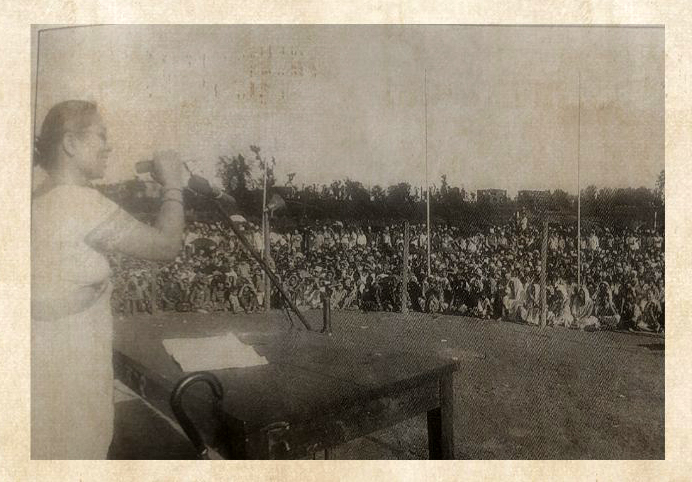
An electoral gathering prior to the general election of 1959. Photo: Social Media
Before the 1959 election, three prime ministers were appointed in Nepal. They were Matrika Prasad Koirala, Tanka Prasad Acharya, and K.I. Singh. However, out of these three former prime ministers, two (Tanka Prasad and Dr K.I. Singh) were defeated.
After the establishment of democracy in Nepal, Matrika took the oath as the first Prime Minister in 1951 as the President of the Nepali Congress. At that time, after he failed to conduct elections, there was great opposition from within the party. He was even accused of strengthening the Royal Palace instead of ensuring the rights of the people and of favoring the Government of India in state operations.
As the internal struggle within the party increased, he was reappointed prime minister after establishing the Nepal Praja Party under his leadership. In 1955, just a few days before the death of King Tribhuvan, Crown Prince Mahendra dismissed him from the post of prime minister.
After this, Mahendra, who became king, did announce on his coronation day that a general election would be held in the fiscal year 1957/58, but he never moved the homework forward toward this. Conversely, he engaged in a campaign to change prime ministers.
After this, the Nepali Congress, out of compulsion, started a ‘Polite Disobedience’ in collaboration with the Nepali Rastriya Congress chaired by Dilli Raman Regmi and the Nepal Praja Parishad chaired by Bhadrakali Mishra. Initially, the king did not fail to try to stop this using force. However, after the opposition increased nationwide, the then King Mahendra had to call the leaders of the agitating parties to Narayanhiti Royal Palace and said, “I am more anxious than you are to ensure the election happens as soon as possible.”
In 1955, just a few days before the death of King Tribhuvan, Crown Prince Mahendra dismissed him from the post of prime minister.
He immediately dissolved the cabinet of KI Singh and called all political parties to the Royal Palace for discussion on December 6, 1957. In the discussion that lasted about two hours, the agitators put forward a proposal to hold elections within six months.
At that time, no preparation for the election had been made. In the fiscal year 1951/52, the work of listing the names of adult voters was done with the intention of holding elections. However, in the interval of six years, how many voters were added had not been updated. Furthermore, because the time for farming and national festivals like Dashain-Tihar would fall in between, the proposal put forward by the leaders of the agitating parties did not appear practical.
After this broad political discussion, King Mahendra, in the process of announcing an election government, appointed Nepali Congress leader and former Finance Minister Subarna Shamsher Rana as the Chairman of the Cabinet.
Subarna, in a difficult situation, once again discussed with all political parties and sent a proposal to the then king for submission, stating it would be appropriate to hold the election on February 12, 1959. However, Mahendra, saying that the day of the establishment of democracy would be memorable for everyone, announced a public message to the nation, “We have fixed Nepal’s first People’s Election for February 18, 1959.”
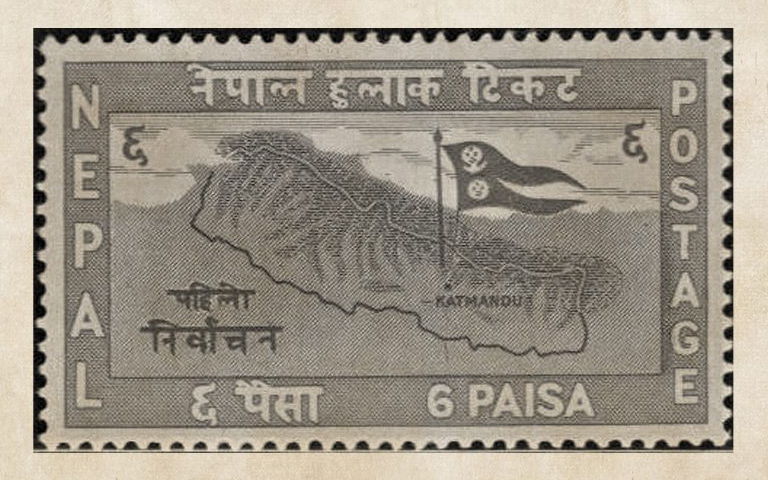
Postage stamp released to commemorate the first general election
Before the year 1959, the government of Nepal only had the experience of conducting municipal elections. How to deploy staff and security personnel across the whole country at once, how to prepare voter lists and voting areas, and where to file complaints if rigging occurred in the election; the election government was initially unaware of all these things.
However, slowly an election atmosphere began to form. To inform the people before the election, the government also organized ‘mock elections’ in various places. At that time, a district-wise structure like the current one had not been formed. Therefore, for the election, the Election Commission separated the constituencies into levels called East, West, North, and South for cities and settlement areas. Until 1959, there were 23 administrative units in the Himalayan and hilly regions and 13 in the Terai region. According to this, a provision was kept that an election constituency must have a minimum population of 23,000 and a maximum of 52,000. This means the population was made the primary basis in the first election.
Lohani, who still gets enthusiastic remembering the atmosphere of the first election. “Oh, the first election was as if a festival had arrived. Not just the youth; even the elderly and women had plunged into the election. One could hear the publicity of one’s party in various places,” he said.
Lohani has the experience that from the first election itself, candidates with money started to lure voters. At that time, the Nepali Congress had provided Rs 5,000 to its candidates as election expenses. Tilak Prakash Kayastha, a 91-year-old veteran leader of the Nepali Congress from Bhaktapur, says that all that money was provided to the party by Subarna Shamsher. Having edited the Subarna Smriti Granth, he says, “Subarna, who had been spending money to run the party since the establishment of the Nepali Congress, had given Rs 1 million at that time for the first election.”
The party that spent the most money in the first election was the Rashtrabadi Gorkha Parishad. It had fielded candidates in 86 places. This party, graced by family members like Bharat Shamsher Rana, had provided Rs 10,000 to its candidates for the election. The Communist Party of Nepal, which was fighting in 47 election constituencies, also provided expenses to its candidates at the rate of 1,200 per person.
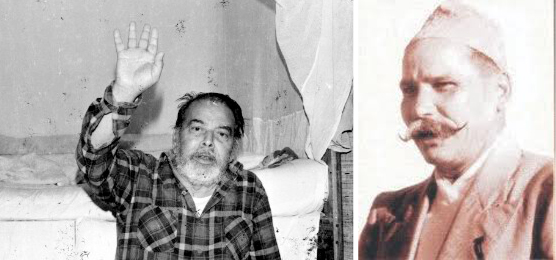
Former Prime Ministers Tanka Prasad Acharya (left) and Dr K.I. Singh (right)
“The custom of feeding and providing drinks to voters in the election started in 1959 itself. At that time, there were many candidates who won the election on the strength of money. Leaders considered good had to face defeat when they could not or did not spend money,” Lohani says.
In this process, the Home Minister of the election government, Dilli Raman Regmi, was unexpectedly defeated in Kathmandu-2. In this constituency where there were eight candidates, an unknown person named Nar Bahadur from the Rashtrabadi Gorkha Parishad won the election by bringing 6,262 votes. Dilli Raman received only a total of 618 votes. He was only a few votes above the independent candidate at the bottom, Padma Bahadur Budhathoki (514 votes). The famous face of the Nepali Congress, Tripuwar Singh, also became defeated, bringing 5,013 votes.
After suffering a defeat in the election he conducted, it was not appropriate to give any reaction. However, while addressing the third conference of the then Nepal Rastriya Students’ Union, Patan District Committee, on May 8, 1959, Regmi poured out his grievance like this: “There is a lack of character strength in the country. People walk for immediate self-interest. There is a tendency to make people work through allurements and force. As long as this kind of atmosphere remains in the country, how can the country’s democracy grow?” The Natyasamrat, meaning Emperor of Drama, Bal Krishna Sama, was presiding over that conference.
With the completion of the vote counting for Baglung North Election Constituency Number 87 on May 11, 1959, the equation for all 109 election constituencies was completed. In which the Nepali Congress won 74, the Rashtrabadi Gorkha Parishad 19, the Samyukta Prajatantra Party Nepal five, the Communist Party of Nepal four, independent candidates four, the Acharya faction of the Nepal Praja Parishad two, and the Mishra faction won one seat.
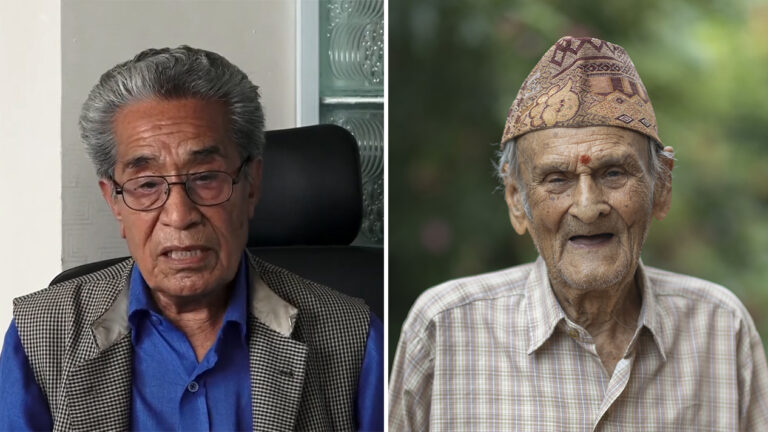
Lila Prasad Lohani (right), a candidate in the 1959 election, with Tilak Kayastha, who worked on the campaign for Ganesh Man Singh
After the results of all election constituencies were made public, the then King Mahendra sent a letter to the leader of the Nepali Congress parliamentary party, BP Koirala, on May 15, 1959, calling to form a new cabinet within 15 days. But interestingly, while the King was calling BP Koirala for the post of Prime Minister, the day before, on May 14, 1959, the Chairman of the Nepal Praja Parishad, Tanka Prasad Acharya, the Chairman of the Samyukta Prajatantra Party, KI Singh, and the Chairman of the Nepal Prajantantrik Mahasabha, Rangnath Sharma, had submitted a joint signature on a statement to the King. In the statement, the king was allegedly instigated to intervene for a fair investigation, saying that illegal and irregular acts had occurred in the recently completed election. In the ‘heavyweight’ election of Kathmandu-5, Lochan Shamsher Rana (8,755 votes) of the Samyukta Prajatantra Party had defeated not only Nepali Congress leader Surya Prasad Upadhyaya (5,717 votes) but also Rangnath (3,264 votes) and Tanka Prasad (1,148 votes).
No matter how much these three leaders instigated the then King Mahendra, the King had no other option except to accept the results of the election he himself had announced. Therefore, he sent a letter to give a single message to these three leaders that it would be in everyone’s interest to settle the dissatisfied complaints according to the relevant acts and rules.
After the king’s answer, Tanka Prasad and Rangnath kept quiet, accepting defeat. However, KI Singh was not satisfied with the king’s answer. He reached out to knock on the door of the Supreme Court. His petition filed in the Supreme Court stated that in the People’s Election that started on February 18, 1959, illegal and unconstitutional acts have occurred, and even the secrecy of voting has not remained. Therefore, let the voting be voided.
To plead his case, Singh had called the famous lawyer of India, Nirmal Chandra Chatterjee. Attorney General Shambhu Prasad Gyawali argued on behalf of the government. After the division bench of the then Acting Chief Justice Bhagwati Prasad Singh and Justice Min Bahadur Thapa determined on November 13, 1959, that the claim of the petitioner Dr K.I. Singh, could not be reached through law and evidence, this case was settled.
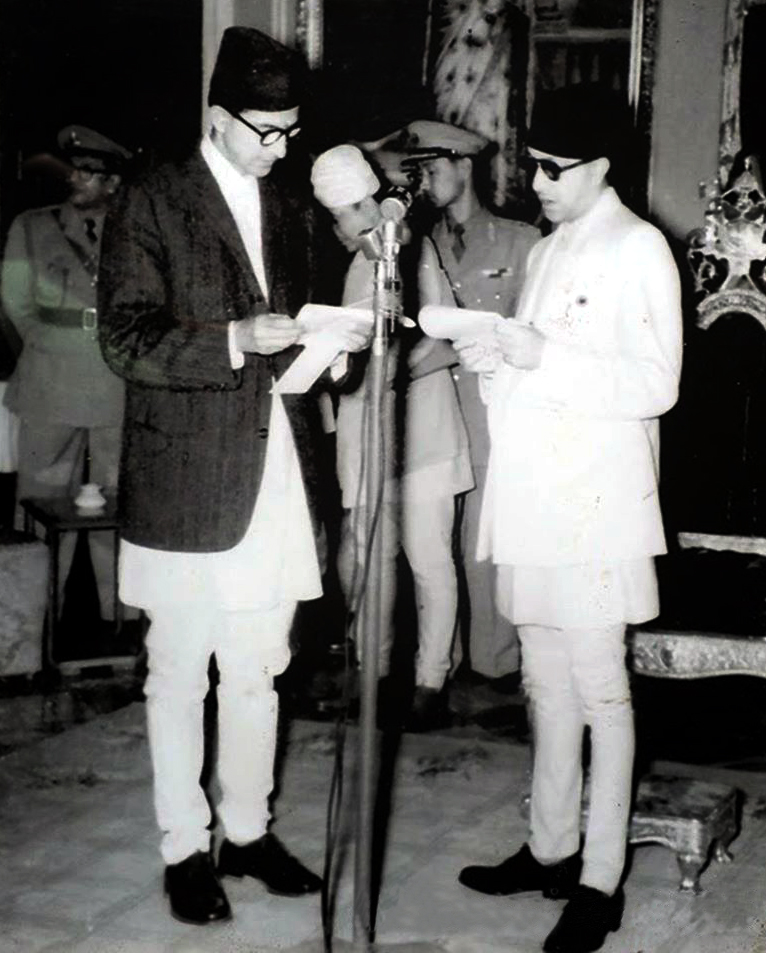
BP Koirala (left) being sworn in by the then King Mahendra (right)
A story is also connected with Nepali Congress leader Ganesh Man Singh regarding the first election. At that time, Ganesh Man was a towering figure in Kathmandu’s leadership. His daring ‘jailbreak’ during the Rana regime, his activism in the 1951 revolution, and his service as a minister in the fiscal year 1951/52 had solidified his popularity in the valley. Contesting from Kathmandu-1, he mistakenly believed that his name alone would guarantee an electoral win.
However, when the election results were made public, Ganesh Man felt as if he had fallen from a cliff. He was given tough competition by the founder of the Communist Party of Nepal, Pushpa Lal Shrestha. Ganesh Man was victorious by bringing a total of 10,986 votes. Pushpa Lal, who came second, received 7,848 votes. Ganesh Man, who was irritated by this result, labeled the people of Kathmandu as ‘sheep.’ Saying that he won by only 3,138 votes against Pushpa Lal, he threatened never to stand for election thereafter.
Kayastha, who was involved in Ganesh Man’s publicity during the first election, recalled, “Ganesh Man’s perspective was that he had suffered imprisonment while fighting for the people’s fundamental rights and stood firm against cruel rulers. He believed the people should have rewarded him with a landslide victory; his dissatisfaction stemmed from that.”
It was a striking coincidence that after the first election, he never faced another electoral battle. Following the 1960 ‘coup,’ he remained a mainstay of the resistance against the Panchayat system for 30 years. When the chance to contest an election finally returned in 1991, he decided instead to retire from parliamentary politics.