Kathmandu
Wednesday, July 15, 2026





Fresh geological evidence from Rara Lake shows that western Nepal has experienced clusters of powerful earthquakes over the past 6,500 years, challenging the long-held belief that the region is overdue for a single catastrophic “pending” megaquake

KATHMANDU: On 3 November 2023, an earthquake of magnitude 6.4 struck with its epicenter at Ramidanda in Barekot Rural Municipality, Jajarkot District. The quake killed 157 people, injured 375, and completely destroyed 26,528 homes.
Before that, a similar moderate earthquake occurred in western Nepal in 1980. On 31 July 1980, an earthquake of magnitude 6.6 with its epicenter in Bajhang struck, resulting in the loss of 46 lives.
Although small and moderate earthquakes have occasionally occurred in western Nepal, scientists have long argued that these quakes have not reduced the risk of a major earthquake in the region. They say that in eastern and central Nepal, large earthquakes have occurred from time to time, but in western Nepal a long period has passed without a large quake, meaning a major earthquake could still happen there. Those who make this claim have said that while eastern and central Nepal have experienced large earthquakes at roughly 100‑year intervals, western Nepal has not seen such a quake for about 500 years, indicating a high seismic risk.
Generally, an earthquake with a magnitude greater than 6.5 is considered a large earthquake, and one with a magnitude of 8.0 or higher is called a great (major) earthquake.
Previous studies have shown that the last major earthquake in western Nepal occurred on 6 June 1505. At that time, with its epicenter in Mustang, various studies have confirmed that a devastating earthquake with a magnitude between 8.4 and 8.8 struck the region.
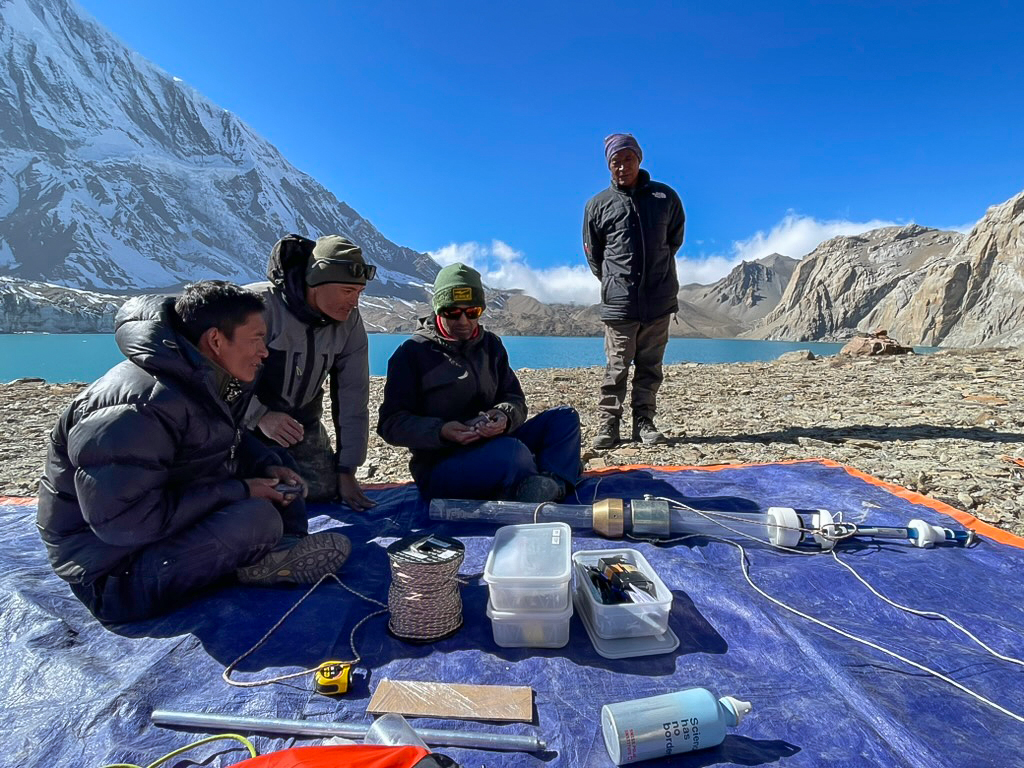
Scientists preparing to collect samples on the shore of Rara Lake. Photo: Ghazoui-Schaus
Since then, scientists have not been able to identify any major earthquake in western Nepal. Therefore, because 500 years have passed without a large earthquake, they indicate that the region is still due for an earthquake of magnitude 8 or higher. Scientists have noted that western Nepal (from Kathmandu to Dehradun in western India) has a long seismic gap. Compared to eastern and central Nepal, this gap in western Nepal is much longer. A seismic gap refers to a region that has not experienced a large earthquake for a long time, located between areas where large earthquakes have been occurring continuously.
However, new research has challenged the commonly accepted facts and concepts about earthquakes in western Nepal and the Himalayan region.
A team of scientists led by Zakaria Ghazoui from the British Antarctic Survey (BAS), a UK government research institution, has claimed that the idea that a major earthquake is still pending in western Nepal is misleading. Their research paper on this topic was published on 11 February in the journal Advanced Science. The team began their study in September 2014, and the paper was published in 2025. This project is a collaboration with Tribhuvan University and the Nepal Mountain Academy, involving professors Anant Prasad Gajurel and Tanka Prasad Paudel.
During the study, the team tested sediment cores (clay and sandy soil) collected from the bed of Rara Lake in Mugu. The study revealed that over the past 6,527 years, there were 50 earthquakes of magnitude greater than 6.5 in the region. According to the research, these earthquakes did not occur at long, regular intervals; instead, they happened in clusters over short periods, meaning multiple large earthquakes occurred in succession rather than being evenly spaced over time.
By analyzing detailed geological and modern data from 4509 BC to 2018 AD about the seismic nature of western Nepal, this fact was revealed.
New research has challenged the concept of a seismic gap in the Himalayan region. New evidence of seismic events has refuted the previous conclusion that no major earthquakes occurred in western Nepal after June 6, 1505. According to research conducted by a team led by Ghazoui, it has been discovered that six major earthquakes occurred in that region after that date. Significant earthquakes were recorded in 1632, 1696, 1731, 1761, and 1902. These earthquake events also demonstrate that there is no fixed timetable suggesting that major earthquakes occur at intervals of 100 or 150 years.
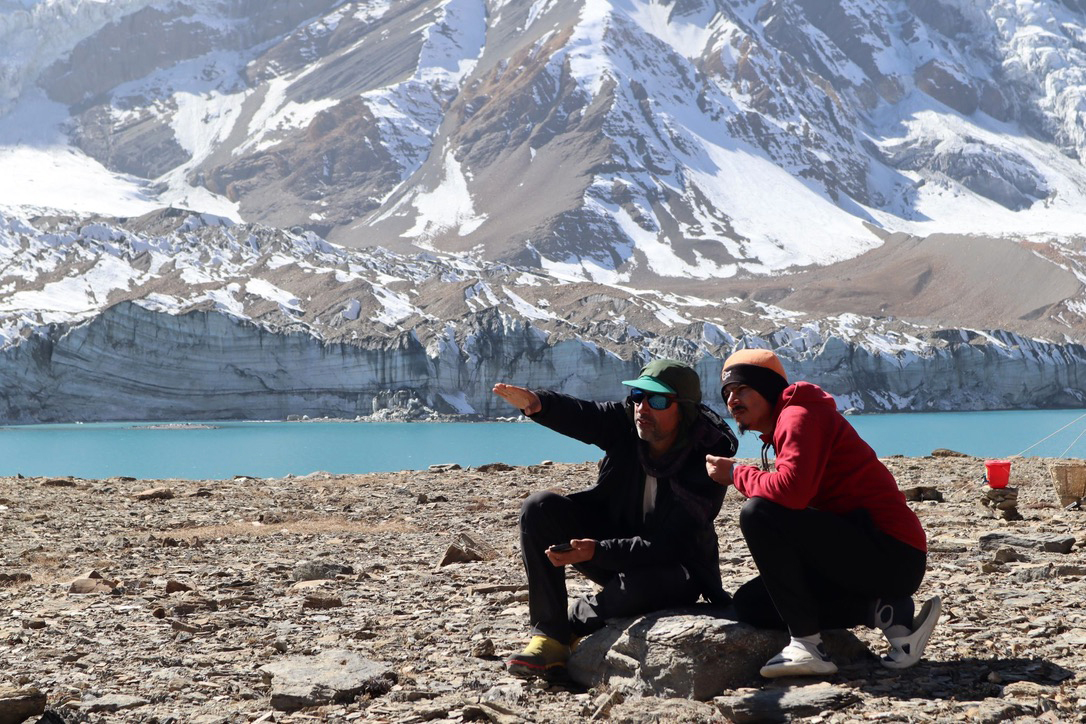
Ghazoui-Schaus and others
The team led by Ghazoui noted that large earthquakes do not occur at fixed intervals but can happen at any time. On the other hand, the new study also shows that there can be long periods of seismic inactivity, or quiet periods, between two large earthquakes. Looking at the 50 large earthquakes of magnitude 6.5 and above that occurred in western Nepal over the past 6,500 years, the study found that these events occurred in 12 clusters, with multiple earthquakes happening in quick succession over short periods, separated by long quiet periods. These quiet periods, according to the research, ranged from 173 years to 722 years.
This evidence has led to the conclusion that there is no fixed interval for large earthquakes, and that the absence of a large earthquake over a long period does not guarantee that a major earthquake is imminent. “The fact that a region has not experienced large earthquakes for a long time cannot be taken as a certainty or countdown for the next major earthquake,” Ghazoui wrote in an email conversation with Nepal News.
Ghazoui has referred to the belief that there is a seismic gap in western Nepal as a knowledge gap, meaning a lack of understanding.
The new research also notes that the occurrence of small earthquakes in a region does not reduce the risk of a large earthquake. In the past, scientists had argued that small and moderate earthquakes release geological energy, thereby reducing the risk of a major earthquake.
From the perspective of earthquake measurement, a magnitude 6 earthquake releases as much energy as 32 magnitude 5 earthquakes, and to release the energy of a magnitude 7 earthquake, 1,000 magnitude 5 earthquakes would be needed. Based on this, earlier researchers believed that the occurrence of small and moderate earthquakes would reduce the risk of large and great earthquakes. “The idea that moderate earthquakes reduce geological stress is misleading and incorrect,” says Ghazoui.
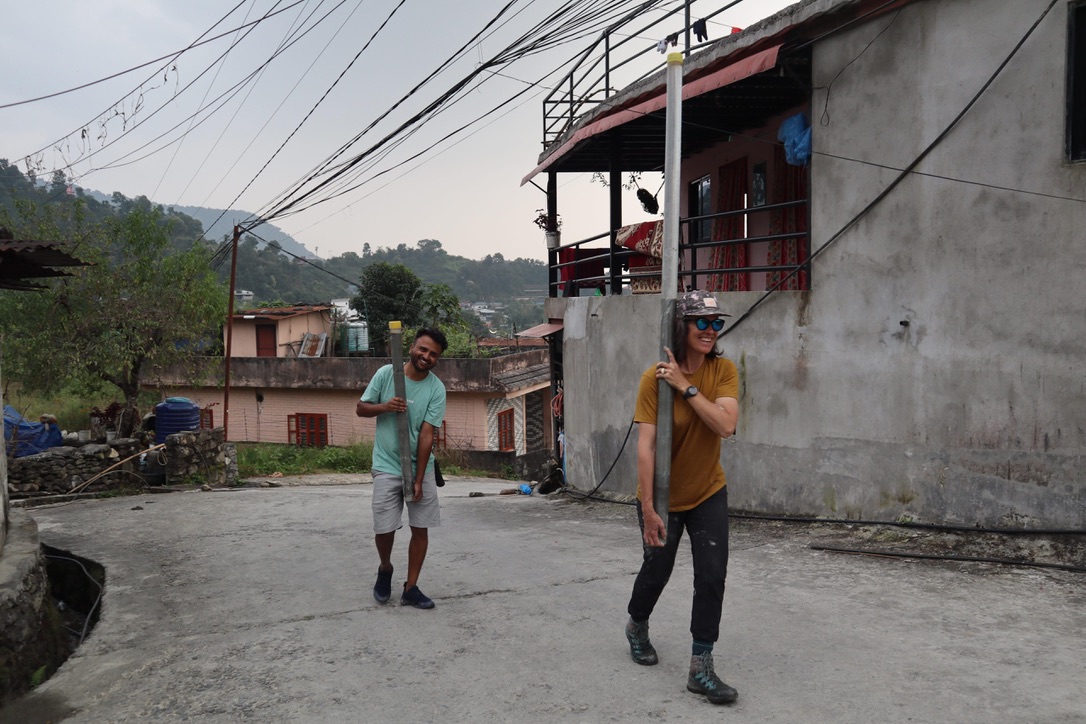
Researchers transporting equipment for the study. Photo: Ghazoui-Schaus
According to Subodh Dhakal, Associate Professor at the Department of Geology at Tribhuvan University, the new study challenges some widely held beliefs about earthquakes in the Himalayan region. “It has been said that a large earthquake will occur from Kathmandu westward and in northwestern India, and that major earthquakes return in the Himalayas at fixed intervals – this study contradicts that belief,” says Dhakal.
Although the research led by Ghazoui concluded that there is no fixed timetable for large earthquakes, this does not mean that western Nepal is free from earthquake risk. The reality is that earthquakes cannot be predicted, and a large earthquake is just as sudden and uncertain as a small one. In other words, like small earthquakes, large earthquakes can occur at any time.
According to Ghazoui, the notion that a large earthquake is still “pending” creates both confusion and fear among the public. “On the one hand, it spreads fear in society; on the other, when people believe an earthquake will happen at a fixed time, they may become complacent and careless in the meantime,” he says.
As active as eastern and central Nepal
The new evidence showing that six large earthquakes occurred in western Nepal after 1505 indicates that western Nepal is seismically as active as eastern and central Nepal, says earthquake scientist Shiva Subedi from the Nepal Academy of Science and Technology (NAST). He adds, “The research led by Ghazoui has revealed that seismic activities in western Nepal are just as active as in eastern Nepal, which was previously unknown.”
In eastern Nepal, large earthquakes occurred in 1833 with a magnitude of 7 and in 1934, centered around the Nepal–Bihar border, with a magnitude greater than 8. In central Nepal, a magnitude 7.8 earthquake struck Barpak, Gorkha on 25 April 2015.
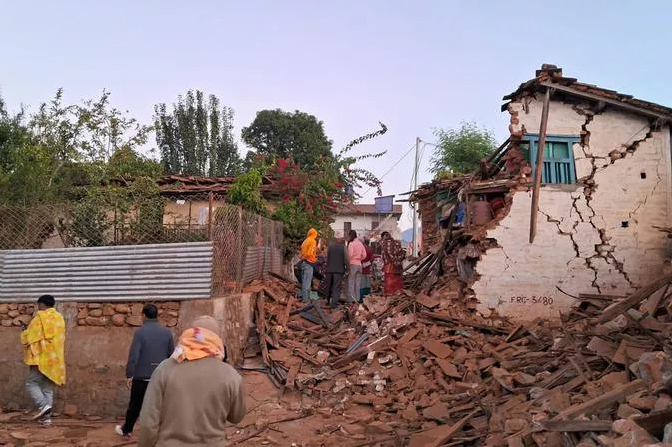
Damage caused by the earthquake centered in Ramidanda, Jajarkot, on 17 Kartik 2080 (3 November 2023). Photo: RSS
Nepal’s Himalayan region falls within a high seismic risk zone. Due to the collision of the Indian Plate and the Eurasian Plate, a major fault line (where the two plates meet) has formed in this area. The Indian Plate moves into the Eurasian Plate by about five centimeters each year. This motion not only contributes to the formation of tall mountains but also plays a role in the expansion of the Tibetan Plateau. Of this five-centimeter geological pressure, three centimeters are used in raising the height of the Himalayas and expanding the Tibetan Plateau, while the remaining two centimeters of energy are stored within the Earth. According to geologists, this stored energy is occasionally released as earthquakes.
Basis of the study
Scientists from the British Antarctic Survey extracted sediment cores from two locations at the bed of Rara Lake, at depths of 120 meters and 168 meters, for their study. These cores recorded earthquake events from as far back as 4509 BC to as recent as 1902 AD.
When an earthquake occurs, the lakebed shakes and can trigger landslides. Soil and sand from the lake’s walls fall into the water and form layers. These layers are called turbidites, which are distinct from naturally formed sediment layers. By studying the turbidites in Rara Lake, scientists were able to determine when and how large earthquakes occurred in the region. The study identified 50 distinct layers, leading to the conclusion that 50 large earthquakes had occurred.
The sediment cores were taken to a laboratory for chemical analysis. To determine the timing of past earthquakes, researchers used radiocarbon dating. This method is used to estimate the age of organic materials such as pieces of wood, coal, or plant remains.