Kathmandu
Sunday, July 26, 2026





On the surface, research culture in Nepal seems to be thriving and currently in its blossoming stage, as there has been a substantial increase in PhD scholars, with graduate and postgraduate students having their research articles published in high-impact journals. There is also a trend among our professors, educational leaders, and faculty members for personal branding based on their publications and citation index metrics. Similarly, universities and their affiliated higher education institutions (HEIs) regularly publish research journals and host national and international conferences.
However, the irony behind this outward enthusiasm is that the volume of research output from universities and colleges barely gets translated into anything substantial in terms of teaching quality, student learning experience, pedagogical orientations, industry-academia collaborations, innovations, impact-driven scholarship, consulting work, and policy reforms within the higher education system in Nepal. Therefore, neither individuals nor higher education institutions are able to derive substantial market, social, business, and industry value from their research publications, PhD scholarships, or research seminars.
Lack of Strategic Direction for Expertise and Specializations
Research culture determines the norms and the way research is formulated and communicated by research communities within the higher education system. A fault line within research culture initiatives in Nepal is that scholars, researchers, and faculty members increasingly operate outside their core domain expertise just to inflate their research portfolios and publication volume without strategic direction for expertise, value creation, and specialization. Hence, we have a research culture obsessed with publication counts, citation indices, and academic credentials rather than committed to building cumulative evidence within a particular domain of specialization or research context for formulating conceptual models, theory building/testing, decision making, and proliferation of knowledge necessary for decision making and problem solving.
For instance, it is not unusual to find a PhD in economics publishing scattered articles across various knowledge domains such as marketing, branding, communication studies, public policy, green HRM, and sociology fields that even contradict basic assumptions of economics, without any rigorous contribution to the theory building, conceptualization, or empirical understanding of Nepalese economics.
Another contradiction lies in how expertise has been defined, or rather, ignored within research culture in Nepalese universities. For example, when a professor of management sciences publishes simultaneous research articles on public health, agriculture, education, climate change, and economics and is added as a co-author to add visibility or institutional prestige, this illusion on the surface creates doubts about the research expertise and impact-driven scholarship of faculty members of our universities and colleges among industries, businesses, and stakeholders who are looking for evidence-based, progressive, and specialized knowledge for decision-making and problem-solving. After all, consulting and collaborative research with organizational leadership for action or problem-driven research requires cumulative, subtle, and rigorous knowledge and in-depth awareness of a particular issue beyond simple interaction with organizations for data collection and analysis.
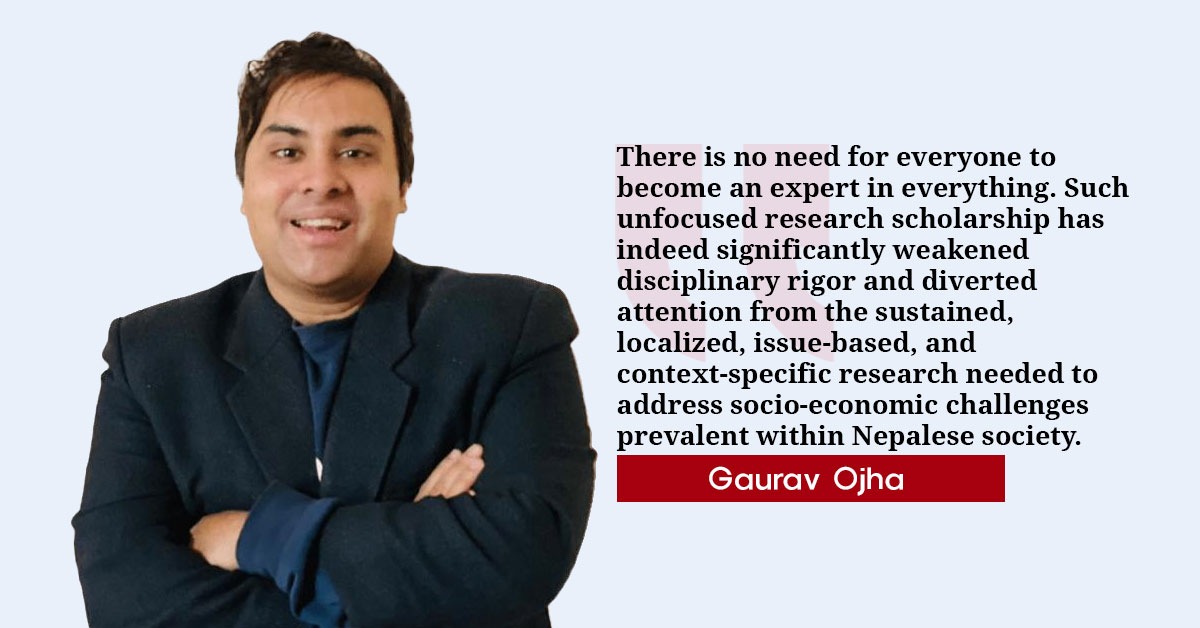
There is no need for everyone to become an expert in everything. Such unfocused research scholarship has indeed significantly weakened disciplinary rigor and diverted attention from the sustained, localized, issue-based, and context-specific research needed to address socio-economic challenges prevalent within Nepalese society.
Student-Centricity and Normalization of Gift Authorship
Academic research in Nepal has become overwhelmingly student-centric. Within the university system in Nepal, faculty members co-author student papers as a part of their supervision roles for thesis, project work, or dissertation. Ironically, this process has given rise to gift authorship, where names of people outside of the knowledge domain are put on research papers by students for the sake of increasing their publication count. And this practice has substantially diluted accountability, eroded academic integrity, and generated disillusionment among students regarding the scope, perceived market, and applied value of research outside academia.
Moreover, the proliferation of research papers with multiple co-authors with diverse expertise on a single paper developed by the student has eroded the credibility of academic research by blurring the standards of authorship, merit, and scholarly rigor. Here, it is important for the universities and colleges in Nepal to realize that a research culture cannot sustain its social, market, and intellectual value if professors merely rely on gift authorship instead of building their own research trajectories and niche specializations. Besides, normalization of gift authorship contributes to the junkification of research in Nepal, as the names of people are attached onto student-led research without making substantial analytical, intellectual, interpretive, and methodological contributions.
University-Industry-Community Research Collaboration Strategy
The socio-economic impact and transformative potential of academic research have been constrained in our universities and colleges due to the disconnection between research, development, and innovation. Research efforts are mostly limited to publishing metrics and self-referential institutional practices, without substantial impact on development concerns, solving community-level issues, policy reform, industrial needs, socio-economic decision-making, or technological innovation. In addition, there are structural, systemic, and policy issues within the university system in Nepal, such as a lack of funding, weak industry-academia collaborations, theory-practice gaps, normalized gift authorship, and limited funding, grants, and incentives for applied research. Because of these issues, the blooming research culture on the surface frequently falls short in producing scalable solutions necessary for addressing socioeconomic, sustainable, industrial, technological, and environmental challenges and issues prevalent in Nepal.
Hence, to close this gap between research, development, and innovation, universities and colleges in Neal need to work together closely with businesses, government, innovators, tech experts, entrepreneurs, and local communities and adopt problem-driven action research strategies to ensure that research culture does not just become an isolated and insular academic endeavor. Similarly, research initiatives of our universities and colleges need to provide a transformative foundation for scientific thinking, creativity, innovation, a comprehensive framework for industry, university, and community collaboration strategy, and evidence-based decision-making that links theory with practice, enables practice to find method, and contributes towards socio-economic progress of the society.