Kathmandu
Sunday, July 12, 2026





What began as door-to-door outreach and party-funded posters in the past has evolved into high-tech social media campaigns, professional content creators, and viral packages — but with new opportunities come new risks of misinformation and manipulation
KATHMANDU: In the 1999 House of Representatives election, Kunta Sharma, a candidate of the CPN (UML), did not have to spend a single rupee personally on her campaign. After having breakfast at home and getting ready in the morning, party workers would arrive in a campaign vehicle equipped with loudspeakers. She would ride in that vehicle and go door-to-door to meet voters.
Local party workers would cook food for the campaign team. Some activists would go out seeking votes while eating beaten rice and snacks. The party covered the costs of simple posters and wall writings. At that time, however, candidates were required to contribute donations to the party. Sharma had contributed around 50,000 rupees. That money was deposited into the party’s fund and used for other purposes.
Having won the election in this way, Sharma recalls, “Workers were motivated by emotion and commitment. The party managed the campaign arrangements. Campaigning was economical.”
There is a vast difference between the campaign style of 26 years ago and today.
The Gatisheel Loktantrik Party, established in 2082 BS (2025), is preparing to participate in the upcoming House of Representatives election. As it did so, representatives from several companies approached the party offering “viral packages” for election campaigning. Party Chair Dinesh Prasai was astonished after hearing their proposals. He says, “People came offering packages costing up to 2 million rupees to promote our party’s candidates and up to 1 million rupees to run negative campaigns against opponents. I was shocked to hear their plans.”
In 2020 (2077 BS), under his initiative, a formal “Cyber Army” was formed. After controversy, on 24 November 2021, UML Chair KP Sharma Oli renamed it the “Cyber Circle.”
Even a decade ago, political parties primarily used manifestos, posters, pamphlets, and banners to introduce candidates and communicate party agendas during elections. They wrote slogans on public spaces and walls. Teams would go door-to-door asking for votes. Party workers themselves carried out these activities. In addition, campaigns were conducted through traditional media.
As internet access expanded and social media reach increased, election campaigning gradually shifted online. Parties began using tech-savvy members to promote their messages through social media. It became common to highlight positive aspects of one’s own party and dig up negative content about opponents. Teams assigned to this work came to be known as “cyber armies” or “IT armies.”
After the split in the CPN (UML), party workers began countering and sometimes verbally attacking those who criticized their party or leaders on social media. UML leader Mahesh Basnet led such online rebuttals. In 2020 (2077 BS), under his initiative, a formal “Cyber Army” was formed. After controversy, on 24 November 2021, UML Chair KP Sharma Oli renamed it the “Cyber Circle.”
Similarly, on 20 July 2021, then-UML leader Prabhu Sah formally announced an “IT Army” in Lokanthali, Bhaktapur. It was planned as a nationwide network with 151 members at the central level, 101 at the provincial level, 51 at the district level, and 33 at the municipal level. Chandra Bhushan Sah was appointed coordinator.

The Nepali Congress also formed the “Nepali Congress Wide Information Network” (NC WIN) on 6 September 2021 to promote the party via social media. Coordinated by Dipesh Bista, NC WIN had a 27-member central committee and was expanded to provincial levels.
Other political parties likewise mobilized groups on social media to promote themselves and spread negative messaging against opponents. However, as social media’s influence grew, relying solely on party cadres was no longer sufficient.
In particular, during the 2022 local elections, independent candidate Balendra Shah (Balen), who ran for mayor of Kathmandu Metropolitan City, received extensive promotion through social media. This had nationwide impact. While party candidates relied mainly on traditional media and limited social media promotion, Facebook pages like “Routine of Nepal Banda” used technology to widely promote Balen. This resonated strongly with urban youth voters and became one factor in his victory.
After that, political parties realized they needed creative individuals who could positively promote the party, rather than just cadres engaged in online abuse. As a result, parties are now using technically skilled “content creators.” For the upcoming parliamentary elections, parties are even running campaigns through professional groups.
Although parties still conduct door-to-door outreach like a decade ago, voters often see candidates’ videos and photos on their mobile phones before meeting them in person. From ordinary content creators to professional IT companies, many are now active in delivering party agendas and candidate information directly into voters’ hands.
To communicate the plans of Nepali Congress President and Sarlahi Constituency No. 4 candidate Gagan Kumar Thapa to the public, a website named “Mutton.world” has been created. In the past, opponents accused Thapa of opening a goat farm and receiving government subsidies, mockingly calling him “Mutton Kaji.” This issue, often referred to as the “Goat Scandal,” was used against him. Recently, his campaign team creatively turned the same term into a digital marketing tool by launching the website. Many have praised this creativity. The same team also records and uploads Thapa’s speeches on social media.
According to Raghav Gautam, a member of the Nepali Congress publicity department who is coordinating the party’s digital campaign, leader Thapa’s website was created by IT experts based abroad. He says, “Digital marketing of candidates has now become essential. We are mobilizing Nepali Congress well-wishers and getting the work done at minimal cost. Many are working voluntarily.”
Although parties still conduct door-to-door outreach like a decade ago, voters often see candidates’ videos and photos on their mobile phones before meeting them in person.
The Rastriya Swatantra Party (RSP) has also mobilized IT experts to handle the digital promotion of its candidates. They are creating videos and posters to promote the party and its candidates. Other political parties have also formed similar groups.
Professional companies that handle digital campaigning for candidates are also active. Sandeep Oli, owner of Aarambha Digital, is managing digital campaigns for six candidates in this election. The candidates he has taken responsibility for are from Surkhet, Bajura, Rajbiraj, and Kathmandu.
Sandeep designs attractive posters based on candidates’ plans and party policies. He also produces videos. These materials are posted on social media and “boosted” to reach voters within the candidate’s constituency. He explains that fees depend on the candidate’s popularity, the type of promotional material required, and the campaign duration. He says, “Popular candidates naturally receive many views, so the cost is lower. For lesser-known candidates, costs are higher. With an investment of around 300,000 rupees, promotional materials can reach all voters in a constituency.”
The fees charged by digital campaign companies and content creators vary. Boosting simple posters on social media may cost between 5,000 to 10,000 rupees, while video shooting, editing, and related work can cost hundreds of thousands of rupees. Costs increase further with additional services such as website development, SMS campaigns, and voice marketing.
Prabin Kirati, who is managing digital campaigns for three candidates in Kathmandu, has assigned cameramen to film the candidates’ door-to-door programs. The footage is edited and uploaded to YouTube and various social media platforms under the candidates’ names. He says that full campaign packages up to election day can cost between 200,000 and 300,000 rupees. “There is no fixed rate for digital campaigning. It depends on the scope of work and the candidate. The fee is decided through mutual agreement. It benefits both the candidate and the content creator.”
Risk of misinformation
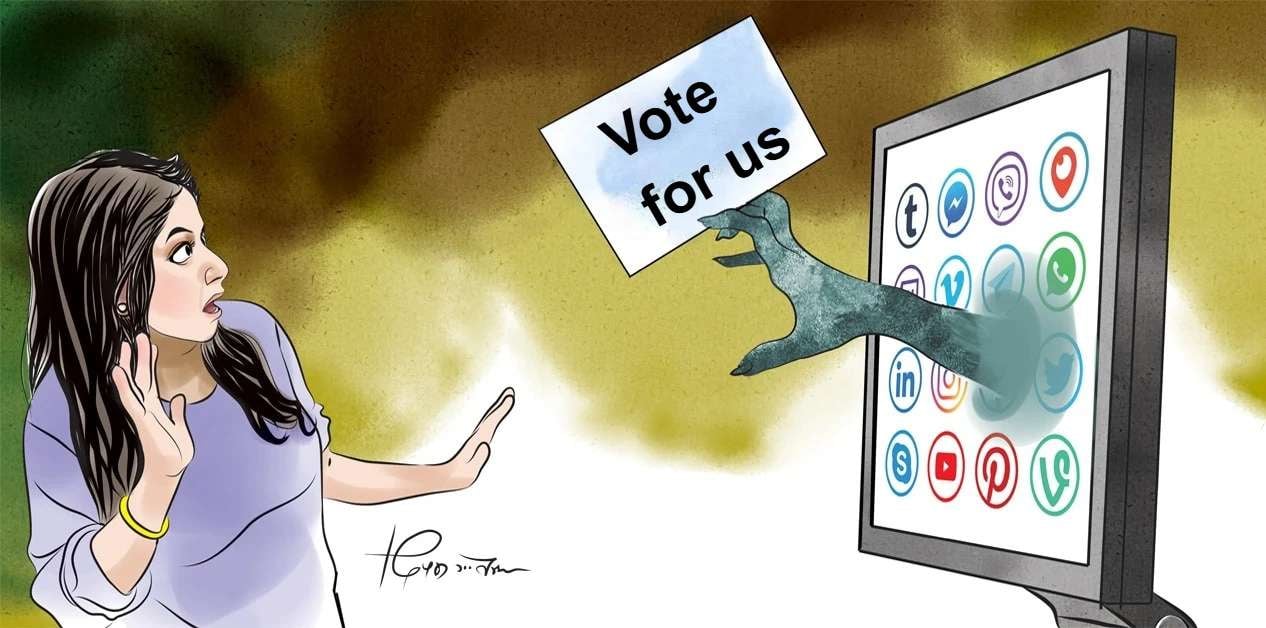
In the market, so-called “viral packages” are available that promote candidates positively, boost their profiles to reach voters’ smartphones, or even search for and amplify negative content about opponents.
However, such viral packages, which have recently become widespread, also carry significant risks of negative social impact. On social media, if a user watches videos on a particular topic for some time, algorithms tend to show similar content repeatedly. According to Aarambha Digital owner Oli, this can spread misleading information widely and create confusion. He says, “Digital campaigning is simple and highly effective, but it also has equal potential to spread misinformation.”
AI expert Dovan Rai also warns that although digital election campaigning is accessible and affordable, it can harm society if citizens are not vigilant. According to her, creating fake IDs to spread misleading information through digital platforms has become common. She says, “Without transparency and accountability, those with malicious intent can misuse it. If citizens are not aware, digital campaigning can influence elections negatively.”
In the market, so-called “viral packages” are available that promote candidates positively, boost their profiles to reach voters’ smartphones, or even search for and amplify negative content about opponents.
The practice of spreading false and misleading content during elections through digital platforms is common even in developed countries. In the 2016 US presidential election, Donald Trump was accused of spending more than 6 million dollars to purchase Facebook data from a company called Cambridge Analytica and using it in his campaign.
In 2018, The New York Times published an investigative report on the matter. The report stated that Facebook had allowed Cambridge Analytica to access personal data of 550 million users, which was used to assist Trump’s presidential campaign.
In Nepal as well, there has been no effective effort to control misleading digital propaganda or manage algorithm-driven misinformation. The Election Commission and the government also lack sufficient skilled personnel to address the issue. Therefore, digital campaigning may pose similar risks in upcoming elections. However, Suman Timsina, information officer at the Election Commission, says that if anyone is found spreading misinformation or exceeding spending limits through social media, action will be taken according to the election code of conduct. He says, “There is general monitoring at the district level as well. If someone files a complaint with the Commission, action will be taken.”