Kathmandu
Monday, July 13, 2026





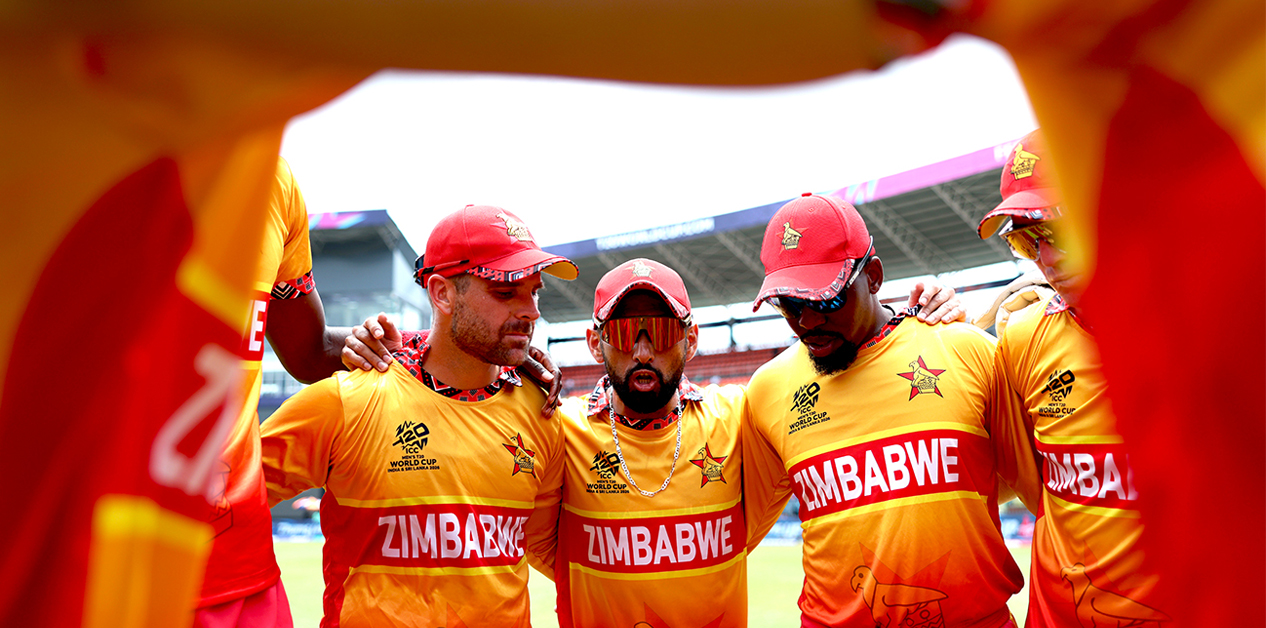
After surviving suspension, internal chaos, and the fallout of the Mugabe years, Zimbabwe announced their return with a performance that made a statement
KATHMANDU: Before the T20 World Cup began, looking at the equation of Group B, it was not difficult for anyone to figure out that the teams to enter the Super-8 in the ongoing World Cup would only be Australia and Sri Lanka. The reason for this was that both teams had already won the T20 World Cup previously.
An experienced test nation like Ireland was also participating in this same group. Therefore, no one had made predictions regarding Zimbabwe’s possibilities. However, the opposite happened. Zimbabwe, which was predicted to remain at the very bottom of Group B, made a huge upset in the ongoing World Cup. After sharing points with Ireland due to rain in the first match, it easily secured a place in the Super-8 by defeating Oman by eight wickets, Australia by 23 runs, and Sri Lanka by six wickets.
Zimbabwe, which has been playing international cricket for a long time, has entered the Super-8 for the first time in a T20 World Cup. Many supporters are surprised looking at the performance of this team, which failed to qualify for the World Cup two years ago.
However, coach Justin Sammons urges everyone not to consider the team’s latest achievement as a coincidence or accidental. During an interview with Zimbabwe’s local newspaper H-Metro, Sammons said, “We are truly excited and extremely happy to have succeeded in reaching the next round. We made this goal about 20 months ago, which we have achieved. It is the result of the team’s hard work, discipline, and preparation.”
Until a few years ago, Zimbabwe was considered the weakest team in world cricket. However, it was not always like this. In the 1980s and 90s, rivals considered Zimbabwe the most dangerous team.
Zimbabwe participated in the third One Day International (ODI) World Cup (then the Prudential Cup) in 1983 as its first major tournament. In that World Cup, where strong nations like England, Australia, India, Pakistan, West Indies, New Zealand, and Sri Lanka participated, Zimbabwe created a sensation by defeating Australia by 13 runs in its debut match. However, it failed badly in the remaining five matches.
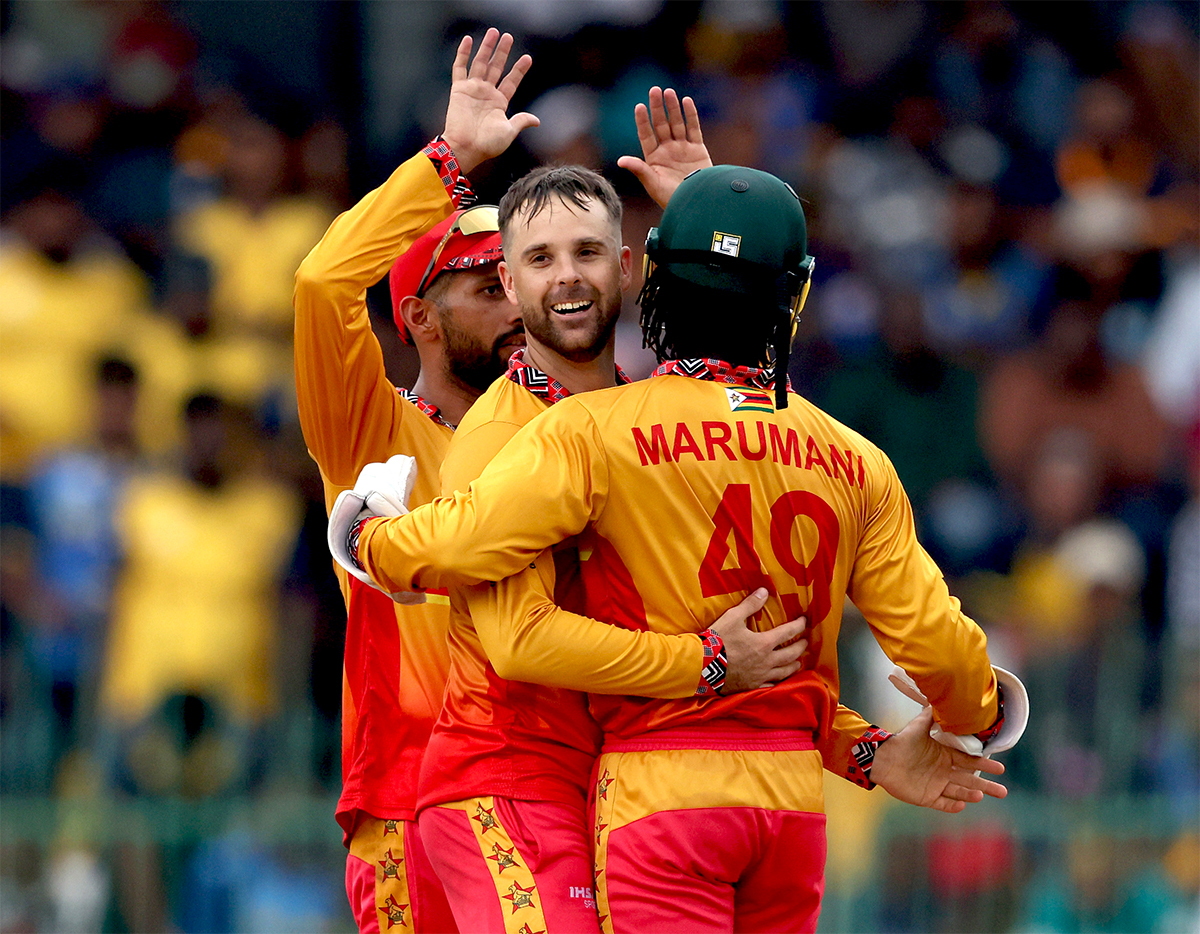
After taking a wicket in the match against Sri Lanka. Photo Courtesy: Zimbabwe Cricket/Facebook
In the fifth One Day International (ODI) World Cup of 1992, it also defeated the creator of cricket, England, by nine runs. World cricket was stunned after this performance. After this, it started winning the hearts of the spectators.
Following such success in the World Cup, the International Cricket Council (ICC) also granted Test nation status to Zimbabwe that same year. This achievement was not ordinary for Zimbabwe cricket. It was being included in the list of cricket-playing nations as the ninth nation.
Within three years of receiving Test nation status, due to the grand batting performance of the Flower brothers, Andy and Grant, Zimbabwe defeated a strong team like Pakistan by 64 runs on home soil. In the first Test held in Harare, the capital of Zimbabwe, in February 1995, Pakistan’s back was broken after Grant scored an unbeaten 201 runs, Andy scored 156 runs, and Heath Streak took nine wickets in two innings.
Another attraction of that test was bowler Henry Olonga. That was Henry’s debut Test, and his arrival gave a new dimension to Zimbabwe’s cricket. Previously, the Zimbabwe team was dominated by Whites.
When observing Zimbabwe’s cricket closely, the period from 1997 to 2002 can be considered successful and productive. During this period, Zimbabwe used to give a tough fight to big teams like Australia and India.
When Zimbabwe’s cricket fell into the grip of extreme politicization, its performance started declining after 2003.
The stable and aggressive style of wicketkeeper-batter Andy Flower and his brother Grant Flower always kept Zimbabwe in balance. The influence of aggressive all-rounders Heath Streak and Andy Blignaut and reliable batsmen Murray Goodwin and David Houghton added necessary runs, while spinners Paul Strang and Eddo Brandes created pressure in the middle order. The coordination of all these players had given Zimbabwe a distinct identity in world cricket. The team always seemed eager to perform excellently and, despite being a small nation, had the capability to topple big powers. This is confirmed by its victory in both ‘home and away’ series against New Zealand in 2000/01.
However, Zimbabwe’s performance did not remain consistent forever. During the reign of former President Robert Mugabe, who was in power from 1980 to 2017, there was a deep impact on Zimbabwean cricket. When Zimbabwe’s cricket fell into the grip of extreme politicization, its performance started declining after 2003. During the 2003 Cricket World Cup, jointly hosted by Zimbabwe and South Africa, players Andy Flower and Henry Olonga wore black armbands on the field to protest what they described as the death of ‘democracy in Zimbabwe.’
Due to this incident, both were immediately dismissed from the team. Furthermore, with the decision to remove Captain Heath Streak from the post in 2004, at least 14 players withdrew their names from the national team in protest.
Remembering the past, Pakistani-Zimbabwean cricketer Captain Sikandar Raza says, “At one time, the world used to talk about Zimbabwe’s cricket; now we have stepped out with the goal of returning the old prestige.”
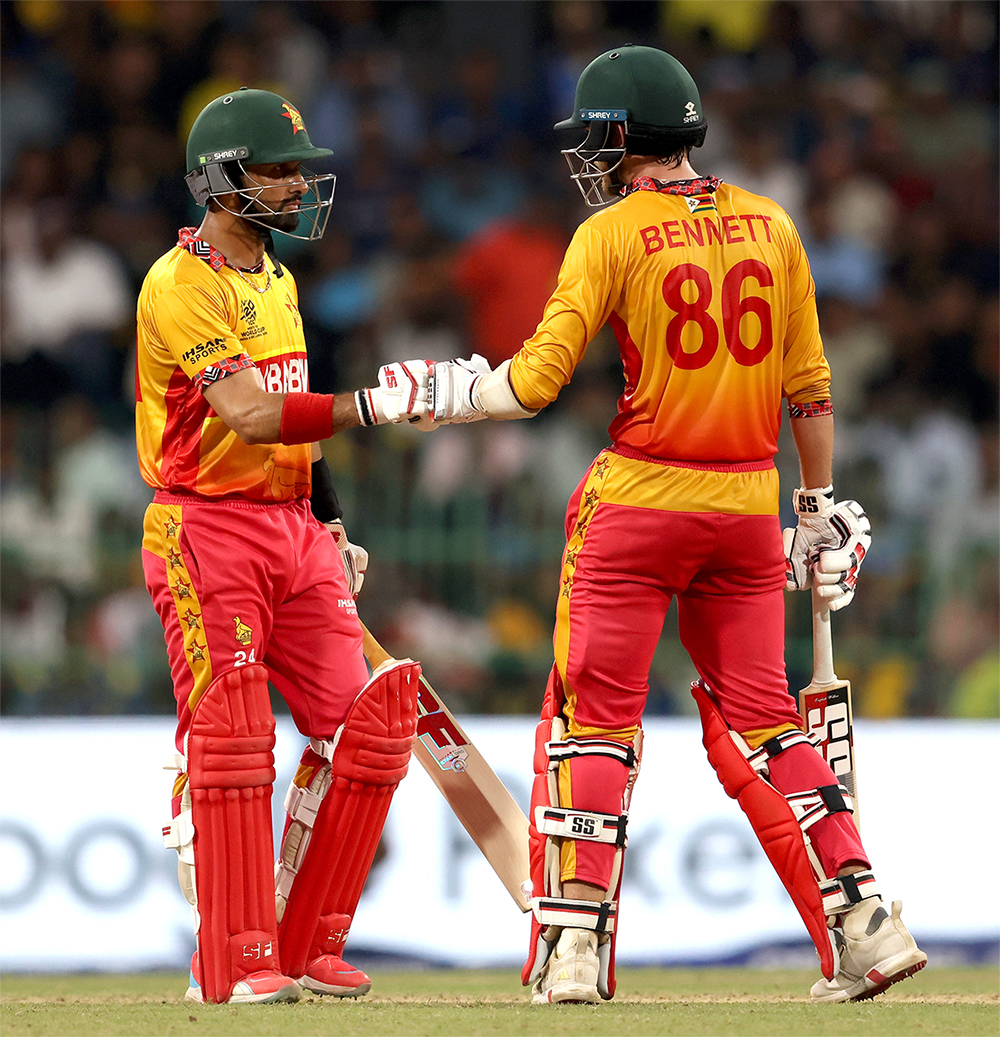
Brian Bennett and Sikandar Raza. Photo Courtesy: Zimbabwe Cricket/Facebook
Due to political instability, Zimbabwe returned to Test cricket again on August 4, 2011, after a six-year boycott. Although some improvements were seen in this country until 2014, a decline started again shortly after that. Furthermore, the problem became more complex after being eliminated from the first round of the 2014 T20 World Cup. The breakdown of cricket infrastructure within the country made it impossible for the team to make it to the 2019 World Cup.
Meanwhile, as government interference increased, the ICC suspended Zimbabwe from international cricket on July 19, 2019.
Although Zimbabwe’s suspension has been lifted now, it has already suffered a great loss. The cricket association is forced to use funds intended for youth development and stadium repairs just to keep the national team from disappearing.
Zimbabwe is a team that has failed to qualify for the ICC World Cup two times in a row. Especially after suffering a defeat in the African qualifiers, it could not reach the 2024 World Cup. At that time, grassroots cricket was also in disarray. It is struggling to run Prince Edward and Churchill School, located in Harare, which produced many national captains.
The backbone that gives birth to Zimbabwe’s talent is club cricket. At one time, that seemed to have vanished. Therefore, all-rounder Sean Williams has compared his career to a ‘rollercoaster.’ This expression was not just his personal experience but also the story of the ups and downs, instability, and struggle faced by Zimbabwe cricket in the past two decades.
Zimbabwe’s cricketers are now on a mission to restore the nation’s former glory. The world watches to see if their efforts can bring stability back to the game.