Kathmandu
Wednesday, July 15, 2026





Despite thousands of deaths each year, weak enforcement, outdated fines, and driver-centric investigations allow reckless driving to go lightly punished, leaving victims without justice and road safety reforms stalled
On 6 March 2024, a passenger bus traveling from Bhairahawa to Kathmandu fell into the Trishuli River at Ghatbesi in Dhading, killing 12 people and injuring 40 others. After the case reached the court, on 17 February 2026, the Dhading District Court sentenced the bus driver, Hareram Chamar, to three years in prison and a fine of 40,000 rupees. The government attorney had demanded a 10-year prison sentence. The driver had claimed in court that the vehicle’s suspension leaf spring had broken.
Courts have often handed down very light sentences in vehicle accident cases. Looking at another old precedent: on 7 July 2010, in Bhelhi of Sarlahi, a tractor driven by Lalbabu Pandit ran over and killed 50-year-old Jagataran Devi Sah. After a complaint was filed with the police, the case was registered in the Sarlahi District Court. On 29 September 2010, the court acquitted Pandit, stating that the victim’s family had already received funeral expense compensation. The Janakpur Appellate Court also upheld the acquittal, after which the case reached the Supreme Court. On 28 December 2023, the Supreme Court overturned the decisions of both lower courts and sentenced him to two years in prison and a fine of 2,000 rupees. It took 13 years for the final verdict in that case.
In Nepal, around 2,500 people die every year due to road accidents. According to statistics from the Crime Investigation Department of Nepal Police, in fiscal year 2024/25, there were 28,692 road accidents nationwide, resulting in 2,549 deaths. During this period, 6,976 people were seriously injured and 37,283 sustained minor injuries. Deaths from road accidents not only deprive families and relatives of their loved ones but also cause the nation to lose active and productive citizens, leading to major economic and social losses. Additionally, many of the seriously injured are left permanently disabled, making the long-term cost of such accidents extremely high.
The extent of negligence among drivers is such that pedestrians are killed even while crossing at zebra crossings or walking on sidewalks. Yet, those involved in such serious offenses often escape with minimal sentences or fines from the courts.
Nepal Police statistics show that on average, seven people die prematurely each day in road accidents. In a recent incident, on the night of 22 February, a bus traveling from Pokhara to Kathmandu fell near the Trishuli River in Benighat Rorang Rural Municipality–5 of Dhading, killing 19 people.
Poor road conditions, excessive speed, driver negligence, and traffic rule violations have contributed to the increasing number of accidents. Driving under the influence of alcohol continues despite traffic police checks and fines.
The extent of negligence among drivers is such that pedestrians are killed even while crossing at zebra crossings or walking on sidewalks. Yet, those involved in such serious offenses often escape with minimal sentences or fines from the courts.
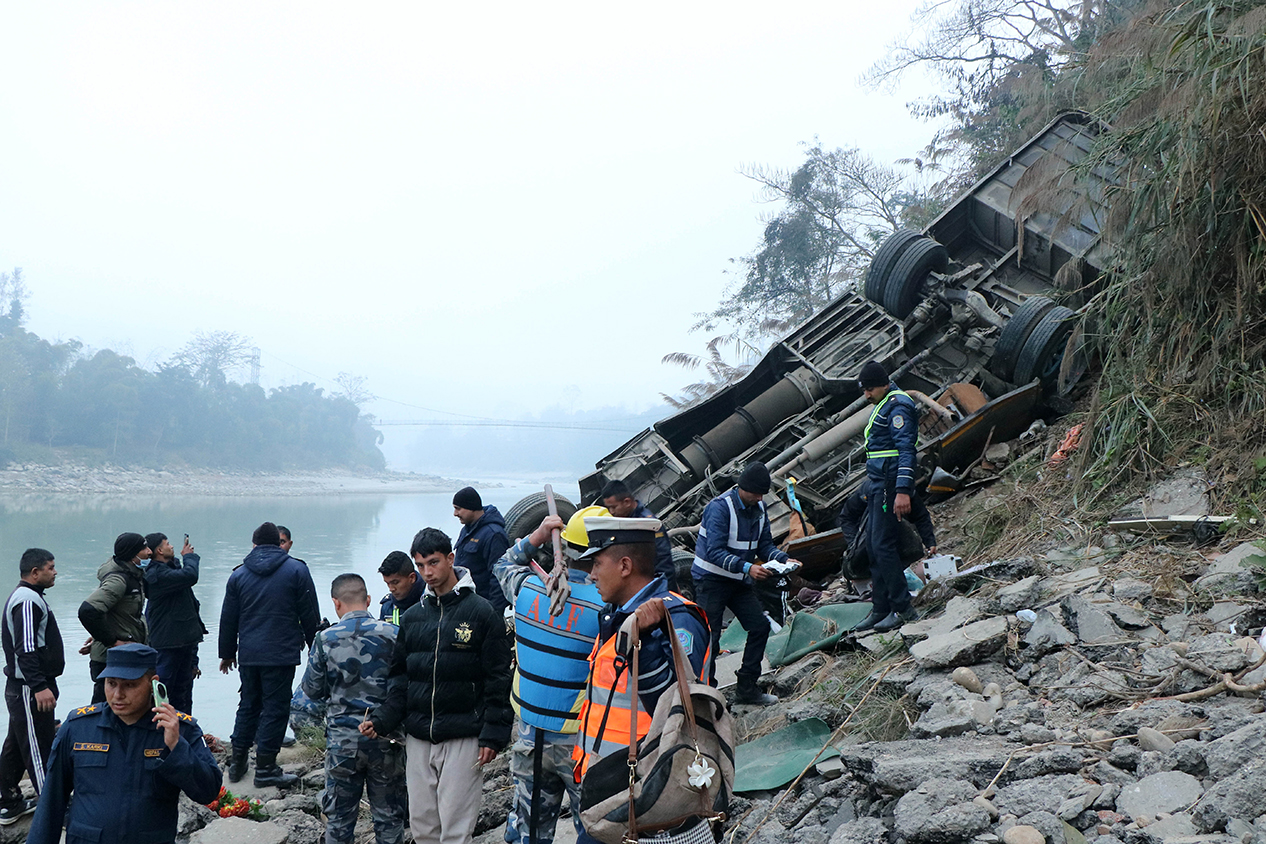
Security personnel carry out rescue operations after a passenger bus fell near the Trishuli River at Bhainsegauda, Ward No. 5 of Benighat Rorang Rural Municipality in Dhading, along the Prithvi Highway, on the night of February 22. Photo: RSS
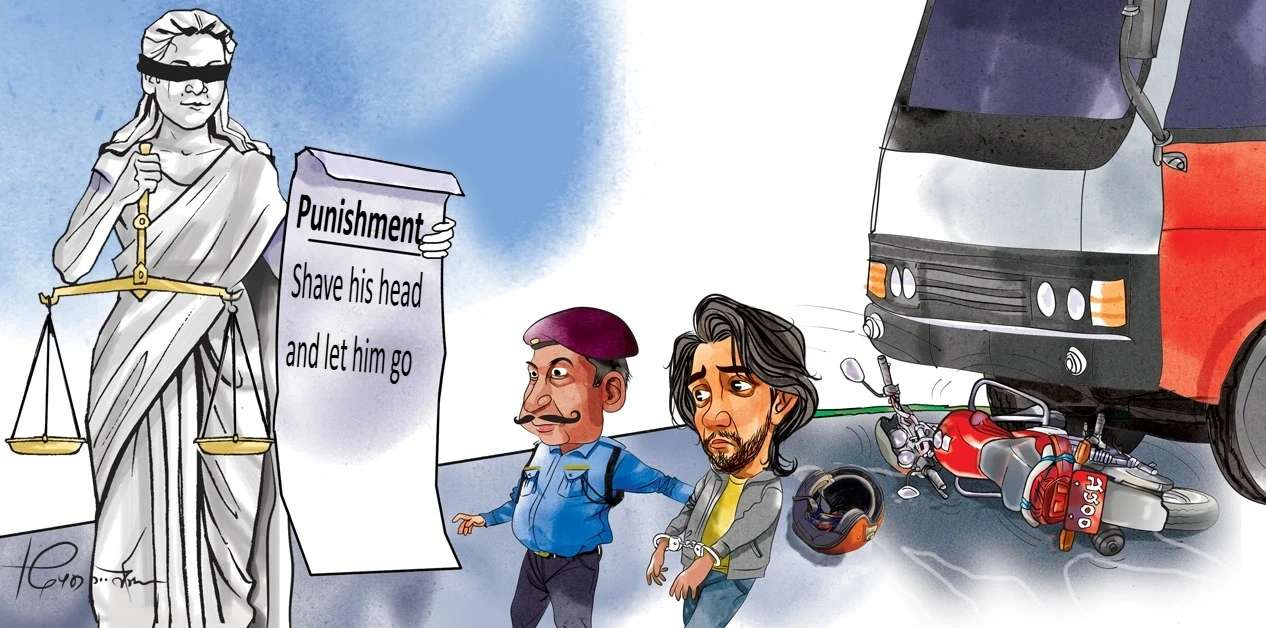
After police investigations into road accidents, government attorneys typically file criminal charges such as “vehicular homicide” and “vehicular injury” against drivers. However, when courts deliver verdicts on cases filed by the government, the sentences and fines are often very light.
Consider one example: On 13 December 2019, in Budhanilkantha, Kathmandu, a car driven by Prithvi Malla struck and killed 42-year-old Leela Devkota from Gorkha, who was walking on the sidewalk. The fact that Malla did not possess a driver’s license and had been heavily intoxicated when he drove the car and killed a pedestrian on the sidewalk sparked public outrage and widespread discussion at the time.
A case was filed against Malla in the Supreme Court. However, eight months after the incident, on 19 July 2020, a bench of Justices Sapana Pradhan Malla and Manoj Sharma ordered his release on a bail of Rs 500,000 while he was in pretrial detention.
In the same case where the government attorney had demanded a 10-year sentence, the Kathmandu District Court, on 21 March 2022, sentenced Malla to six months in prison and a fine of 1,000 rupees. The district court cited mechanical failure in the car as the reason for awarding the minimum sentence.
When road accidents occur, they become news and spark heated debates about road and vehicle safety for a few days. But soon the issue fades away, and people forget about necessary reforms related to roads and traffic until another similar accident happens.
After such a light sentence was imposed in a case where a pedestrian was killed on the sidewalk due to reckless driving, suspicion was raised about the court’s decision. A complaint was filed with the Judicial Council against District Court Judge Surya Prasad Adhikari. While the investigation was still ongoing, Judge Adhikari retired on 6 November 2021 due to the age limit.
An appeal was filed in the Patan High Court against the district court’s verdict. On 2 October 2023, a joint bench of Judges Rajendra Kharel and Jagadish Ghimire overturned the district court’s decision and sentenced Malla to four years in prison and a fine of 40,000 rupees. The High Court stated in its verdict that Malla had only a learner-type foreign driver’s license, had consumed alcohol, was sleep-deprived, had driven into the opposite lane, and struck a person walking on the sidewalk.
When road accidents occur, they become news and spark heated debates about road and vehicle safety for a few days. But soon the issue fades away, and people forget about necessary reforms related to roads and traffic until another similar accident happens.
The law mandates a driving license to operate vehicles. However, in Nepal, some people drive without obtaining a license. There are numerous examples where accidents caused by such drivers have resulted in untimely deaths.
Consider another old precedent: On 2 December 2007, on an inner road in Balkumari, Lalitpur, 74-year-old Lati Maharjan, who was grazing goats, was struck and injured by a motorcycle. The driver, Sunny Maharjan, himself took the elderly woman to the hospital, where she died during treatment. After a complaint was filed with the police, a case was registered. On 27 April 2008, the Lalitpur District Court sentenced the motorcycle driver to three months in prison and a fine of 2,000 rupees.
The National Human Rights Commission’s Annual Report for fiscal year 2024/25 mentions that citizens have been deprived of their fundamental right to life due to road accidents.
After the victim’s side expressed dissatisfaction with the verdict, the case went through appeals and eventually reached the Supreme Court. On 14 December 2017, a bench comprising Justices Anand Mohan Bhattarai, Anil Kumar Sinha, and Tanka Bahadur Moktan overturned the decisions of the district and high courts and sentenced the driver to two years in prison. In addition, since the driver had been operating the vehicle without a license and had run over and killed the victim, the court imposed a fine of 4,000 rupees (including an additional fine of 2,000 rupees for driving without a license).
So far, cases continue to be registered under the Vehicles and Transport Management Act, 2049 BS (1993). On that basis, in most cases courts have typically imposed a maximum sentence of three years’ imprisonment and a fine of 2,000 rupees. Deputy Attorney General Sanjiv Raj Regmi states that laws related to motor vehicles differ from Nepal’s broader penal policy framework. Due to weak legal provisions, government attorneys have not been able to achieve desired success in such cases. He says, “In 2049 (1993), a government officer’s salary was 3,000 rupees. Now it has increased to 45,000 rupees, but the 2,000-rupee fine provision in the motor vehicle law has not been amended.”
Deputy Attorney General Regmi explains that although cases are being filed, the minimal sentences and fines have failed to reduce road accidents. “Because of the provision for minimum punishment and fines, victims have not received adequate compensation and the injured have not received sufficient treatment,” he says. “To reduce accidents, those who cause them must be held accountable to some extent. Traffic laws must be strictly enforced.”
He analyzes that the low penalties and fines have emboldened drivers, resulting in negligent incidents such as hit-and-run cases. Since it is often difficult to prove malicious intent or deliberate action by drivers as defined in the law, lighter punishments are typically imposed.
The National Human Rights Commission’s Annual Report for fiscal year 2024/25 mentions that citizens have been deprived of their fundamental right to life due to road accidents.
Provision for up to life imprisonment in law
Section 161(1) of the Vehicles and Transport Management Act, 1993 provides for up to life imprisonment in cases of intentional killing. It states that if a person, while driving, runs over or hits someone causing death immediately or within 21 days, and if it is proven that the act was committed with the intent to kill, the driver shall be sentenced to life imprisonment. However, the provision specifies that death must occur immediately or within 21 days. The Office of the Attorney General has already suggested amending the law, arguing that fixing a 21-day limit is impractical. The Criminal Justice Administration Reform Study and Recommendation Report 2081 BS states that the Vehicles Act should be revised to ensure punishment based on intent. Section 161(2) provides that if death occurs immediately or within 21 days due to negligent driving, the driver may face imprisonment from three to 10 years and a fine ranging from 30,000 to 100,000 rupees.
Section 161(3) states that if death was not foreseeable but an accident occurs and a person outside the vehicle dies, the driver may face up to one year in prison and a fine of 2,000 rupees. In most accident cases, courts appear to rely on this subsection when issuing decisions. When dissatisfaction with lower court rulings leads cases to reach the Supreme Court, it often takes at least a decade for a final resolution.
Section 162(1) provides that if a person suffers disability due to an accident, the driver may face imprisonment from three to 10 years and a fine of up to 30,000 rupees. If the injury is curable, a fine of 5,000 rupees may be imposed. The Office of the Attorney General has recommended amending the law to ensure that in cases of property damage, compensation is recovered from the responsible party. It has also emphasized the need to grant appellate jurisdiction at the district court level itself. Increasing penalties and accountability is expected to reduce ordinary accidents. The report further recommends addressing the legal gap regarding treatment and punishment provisions when a person is injured in a vehicle accident.
The law requires that buses operating over distances longer than 250 kilometers must have three drivers. The road distance from Kathmandu to Dadeldhura is 766 kilometers, and to Taplejung it is 617 kilometers. However, there is no effective monitoring to ensure that long-route passenger buses actually have three drivers.
Road accidents are not caused solely by drivers; many other factors are also responsible. However, cases registered in court appear to be driver-centric, and other responsible parties are rarely held accountable.
Govinda Bhattarai, Executive Director of the Nepal Automobiles Association, argues that instead of blaming only the driver, other factors must also be examined. He contends that investigations focused solely on the driver after accidents fail to identify the real causes and therefore do not provide solutions. “Even when legal provisions are adequate, improper practices occur in implementation. Shouldn’t government officials who allow vehicles to operate on roads that fail to meet standards be prosecuted?” Bhattarai questions.
The law requires that buses operating over distances longer than 250 kilometers must have three drivers. The road distance from Kathmandu to Dadeldhura is 766 kilometers, and to Taplejung it is 617 kilometers. However, there is no effective monitoring to ensure that long-route passenger buses actually have three drivers. As a result, some buses on long routes operate with only two drivers, and in many cases, just one driver handles the entire journey. Bhattarai asks, “If a bus operating on a long route meets with an accident without having three drivers, should action be taken against the administrative body that allowed it to operate? Should the owner be blamed? Or the driver? Such issues must also be debated.” Similarly, he questions who should be held responsible when vehicles that have not passed inspection cause accidents due to technical defects.
He alleges that in some road accident cases, charges are filed through collusion between the police and government attorneys. Therefore, he suggests that conclusions about what charges to file should be reached only after a thorough investigation by the police, the Office of the Government Attorney, and independent experts. “Accidents are not always fate or negligence. Sometimes investigative bodies categorize them as accidental. The police administration can come under pressure from the victim’s family,” he says.
According to data from the Office of the Attorney General, among cases prosecuted by government attorneys in district courts across the country, vehicular homicide ranks sixth among the top ten types of offenses filed. In fiscal year 2024/25, a total of 5,046 vehicular homicide cases were registered in district courts nationwide. Similarly, last year the Office of the Attorney General decided to file 2,826 vehicular homicide cases, naming 3,574 individuals as defendants in those cases.
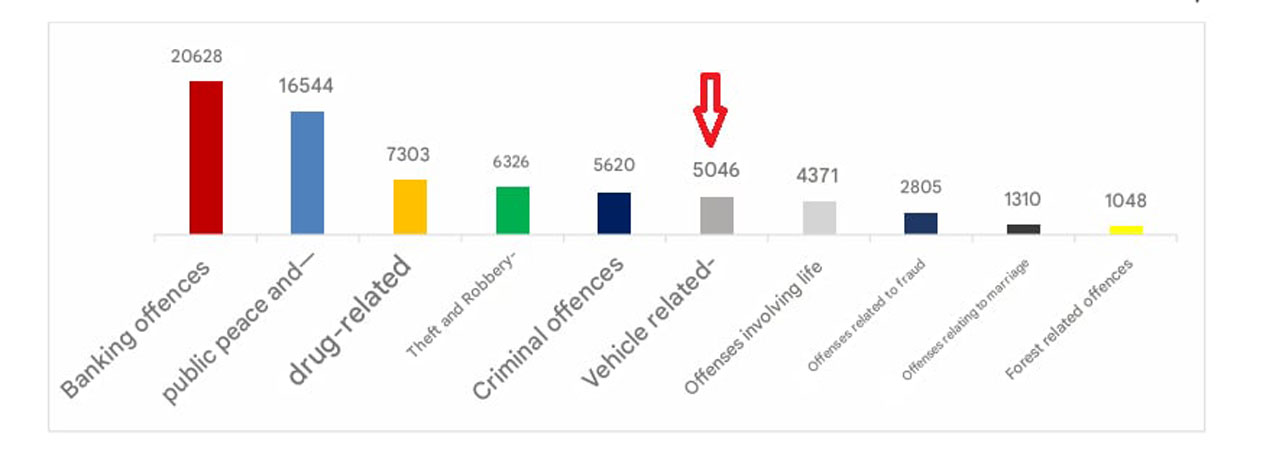
Vehicular homicide is the sixth most common offense among the ten types of criminal cases filed by government attorneys. Source: Office of the Attorney General Annual Report, FY 2024/25
Among the registered cases that reached the Supreme Court, there are several precedents related to vehicular homicide. One precedent from 2071 BS (2014), Nepal Government v. Kalu Chaudhary, stated: “No matter how many lives a driver takes, the driving license is not revoked, nor is there any significant financial burden.” It interpreted that conveying a message that punishment is merely symbolic or ornamental amounts to the beginning of anarchy and impunity. The verdict stated, “The alarming state of air and road accidents in Nepal has severely tarnished the country’s international image. It is the responsibility of the court to discourage this through proper application of law and criminal justice.” It further said, “The defendant driver’s manner of driving must be considered extremely incompetent and irresponsible. The level of driving must be regarded as far below that of a capable and cautious driver.”
Road safety expert Bhagwati Sedhain says that because the state has not prioritized road safety, loss of life and property is occurring as if in a pandemic. According to her, technologies such as CCTV cameras should be installed to reduce road accidents, and punishment should be imposed according to the offense identified through such evidence. She suggests that the law should provide for high fines for offenders and that vehicular homicide cases should be resolved swiftly. “The state must be uncompromising in enforcing rules such as requiring a valid driving license, route permits, prohibiting overloading, and banning drunk driving,” she says.
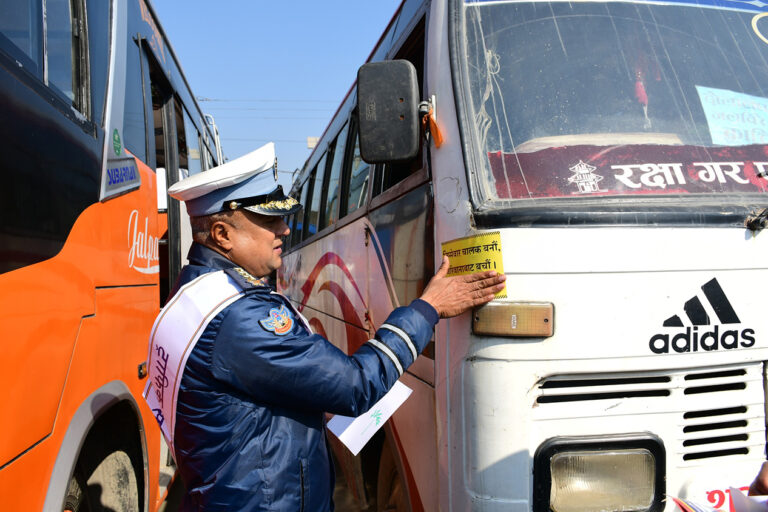
Traffic police placing awareness stickers on a bus during Traffic Week 2026. Photo: Facebook page of Kathmandu Valley Traffic Police Office
She adds that reducing accidents requires initiative from all sectors—state agencies, vehicle owners, drivers, and the general public.
Why do accidents occur?
In its annual report for fiscal year 2024/25, the National Human Rights Commission stated, “Due to ineffective government regulation in vehicle management, citizens are being deprived of their right to life through road accidents.” Weak and low-quality roads, construction without standards, driver negligence, disregard for traffic rules, continued use of old vehicles, and overloading beyond passenger capacity have not been controlled. The Commission analyzed that government bodies have not been as effective as expected in reducing such incidents. The data reflect the overall weak state of road safety in the country.
The “Road Accident Reduction Study Subcommittee Report 2077 BS (2020),” prepared by Parliament’s Development and Technology Committee identified causes such as disregard for road discipline, shortage of skilled and experienced drivers, substandard road infrastructure, lack of knowledge of traffic rules among vehicle users, poor vehicle condition, and negligence by road users.
Especially in rural areas, road construction carried out without technical standards in the name of development has led to increasing floods, landslides, and road accidents, resulting in significant loss of life and property, the Commission noted.
The “Road Accident Reduction Study Subcommittee Report 2077 BS (2020),” prepared by Parliament’s Development and Technology Committee, also stated that no single factor alone is responsible for road accidents. It identified causes such as disregard for road discipline, shortage of skilled and experienced drivers, substandard road infrastructure, lack of knowledge of traffic rules among vehicle users, poor vehicle condition, and negligence by road users.
Although road accidents have been increasing daily, efforts to reduce them were already seen as weak at that time. The report emphasized the need for a long-term strategic plan on road safety. However, even five years later, the situation remains unchanged. Not only has a long-term strategy not been formulated, but even existing policies and regulations have not been effectively implemented.
Parliamentary report recommendations remain on paper
Concerned about the growing number of road accidents, Parliament’s Development and Technology Committee prepared a report in 2077 BS (2020) identifying problems and recommending reforms. However, such reports often remain unimplemented and shelved.
Road accidents often affect people involved in economic activities, meaning the state is daily losing productive citizens or rendering them incapacitated.
The five-member study committee, coordinated by then-MP Ganesh Kumar Pahadi, stated in its report that in order to reduce road accidents, there is a need for laws that define not only the qualifications of drivers but also their responsibilities. “There is not even an evaluation of the annual number of accidents or the human and material losses caused by them. The greatest loss from accidents is human loss,” the report stated, “When families lose loved ones, they suffer unimaginable pain.”
Since many agencies in Nepal work on road safety, duplication of efforts, lack of coordination, and jurisdictional disputes have hindered effective action. In such a situation, the report drew the government’s attention to the need to form an empowered Road Safety Council to play an effective role in reducing road accidents.
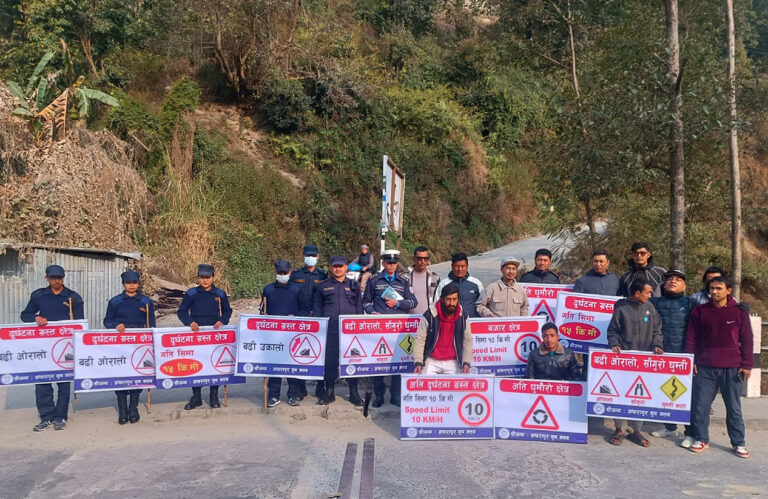
Traffic police installing public awareness hoarding boards in Sankhu on February 22. Photo: Facebook page of Kathmandu Valley Traffic Police Office
Road accidents often affect people involved in economic activities, meaning the state is daily losing productive citizens or rendering them incapacitated. In a country weak in road safety, vehicle accidents are becoming an increasingly serious challenge. The lack of manpower, equipment, and other resources for post-accident rescue has also contributed to the rising number of fatalities.
Som Raj Kafle, District Government Attorney of Dhading, a district where many vehicle accidents occur, says accidents are increasing due to weak enforcement of transportation laws. “There is no regular monitoring of whether public buses carry more passengers than seat capacity, whether drivers are under the influence of alcohol or drugs, or whether road conditions are adequate. As a result, road accidents are likely to continue appearing as alarming news in the coming days,” he says.