Kathmandu
Sunday, July 12, 2026





PM Sushila Karki aligned her schedule with Nobel laureate Takaaki Kajita and academic calendars, signaling a shift in how Nepal’s top executive office engages with universities
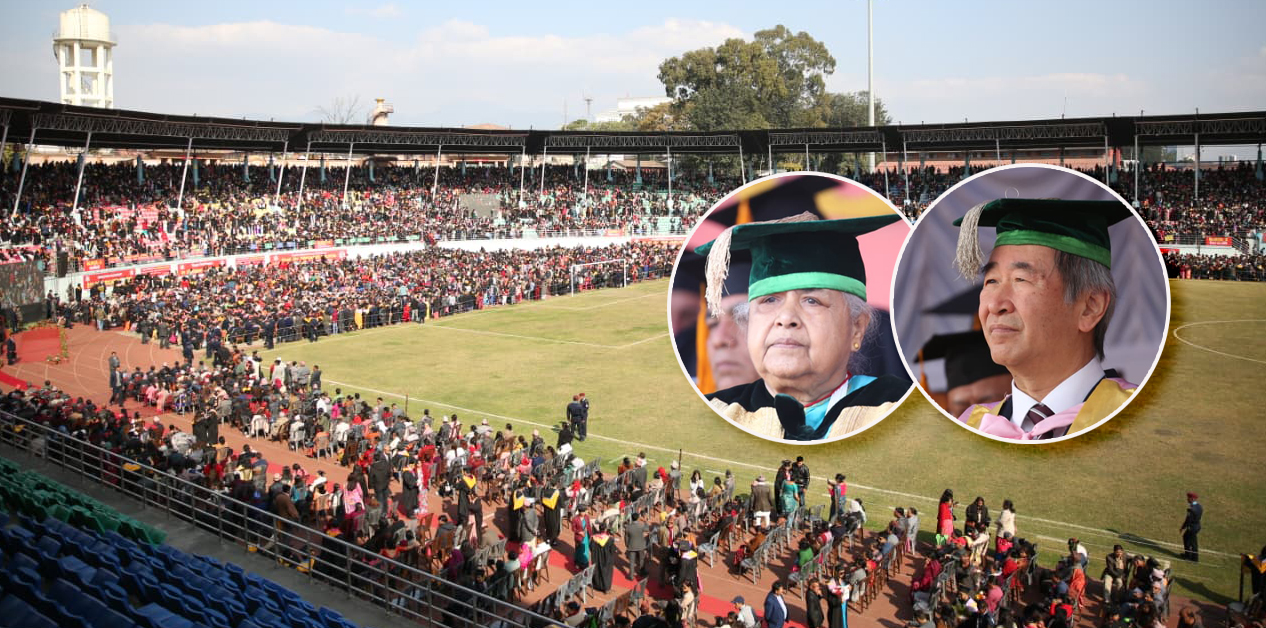
KATHMANDU: Preparations were underway for the 51st convocation ceremony of Tribhuvan University. It was decided to invite Nobel Prize winning Japanese professor Takaaki Kajita as the chief guest. After checking Kajita’s schedule, he informed TU that he would attend only if the event were fixed on a specific day he had designated, and only at that time.
Tribhuvan University holds its convocation ceremony in the final month of every Gregorian year. Since past practice has been to schedule the ceremony according to the Prime Minister’s availability, the exact date is not fixed in advance. The Controller of Examinations at Tribhuvan University determines the ceremony date only after confirming the availability of both the Prime Minister and the foreign guest.
As the chief guest, Nobel Prize laureate Kajita had set the date as December 25, 2025. However, the university administration was under stress over whether the Prime Minister and Tribhuvan University’s Chancellor, Sushila Karki, would be available on that day. In the past, Tribhuvan University had struggled to fix the convocation date due to the Prime Minister’s busy schedule. Only after aligning with the Prime Minister’s availability would the university finalize the ceremony date and then invite the chief guest accordingly.
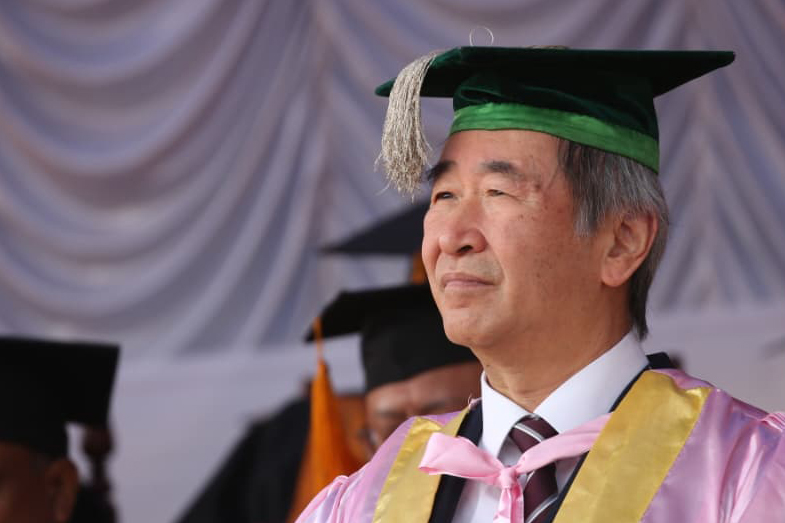
Nobel Prize-winning Japanese professor Takaaki Kajita. Photo: Nepal Photo Library
However, this time chief guest Kajita had stated that he could not attend on any date other than the one he had specified. Before that, Tribhuvan University’s Controller of Examinations, Laxman Paudel, who was coordinating the convocation preparations, had met with Prime Minister Karki and only fixed a tentative date for holding the ceremony.
In such a situation, the Tribhuvan University administration was uncertain about what to do if the Prime Minister and Chancellor did not allocate time for December 25. This kind of uncertainty and stress over having to secure the Prime Minister’s availability recurs every year.
However, for this year’s convocation ceremony, the Tribhuvan University administration did not have to worry about the difficulty of arranging the Chancellor’s schedule. Controller of Examinations Paudel informed the Prime Minister’s Office about the chief guest’s busy schedule and the time he had specified. Prime Minister Karki responded positively to holding the convocation ceremony according to chief guest Kajita’s schedule.
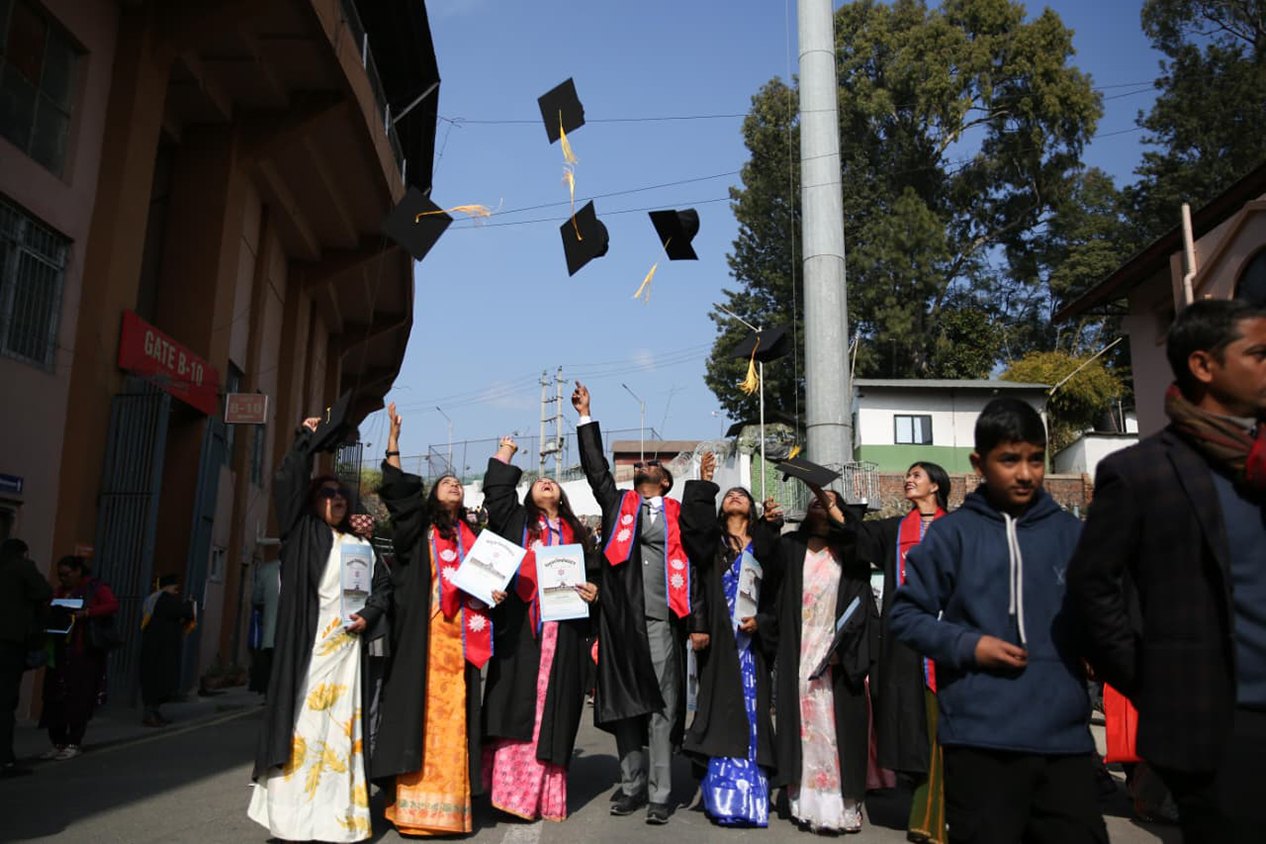
Graduates participating in the first convocation ceremony of Nepal Open University held on January 25, 2026.
Photo: Nepal Photo Library
Prime Minister’s press advisor, Ram Bahadur Rawal, says that Prime Minister Karki participated in the convocation ceremony in a manner that respected the schedules of both the academic institution and the foreign chief guest. “In previous convocations, it was always a struggle just to accommodate the chief guest’s schedule; on the other hand, either the Prime Minister’s schedule didn’t align, or the ceremony had to be held according to the Prime Minister’s time, which made coordinating very difficult. This time too, the administration were under the same stress,” he says. “The Prime Minister believes she should not be directing these matters and that the academic and scholarly calendar should not be disrupted. So she agreed, saying, “If someone coming all the way from Japan can arrange time, then why I can’t?”
Ultimately, more than 16,300 students who graduated from Tribhuvan University received their degrees on December 25, 2025, with Nobel Prize-winning Kajita presiding as the chief guest.
According to Tribhuvan University’s Controller of Examinations, Paudel, the convocation ceremony, which lasted about five hours, saw Prime Minister Karki fully present throughout. “In this regard, this year’s convocation was special,” he says.
Rawal adds that, so far, Prime Minister Karki has been attending events strictly according to the schedules proposed by academic and scholarly institutions.
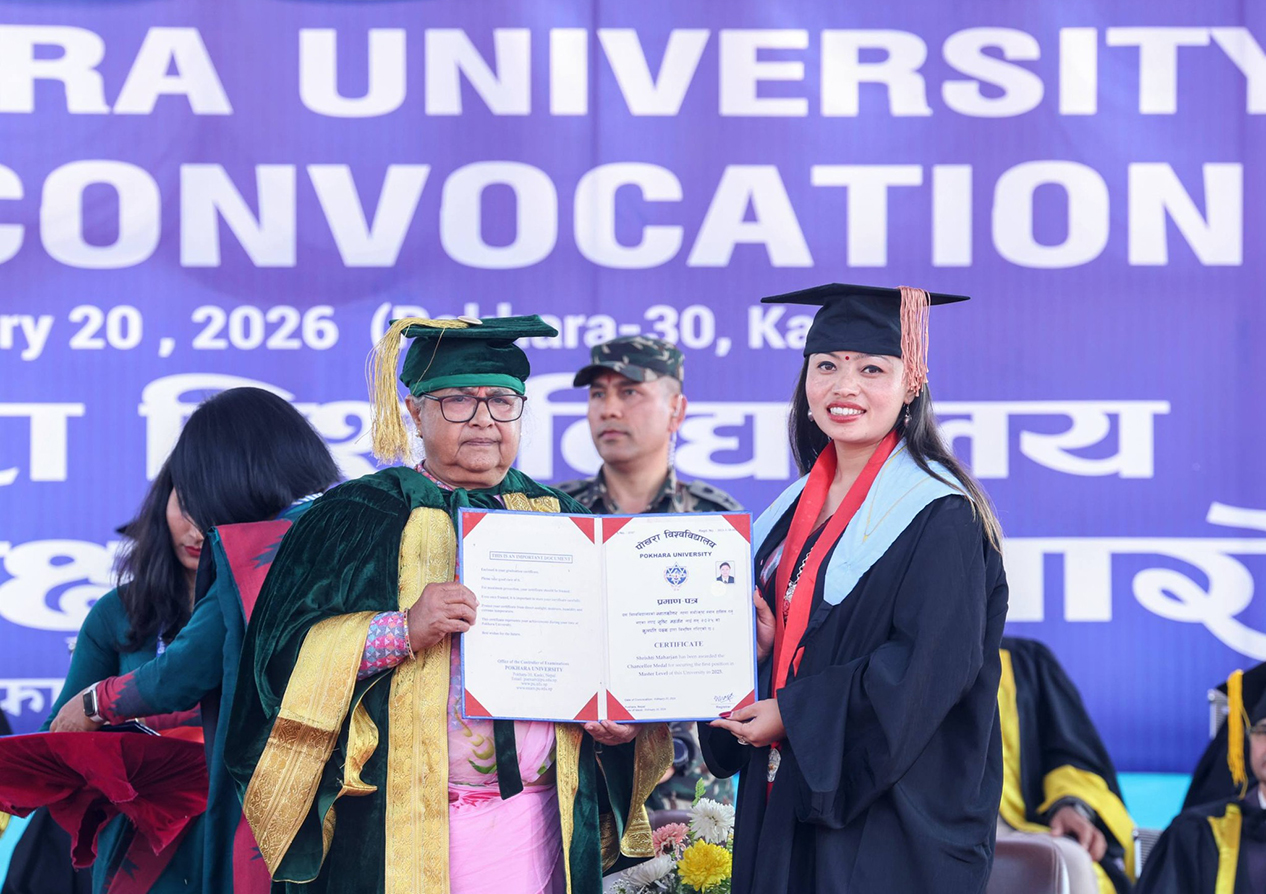
Chancellor Sushila Karki conferring degrees on students at the 21st convocation ceremony of Pokhara University held on February 20, 2026. Photo: Prime Minister’s Secretariat
There is a provision that the Prime Minister serves as the Chancellor of the universities in the country. Although the regular procedure requires the Chancellor to be present at the convocation ceremony, previous Prime Ministers insisted on holding the program at a time convenient to themselves. Not only that, even getting a meeting with the Prime Minister to discuss the ceremony would be a major challenge. Using this as a pretext, there used to be bargaining, such as providing favored positions or jobs to associates of people in the Prime Minister’s secretariat.
Educationist and former Vice-Chancellor of Tribhuvan University, Kedar Bhakta Mathema, recalls that the university’s convocation ceremony was stalled for years due to conflicts among student organizations. “After I took charge, we resumed holding convocations. I remember it took me about 10 days, including nights, to sign students’ certificates when we revived a convocation that hadn’t been held for around ten years,” he says.
Former Vice-Chancellor Pushpa Raj Joshi recalls that the convocation date was set only after the Prime Minister’s schedule was finalized. “We had to follow up from at least a month in advance,” he says. According to Joshi, if the Prime Minister could not attend, the Education Minister would preside over the ceremony. Some Prime Ministers would deliver their address at the ceremony and leave quickly.
Prime Minister Karki has ended the past practice of not prioritizing convocation ceremonies. Her interest and active participation in university convocations sends a positive message, says Mathema. “Earlier, perhaps to avoid getting entangled in student issues, the Prime Minister would send the Education Minister. Now, the Prime Minister’s eager participation reflects a growing concern for higher education,” he says.
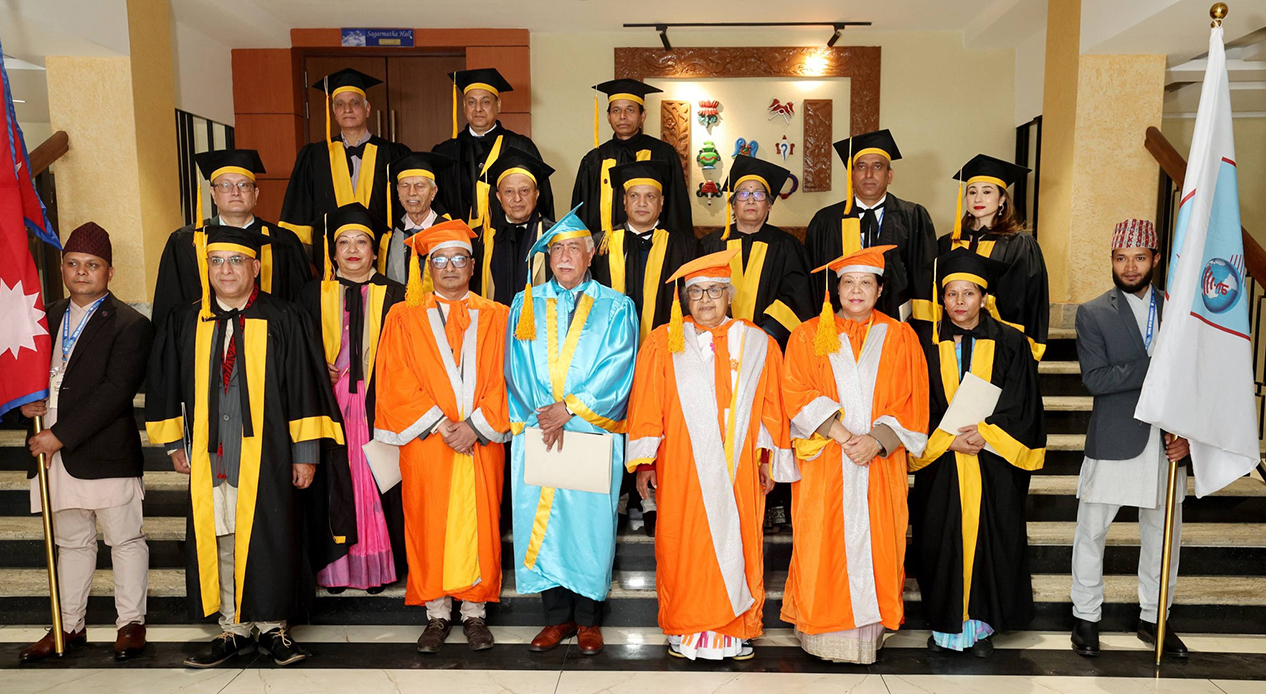
Prime Minister and Chancellor Sushila Karki with guests at the first convocation ceremony of Nepal Open University held on January 25, 2026. Photo: Prime Minister’s Secretariat
Prime Minister Karki attended the 31st convocation of Kathmandu University (first phase) held on 20 November 2025, the first convocation of Open University on 25 January 2026, and the 21st convocation of Pokhara University on 20 February 2026. She was also personally present at the 49th academic assembly of the Nepal Academy of Science and Technology (NAST) held on 28 November 2025 and the 12th assembly of Karnali Academy of Health Sciences held on 14 January 2026.
Shiva Prasad Upadhyay, Chief Administrative Officer of NAST, says that this time they were able to hold the academic assembly at the NAST premises at the time they had proposed. “It depends on what kind of Prime Minister you have. In the past, due to health reasons, the Prime Minister used to hold programs at the Prime Minister’s Office in Baluwatar,” Upadhyay says. “This time, we conducted the academic assembly on NAST premises itself, with the Prime Minister present, exactly on the date we had proposed.”
In the past, NAST had to fix the date of its academic assembly according to the Prime Minister’s convenience. The 49th academic assembly of NAST had been scheduled to be held at the Prime Minister’s residence in Baluwatar 9 September 2025, according to the availability of then-Prime Minister KP Sharma Oli. However, it was postponed due to the Gen Z revolt.