Kathmandu
Sunday, July 19, 2026





As politicians fan out across villages with development promises ahead of elections, 74-year-old Jaya Jaisi arrives at Singha Durbar asking for drinking water
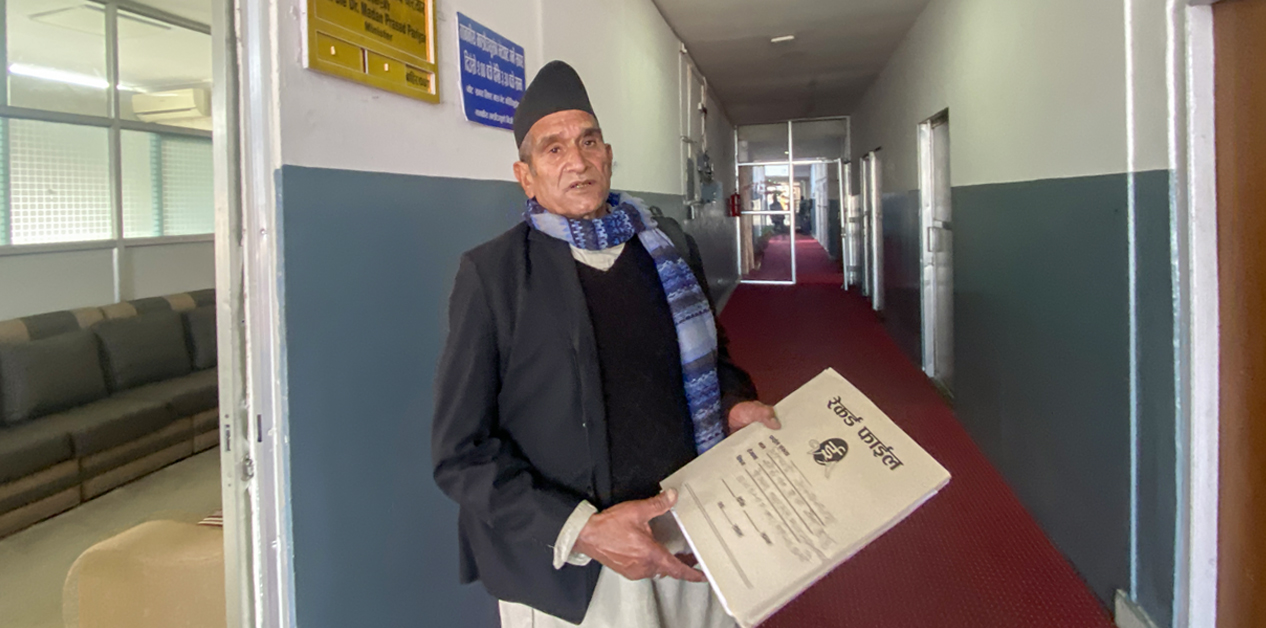
Carrying a bag stuffed with documents and a bundle of files in his hand, an elderly man was wandering around the Ministry of Water Supply inside Singha Durbar on Monday afternoon.
Seventy-four-year-old Jaya Jaisi from Mugu had arrived in Kathmandu seeking budget allocations for drinking water, irrigation, and temple conservation.
In his hand were petitions addressed to the minister and secretary, requesting drinking water for his village. In the application, he had written: “So far, 397 households have been surviving on muddy river water. If water could be brought from the Bamru Khola source and even four taps installed in the village, it would be sufficient for us.”
He was trying to meet Minister Madan Prasad Pariyar. He made inquiries and reached the minister’s office, but neither the minister nor any employees were present.
Showing the petitions he had written himself—addressed to the minister and secretary—along with the village decision to request water from the government and recommendation letters from the ward and rural municipality, he climbed to the fourth floor and appealed to staff members. They advised him to meet the secretary instead.
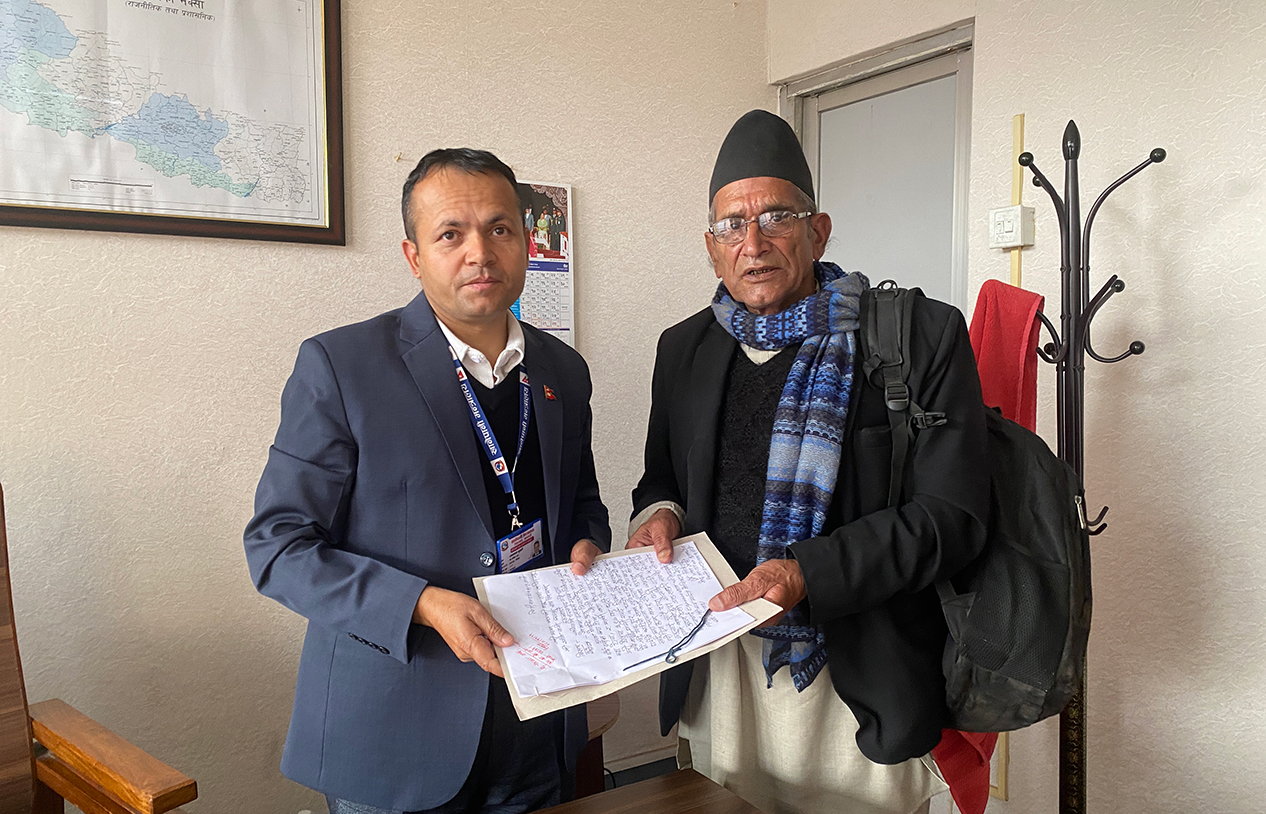
Jaya Jaisi submitting his petition to Joint Secretary Ramakant Duwadi at the Ministry of Water Supply
He waited outside the office of Secretary Bishwa Babu Pudasaini. The secretary stepped out in a hurry. A staff member told him, “Please come back after half an hour.”
Coming down to the ground floor, he began asking for directions to other ministries. He also carried files containing petitions addressed to the Ministry of Tourism and the Irrigation Ministry.
Jaisi had come alone to Kathmandu from Thula Dhain in Ward No. 10 of Soru Rural Municipality, Mugu, seeking drinking water facilities. He managed to enter Singha Durbar after requesting officials at the gate, but finding neither ministers nor clear directions, he became confused.
“Please, sir, take me to the ministry,” he requested Nepal News correspondent. “There is terrible hardship in the village due to lack of water. No one is available here. Please help me.”
When asked whether he had approached the rural municipality or provincial authorities—since small projects can be funded there—he replied immediately: “Of course I went. I’ve gone many times. I submitted applications everywhere. When nothing worked out, I saved a year’s worth of old-age allowance for travel expenses and came here. I did not come out of desire, but out of compulsion and hope that something might happen.”
Traveling from Mugu to Kathmandu costs between Rs 45,000 and 50,000. He saves his and his wife’s annual old-age allowances to afford the journey.
In Ward No. 10 of Soru Rural Municipality—including Dalit Bada, Joshi Bada, Upadhyay Bada, and Mathi Bada—there is an acute drinking water shortage. According to him, villagers fetch water from a river two kilometers away. During the rainy season, floods muddy the water; they let it settle in pots before drinking. In winter, they collect snow, melt it, and drink it.
“The government says one tap per household, but we are still drinking river water. Our ancestors drank muddy water, and we are forced to do the same,” he said.
The Bamru Khola lies about five kilometers from the village. If water could be brought from there, it would not only provide drinking water but also improve agriculture. “We have soil suitable for paddy cultivation. Without water, we are forced to plant millet and maize,” he explained.
Jaisi carried xerox copies of applications submitted to various offices, along with ward and rural municipality recommendations. He says it has been 17 years since he began visiting Singha Durbar seeking budget for water.
“There is no water, no toilets in the village. The youth leave for India after Dashain. Only the elderly and disabled remain. With no one to advocate for us, this old man had to come,” he said.
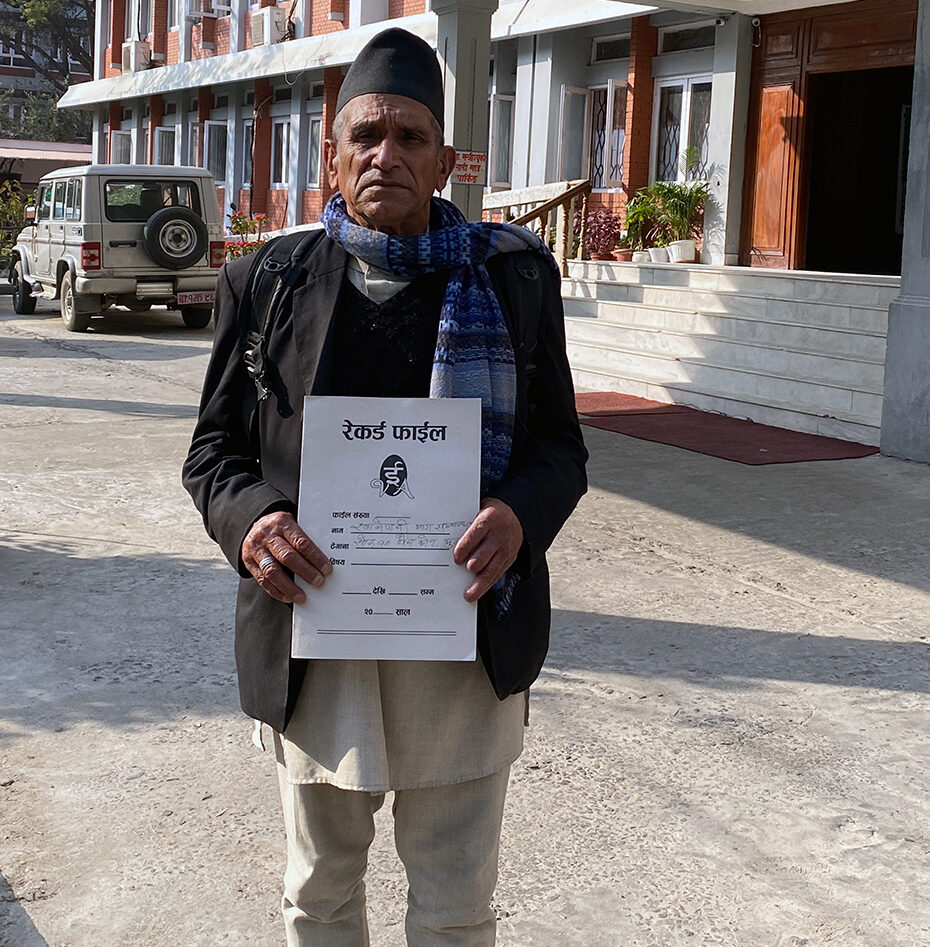
Jaya Jaisi at Singha Durbar
Since 2009, he has been traveling to Singha Durbar every year at his own expense, yet the drinking water problem remains unresolved. Traveling from Mugu to Kathmandu costs between Rs 45,000 and 50,000. He saves his and his wife’s annual old-age allowances to afford the journey.
“We heard the slogan ‘Singha Durbar in every village.’ But Singha Durbar reached only where leaders live. It did not reach where ordinary people live. That is why I had to come here,” he said.
His village is home to the Tharp Mast and Rumal Mast temples. On Monday, he also visited the Ministry of Culture, Tourism and Civil Aviation to seek budget for their preservation. Minister Anil Kumar Sinha’s office was empty; no one was present at his secretariat either. He met Undersecretary Arjun Sen Oli instead. Jaisi, who also serves as a temple priest, hopes that preserving the temples could promote religious tourism.
Undersecretary Oli told him, “The country is heading toward elections. The next budget will be prepared by the new government. We will register your application.” With that assurance, he left the ministry carrying hope.
He returned again to the Ministry of Water Supply and met Joint Secretary Ramakant Duwadi from the Planning and Coordination Division. After reviewing the petition, Duwadi immediately took a photo of it and sent it via WhatsApp to officials at the Nepalgunj water supply office.
According to government policy, the ministry handles projects serving more than 500 households, while smaller ones are managed by local and provincial governments. “Regardless of population, everyone deserves access to basic services like drinking water,” Duwadi said, “The Nepalgunj office will conduct a study; if the problem is large-scale, the ministry will address it, otherwise it will be resolved at the local level.”
This was not his first time submitting such petitions. Since 2009, he has been coming every year. Officials never outright reject him.
By then, it was nearing 5 p.m. Jaisi still needed to visit the Irrigation Ministry. He could not meet the minister there either. The secretary was busy in an online meeting. Though he failed to meet him, the secretary marked his petition for processing. After registering the application, he left.
This was not his first time submitting such petitions. Since 2009, he has been coming every year. Officials never outright reject him. “They say they will include it in this year’s budget. But our village has never received a water tap or irrigation facility,” he said.
“To get drinking water in the village, it seems you need your own people in positions of power. I have no influential relatives. There’s no one in my village more powerful than the ward chairperson. So how can we secure a budget? I came only in the hope that someone might show mercy.”
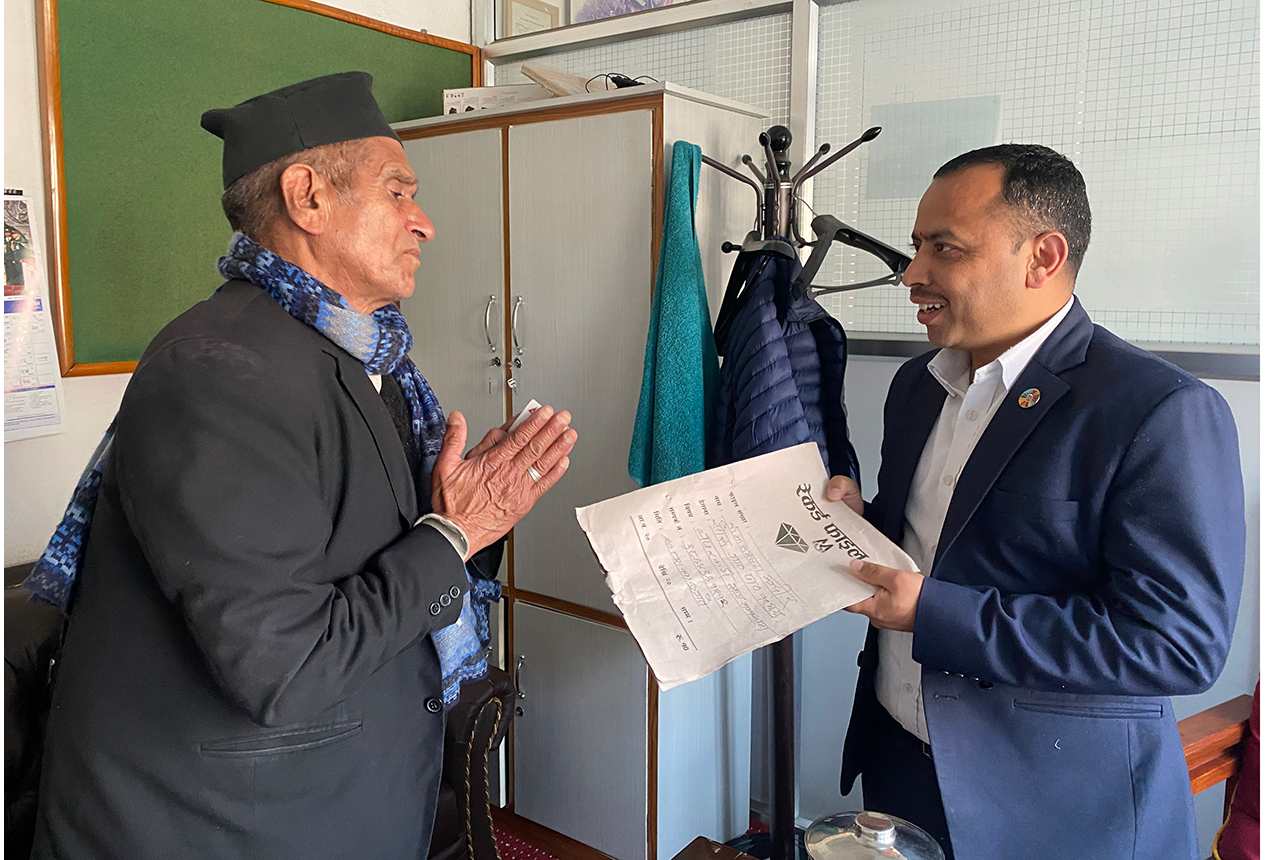
Jaya Jaisi handing over his petition to Under Secretary Arjun Sen Oli at the Ministry of Tourism.
Jaisi was elected vice-chair of Dhain VDC in the 1997 local elections. In 2001, during the Maoist conflict, he was displaced and moved to Kohalpur. After peace was restored, he returned to his village in 2009, only to find conditions even worse—no water taps, no electricity, no toilets, broken roads, and youth already migrated to India.
Seeing his village in such a state, he began his yearly trips to Singha Durbar. “All the young people have left. Only the elderly remain. There isn’t even anyone to carry our bodies when we die. So I have no choice but to keep coming here,” he said.
Election campaigns are once again underway in his village. Leaders are coming to seek votes. But Jaisi has little hope in them. He has handed petitions and received promises before, yet the village still lacks drinking water, irrigation, and basic services.
“We voted them in hoping they would do something. They only serve themselves. They never look back at people like us who have no one,” he said.
He is exhausted from running from ward offices to ministries in search of water. Over the years, he has seen many ministers come and go, but none have delivered. Villagers now tell him to stop trying—that he cannot succeed. Even he sometimes wonders whether he can continue making the long journey.
“Villagers say, don’t go like this; you might die on the way. Let’s just drink muddy water and stay here. But my heart does not agree,” he said.
It takes him three days to reach Mugu from Kathmandu, including one full day of walking. Federalism was supposed to ensure that villagers would not need to come to Singha Durbar, with local and provincial offices handling services like water and irrigation. Federal offices also exist outside Kathmandu.
Yet for citizens without access to state power, life remains difficult. Frustrated with political leaders, Jaisi concludes: “We vote and make them chairpersons, MPs, ministers. They become lions. And we— we have become like animals.”