Kathmandu
Tuesday, July 28, 2026





The indiscriminate use of Indian number plate vehicles without permission for election purposes in Madhes Province has increased security concerns
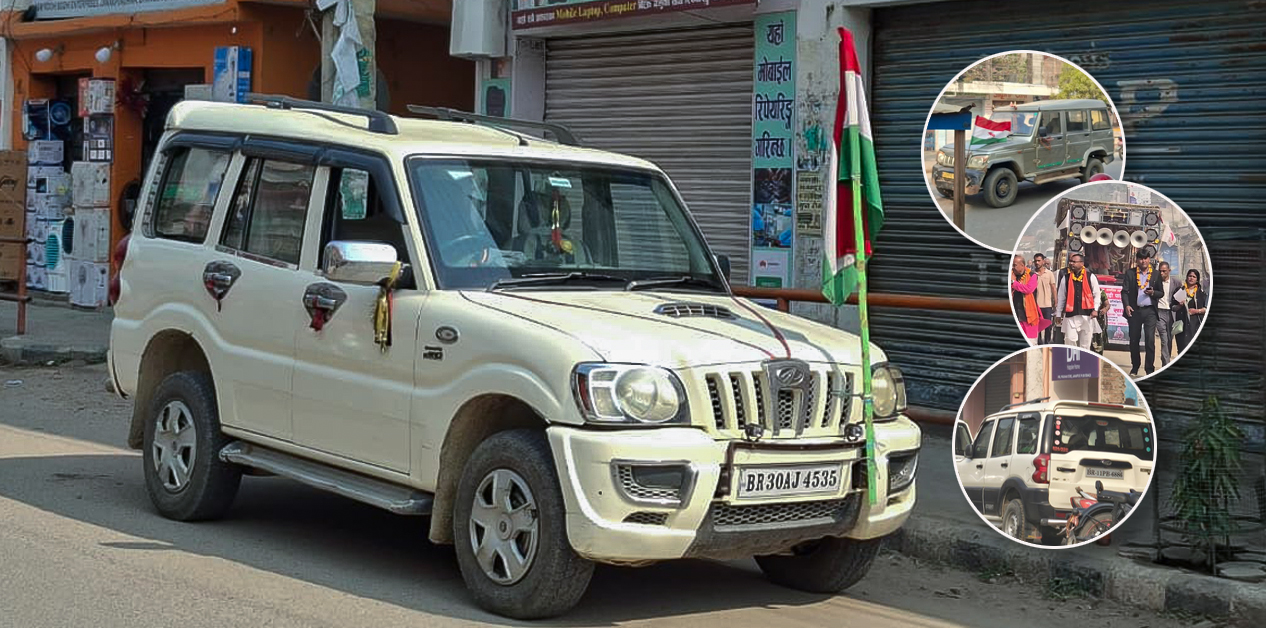
In front of the houses of Nepali Congress Dhanusha Constituency No. 3 House of Representatives candidate Bimalendra Nidhi and his competitor, CPN (UML) candidate Juli Kumari Mahato, two to three Indian-registered Scorpios can be seen parked every day these days. These vehicles, parked outside the former ministers’ homes, are being used for door-to-door campaigning and election publicity activities for the House of Representatives election scheduled for March 5 this year.
In Madhes, it is common not only during elections but also at other times for Indian-registered vehicles to operate as rentals. However, their use has sharply increased during the election period. Not only Nidhi and Mahato, but candidates from other parties have also increased their use of Indian vehicles in campaigning. On 16 February, a Scorpio with Indian number plate used by the Swabhiman Party for election campaigning in Saptari was even taken under control by Saptari police. Supporters of Satish Kumar Singh, Swabhiman Party candidate from Saptari-2 and former Chief Minister, had used the Indian Scorpio bearing registration number BR 11 PB 8610. The police impounded the vehicle briefly and later released it.
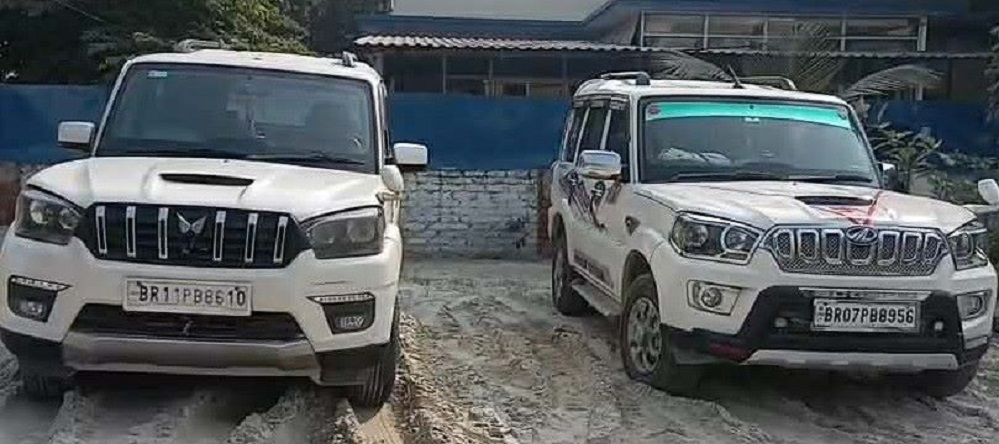
Two Indian vehicles taken under control by Saptari Police on February 16.
Similarly, in Saptari, Ramji Yadav, a candidate of the Rastriya Swatantra Party (RSP), used an Indian-registered vehicle for election campaigning. On February 16, he drove a Scorpio with Indian registration number BR 67 PB 8956. That vehicle was also briefly detained and then released by police. Although police seized both Indian-registered Scorpios used by the Swabhiman Party and RSP, no legal action was taken.
In Madhes, candidates were found using Indian-registered vehicles not only for campaigning but even for filing their nominations. In Parsa-4, UML candidate Jalim Miya Mansuri arrived to file his nomination on January 20 riding in a vehicle with Indian number plates. Interestingly, the number plate of the vehicle he was traveling in was covered with the UML party flag. Mansuri is just one representative example; other candidates in Madhes have also openly used rented Indian Scorpios for election purposes after covering the number plates, and related images and videos have spread across social media.
Indian vehicles are also used excessively during election-focused public rallies organized by political parties. For instance, RSP organized a large public rally at Tirhutiya Gachhi in Janakpur on January 19, a day before candidate registration. Party chair Rabi Lamichhane and senior leader Balen Shah participated in the event. Party workers and supporters came from villages across Madhes to attend. Around a thousand vehicles of various types were used from different districts to transport participants to the rally. Notably, a significant number of these vehicles bore Indian number plates.
Indian vehicles are also used excessively during election-focused public rallies organized by political parties.
To counter the RSP rally held on January 19, the Nepali Congress organized a large election rally at Tirhutiya Gachhi one month later, on February 18. Indian-registered vehicles were again seen in large numbers. Many buses were rented from various villages to bring party workers and supporters, but most of the smaller vehicles seen at the rally carried Indian number plates.
Madhes Province has 32 parliamentary constituencies and shares a border with Indian villages and towns where Nepali communities have maintained family ties for years. Saptari-based journalist Dipesh Joshi says that people in border areas bring Indian vehicles to Nepal through family connections and rent them out cheaply. Joshi explains, “It is cheaper for Nepalis to bring vehicles registered in the names of relatives in India and operate them here. Those who need rental vehicles also prefer Indian vehicles because they are cheaper than the Nepali ones. That’s why this practice has increased during elections than at other times.”
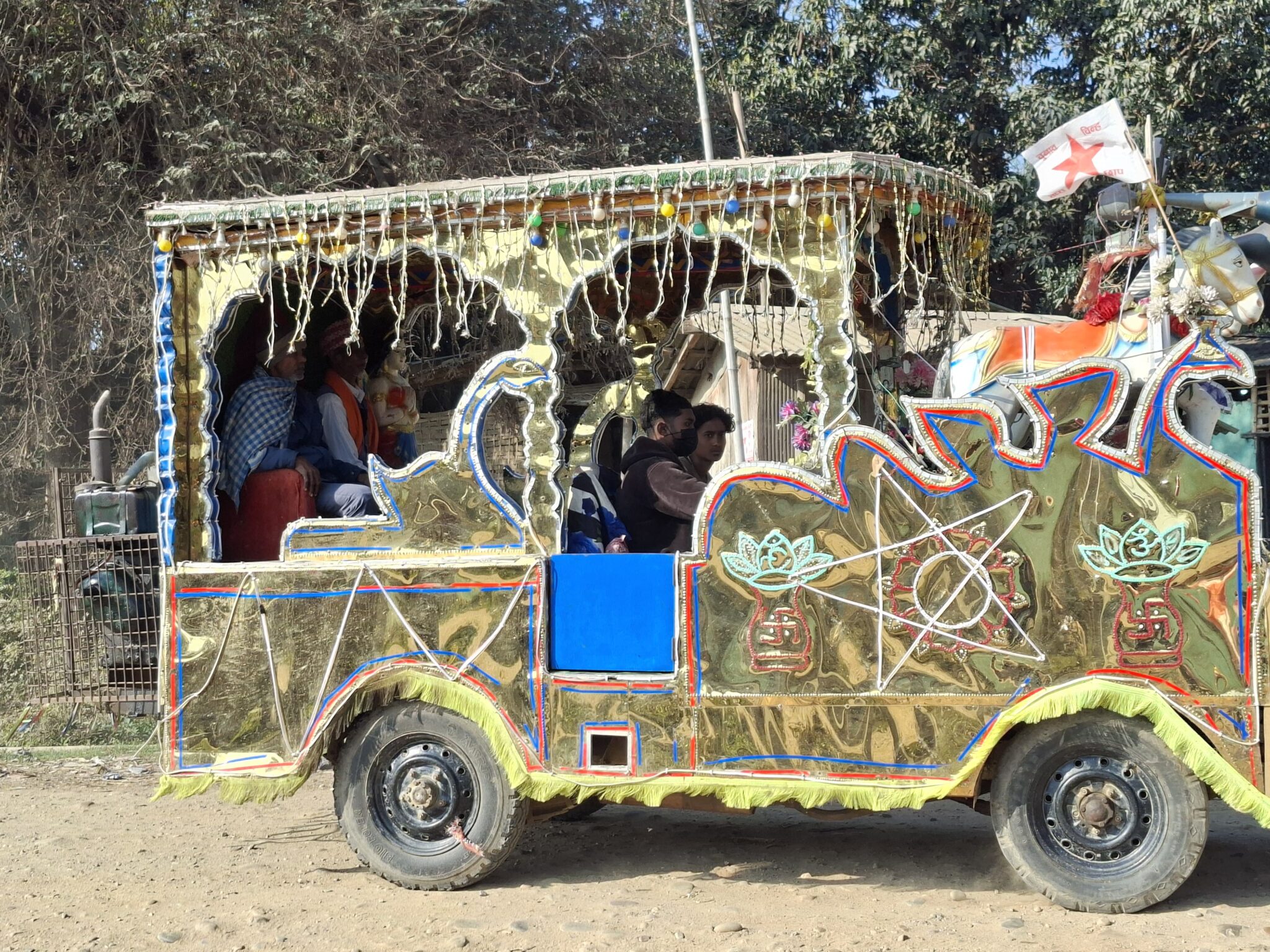
A campaign chariot used for publicity bearing the flag of the Nepali Communist Party.
Primarily for this reason, political parties and candidates bring vehicles from India through relatives and use them as rentals during elections. However, such practices violate the election code of conduct. Candidates in Dhanusha, Mahottari, Rautahat, Bara, Parsa, Saptari, and Siraha districts of Madhes Province have been renting Indian vehicles to transport party workers during elections. Since these districts are connected to Indian markets, it is easy to bring vehicles from across the border. For example, Dhanusha is linked with Indian markets such as Umgaon, Harine, Harilakhi, and Raxaula; Mahottari is connected with Bhittamod and Jaynagar; Bara with Bhikhnathori and Adapur; Rautahat with Sitamarhi, Parsoni, Bela, and Bhairavsthan; and Sarlahi with Sonbarsa and Bairgania. Indian vehicles frequently enter Madhes districts from these markets.
Legally, Indian-registered vehicles that enter Nepal after paying customs for a fixed period are not allowed to participate in election campaigning or political activities. However, once customs duties are paid and the vehicles enter Nepal, no one monitors how and for what purpose they are used.
According to the Jatahi Customs Office, the number of Indian vehicles entering Madhes after paying customs for a seven-day period at a time has recently increased. This trend has risen specifically due to the elections. Previously, the number of Indian vehicles entering Nepal after paying seven-day customs fees was low. Ajay Sah, a staff member at Jatahi Customs, says that in Dhanusha alone, more than 50 Indian vehicles are currently operating daily. He states that these vehicles do not declare at customs that they are entering Nepal for election purposes, but once inside, they are deployed in election campaigning. Sah says, “Vehicles coming from India do not say they are here for elections, but they end up working in election campaigns. That is why we have recently started charging seven days’ advance customs fees.”
The number of vehicles entering Nepal from India has also increased due to the elections. In one district of Madhes alone, at least 50 Indian-registered Scorpios are operating daily. According to the District Customs Office in Dhanusha, around 400 Indian vehicles are being rented and operated daily across the eight districts of Madhes. When 50 Indian vehicles operate on Nepali soil, they earn an average of 200,000 rupees per day. Likewise, when an average of 400 vehicles operate daily across the eight districts of Madhes, their total daily earnings reach around 1.6 million rupees.
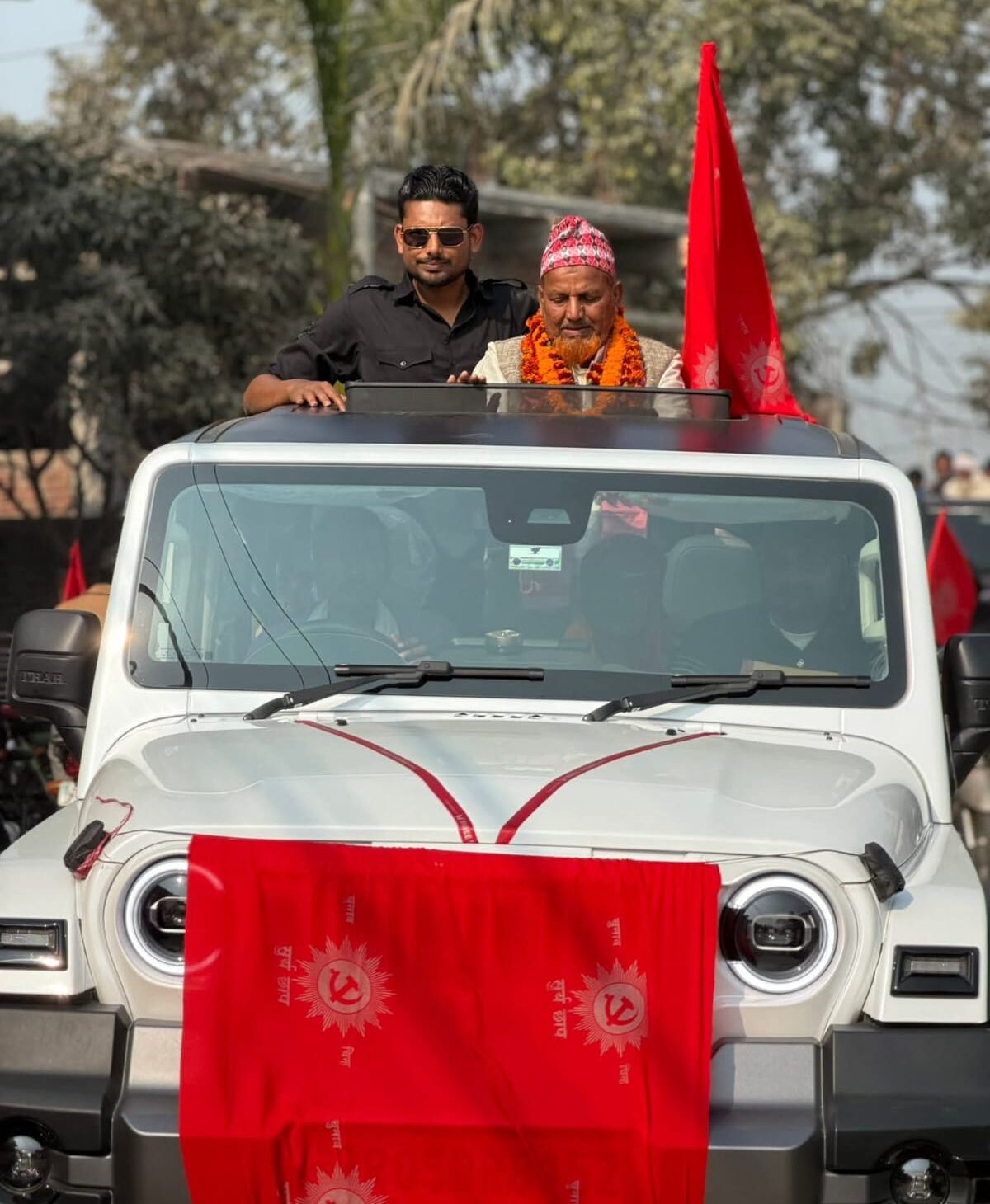
CPN (UML) candidate Jalim Miya riding in an Indian vehicle with its number plate covered while going to file his nomination in Parsa-4.
Police turning a blind eye
In Madhes, candidates and their supporters have been openly conducting door-to-door campaigns using Indian-registered vehicles adorned with party flags, banners, and election symbols. However, the election offices, traffic police, security agencies, and district administration offices in the eight districts have ignored this irregularity. Legally, Indian-registered vehicles that enter Nepal after paying customs for a fixed period are not allowed to participate in election campaigning or political activities. However, once customs duties are paid and the vehicles enter Nepal, no one monitors how and for what purpose they are used. As a result, the misuse of Indian vehicles during elections has increased.
Political parties and candidates have disregarded even the provisions regarding the permitted number of vehicles under the Code of Conduct. As a result, Indian-registered vehicles are being openly used in elections without permission.
Raj Kumar Gyawa, Information Officer at the Dhanusha District Customs Office, says there is no restriction on Indian vehicles entering Nepal after paying customs. He notes that compared to previous times, the number of Indian vehicles has increased significantly during the election period. He says, “Previously, about 100 Indian-registered vehicles would enter a district daily; now, during the election period, around 200 vehicles are entering daily.”
The Customs Tariff Act 2024, sets different customs rates depending on the type of foreign vehicle entering Nepal. For temporary entry into Nepal, the daily customs fee is Rs 200 for motorcycles or scooters, Rs 400 for three-wheelers, and Rs 600 for cars, jeeps, or vans. Similarly, buses, minibuses, microbuses, and other tourist vehicles are charged Rs 600 per day; tractors without trailers Rs 500 per day; tractors with trailers or trailers alone Rs 800 per day; and trailers (other than tractor trailers), trucks, or other goods transport vehicles Rs 1,700 per day. After paying the prescribed fee, foreign vehicles are allowed to enter Nepal.
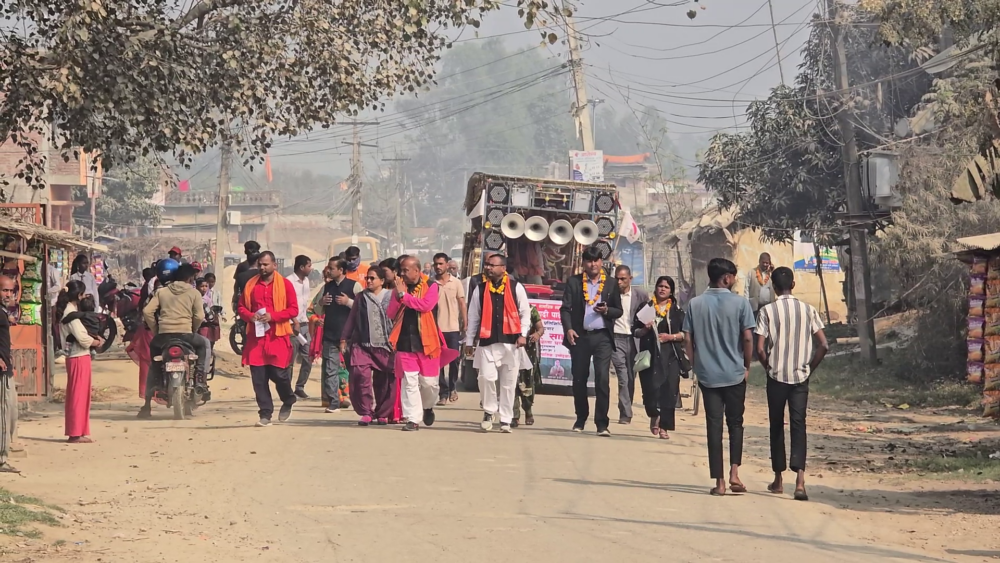
JSP Nepal’s Dhanusha-3 candidate Parmeshwar Sah campaigning with a DJ chariot.
Violation of the code of conduct
The Election Code of Conduct, 2082 2026, prohibits the use of foreign-registered vehicles in election campaigns. Section 14 of the Code outlines the conduct to be followed when using vehicles. Subsection (a) states that, with permission from the Election Officer, candidates may use a maximum of two two-wheelers, three-wheelers, or four-wheeled light vehicles powered by electric or mechanical energy within the concerned electoral constituency, as specified by the Election Commission. In areas where such vehicles cannot operate, up to four horses may be used. However, foreign-registered vehicles are not permitted for election campaigning.
Political parties and candidates have disregarded even the provisions regarding the permitted number of vehicles under the Code of Conduct. As a result, Indian-registered vehicles are being openly used in elections without permission. Nevertheless, no action has been taken against the candidates who have openly used Indian vehicles or rented them for election purposes. Subhash Babu Puri, Chief Election Officer of Dhanusha, claims that discussions are ongoing with political parties regarding compliance with the Code of Conduct. He says, “Election monitoring is ongoing. We are working to ensure compliance with the Election Code of Conduct.”
Due to these security challenges, in some districts of Madhes, police have occasionally taken control of Indian-registered vehicles that were openly used in election campaigning.
Candidates from political parties who are openly using Indian vehicles in election campaigns also claim that they are fully committed to complying with the Code. Mahendra Yadav, Nepali Congress candidate from Dhanusha-4, asserts that they have followed the Code of Conduct. Similarly, Ram Binod Yadav, Rastriya Swatantra Party candidate from Dhanusha-2, claims that the party has not used foreign vehicles in election campaigning. He says, “We have not used Indian vehicles in the election.”
Parmeshwar Sah, Janata Samajbadi Party Nepal candidate from Dhanusha-3, who has also been seen openly using Indian-registered vehicles in campaigning, states that he has not used foreign resources in the election campaign. “Some well-wishers may have attached party flags to Indian-registered vehicles. However, we have wanted to avoid the use of foreign vehicles in the election,” he says.
Increased security risk
The growing use of Indian vehicles on the eve of the election has increased security risks in Madhes. Due to the open border, Indian vehicles are entering not only through official checkpoints but also through various routes, posing a security challenge for the province. With the open use of Indian vehicles in election campaigns and the apparent lack of control, questions have arisen regarding election security. Deputy Inspector General (DIG) Govinda Thapaliya, chief of Nepal Police of Madhes Province, has clarified that security agencies in the eight districts of Madhes have taken seriously the increased security risks posed by the growing use of Indian vehicles. He says, “Due to vehicles entering from India during the election period, security risks have increased. We have intensified surveillance.”
According to Thapaliya, most border police posts in Madhes have been instructed to tighten security checks. He adds, “We have studied where security risks exist and issued necessary directives. We are also preparing to increase vigilance and security measures.”
Due to these security challenges, in some districts of Madhes, police have occasionally taken control of Indian-registered vehicles that were openly used in election campaigning. According to Kamal Thapa, spokesperson of Madhes Province Police, Indian vehicles found being used for election purposes and campaigning are being taken under control. Thapa says, “Indian vehicles deployed in elections have been taken under control. However, the police do not have exact statistics on them.”