Kathmandu
Sunday, July 19, 2026





Footballer Sabitra Bhandari, popularly known as ‘Samba’, gets both support and criticism for blaming the Nepali state and ANFA for not sponsoring her knee treatment
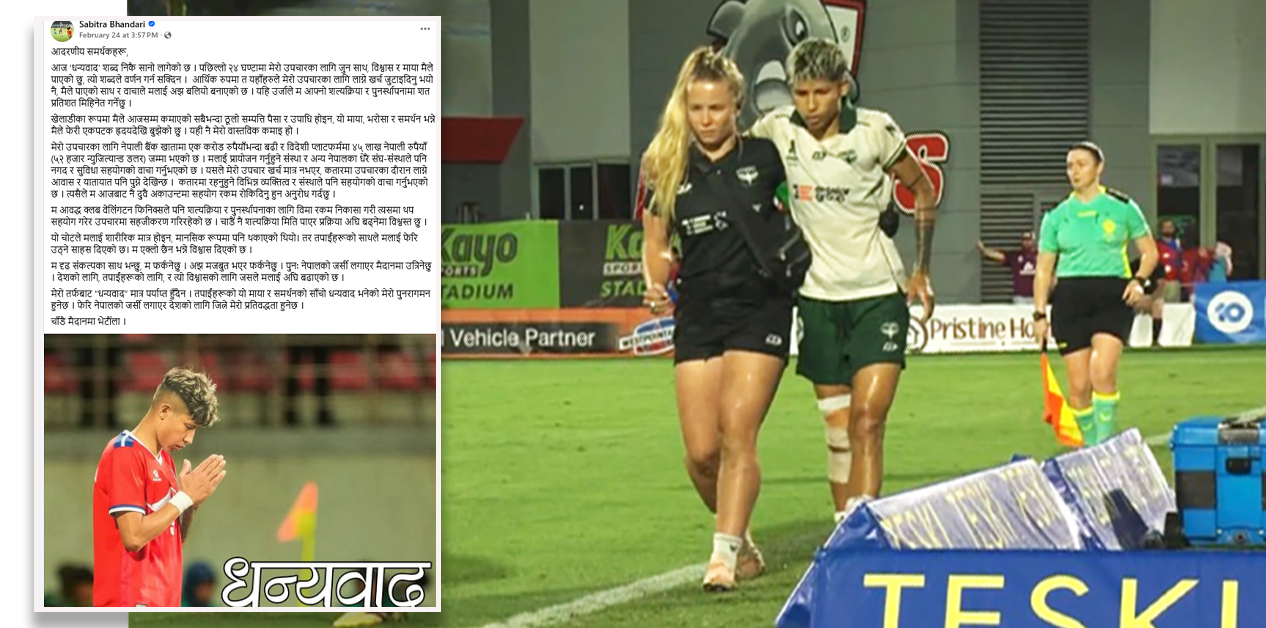
KATHMANDU: Namaskar, I am Sabitra Bhandari, your “Samba.” As you all know, I have been out of the field for the past seven weeks due to injury. If things had gone as planned, I would have already undergone surgery and started physiotherapy by now. But I am still struggling to secure proper treatment.
There is a serious injury to both the ACL graft that was previously placed in my knee and my MCL. Because of this, I now need another complex surgery. Last time, under the initiative of the ANFA (All Nepal Football Association) leadership, all arrangements and support for my treatment were managed. At that time, I faced no financial or mental burden, which allowed me to return to the field on time.
But this time, I did not receive the support that ANFA leadership had promised. Three weeks after the injury, my club had scheduled a surgery date, but ANFA said they would try from their side. However, the process did not move forward as expected. Despite repeated attempts, it was difficult to contact them. Last week, the ANFA president personally informed me that ANFA could not provide administrative support for my treatment. He said ANFA could provide up to Rs 500,000 in cash assistance, and I would need to handle the rest of the process myself. As a result, the earlier process I had initiated was halted, and now, nearly two months later, I have to try again to secure a new surgery date.
Meanwhile, my club has expressed readiness to arrange treatment at a local hospital in New Zealand. However, since my injury is serious and my previous treatment at Aspetar in Qatar was of a very high standard, I wish to undergo treatment there again. The club has agreed to release the insurance amount available for me. But that amount will not be sufficient to cover my surgery and seven to eight months of rehabilitation, so I have come forward to request support from the public. The initial estimated cost is USD 80,000.
This week, Nepal’s football star Sabitra Bhandari, also known as Samba, posted the above information on social media regarding her injury. Following her post, Nepalis living at home and abroad deposited around Rs 15 million into her account at Agricultural Development Bank via QR code within 21 hours.
While contributing financially toward her knee surgery, some people criticized the state, while others criticized the current leadership of the All Nepal Football Association (ANFA).
In response to her post, Nepali physiotherapist Sudin Maharjan suggested, “You can come to Nepal for surgery. We have many good surgeons and physiotherapists here as well.”
Sudin is a physiotherapist who studied at a medical science university in Spain and returned to Nepal. He was also involved in the rehabilitation of national women’s team star midfielder Preeti Rai. He claimed that the treatment could be completed in Nepal for around Rs 500,000 .
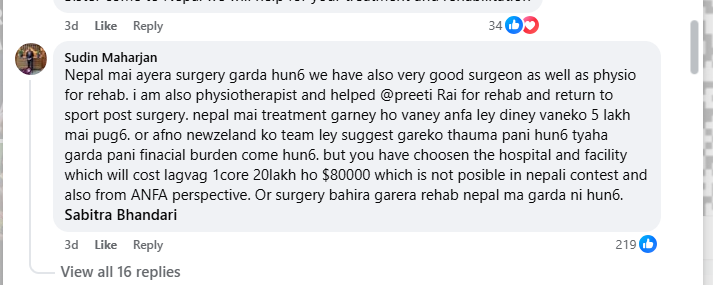
Physio Sudin Maharjan’s comment on Samba’s Facebook status.
Questioning this suggestion, Ziwan Khadka wrote on social media, “Would you give the same suggestion if it were a political leader’s treatment, sir?” He expressed sadness that the state and ANFA could not provide even Rs 12 million (USD 80,000 ) to a national team player who had already served as the national team’s captain.
However, Nishchal Shrestha, residing in Melbourne, Australia, had a different argument. He wrote on social media, “Let’s assume another Nepali player gets a similar injury. Is it possible to raise money and send everyone abroad for treatment?” He pointed out that Nepal also has hospitals and that the club has even offered to arrange treatment in New Zealand.
Sunita Baral, who previously worked as a nurse at Lifeguard Hospital and is currently based in the UK, also disagreed with Sudin’s suggestion. She commented, “I do not agree with you. Nepal is operating with 18th-century technology, while abroad it is 2026.” Referring to Preeti Rai’s surgery, she added, “Maybe Preeti’s was a minor surgery or could be handled with rehabilitation, but in Samba’s case, I do not think returning to Nepal for treatment would be a wise decision.”
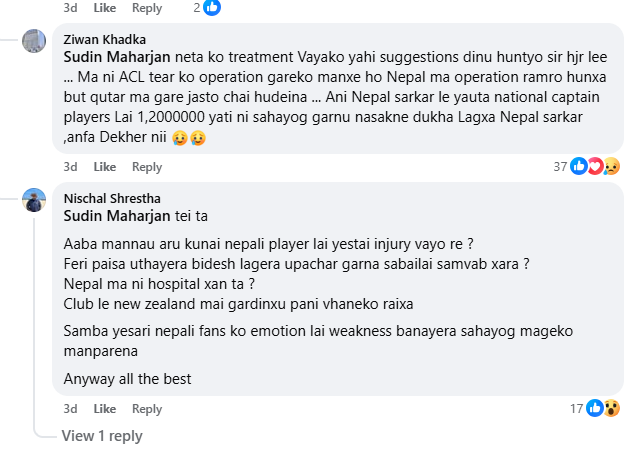
Ziwan Khadka and Nischal Shrestha in the replies to the comment written by physio Sudin Maharjan on Samba’s Facebook status.
Sudin disagrees with this view. He responded, “Your understanding that Nepal is operating in the 18th century is incorrect. Nepal also has advanced doctors and hospital facilities, though limited in number. I am fully confident that injuries like hers have been successfully treated in Nepali hospitals many times.”
The issue of Samba’s treatment has heated up social media, with people blaming each other. But what is the reality? Why did Samba suddenly become critical of ANFA leadership? Was the state truly indifferent to her treatment as claimed?
ANFA President Pankaj Nembang responded, “After Samba got injured, she informed us. She asked us to facilitate treatment at Aspetar in Qatar. We wrote to the Qatar Football Association to assist, but they did not respond to our letter. That’s where the problem began.”
Before Nembang’s election as president, Nepal and Qatar Football Associations had very good relations. During the 2022 FIFA World Cup in Qatar, Nepali workers worked tirelessly to build stadiums despite the COVID-19 pandemic. In appreciation, Qatar Football Association sent Pro-License coach Abdullah Almutairi to Nepal in 2021 to support football development. At that time, three injured players—Bimal Gharti Magar, Bikram Lama, and Samba—received free treatment at Aspetar from the Qatari government. This is why Samba prefers treatment there. Aspetar is considered one of the world’s top orthopedic hospitals.
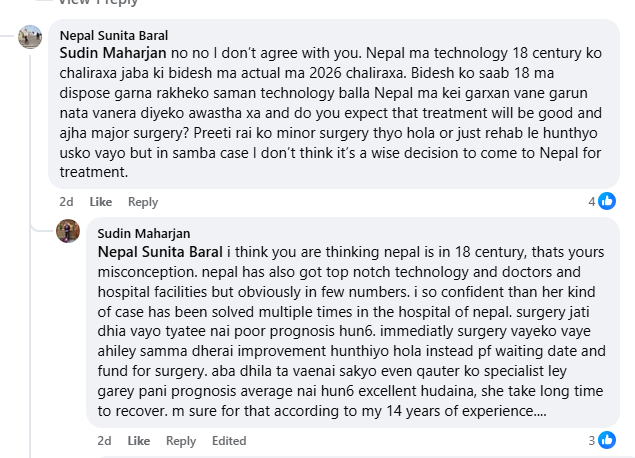
Sunita Baral’s reply to the comment written by physio Sudin Maharjan on Samba’s Facebook status.
However, disputes between former ANFA President Karma Tsering Sherpa and Nembang led to controversy involving coach Almutairi. Many national team players also opposed him. As a result, Qatar Football Association became displeased with Nepal.
This is believed to be the reason Qatar FA has not responded to ANFA’s letter regarding Samba’s treatment. However, portraying this lack of response as state negligence is unfortunate.
Samba signed with Wellington Phoenix Club in New Zealand on 18 July 2025. She joined after being released by Nepal’s APF Club and receiving a transfer certificate from ANFA. The contract amount and insurance details have not been disclosed publicly. She has stated that the Kiwi club agreed to provide 20,000 NZD for treatment in Qatar.
After joining Wellington, Samba first sustained injury on 8 November 2025 while playing against Canberra United. She was injured again on 9 December 2025 against Melbourne City, missing the Three Nations Cup in Yogyakarta, Indonesia. The Three Nations Cup was organized November 26 to December 2, 2025.
After returning to the field on 19 Poush, she collided with Brisbane Roar goalkeeper Chloe Lincoln, which aggravated her old knee issue. This knee injury is the subject of the current controversy.
After returning to the field on 3 January 2026, she collided with Brisbane Roar goalkeeper Chloe Lincoln, which aggravated her previous knee problem. The current controversy is centered on the treatment of that same knee injury.
When discussions about receiving treatment in Qatar did not move forward, Samba said that she would proceed in her own way. “After there was no response from the Qatar Football Association, she asked how much support ANFA could provide. We said the association might be able to provide 800,000 to Rs 1 million . We also discussed that colleagues within the association could collectively help with the remaining amount,” said Nembang.
Before Nembang, when Karma Tsering Sherpa was president, ANFA had created a policy regarding players’ medical treatment. According to that policy, ANFA would cover treatment costs for injuries sustained in competitions organized by ANFA, while clubs would be responsible for injuries sustained in other competitions.
Since Samba went abroad to play for a foreign club, the issue of how the Nepali state should fund her treatment has become the most complicated matter at present.
Once ANFA issues a transfer certificate for a player to compete abroad, the full responsibility for treatment of injuries sustained in foreign leagues lies with the foreign club.
Samba’s club, Wellington Phoenix, has committed to providing her with world-class treatment in New Zealand or Australia. Samba herself confirmed this in her status update. However, the problem arose because she chose Qatar for her treatment.
At present, there are two Nepali athletes who are widely recognized even internationally — effectively the “multi-stars” of Nepali sports. They are Sandeep Lamichhane and Samba.
In such a situation, it is natural for Nepalis at home and abroad to express concern about Samba’s treatment. However, in a sports system that is progressing with limited resources, emotional reactions can be the most dangerous factor.
Chief Secretary of the Government of Nepal, Suman Raj Aryal, stated that under his initiative, detailed discussions were held last Wednesday between the secretaries of the Ministry of Youth and Sports and the Ministry of Health regarding Samba’s treatment.
“A Nepali player was injured while playing for a foreign club, yet the government ended up facing criticism,” said Aryal, who previously served as Secretary of the Ministry of Sports. “Since Samba is a star player of Nepal, we have expressed concern and discussed with the relevant officials what can be done.”
ANFA President Nembang also participated in the meeting held at Singha Durbar. According to existing laws in Nepal, if the government funds medical treatment for any individual, approval must be obtained from the Nepal Medical Council. The council typically recommends such cases only when the required treatment is not available within Nepal.
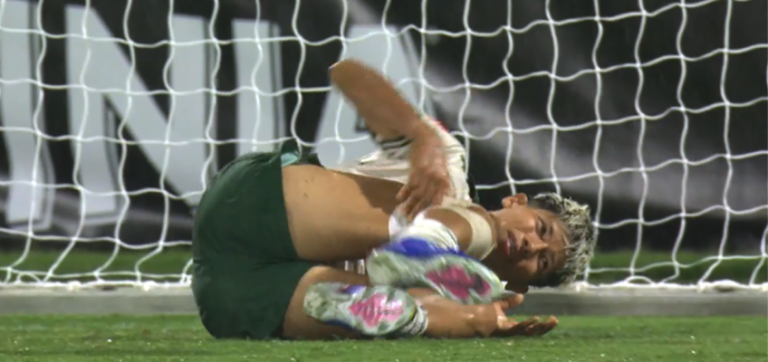
Samba injured on the playing field. Photo: Samba’s Facebook page.
Nepali orthopedic surgeons claim that ACL treatment can be done successfully in Nepal. What level of initiative the state ultimately takes remains to be seen.
Past internal disputes within ANFA over Almutairi have now made it difficult for Samba to seek treatment in Qatar. Furthermore, disciplinary issues among Nepali players previously cost them professional opportunities in the Middle East.
Samba’s rejection of her foreign club’s treatment offer could also influence how European clubs view Nepali players in the future. For example, in 2002, Indian cricketers Virender Sehwag and Harbhajan Singh were stopped at Auckland airport in New Zealand for wearing dirty shoes while traveling for cricket.
Currently, Nepali football is once again seeing increased blame-shifting. This incident could potentially impact future opportunities for Nepali players to pursue professional football careers in Europe.