Kathmandu
Wednesday, July 22, 2026





Nepal has taken a significant step toward opening its energy sector with the issuance of the Open Access Directive, 2025. This ends the Nepal Electricity Authority’s (NEA) four-decade-long monopoly over grid access and customer service. The shift allows the private sector to sell electricity directly to consumers through the national grid under regulated open access. What was once a transmission shortage has now become an investment opportunity for private investors.
The vertical integration of the NEA had long been a structural constraint for the private sector. Decision-making authority for generation, transmission, and distribution was concentrated under a single institution, resulting in unclear operational responsibilities and limited accountability. The directive addresses this by clarifying the roles of institutional actors and separating NEA’s system operation role from its commercial functions. NEA’s System Operation Department (SOD) now serves as the nodal agency responsible for reviewing and approving open access proposals, focusing on data-driven planning. NEA retains a critical supervisory role to ensure the reliability of the grid.
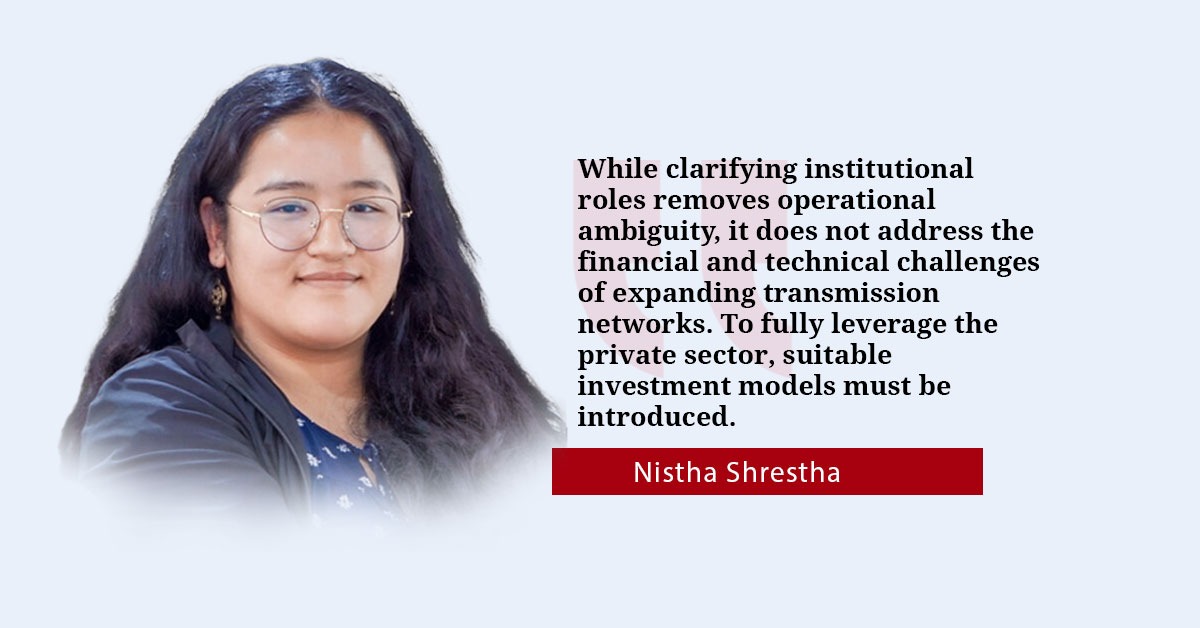
While clarifying institutional roles removes operational ambiguity, it does not address the financial and technical challenges of expanding transmission networks. To fully leverage the private sector, suitable investment models must be introduced.
BOT and BOOT Models: Allocating Risk and Leveraging Private Investment
In this progressively unbundled electricity market, where ownership of major infrastructure remains with the government, concession-based models like Build-Operate-Transfer (BOT) and Build-Own-Operate-Transfer (BOOT) are particularly suitable. Under these models, the private sector finances, constructs, and operates transmission lines for a defined concession period, after which ownership is transferred to the state. During this period, the government regulates service standards and tariff rates.
This arrangement allows the private sector to take on operational and financial risks while ensuring ownership of strategic assets remains with the state. It also reduces pressure on government finances and brings in technological and managerial expertise, improving overall efficiency.
According to NEA estimates, USD 0.4 billion per year is required to achieve desired transmission development by 2030 and ensure an efficient electricity market. Private sector involvement may raise concerns about control and stability, but these are mitigated by SOD’s regulatory oversight of service quality and tariff compliance. Essentially, responsibility and risk shift to the private sector, incentivized by tariff assurance, while NEA maintains regulatory oversight over critical infrastructure.
Even with these partnership models in place, investments will only succeed if complementary institutional measures, such as tariffs, procurement rules, and land acquisition procedures, are clear and predictable.
Institutional Reforms to Strengthen Transmission Infrastructure
The Open Access Directive ensures full utilization of transmission lines through cost-reflective tariffs. However, BOT and BOOT projects require further institutional reforms. These include competitive bidding for procurement, simplified land acquisition procedures, and a clear framework for compensating rights of way (ROW). Tariffs now reflect operational costs, cross-subsidy charges, and infrastructure expenses, giving private investors clarity on cost recovery.
Globally, cross-subsidy surcharges have been a source of controversy, and similar issues could arise in Nepal. For example, in India, private firms face additional charges of INR 2–3 per unit for using open access lines, limiting competitive advantages. Such surcharges have faced scrutiny and calls for removal to ensure fair power pricing. Unclear or excessive surcharges could undermine competition and investor confidence.
Even with tariffs clarified, transparent and predictable procurement processes remain critical. Inefficiencies in licensing, bid evaluation, or network management could raise costs and delay project implementation, passing additional burdens onto end consumers.
Competitive Bidding and Risk of Overbidding
The proposed Electricity Bill, 2023, seeks to address these issues by emphasizing competitive bidding based on technical, financial, and managerial capacity rather than immediate fiscal gains. However, focusing excessively on financial viability may encourage overbidding, resulting in higher costs for consumers. Tariff-based selection approaches, such as those used in Brazil and Peru, where bids are evaluated based on the lowest expected annual revenue required to operate and recover investment, can help ensure cost-effective outcomes while maintaining competition.
Addressing procedural and regulatory inefficiencies alongside financial incentives is crucial. Without such measures, even large investments may not translate into timely and reliable transmission development.
Facilitating Infrastructure Investment
NEA’s unbundling has encouraged private investment in modernizing transmission and distribution infrastructure. Lengthy bureaucratic procedures and inconsistent compensation for land acquisition and ROW have delayed projects and increased costs. With multiple generators now using the same transmission system, adequate corridors and a clear regulatory framework are essential.
A facilitation unit could simplify processes for investors, streamlining approvals for transmission corridors, land acquisition, and fair compensation. Examples from India show that such facilitating bodies, with transparent rules, can accelerate infrastructure development. Institutional support of this type strengthens the impact of NEA’s unbundling, encouraging efficient and reliable private investment in transmission and distribution systems.
Immediate Measures for Functional Open Access
As Nepal transitions to an open access regime, infrastructure development becomes even more critical. Both NEA and the private sector have complementary roles: the private sector through investment and NEA through regulation, supervision, and facilitation. Simplifying regulations, providing predictable tariffs, and improving institutional processes will encourage private participation while maintaining system stability.
Systemic reforms are necessary to ensure that open access achieves its objectives: energy autonomy, industrial productivity, and self-sufficiency. By addressing regulatory, financial, and procedural barriers, Nepal can convert its transmission challenges into opportunities for a competitive and resilient electricity market.
Ultimately, the Open Access Directive is more than a policy statement; it is a blueprint for a modern, efficient, and inclusive electricity sector. With clear regulations, investment-friendly frameworks, and institutional support, Nepal can turn transmission constraints into a foundation for energy independence and industrial growth.