Kathmandu
Sunday, July 26, 2026





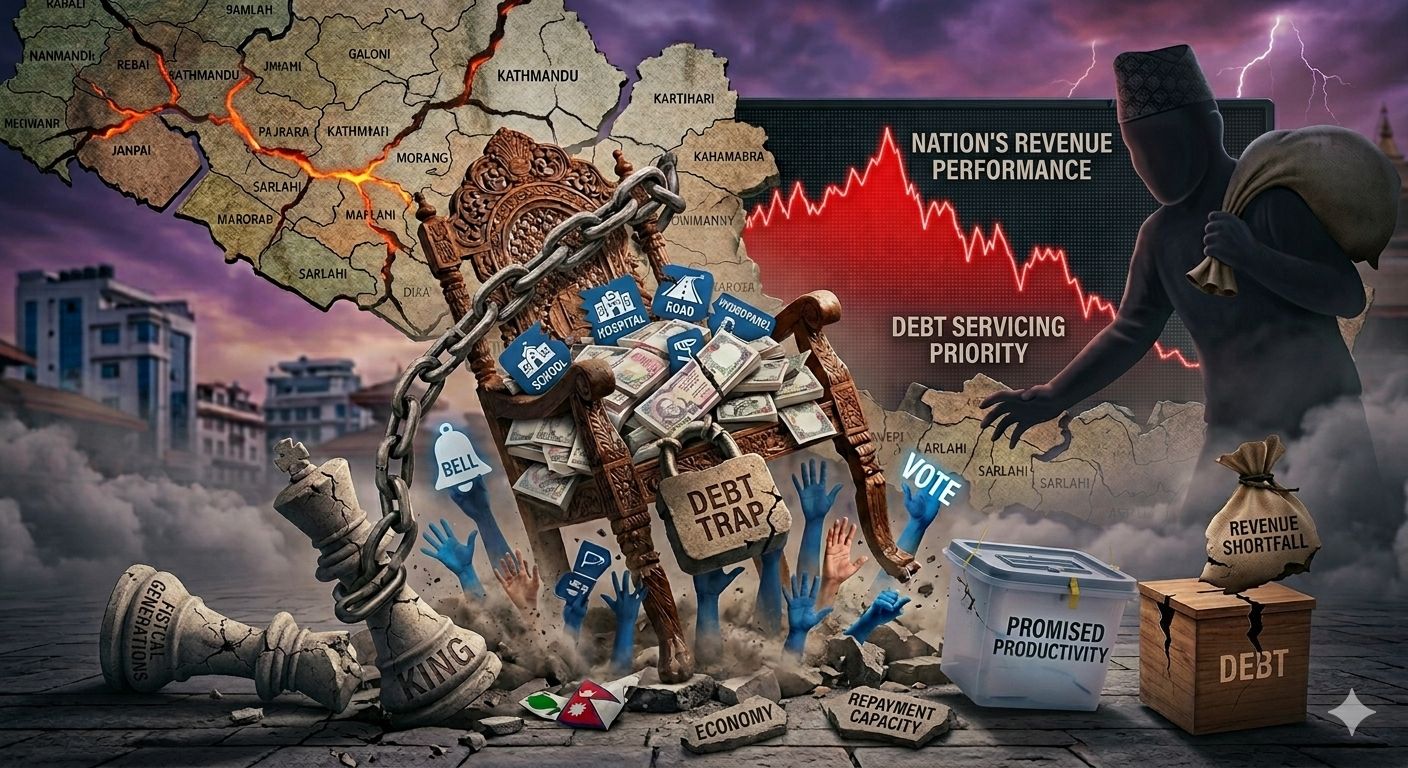
Nepal’s public debt has surged to Rs 2.859 trillion as of mid-February 2026, equivalent to 46.81% of the country’s gross domestic product. This sharp increase occurred within the first seven months of fiscal year 2025/26, driven by new borrowing to repay maturing loans, a depreciating Nepali rupee that inflated the cost of external debt, and persistent shortfalls in domestic revenue collection. Over the past six-and-a-half years the total debt burden has nearly doubled from Rs 1.433 trillion. With major national elections on the horizon, political parties are promising stricter borrowing discipline, but experts warn that without shifting funds toward genuinely productive investments, Nepal risks entering a prolonged debt trap that could squeeze spending on education, healthcare, and infrastructure for years to come.
Why is Nepal’s public debt growing so rapidly right now?
The debt climbed by Rs 185 billion in just seven months because the government continues to borrow fresh money primarily to service and repay older loans, with gross new borrowings reaching Rs 255 billion during this period. At the same time, the Nepali rupee’s depreciation against major currencies added an extra Rs 93 billion burden to existing external loans, as most foreign debt is denominated in stronger currencies like the US dollar. Revenue collection has not kept pace with rising expenditure needs, forcing more reliance on debt even for routine operations and some capital projects, while foreign grants have declined and expected tax inflows have fallen short due to slower economic activity.
How much of the current debt comes from domestic versus foreign sources?
Internal (domestic) debt stands at Rs 1.349 trillion, accounting for roughly 47% of the total. External debt is slightly higher at Rs 1.509 trillion, or about 53%. Most new borrowing this fiscal year has been domestic – around 85% of the fresh funds raised so far came from inside Nepal through treasury bills, development bonds, and other local instruments, as the government has only achieved 16% of its external borrowing target of Rs 233 billion, managing just Rs 38 billion amid delays in international aid disbursements.
What portion of the national budget is already being eaten up by debt payments?
In the first seven months alone, the government spent Rs 204 billion on principal repayments and interest. For the full fiscal year a massive Rs 411 billion has been earmarked for debt servicing. This single line item now consumes a significant share of total government resources – over 10% of the annual budget – leaving less room for priority sectors such as schools, hospitals, roads, and rural development, and putting pressure on other areas like social welfare programs that rely on limited fiscal space.
How does today’s debt level compare with the situation six-and-a-half years ago?
In fiscal year 2019/20 the total public debt was only Rs 1.433 trillion, representing just 38.05% of GDP. By mid-February 2026 it has almost doubled to Rs 2.859 trillion and pushed the debt-to-GDP ratio close to 47%. This rapid escalation reflects a combination of pandemic-related spending spikes, ambitious infrastructure ambitions that under-performed, declining foreign grants, and structural weaknesses in revenue generation, including low tax compliance and a narrow industrial base that limits economic expansion.
Is there a real risk that Nepal could fall into a full-blown debt trap?
Many economists believe the risk is growing substantially. When a country borrows mainly to pay back old loans rather than to finance investments that generate higher future income, it can enter a vicious cycle where debt servicing crowds out productive spending. Several high-profile projects funded by debt – including Pokhara International Airport, Gautam Buddha International Airport in Bhairahawa, and the Melamchi drinking water scheme – have delivered far lower economic returns than expected due to underutilization, delays from natural disasters, and insufficient international traffic, meaning taxpayers are shouldering the cost without corresponding benefits in growth, jobs, or revenue.
What do independent experts and commissions say should be done differently?
Economists argue that new borrowing should be restricted to projects where the expected economic return clearly exceeds the cost of capital, emphasizing a shift away from funding non-essential or low-yield initiatives. The National Natural Resources and Finance Commission has repeatedly urged a strict ban on using debt for salaries, administrative overheads, or current consumption, recommending instead that funds flow only to production-enhancing infrastructure, export-oriented industries, agriculture modernization, or other areas that directly boost national income, tax revenue, and overall productivity over the long term to ensure sustainable repayment capacity.
Which specific reforms have been proposed to improve debt management?
The High-Level Economic Reform Suggestion Commission recommended rigorous cost-benefit analysis, net present value calculations, and internal rate of return assessments for every proposed project before any borrowing is approved, ensuring only high-impact schemes proceed. It also called for mandatory disclosure of debt financing sources in every budget line item, including at provincial and local levels, to enhance transparency. Another key suggestion is to prohibit debt-financed recurrent spending entirely and to prioritize only those schemes whose preparations are complete and whose returns are demonstrably positive, while imposing stricter limits on overall borrowing to prevent fiscal slippage.
How are the major political parties planning to address the debt issue in their election platforms?
Nearly every major party has acknowledged the problem in their manifestos ahead of the March 5 elections. The CPN (UML) has pledged to borrow exclusively for nationally prioritized, high-impact projects and to keep overall debt within a “safe” proportion of the country’s repayment capacity, emphasizing productive use to support 7-9% annual growth. The Nepali Congress has committed to maintaining fiscal discipline so that debt stays inside prudent GDP limits and does not impose an unfair burden on future generations through excessive interest obligations. The Communist Party of Nepal has gone further, promising to channel all borrowings – domestic and foreign – solely into productive sectors and projects of genuine national pride, explicitly ruling out loans for luxury imports or day-to-day administrative costs.
What could happen to ordinary citizens if debt keeps rising without meaningful change?
If the current pattern persists, future budgets may face increasing pressure to allocate larger shares to interest and principal repayments, potentially leading to reduced funding for public services – fewer new schools and health posts, slower road and hydropower development, delayed social security payments, and less support for small farmers and entrepreneurs. In the worst case, higher taxes or cuts in subsidies might become necessary to stabilize finances, directly affecting household living standards across the country by raising costs for essentials like food, fuel, and utilities while limiting opportunities for economic mobility.
What role has the weakening Nepali rupee played in escalating the debt burden?
The rupee’s depreciation has significantly worsened the situation by adding an extra Rs 93 billion to the public debt in just seven months, as around 53% of Nepal’s liabilities are external and denominated in foreign currencies. When the rupee weakens, the local-currency equivalent of these loans balloons, increasing repayment costs without any additional borrowing. This currency effect has compounded the pressure from new loans, making debt servicing more expensive and diverting funds that could otherwise support domestic priorities, while also highlighting Nepal’s vulnerability to global economic shifts like rising US interest rates or regional trade imbalances.
How does Nepal’s public debt compare to its South Asian neighbors?
Nepal’s debt-to-GDP ratio of 46.81% is moderate compared to neighbors like Sri Lanka (over 100%) or Pakistan (around 80%), but higher than India’s 60% or Bangladesh’s 40%. However, Nepal’s lower revenue base and heavy reliance on remittances make it more vulnerable, as debt servicing already claims a larger share of its budget relative to these countries. While Bhutan faces similar issues at around 110% due to hydropower loans, Nepal’s faster recent growth in debt – nearly doubling in six years – raises concerns about sustainability without reforms to boost exports, domestic production, and overall fiscal resilience.