Kathmandu
Wednesday, June 17, 2026





Sixty percent of citizens burdened by taxes want state relief
KATHMANDU: On 19 February, Nepali Congress (NC) President Gagan Kumar Thapa, in the party’s manifesto made public from Kathmandu, pledged that if his party forms the government after the elections, no income tax will be levied on the first Rs 1 million of personal income. With the aim of providing relief to ordinary citizens from the tax burden, the NC stated it would revise income tax rates.
It does not require further investigation to understand that this announcement is intended to appeal to working and middle-class citizens. Especially as middle-class citizens are feeling intense tax pressure, the party’s manifesto mentions implementing a progressive system in which the maximum personal income tax rate would not exceed 25 percent, and imposing additional surcharges only on annual incomes above Rs 10 million. Under the current system, a citizen earning Rs 500,000 annually must pay 1 percent income tax. The maximum personal income tax rate goes up to 39 percent.
The burden of taxation
Changes in ownership of the means of production and in the economy have altered class structures in Nepali society. Economic, social, and political transformations over the past three decades have also affected social classes.
The Nepal Living Standards Survey conducted by the government in fiscal year 2022/23 shows that, based on consumption, Nepal has five classes. Those who spend less than Rs 72,908 per person annually are classified as poor (extremely low). This group makes up 20.27 percent of the population. Similarly, the lower class constitutes 19.98 percent, the middle-class 20.02 percent, the upper-class 19.98 percent, and the uppermost class 19.99 percent. The interpretation of this classification is that a person’s spending capacity reflects their earning capacity.
If we combine the extremely low, lower, and middle classes, they account for 60.03 percent of the population, or 17,507,496 people. Adding the upper and uppermost classes totals 11,657,081 people. Of these, the uppermost class alone comprises 5,830,000 people.
A 2023 survey conducted by the Central Department of Anthropology at Tribhuvan University categorized Nepali society into five classes based on monthly income. According to it, the upper-class accounts for 1.6 percent, upper-middle class 13.2 percent, middle class 35.4 percent, lower class 28.2 percent, and vulnerable-risk class 21.7 percent.
People in the uppermost class possess large amounts of economic capital and property. Large business establishments, import-export trade, industries, companies, and their shares and ownership are under the control of the upper class. Anthropologist Mukta Singh Tamang says, “In the upper class, risk is low and the potential for capital growth is high, while middle-class people struggle for livelihood. Especially those engaged in small businesses and salaried jobs fall into the middle class. Despite having moderate income, they carry debt burdens and lack economic security.”
In Nepali society, this middle class constitutes the largest group. If the lower and middle classes identified in the Living Standards Survey are considered together, the middle-class population reaches 40 percent. Since the upper class does not have the same economic status and access as the uppermost class, their characteristics largely resemble those of the middle class. Thus, including the upper class with the middle class brings the figure to 60 percent. This represents a majority and influential population. The taxes paid by such a large population form the largest share of state revenue.
According to the Nepal Living Standards Survey conducted in fiscal year 2022/23, citizens spend 52 percent of their total income on consumption.
Both direct and indirect tax rates in Nepal are high, placing a particularly heavy burden on the middle class. For example, a personal income tax rate of up to 39 percent is excessive. In neighboring India, the maximum income tax rate is only 30 percent. There, income up to Rs 640,000 rupees (400,000 Indian rupees) is tax-free, and those earning Rs 3,840,000 annually (2.4 million Indian rupees) pay 30 percent tax. In Nepal, however, individuals earning between Rs 1.1 million and Rs 2 million rupees annually must pay 30 percent tax. Those earning above Rs 5 million annually are taxed at 39 percent.
In Nepal, annual income up to 500,000 rupees is taxed at 1 percent. This means someone earning about Rs 41,600 per month must pay 1 percent income tax. For an annual income of Rs 1 million, the tax rate is 20 percent. To earn Rs 1 million annually, one must earn Rs 83,333 per month.
The high rate of personal income tax has begun to negatively impact the economy. According to Gaurav Raj Pandey, president of the Nepal Association for Software and IT Services Companies (NAS-IT), the high-income tax is affecting the information technology sector, which brings in around Rs 150 billion in foreign currency annually. He says, “Since a large portion of their income goes to the state as tax, high-level IT professionals do not want to stay in Nepal.” Around 5,000 individuals in Nepal’s IT sector earn about Rs 500,000 per month. According to tax rates, an unmarried person earning that amount must pay Rs 1,135,000 annually in tax, while a married person must pay Rs 1,106,000.
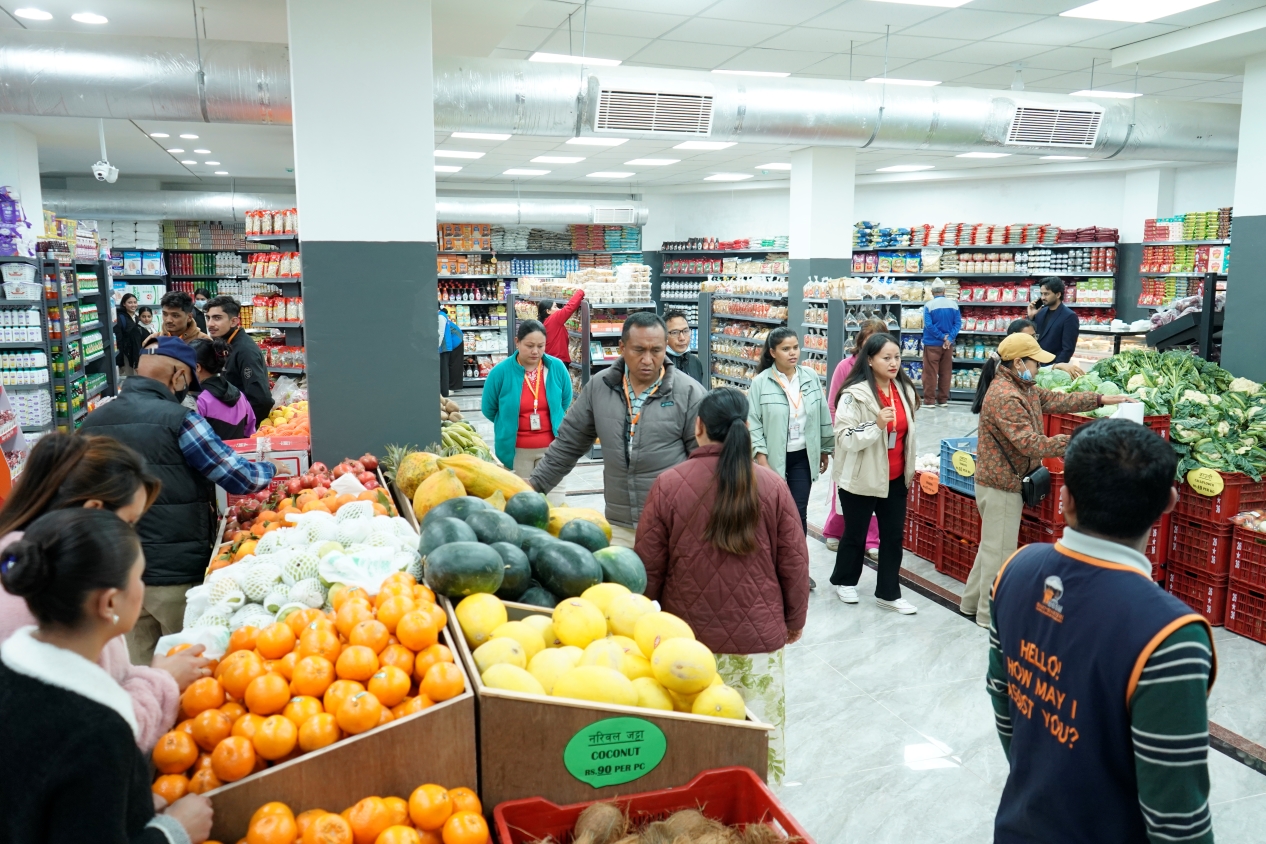
Customers shopping at Bhatbhateni Superstore in Maharajgunj, Kathmandu. Photo: Bikram Rai
Because indirect tax rates are uniform, the extremely low, lower, middle, and upper classes all pay the same rate. For example, regardless of income level, anyone owning a landline telephone must pay a 500-rupee ownership fee. A 2 percent tax is levied on mobile SIM cards and recharge cards. Fuel taxes are also the same for everyone. Economist Keshav Acharya says, “People who are part of Nepal’s tax system feel that they pay an excessive amount of tax. I also feel that the middle class is paying quite a lot.”
In fact, taxation is the primary source of government revenue. The state’s administrative and development activities are financed through taxes collected directly and indirectly from citizens. Plans and budgets are formulated accordingly. In the current fiscal year 2025/26, the government has estimated that it will collect Rs 1.315 trillion in revenue.
According to the government, a progressive tax system—meaning tax rates based on income level—is in place. Under this system, those with lower incomes pay lower tax rates, while those with higher incomes pay higher rates. However, this structure applies only to direct taxes. According to data from the Ministry of Finance, direct taxes account for only about 30 percent of total revenue. The remaining 70 percent is collected through indirect taxes. These are largely paid by the middle class, as their population size is larger compared to other classes.
According to the Nepal Living Standards Survey conducted in fiscal year 2022/23, citizens spend 52 percent of their total income on consumption. Since indirect taxes are imposed at the same rate on all citizens, the middle class—who spend a large portion of their income on consumption—are more heavily affected. Taxes are added when purchasing daily consumer goods from the market, refueling vehicles, or using mobile phone and internet services.
Citizens pay direct taxes such as income tax, corporate tax, property tax, and capital gains tax. Indirect taxes include Value Added Tax (VAT), customs duties, and excise duties. Indirect taxes even affect household kitchens. Commonly used items such as cooking oil, sugar, tea, and spices include 13 percent VAT in their price. Although staple foods like rice and lentils do not have a fixed tax rate, VAT is applied to transportation costs. When determining the retail price of rice, transport costs and the tax applied to them are included. For example, in India, a 25-kg sack of rice may cost Rs 2,000. When transported to Kathmandu, an additional Rs 200 is charged as freight, and 13 percent VAT – Rs 26 rupees – is added to that freight cost. By the time it reaches Kathmandu, the price of the sack becomes Rs 2,226, excluding the trader’s profit margin. Out of that, Rs 26 go to the state as tax.
Large business establishments, import-export trade, industries, companies, and their shares and ownership are under the control of the upper class.
Former director general of the Inland Revenue Department, Dhiraj Raj Mainali, says that tax rates currently imposed by the government need timely revision. He states, “Citizens are complaining that income tax rates are too high. The state must gradually expand the scope of tax exemptions and facilities in line with the times.”
Nepal’s revenue system is heavily dependent on indirect taxes such as customs duties, VAT, and excise duties. Since these taxes are levied on imports and sales of goods and services, they have become the main source of revenue in Nepal’s import-driven economy. Such taxes are collected at customs points. The more imports there are, the greater the share of revenue the state receives. Among those consuming imported goods, the middle class forms the largest proportion of the population. As their consumption spending increases, so does the amount of tax paid to the state.
Direct taxes, on the other hand, are collected from individuals and companies based on income and property.
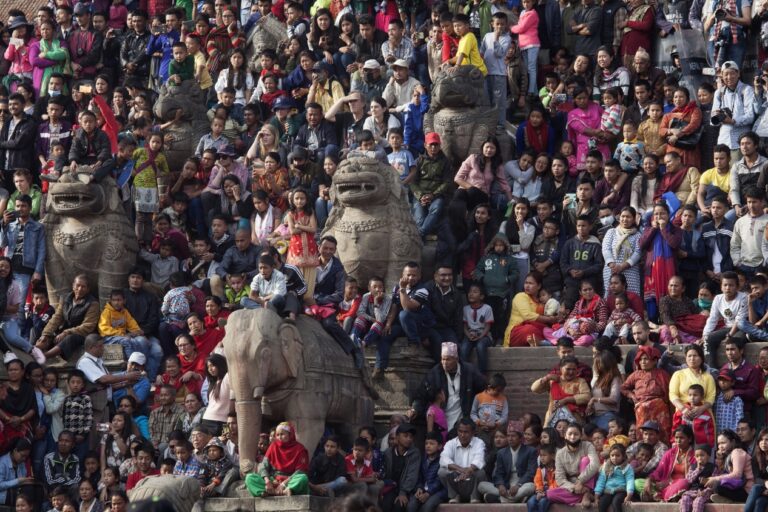
People gathered at Nyatpol Temple in Bhaktapur. Photo: Bikram Rai
The impact of the informal economy
Employees working in government bodies and other formal sectors—such as banking, insurance, corporate professionals, teachers, and technicians—are included within the tax system. However, since the informal economy is large, a significant portion of the population remains outside the tax net. As a result, the tax burden is naturally concentrated on a limited group.
According to anthropologist Tamang, Nepal’s economy has shifted from an agriculture-based production system toward a consumption-driven economy via services and remittances. Foreign employment, urbanization, private education and healthcare, cooperatives, banking, and real estate transactions have given rise to new economic classes. Even without land ownership, some individuals have moved into the middle and upper-middle classes due to other sources of income.
According to a study report titled “The Size of the Informal Economy,” published in 2024 by the Central Department of Economics at Tribhuvan University, 38.6 percent of Nepal’s Gross Domestic Product operates informally. An informal economy means that economic activities conducted by individuals or institutions are not under state regulation. They are not registered with state authorities and do not pay taxes.
Tax expert and senior chartered accountant Shesh Mani Dahal, however, argues that the informal economy benefits lower-income groups. He says, “The wealthy purchase more from the formal sector and consequently pay more consumption tax. Other groups purchase more from the informal sector and pay less tax. In that sense, the tax system benefits the poor.”
It is justifiable that taxes paid by the wealthy provide relief to lower-income groups. However, in the informal economy, those who earn substantial income but do not pay taxes gain the most benefit. For example, individuals engaged in real estate transactions often do not pay taxes on their profits. Income earned through intermediary dealings also frequently escapes taxation. Economist Acharya says, “Those outside the tax net do not pay taxes, and the burden falls on those within it. Therefore, bringing informal sector transactions into the tax net could reduce the burden on the middle class.”
Tax evasion increasing pressure on the middle class
Other reasons why the middle class bears a heavier tax burden include tax evasion and revenue leakage. Due to the inefficiency of the government’s tax enforcement system, the tendency to evade taxes has been increasing. To control tax evasion, there is a mechanism called the Department of Revenue Investigation. In fiscal year 2024/25 alone, the Department filed cases in district and high courts against 173 individuals in 52 revenue leakage cases, demanding Rs 2.6463 billion in principal amounts along with 100 percent penalties. According to the Department’s report, in cases of foreign exchange misuse, 184 individuals were made defendants in 120 cases, with Rs 1.3976 billion in principal amounts determined, and penalties of up to three times the principal amount demanded.
In fiscal year 2024/25 alone, the Department filed cases in district and high courts against 173 individuals in 52 revenue leakage cases, demanding Rs 2.6463 billion in principal amounts along with 100 percent penalties.
Former director general of the Inland Revenue Department, Mainali, says that if tax evasion can be controlled, the state’s revenue base would be strengthened and tax rates could be reduced. “Tax leakage and evasion have not been effectively controlled. There are significant systemic and behavioral problems. If those are resolved, the state’s share of revenue will increase, creating a basis for providing tax relief,” he says.
No services commensurate with taxes
A paradoxical situation exists in which a large portion of the middle class’s income is spent on taxes, yet they are unable to enjoy state services proportionate to what they pay. Public hospitals lack accessible and quality healthcare services. Government schools do not provide satisfactory educational standards. Because citizens do not receive quality healthcare and education from public institutions, they are compelled to spend additional money in private institutions. Being forced to turn to private providers due to poor public services and having to spend there is equivalent to paying an additional “tax equivalent.”
The condition of roads and public transportation services is similar. The average income of citizens is not sufficient to cope with rising market prices. Senior chartered accountant Dahal says, “Since the services provided by the government are not of good quality, the amount citizens spend privately—equivalent to paying additional tax—is substantial. If government schools and hospitals were effective and high-quality, there would be no need to incur such additional expenses.”
On the one hand, there is a heavy tax burden; on the other, there is the compulsion to pay high prices to private institutions. This creates a sense of double hardship for middle-income groups. Senior chartered accountant Pandey says, “Because middle-class people spend more on consumption, their share of indirect taxes paid to the state automatically becomes higher. When they cannot enjoy services proportionate to the taxes they pay, they feel they are only paying taxes without receiving benefits.”
According to Mainali, citizens do not receive direct compensation for the taxes they pay, but the state must instill confidence that their money is being properly utilized. He says, “Citizens must be assured that their tax payments have not been misused and that the government has done good work.”
Customers shopping at Bhatbhateni Superstore in Maharajgunj, Kathmandu. Photo: Bikram Rai
Recommendations left in drawers
The “High-Level Economic Reform Recommendation Commission,” formed by the government in 2024, recommended reforms to the tax system. In a report submitted to then Finance Minister Bishnu Prasad Paudel in Chaitra 2081 (mid-March to mid-April 2025), 20 recommendations were made regarding tax reform. The report noted that Nepal has too many types of taxes and that these should be reduced. It suggested that because the informal economy is large, bringing it into the tax net would allow tax rates to be lowered. The commission’s coordinator, Rameshor Khanal, is currently the finance minister. However, little progress has been made regarding tax relief.
On 12 November 2014, the Ministry of Finance formed the “High-Level Tax Review Commission” under the coordination of tax expert Rup Khadka. The commission submitted its report to the finance minister on 30 June 2015.
On 15 September 2023, a “High-Level Committee on Tax System Reform” was formed under the coordination of former administrator and tax expert Vidyadhar Mallik. The committee submitted its report to the Ministry of Finance in Falgun 2080 (mid-April to mid-March 2024). The committee recommended removing VAT exemptions on various goods, revising income tax slabs, eliminating excise duties on goods other than those harmful to health, reforming social security taxes, reducing the limit on cash payments while increasing the limit on digital payments, among other measures. It estimated that reforming the current tax system could generate an additional Rs 300 billion in revenue. However, the recommendations of both the Khadka and Mallik committees have not been effectively implemented by the government.
Taxes in party manifestos
Some political parties have mentioned providing tax relief to the middle class in their election manifestos, while others have not presented clear positions on taxation.
The Nepali Congress manifesto clearly states that no tax will be levied on income up to Rs 1 million. It also proposes reducing the maximum income tax rate from 39 percent to 25 percent. The manifesto mentions lowering the corporate tax rate to 20 percent and simplifying other tax rates while incorporating everyone into the VAT system.
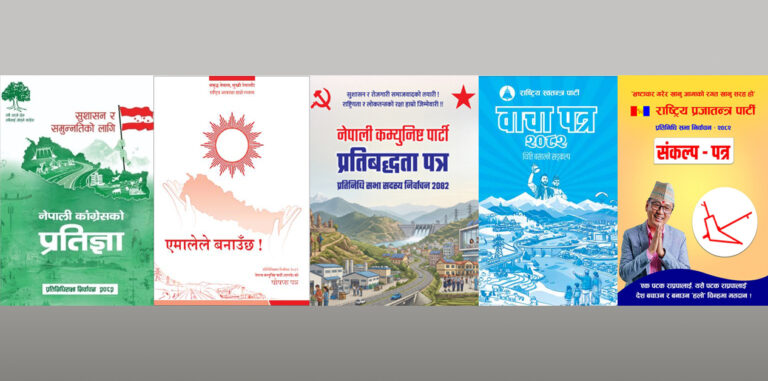
Manifestos released by political parties for the elections to be held on 5 March.
The CPN (UML), however, has not clearly specified its position on income tax in its manifesto. It states: “Through a progressive tax system, fair distribution of state resources, balanced regional development, and promotion of social entrepreneurship, we will reduce inequalities in opportunity, income, and wealth.” UML has pledged to make income inequality reduction and elimination of extreme poverty central goals of the state. It has also announced a “matching contribution” system for low-income workers. This means that the amount low-income workers contribute to social security funds will be matched by their employers.
The Rastriya Swatantra Party (RSP) has stated that it will adopt a policy of reviewing income tax thresholds but has not specified the exact limits. Its manifesto says: “For the bright future of middle-class families and children, we will adopt a policy of reviewing income tax thresholds based on family burden.” The RSP has also proposed legal provisions allowing certain amounts spent on education, health, and child-rearing to be deducted from taxable income.
In 1990, as much as 41.76 percent of Nepal’s population was below the poverty line. Over the past 35 years, significant improvement has reduced this figure to around 20 percent.
The Rastriya Prajatantra Party (RPP) has mentioned reforming the tax structure and scope to make the tax system simpler, more scientific, and more equitable. It has pledged to end all forms of double taxation and to expand the tax base rather than increase tax rates.
In 1990, as much as 41.76 percent of Nepal’s population was below the poverty line. Over the past 35 years, significant improvement has reduced this figure to around 20 percent. With rising per capita income, this proportion is expected to decline further while the middle class continues to grow. This means the middle class will become increasingly influential in the country’s political, social, and economic spheres. Therefore, whichever government is formed after the elections will face pressure to formulate policies and programs that provide relief to this group.