Kathmandu
Tuesday, July 28, 2026





In eastern Nepal, a cable car has become the unlikely frontline of an ancient civilizational battle, between people who believe a mountain is a goddess and a state that sees it as a tourism asset
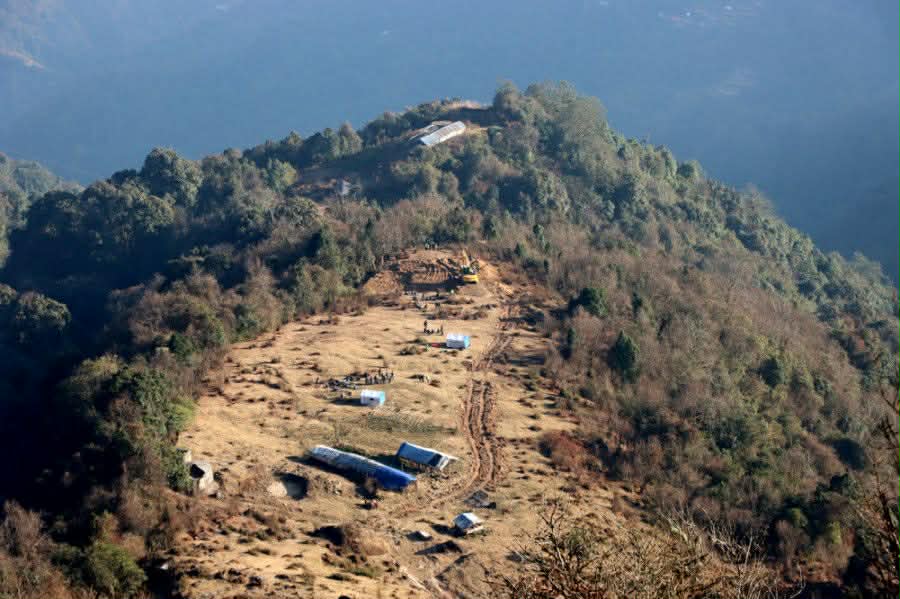
KATHMANDU: There is a moment in the theatrical production that ran at Mandala Theatre in Kathmandu for an entire month, performing to packed and emotionally charged audiences, when an actor repeats the line that had become the movement’s unofficial slogan: No matter what, one cannot step on the head.
The phrase is Yakthung in spirit, even when spoken in Nepali. It carries the weight of something that cannot be negotiated away at a government table, cannot be resolved with a compensation package, cannot be soothed by the promise of a thousand jobs. It is the kind of statement communities make when they have run out of patience with being reasonable and have decided, collectively, that something is simply non-negotiable.
That play, titled Mukkumlung: Cho:t-lung of Yakthung, was not just a cultural event. It was a political act, performed in the capital of a country whose government had, for years, been unable or unwilling to hear what the Limbu people of Taplejung were saying about a mountain they have worshipped for as long as their oral tradition can remember. That government is now, finally, being forced to listen — not because it developed a conscience, but because a new prime minister walked in, looked at the mess, and told everyone to stop.
For the moment, construction has stopped. For the moment, the armed police personnel who guarded bulldozers against protesters with their own bodies are being asked to stand down. For the moment, the mountain breathes.
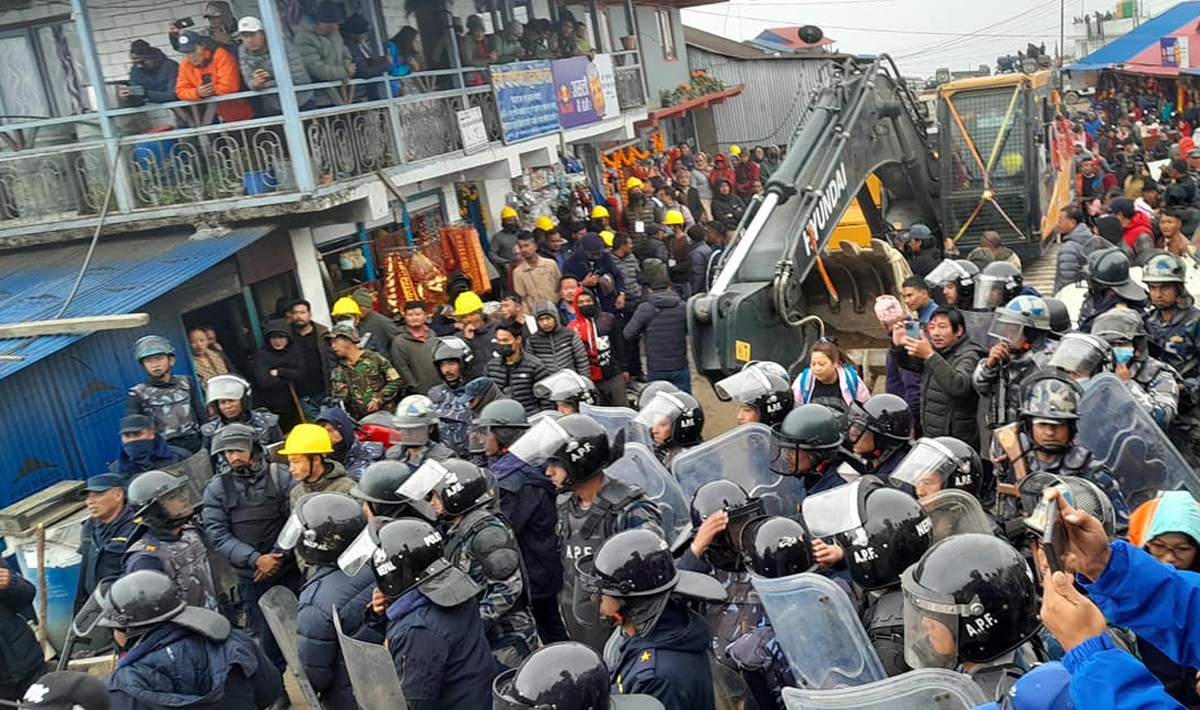
Security personnel deployed in the Pathibhara area to control clashes with local protestors. File photo
But the question that hangs over Taplejung, over Kathmandu, and increasingly over international human rights chambers and World Bank compliance offices is whether this pause is the beginning of real reckoning or just another chapter in a decades-long pattern of delay, half-measures, and broken promises.
A Place With Two Names and One Wound
To understand the Pathibhara cable car controversy, you have to begin with the most basic fact about it, which is also the most contested: the place has two names, and those two names do not merely reflect different languages. They reflect two entirely different ways of understanding what a mountain is and what it is for.
Mukkumlung is what the Yakthung people, the Limbu indigenous community of eastern Nepal, have always called this summit. The name exists within the framework of Mundhum, the ancient oral scripture that functions as philosophy, cosmology, legal code, and spiritual manual for the Yakthung. In that tradition, Mukkumlung is not a location where a deity lives. It is itself alive. It is the dwelling ground of Yuma Sammang, the supreme goddess of the Yakthung, whom they address as Grandmother, as Mother Earth, as the animating spirit behind all living things.
Within Mundhum, there is a specific story about pilgrims carrying a sacred thread from the base of the mountain to the top — a thread that represents the unbroken continuity of life itself. The mountain, the forest, the rivers that drain from it, the red pandas that move through its undergrowth, the Himalayan yew trees whose bark is harvested by pharmaceutical companies for cancer drugs — all of this constitutes a single sacred whole. You cannot build a cable car through it without, in the cosmological sense, cutting the thread.
Pathibhara is a name in Khas Nepali that came to overlay Mukkumlung as part of Nepal’s long process of national unification, which was also, for many of its non-Hindu and indigenous communities, a process of cultural assimilation. The Pathibhara Devi temple was established at the summit. A statue of Goddess Durga was installed in 2001. A Hindu institutional framework was built on top of a Yakthung sacred landscape, not through violent conquest but through the slower and in some ways more devastating mechanism of administrative legitimacy.
Three hundred thousand pilgrims visit each year now. Most of them are Hindu. Most of them call it Pathibhara. The Limbu community is not opposed to pilgrimage. What they are opposed to is the claim, implicit in everything that has followed, that because the site now draws Hindu pilgrims it has effectively become a Hindu place, and therefore its future can be decided without consulting the people who have always regarded it as their own.
The insistence on using the name Mukkumlung in every protest statement, every legal filing, every theatrical performance is not stubbornness. It is a precision instrument. The name is the argument.
How a Cable Car Became a Crisis
There is a version of this story in which a cable car to a popular pilgrimage site is an entirely reasonable piece of infrastructure. Elderly pilgrims. People with mobility challenges. A remote mountain region that needs investment. A government trying to monetize its natural and religious assets in a country where GDP per capita is roughly $1,377 and where one in ten working-age people cannot find employment.
That version of the story is the one Chandra Prasad Dhakal tells. He is the chairman of the IME Group, one of Nepal’s most powerful business conglomerates, which also controls Global IME Bank and whose owner serves as president of the Federation of Nepalese Chambers of Commerce and Industry. He is, in other words, someone who has the financial resources, the institutional relationships, and the political access to make a project like this happen.
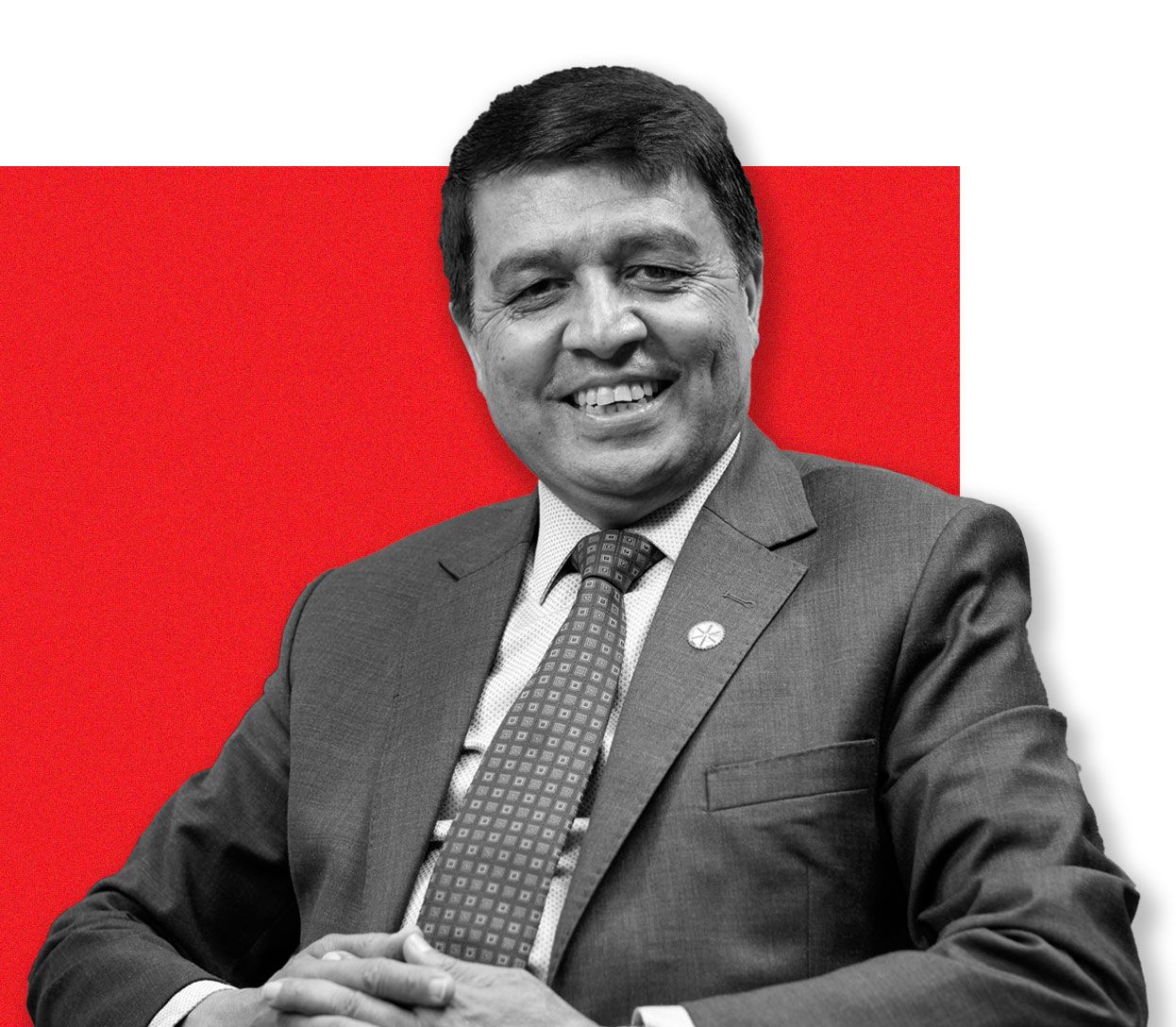
FNCCI President Chandra Dhakal, central to the Pathibhara cable car controversy, faces criticism over the project’s impact on the sacred Mukkumlung site.
Dhakal has said he was unaware of the depth of past protests when his group took over the project from Yeti Group. He has dismissed environmental concerns by asking why a cable car is objectionable when helicopters already fly to the summit. He has framed the project as development, as modernity, as the kind of thing that lifts a struggling region out of poverty.
The government has backed him. It declared the Pathibhara cable car a project of national pride. It approved the project in 2018. It sent the Armed Police Force to protect the construction site. When the APF fired on protesters on January 25, 2025, wounding at least four people, some of whom were airlifted to Kathmandu with gunshot wounds, it was because they were there, at a government-sanctioned project, doing what they were sent to do.
And yet.
The environmental assessment prepared for this project, called an Initial Environmental Examination, identified four tree species in a forest that botanists who visited the site say contains at least 112. It did not mention the Himalayan yew, which is a legally protected endangered species. Its own internal chapters contradicted each other: one section described 112 trees to be affected by construction while another described an additional 10,119 seedlings, saplings, and young trees to be removed.
And because the project actually requires 6.22 hectares of forest while only 4.97 hectares were officially allocated, it crossed the legal threshold requiring not an IEE but a full Environmental Impact Assessment — a process far more rigorous, far more public, and far more demanding of community consultation.
The EIA was never done. By using the lighter IEE process, the developer avoided the scrutiny that would have exposed these problems before a single tree was cut. Whether that was oversight or strategy is a question that the new government says it intends to investigate. What it means in practical terms is that the legal foundation of this project is built on a document that, by multiple measures, does not accurately describe the place it is supposed to assess.
In May 2024, contractors arrived at the sacred forest at night, under armed escort, and began felling trees. Thousands of trees fell before daylight. Some accounts put the number at 12,000 in a single night, many of them rhododendrons — Nepal’s national flower — and other species not listed in the assessment. The Limbu community found out the way communities always find out about things that happen under cover of darkness: in the morning, looking at what was left.
Whatever calculation had been made about community acceptance in the years since 2018, that calculation was destroyed in that night. The banda that followed, the shutdown of transportation and commerce that spread across the region, was not just a protest tactic. It was grief, taking the form available to it.
When the State Shoots Its Own Citizens
January 25, 2025, is the date that changed the political character of this dispute. Protesters from the No Cable Car group attempted to march toward the construction site. Security forces intervened. Police opened fire.
Yam Bahadur Limbu was shot. Sagun Lawati was shot. Others were wounded. Three of the most seriously injured were airlifted to Kathmandu for treatment at Teaching Hospital. Security personnel were also reportedly injured in the clashes.

Three injured protesters from the ‘No Cable Car’ group receive treatment at Teaching Hospital in Kathmandu after sustaining gunshot wounds during a police intervention near the Baludada area, close to Pathibhara, amid protests against the cable car construction on January 25, 2025. File photo
Nepal is not a country without experience of state violence against its own citizens. The decade-long Maoist conflict left deep scars. The political upheavals of 2006 and 2015 each had their moments of police excess. But there is something distinctly disturbing about a democratic government using live ammunition against indigenous people trying to protect a forest they consider sacred.
The demand that followed the shooting was precise and multifaceted. The protesters called for cancellation of the cable car project. They called for dismissal of the Pathibhara Area Development Committee, which they regard as an institutional vehicle for erasing indigenous authority over the site. They called for public apologies from the Chief District Officer and the Armed Police Force chief. They called for a ban on project representatives entering Taplejung. And they called for the closure of Global IME Bank branches across several districts — a targeted economic signal that they understood exactly whose money and whose power lay behind the armed presence protecting bulldozers on their mountain.
That last demand is worth pausing on. When a protest movement targets a bank, it has moved beyond slogan-making into analysis. It has mapped the network. The No Cable Car group knew that Chandra Dhakal chaired Global IME Bank. It knew that the project was ultimately about a private business interest using state security infrastructure to impose a commercial development on an unwilling community. By naming the bank, they named the architecture of power.
The six-point agreement reached on February 4, 2025, after two days of dialogue, was supposed to begin a process of de-escalation. Construction would pause. Protests would pause. Both sides would talk. A negotiation team led by Saru Singhak would represent the community. The government would constitute its own team.
The government never constituted its team. When talks were scheduled for March 19, the government simply did not appear with a designated negotiating body. Construction reportedly continued even while the agreement was nominally in force. On February 20, clashes broke out again.
This is the pattern that has defined the state’s relationship with this movement for years: the appearance of engagement combined with the reality of non-compliance. Enough talk to prevent the protests from being seen as entirely without recourse. Never enough substance to actually resolve anything. And behind the performance of negotiation, the machinery of construction continuing wherever and whenever it could.
What the Lawyers Saw
The Supreme Court’s involvement in this dispute has been both consequential and frustratingly partial.
On March 30, 2025, after a writ petition was filed by Yam Bahadur Limbu and seven others, a single-judge bench led by Justice Saranga Subedi issued a short-term interim order halting all construction. The court had looked at the issues raised in the petition and concluded they were serious enough that both sides needed to be heard before any final decision.
On April 14, a separate interim order on a related writ petition by the Kanchenjunga Conservation Area Management Council imposed a status quo on all matters related to cable car construction. Two courts, two orders, both saying: stop, while we think.
Then in May 2025, a joint bench declined to extend the initial stay order, pointing to earlier decisions not to issue stays on related petitions. The company said this meant it could resume construction immediately. The case remains before the court as of April 2026.
The legal landscape is therefore one of unresolved contradiction. Court orders that halted construction were eventually narrowed. The company interpreted the narrowing as permission. The protesters interpreted it as a technicality that did not address the underlying constitutional and international law questions. Neither interpretation is entirely wrong, and neither resolves anything.
What the case has done, however, is formalize several of the movement’s core arguments. The writ petition places on the record the violations of free, prior, and informed consent — the international law principle, embedded in ILO Convention No. 169 and the UN Declaration on the Rights of Indigenous Peoples, both of which Nepal has signed, that requires governments to genuinely consult indigenous communities before any project affecting their lands proceeds. Not inform. Not announce. Genuinely consult, before construction begins, with accurate information, free from coercion.
There is no credible account of that consultation having taken place before the Pathibhara cable car project was approved in 2018. The Yakthung community did not consent. They were not asked. The government approved, the company began work, and the community found out.
The principle of FPIC is not a procedural nicety. It is the legal mechanism through which states acknowledge that indigenous peoples have rights over their ancestral territories that cannot simply be overridden by a national development agenda. Nepal’s own constitution enshrines FPIC in Articles 26 and 32. The violation here is not a matter of opinion. It is documented, argued before a court, and acknowledged by international bodies.
The Forest the Documents Didn’t See
Among all the technical failures associated with this project, the environmental assessment stands as perhaps the most damning.
A forest is supposed to be easy to describe. You walk through it. You identify what grows there. You count, roughly, what you would need to remove. You compare what you find to lists of protected species. You note where the endangered ones are. You do this before you plan anything, so that your plan reflects reality.
The IEE for the Pathibhara cable car did none of this adequately. Out of 112 tree species that botanists have since identified in the project area, the document catalogued four. It omitted the Himalayan yew, known scientifically as Taxus wallichiana, whose bark compound paclitaxel is used in chemotherapy drugs and whose rarity makes it legally protected under Nepali law. It omitted species of rhododendron. It was, in the assessment of conservationists who reviewed it, a document describing a different forest from the one that actually exists in Taplejung.
The internal contradictions are almost equally striking. One section of the report described the project as affecting around 112 trees during construction. Another section of the same document described 10,119 seedlings, saplings, and young trees to be removed. These are not rounding errors. They reflect either extraordinary incompetence in the preparation of a regulatory document or something more troubling.
The land calculation is the most legally significant problem. Because the project requires 6.22 hectares of forest, it exceeds the 4.97 hectares officially allocated. This threshold matters because Nepali law stipulates that projects above a certain ecological footprint must undergo a full Environmental Impact Assessment rather than the lighter Initial Environmental Examination process. The EIA is not just more thorough scientifically. It is more public, more consultative, and far more difficult to quietly approve without community knowledge.
By underreporting the land requirement, the project avoided that more rigorous process. Whether that was a calculation or an accident is, again, something the new government says it intends to examine. But the consequence is that a major infrastructure project on the edge of a protected conservation area, through an endangered forest, was approved on the basis of a document that did not accurately describe the forest it proposed to destroy.
When construction crews arrived in May 2024 and began cutting at night, the discrepancy between what the IEE said and what actually fell became viscerally, irreversibly visible. Activists reported 12,000 trees destroyed in that single night. The official figure was vastly smaller. The forest does not lie.
The World Beyond Kathmandu
Perhaps the most significant development in this dispute over the past year has been its successful internationalization. The No Cable Car group has moved this conflict from a regional grievance into a global conversation, and it has done so through channels that carry real institutional weight.
By early 2025, 286 organizations from around the world had formally expressed solidarity with the movement opposing the cable car. These were not symbolic online petitions. They included organizations with legal expertise, institutional access, and established relationships with international bodies.
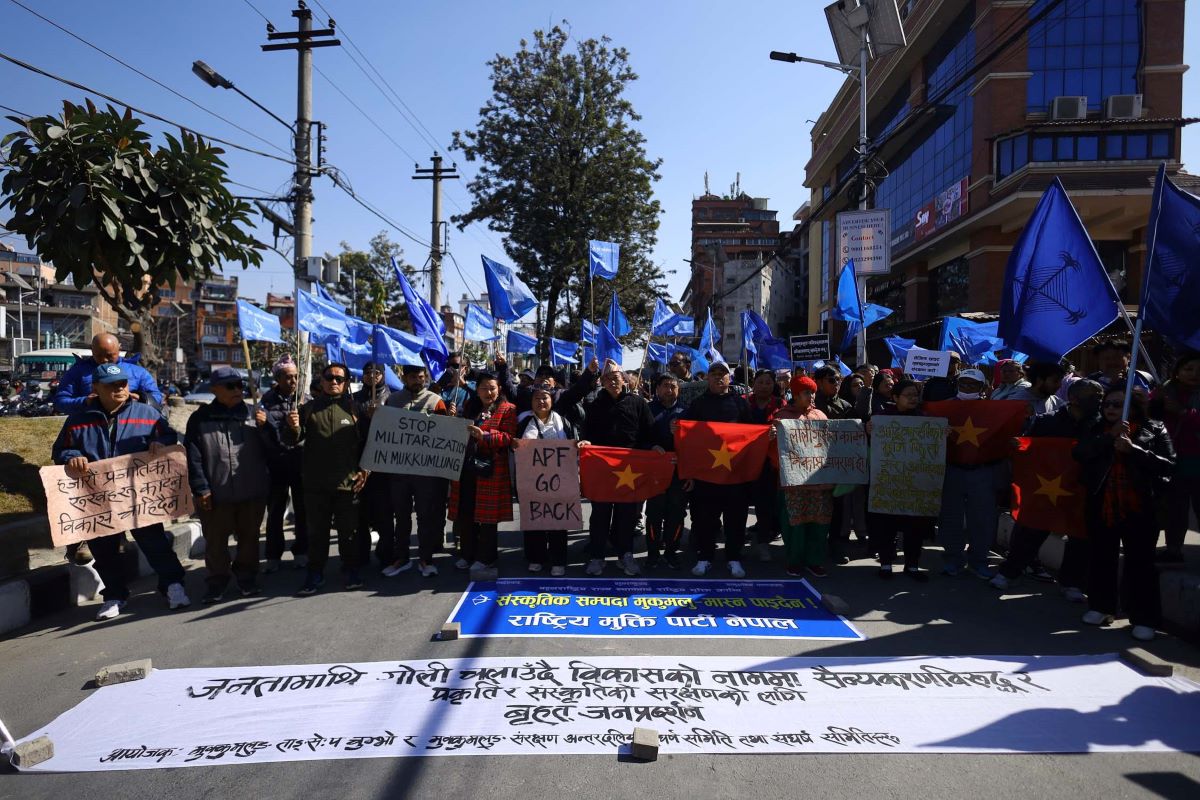
Mukkumlung protest. Photo courtesy: Nepal Photo Library/File photo
The International Network for Economic, Social and Cultural Rights — ESCR-Net, a coalition of over 300 organizations globally — sent a formal urgent appeal to then-Prime Minister KP Sharma Oli and Home Minister Ramesh Lekhak. The appeal called for an immediate halt to construction, an independent investigation into the January 25 shootings, the release of anyone unlawfully detained in connection with the protests, and the withdrawal of the heavy security deployment from the area.
The language of the appeal was precise and grounded in international law: it invoked FPIC, it cited Nepal’s obligations under ILO Convention No. 169 and UNDRIP, and it documented the failure of the government’s nominal dialogue processes to constitute a genuine negotiating mechanism.
Then, in August 2025, the Yakthung community filed a complaint with the World Bank Group’s Compliance Advisor and Ombudsman — the CAO — targeting the International Finance Corporation, the private sector arm of the World Bank, for its undisclosed advisory support to the IME Group. The IFC has said it exited its advisory role early and did not directly finance the Pathibhara project. But the complainants argue that the IFC provided advisory support that helped legitimize the project without ever disclosing that support publicly — a disclosure that only appeared in July 2024, nearly two years after construction formally began in September 2022.
The CAO formally registered the complaint in December 2025. By the time of this writing, it has undergone a 90-day assessment period to determine whether it moves to dispute resolution or a full compliance review. If it proceeds to a compliance review, it would examine whether the IFC violated its own environmental and social performance standards by supporting a project that failed to secure FPIC and that proceeded over an inadequate environmental assessment.
That is no longer just a dispute between a community in Taplejung and a developer in Kathmandu. That is a global accountability mechanism examining whether one of the world’s most powerful financial institutions played a role, however advisory, in enabling a project that violated indigenous rights.
The No Cable Car group has also announced plans to pursue legal options beyond Nepal’s borders, including appeals to United Nations mechanisms. The movement has, in other words, understood something that successful indigenous rights campaigns in other parts of the world have also discovered: the national courts and the national government are not always sufficient. When they fail, the international architecture of human rights law provides alternative pathways. Slow pathways. Expensive pathways. But real ones.
The Economics Nobody Wants to Calculate
The case for the cable car has always rested heavily on economics. Dhakal and his supporters argue that $22 million of private investment, a thousand jobs, expanded tourism access, and improved infrastructure for a remote mountain district are straightforwardly good for Nepal and particularly good for Taplejung.
This argument deserves to be engaged seriously before it is challenged, because the economic marginalization of eastern Nepal is real. Unemployment in these districts is genuinely high. Outmigration has hollowed out communities. Infrastructure is genuinely poor. The idea that development should bypass a struggling region because its most visible landscape is contested is not a morally comfortable position.
But the economics that the developer presents are also selectively chosen, and the costs they omit are considerable.
Along the current trekking route to Mukkumlung, there are porters who carry supplies and luggage for pilgrims. There are tea stall owners who have fed those pilgrims for generations, their small enterprises woven into the social fabric of the route. There are lodge-keepers, guides, and small traders whose entire livelihood depends on the hours it currently takes to walk from the roadhead to the temple.
A cable car that transports pilgrims from the base to the summit in minutes does not just change the journey. It eliminates the economy of the journey. The people who have quietly sustained themselves along that path for decades will find, one morning, that there is nothing left for them to do. The jobs the cable car creates — operating the cars, maintaining the machinery, managing the facility — are technical positions that tend to go to contractors and specialists from urban centers, not to the women selling tea at the second rest stop on the way up.
Research on cable car projects elsewhere in Nepal consistently shows that the economic benefits of such developments flow primarily to investors and urban-based operators, while local economies built around the existing mode of access are disrupted or destroyed. The thousand jobs Dhakal promises are real in aggregate. Whether they belong to the community that currently depends on the mountain is a different question, and it is one that the economic case for the project never really answers.
The environmental costs similarly go uncalculated in the official narrative. A forest containing an endangered tree species used in cancer treatment does not appear on any balance sheet as a loss when it is cleared. A red panda habitat does not generate a GDP entry. The water that the Chure-adjacent ecological systems filter and regulate, the downstream communities that depend on those systems, the biodiversity that makes a forest more than a collection of individual trees — none of this shows up in the return-on-investment projections for a cable car.
This is the fundamental dishonesty in the purely economic framing of the project: it counts the cable car’s revenues and counts the jobs it promises, while treating the forest, the culture, the sacred landscape, and the traditional economy as things that simply do not count, because they do not appear in any ledger that the planners are required to consult.
The Community That Is Not One
It would be convenient if the Taplejung community were uniformly opposed to the cable car. The picture is more complicated, and that complication is part of what makes the dispute so difficult to resolve and so revealing of the deeper tensions it surfaces.
There are people within the Yakthung community who see the project differently. Some regard it as an economic opportunity that their region has been denied for too long. Some are tired of the poverty, the outmigration, the sense that Taplejung is perpetually overlooked while development happens elsewhere. Some believe that the protests, whatever their cultural legitimacy, are being used by political actors who care more about identity politics than about the material lives of people in the district.
Local journalists who have covered this dispute over years have put it plainly: the project has turned fathers and sons against each other. That is not a metaphor. There are families in Taplejung where one member works for the construction company or supports the development argument and another has been at the front of the protest marches or been present when police fired.
This internal division is partly organic and partly manufactured. Projects of this kind, at this scale, with this level of political backing, do not arrive without resources for community relations work. Money flows into divided communities in particular ways. Promises of employment are made in particular rooms to particular people. The movement has alleged that some of the apparent local support for the cable car is mediated by exactly these kinds of transactions, though such claims are difficult to verify.
What is clear is that the movement’s core — the Mukkumlung Struggle Committee, the Cable Car Cancellation Joint Struggle Committee, the Kirat Yakthung Chumlung — represents a substantial, organized, and sustained expression of Yakthung community sentiment. These organizations have maintained their mobilization over years, not weeks. They have survived clashes with police, the imprisonment or detention of members, the breakdown of government dialogue, and the company’s attempts to restart construction during nominal pause periods. Movements that fracture under that pressure do not last. This one has lasted.
What Balendra Shah Has Set in Motion
Prime Minister Balendra Shah’s order halting construction is the most significant government action since this dispute began, and it deserves to be understood carefully — both for what it is and for what it is not.
What it is: a direct political intervention from the country’s top executive that stops, at least temporarily, the forward momentum of a project backed by one of Nepal’s most powerful business figures. Shah has also indicated that a broader review is coming, one that will examine alleged irregularities in land transactions, the environmental assessment’s failures, financial management decisions linked to previous political leadership, and potential banking-related fraud connected to the project.
That is an extraordinarily broad scope of review. If it proceeds seriously, it amounts to an admission that the entire approval process for this project was compromised from the beginning — that the environmental document was inadequate, that the land arrangements were irregular, that the financial structures had problems, and that the political backing that protected the project from scrutiny was itself part of the problem.
What the order is not: a cancellation. Construction has paused, but it has not been legally terminated. The Supreme Court has not yet delivered its final verdict. The company has made no public statement that it has abandoned its intention to complete the project. The Armed Police Force personnel who were ordered to withdraw had, as of the time of reporting, not fully done so. A directive from a prime minister and the actual behavior of security forces on the ground are, in Nepal’s institutional landscape, two different things.
The earlier incident in which then-Home Minister Sudan Gurung issued instructions to the APF Inspector General to remove security personnel from the site, instructions that were simply not implemented, is a relevant precedent. Nepal’s security apparatus has its own institutional logic and its own relationships. An order from the Home Ministry, or even from the Prime Minister, does not automatically translate into action on a mountainside in Taplejung.
There is also the political economy of the situation to consider. Chandra Dhakal is not just a businessman. He is the president of the Federation of Nepalese Chambers of Commerce and Industry and the chairman of a major bank. The investment in this project runs to approximately $22 million. The political relationships built around its approval are extensive. A government that genuinely cancels this project would be making a statement about the limits of business-political power in Nepal that goes well beyond one cable car on one mountain.
Shah’s government may be willing to make that statement. It may not. What it has done so far is create the space in which such a statement could be made, which is more than any previous government managed.
A Longer Story
The Pathibhara cable car dispute is, among other things, a story about how historical wounds travel through time and surface in unexpected places.
The process by which Mukkumlung became Pathibhara — by which an indigenous sacred site was absorbed into the dominant Hindu identity of the Nepali nation — was not violent in the ordinary sense. There were no armies. There was no massacre. There was, instead, the slow accumulation of administrative decisions, institutional frameworks, and cultural normalization that, over generations, changed who had authority over a place without anyone explicitly declaring that a transfer had occurred.
The demand for Koshi Province to be named Kirat-Limbuwan, which dates back decades, reflects the same historical dynamic. The Limbu people have asked, repeatedly, that their ancestral homeland be recognized by a name that reflects their presence and their history. The government renamed the province Koshi in 2023, overriding that demand in favor of a geographic designation that carries no indigenous meaning. That decision, and the cable car, are part of the same pattern.
There is a phrase that runs through the theoretical literature on this kind of gradual erasure: slow violence. It describes harm that accumulates over time rather than arriving in a single catastrophic event — the kind of harm that is easy to ignore because it happens in increments and because those who suffer it are often not the people whose suffering is politically visible. The renaming of Mukkumlung. The installation of a Hindu statue at a Yakthung sacred site. The approval of a commercial cable car project without consulting the community that regards the site as sacred. Each, individually, is a decision that can be explained and defended. Together, they constitute something else.
What the No Cable Car movement has done — and this is perhaps its most significant achievement — is make the slow visible. By giving the dispute a dramatic focus, by organizing marches and shutdowns and theatrical performances, by getting shot at and surviving and telling the world what happened, by filing at the World Bank and announcing plans for international courts, the Yakthung people of Taplejung have forced a decision that decades of quiet administrative dispossession never required anyone to make.
Now a prime minister has had to act. Now courts have had to rule. Now a global compliance mechanism is assessing whether a multinational financial institution violated its own policies. The slowness has been accelerated into a crisis, and crises, unlike slow processes, require answers.
What the Mountain Requires
There is no resolution to this dispute that will make everyone content. The community is divided. The law is unsettled. The economics point in conflicting directions. The politics are complex. The international processes are slow.
But there are some things that are not ambiguous.
A government-owned national airline discriminating against its cabin crew on the basis of gender-coded employment rules is wrong. A university suppressing students’ access to their own examination papers under the claim of institutional secrecy is wrong. A conservation law enforced against the poor but not against the powerful is wrong. These are the kinds of wrongs that Nepal’s Supreme Court has, in its best moments, been willing to name and address.
The Pathibhara cable car case presents the same fundamental question in a more complex form: can the state authorize the destruction of a community’s sacred landscape, on the basis of an inadequate environmental assessment, without the consent of the indigenous people for whom that landscape is not a tourism resource but a living cosmology?
International law says no. Nepal’s own constitution says no. The treaties Nepal has signed say no. The Supreme Court, when it delivers its final verdict, will have to say something — and what it says will either add the Mukkumlung case to its long list of landmark rulings that extended rights to people the state had failed, or it will not.
In the meantime, a community of Yakthung people continues to do what it has done throughout: watch the mountain, protect the thread, and refuse the comfortable fiction that development and dispossession are different things.
The mountain at 3,794 meters does not change. The rhododendrons that were not in the environmental report either grow or they do not. The red pandas move through what remains of their habitat or they do not. The sacred thread that runs from base to summit in the Mundhum tradition either holds or it breaks.
Whether it holds depends, at this particular moment in Nepali history, on whether the people with the power to stop what has been started are willing to use that power for something other than delay.
That is the question Taplejung is asking Kathmandu.
It has not yet received an answer it can trust.