Kathmandu
Saturday, July 18, 2026





Demolition campaign launched against river encroachment for beautification

POKHARA: Jayaprakash Thapa of Pokhara spent his childhood swimming in Phirke Khola (Phirke Stream) and enjoying its surrounding areas. Crystal clear water used to flow through the stream, where he would catch fish alongside his childhood friends.
When looking back at his childhood, numerous anecdotes connected to Phirke stream come to his memory, though they feel like mere stories today. As he grew up, the stream shrank under the weight of encroachment. Jayaprakash, who has now crossed the age of 40, witnessed a massive transformation in Phirke’s appearance within a short period. Over a span of just a few decades, right before his eyes, the stream narrowed and turned unsightly. For the generations after him, rapid urbanization squeezed Phirke’s existence between concrete structures, turning it into a polluted drainage channel.
Jayaprakash’s heart aches to see the stream where he once swam and fished turn into a sewer. “In the past, the stream flowed clear, and some fish could be found. There was a forest nearby with birds chirping. It was extremely peaceful,” he says. “Even during winter, the stream had gurgling water. Now, water only flows during the monsoon; at other times, it is just sewage.”
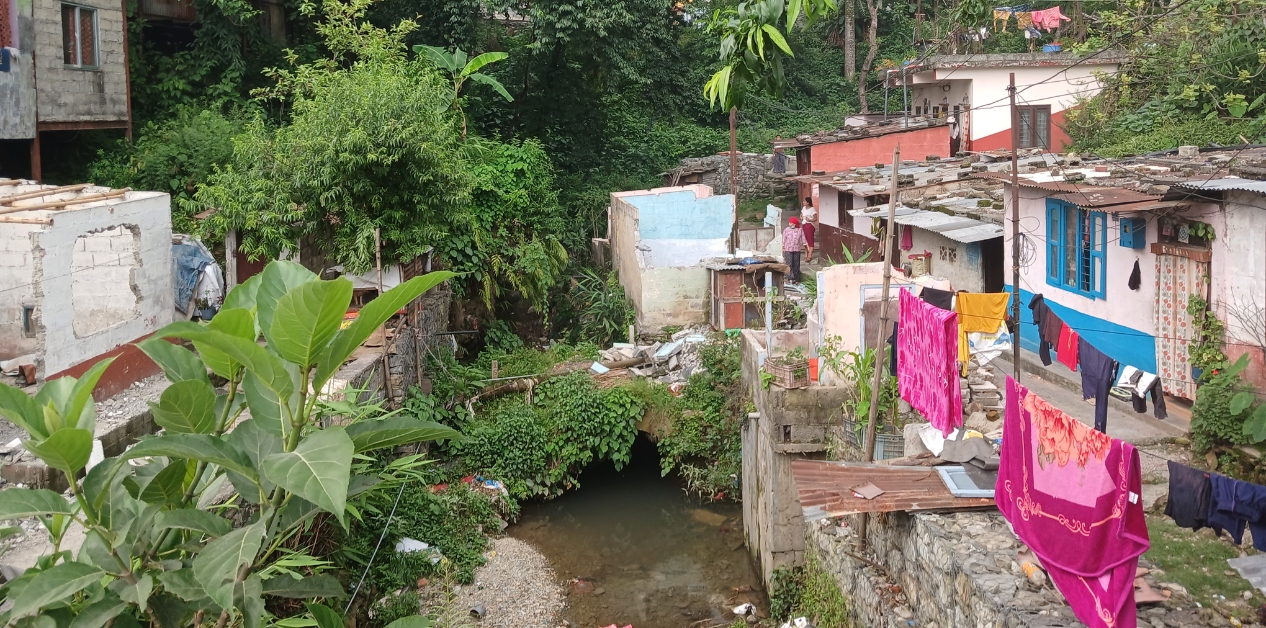
Photo: Reena Thapa
Flowing through the middle of Pokhara, Phirke Khola originates at Andherikuna in Pokhara Metropolitan City-18. Starting from Ward No. 18 and flowing through seven other wards, this approximately eight-kilometer-long stream eventually empties into Phewa Lake. Studies show that its existence fell into crisis due to rapid urbanization, settlements along the stream banks, and the dumping of sewage directly into the water.
Jayaprakash appeared for his SLC exams around 1999. Even up to that time, the beauty of Phirke stream was intact. However, after 2001, the stream suddenly began to narrow. Back then, Pokhara city itself possessed a distinct charm. Later, alongside urbanization, the city became crowded, and Phirke stream lost its natural form.
Pokhara Metropolitan City had deployed a technical team to study Phirke stream. The ‘Phirke Khola Stream-Bed Measurement Report, 2023’ mentions that Phirke is in crisis and that this has also adversely impacted Phewa Lake. The study report revealed that 160 structures had been built by encroaching upon the stream. Pokhara Metropolis launched a campaign on May 24 to remove those structures built by encroaching on the stream area. Initiatives have begun to run bulldozers over the illegal structures to restore the stream to its original natural form.
The metropolis started removing structures by deploying bulldozers simultaneously in three locations. Among them was the Lions Club building located at Zero Kilometre, on the border of Wards 7 and 8, which the metropolis demolished on May 24. Little Step School, located in Ward 8, is another structure built on the stream area, where an open meadow used to exist. Jayaprakash remembers playing in that meadow with his friends during his childhood. Buildings of various organizations, houses, schools, a police training center, and private residences have been constructed by encroaching upon the stream area. He says, “From organizations to individuals, people encroached on the stream area to build structures. Some would buy one Ropani (508.72 square meter) of land and expand it to four times through encroachment.”
The metropolis Initiative
Like Jayaprakash, Basanta Giri of Pokhara-5 also grew up swimming in Phirke stream. He remembers going to search for fiddlehead ferns (niuro) around Phirke. Sharing his memories, he said, “We used to swim in Phirke and Bulaudi streams. At that time, the water was clean. Pokhara was a cool place, and natural springs would burst forth constantly. We also used to go looking for fiddlehead ferns near Phirke.”
Basanta states that individuals grabbed Phirke stream’s land, which used to be wide back then, under the guise of social organizations, causing the stream to narrow. “Along with the encroachment, sewers and toilets were seen mixed into Phirke, where clean water used to flow,” he says. At that time, locals even used the stream’s water for drinking.
Basanta recalls, “Our grandfather told us that they used to bring water from the stream because churning buttermilk with cold water yields more butter.”

The findings of the 2023 study report also reflect what he mentioned. “The study shows that until about two decades ago, clean, pristine, and drinkable water flowed in Phirke stream. The older generation’s experience indicates that people used Phirke’s water to churn buttermilk and extract butter, as well as for bathing, swimming, and watering cattle,” the report states.
Among the 160 structures built by encroaching upon the stream area, 35 permanent private structures, 97 temporary private structures, 18 permanent structures belonging to various organizations, and 10 were temporary institutional structures. By removing these structures, the metropolis has brought forward a plan for the conservation and beautification of Phirke stream.
On May 24, the first day of the demolition campaign, the Mayor of Pokhara Metropolitan City, Dhanraj Acharya, posted on social media to share his dream of the Phirke Corridor Project with the city residents. He wrote: ‘By maintaining a criterion of at least 6 meters on both sides of Phirke Khola, an organized foot-trail, a safe bicycle lane, and an attractive pathway for morning and evening walks will be constructed. While protecting the natural flow of the stream, both banks will be decorated with green belts, indigenous plants, stone embankments, smart LED lighting, and eco-friendly public open spaces.’
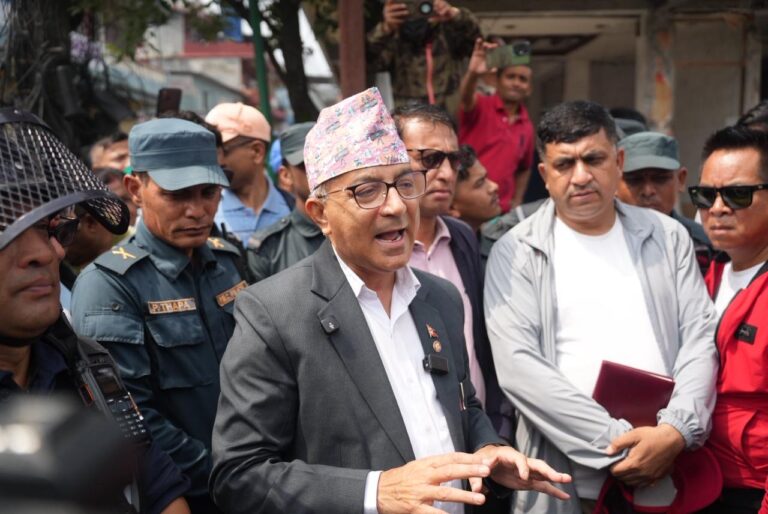
Photo: Mayor of Pokhara Metropolitan City, Dhanraj Acharya
After the study report was released in 2023, the metropolis fixed the Phirke boundary criteria at 6 meters and carried out work to drive demarcation pillars from Andherikuna to Gaighat. This matter eventually reached the court. The metropolis had temporarily halted its work after the Kaski District Court issued an interim order. However, the metropolis moved its work forward after a later court verdict cleared the way.
Apart from individuals and organizations, there are also some landless peoples’ families living in the stream area. Mayor Acharya states that the respective wards are currently managing their relocation.