Kathmandu
Wednesday, July 15, 2026





As changing weather patterns increase risk, disaster preparedness in Koshi Province remains confined only to paper

BIRATNAGAR: At around 11 PM on the night of May 25, 28-year-old Mohammad Zahid of Duhabi Municipality-4, Sunsari, was riding his motorcycle back home from Budhiganga Rural Municipality, Morang. He lost his life after meeting with an accident. The cause of the accident was neither a collision with another vehicle nor an imbalance of the motorcycle. A corrugated zinc sheet blown away by a storm struck the neck of the moving motorcycle rider (Ko 29 Pa 8546). Although the severely injured youth was immediately rushed to Virat Teaching Hospital, doctors could not save him.
On the same night Zahid lost his life, the family of Umesh Jung Chaudhary from Nimuwa, Budhiganga-4, Morang, narrowly escaped the jaws of death. Although the midnight storm caused a loss of Rs 1.5 million when a silk cotton tree crashed onto their house, his family of five managed to save their lives. “Thank God our lives were saved, but now we have no place to take shelter,” said Chaudhary, sharing his grief after taking refuge with relatives.
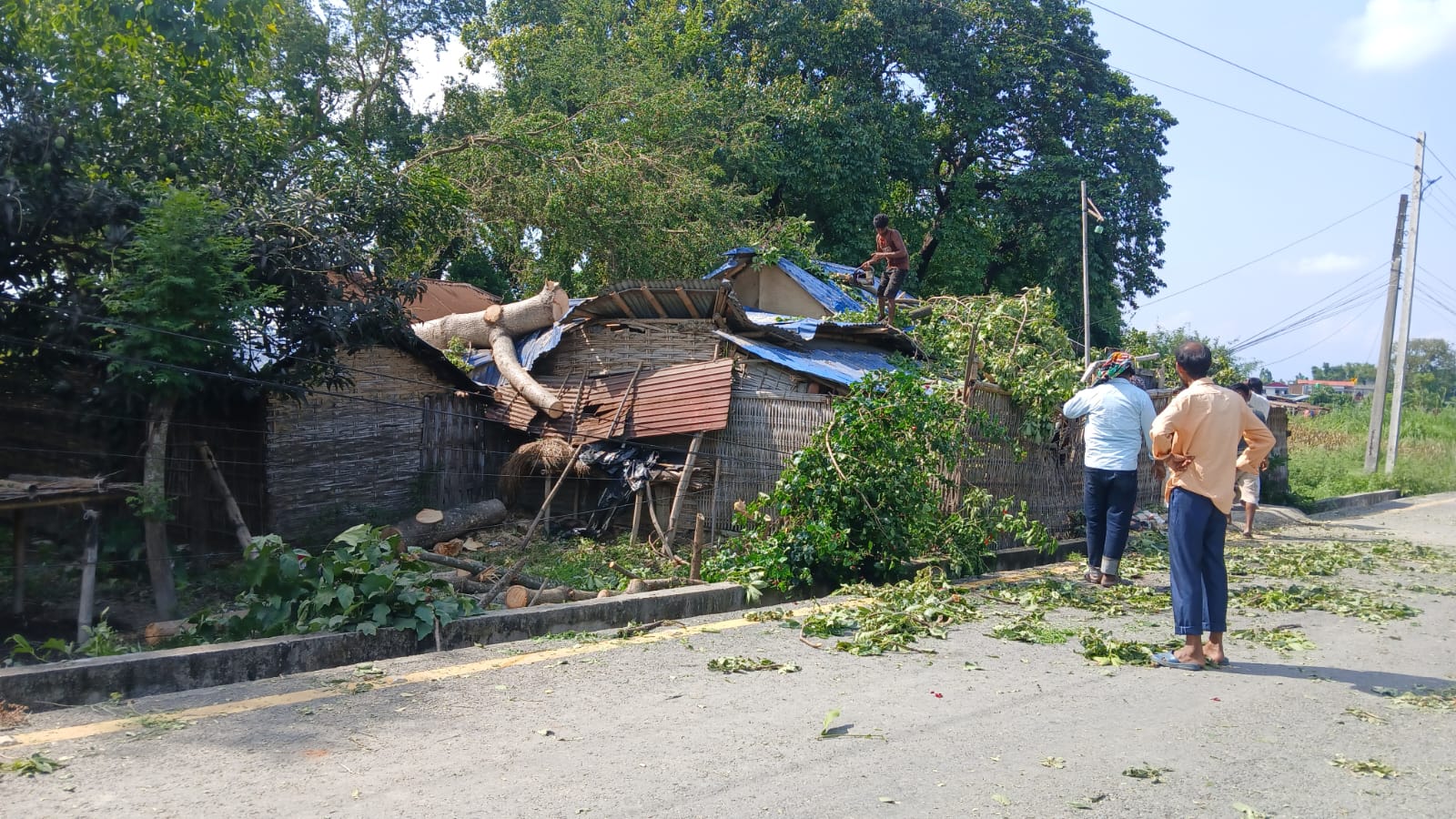
Morang’s Budhiganga Rural Municipality-4, Nimuwa: Damage caused by a tree falling on Umesh Jung Chaudhary’s house during a storm on the night of May 25
These are two representative incidents that show a terrifying picture of disasters brought by extreme or unpredictable weather systems. Due to such altered weather patterns, Nepal has suffered immense loss of life and property in recent decades, and Koshi Province is no exception.
Residents of this province, from the plains to the hills, are living in terror of natural disasters due to the altered weather cycle. They have been continuously affected by weather anomalies such as irregular monsoons due to disrupted rainfall patterns, droughts during winter and monsoon seasons, and cloudbursts—massive rainfall occurring all at once. Problems such as droughts during the prime paddy plantation season or heavy rainfall leading to floods and landslides have badly hit the agricultural sector.
In the past, the months of June, July, and August were considered the main period for floods and landslides. However, in recent years, the timing and nature of rainfall have changed. Different weather anomalies have appeared, such as rainfall becoming highly active during the pre-monsoon period, minimal or no rain during the actual monsoon period, and the delayed withdrawal of the monsoon.
On April 24, the nature of the flood and landslide that struck Yangwarak Rural Municipality in Panchthar created terror among local residents. Despite scorching sunshine throughout the day, the water level in the Kabeli and Tamor rivers suddenly rose at night, throwing normal life out of gear. The flood washed away two houses in Yangwarak Rural Municipality and blocked the Mid-Hill Highway. Not only drinking water and irrigation infrastructures, but also the farmers’ large cardamom plantations were turned into riverbanks.
The impact of the flood also caused damage to hydropower projects. Flooding in the Kabeli and Indrawati streams has completely halted 55 megawatts of electricity generation. Billions of worth of damages occurred when the dams and pipelines of Arun Kabeli (25 MW), Kabeli ‘B-1’ (10 MW), Iwakhola (9.9 MW), and Indrawati (9.7 MW) projects were swept away.
203 deaths in four years
According to the data from the Koshi Province Police Office, Biratnagar, more than 200 people have died in disasters between the fiscal years 2022/23 and May 2026. Provincial police records show that 203 people died and 374 people were injured due to floods, landslides, storms, and lightning during this five-year period.
Among the disaster-related deaths in Koshi Province, those losing their lives to floods and landslides comprise the highest number. During this period, 151 people died and 119 were injured from floods and landslides alone. A total of 14,602 houses were affected by floods and landslides. Similarly, data shows that damages totaling Rs 6.89 billion were incurred across livestock, agriculture, and physical infrastructure.
Similarly, the data mentions that 47 people died and 227 were injured due to lightning strikes. Police records show that five people lost their lives and 28 were injured due to storms.
As the cycle of disasters becomes more terrifying every year, economic losses are rising alongside human casualties. In October of last year, a flood in Ilam that claimed 39 lives caused physical damages worth 12 billion rupees. Likewise, incidents of unexpected rainfall in Miklajung and Phalelung of Panchthar have already displaced numerous families.
Inadequate preparedness
While the risk of disasters is increasing due to the changing nature of the monsoon, the preparedness of government bodies in Koshi Province remains stuck in old patterns. Disaster management committees appear confined only to meetings and formalities. The development of early warning systems, the relocation of high-risk settlements, and mechanisms for immediate relief delivery have not yet become effective.
During a meeting of the Koshi Provincial Assembly on May 25, Member of Provincial Parliament (MP) Maiya Shrestha from Panchthar raised questions about the government’s apathy toward risk reduction and response (search, rescue, and relief) under disaster management. “The government is sleeping through disaster management without any prior preparation,” she said. “The government must not limit itself to declaring relief but must reach the doorsteps of those affected.” She added that rainfall and storms causing such massive damage as early as May are a direct impact of climate change.
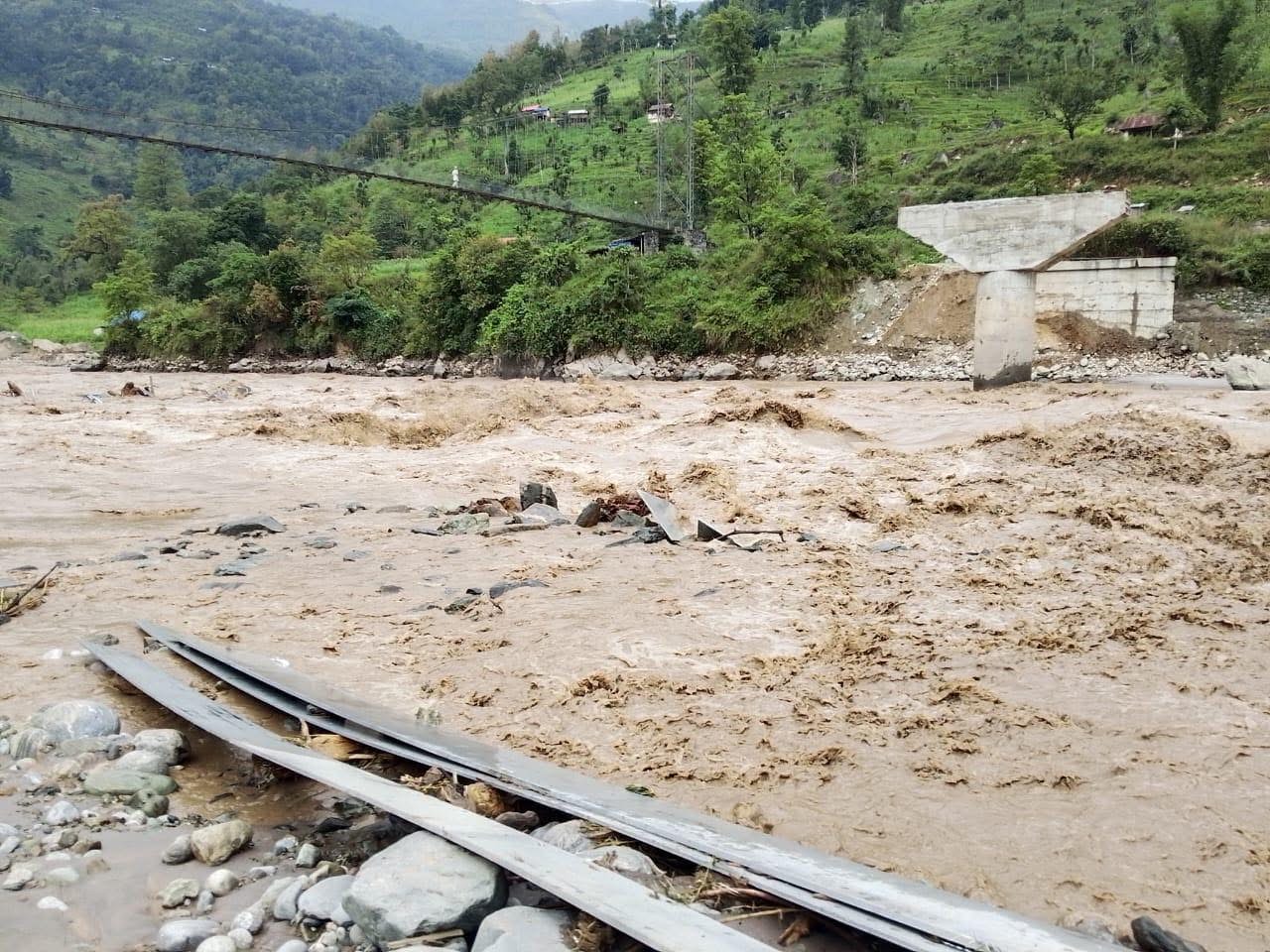
Damage caused by floods and landslides in Panchthar
This destructive rainfall, which fails to arrive on time but sweeps away everything when it does, appears set to bring an even greater crisis in the coming days. Speaking in the provincial assembly on the same day, May 25, MP Kamal Prasad Jabegu from Panchthar stated that if government bodies do not create timely preparedness and concrete plans for risk reduction, the trend of innocent citizens losing their lives in vain will not stop. “25,436 square meters (Fifty ropanis) of paddy fields in Sigdeltar turned into a riverbed, and bridges under construction were swept away. The government must immediately focus on relief and road repairs,” he said.
The provincial government, which has failed to work on preparedness to reduce disaster risks, appears focused on post-incident relief and management. In the event of a death due to a disaster within Koshi Province, the provincial government provides Rs 100,000 as relief to the victim’s family. If other members of the same family lose their lives, an arrangement has been made to provide additional relief at the rate of Rs 50,000 per person. This relief amount is separate from what is provided by the federal government.
When searching for missing persons during monsoon-induced disasters, if they are not found within the timeframe stipulated by the Government of Nepal, the amount is provided to the closest legal heir of the immediate family based on the recommendation of the respective local level and police reports. Similarly, the working procedure mentions that in the event of rental housing or residences being destroyed by a disaster, temporary accommodation including clothing and utensils will be arranged, and Rs 20,000 will be provided to families with up to five members. For families with more than five members, assistance of Rs 25,000 is specified.

MP Maiya Shrestha speaking at the Koshi Provincial Assembly meeting about the lack of preparedness for disaster prevention
Koshi Province Police Chief, DIG Binod Ghimire, states that all units across the province have been kept on high alert. “Considering the risks of storms and bad weather, we have urged everyone to adopt safety precautions,” he said. “We are also disseminating messages to the general public to stay in safe places and remain alert.” According to Ghimire, management of manpower, necessary training, and the availability of physical resources and equipment have been ensured across all districts of the province.
He adds that the identification and mapping of areas highly vulnerable to potential floods and landslides have been completed. “To immediately move citizens from high-risk areas to safe locations, safe houses have already been identified and managed,” says DIG Ghimire. “For effective rescue operations during disasters, full coordination exists between the Nepal Police, Nepali Army, and the Armed Police Force, and all security agencies deploy in an integrated manner.”
Indra Mani Parajuli, spokesperson for the Koshi Provincial Government and Minister for Internal Affairs and Law, states that the provincial government has already formulated a concrete plan for monsoon-induced disaster management and has commenced work. According to him, preparations are currently underway to visit Ilam and Panchthar to inspect the damage caused by last year’s floods and landslides and to accelerate reconstruction work. “Data has been collected showing that 315 houses were completely destroyed due to floods and landslides in Ilam alone. Agreements and other processes for the reconstruction of those houses will be pushed forward,” he says.
He expresses that coordination among all three levels—federal, provincial, and local—is essential for disaster management. “Even though certain tasks are handled by local levels and massive reconstruction work is carried out by the federal government, the provincial government is working effectively within its defined responsibilities and jurisdiction,” he concludes.