Kathmandu
Tuesday, July 28, 2026





In an interview with Nepal News, former Foreign Secretary Madhu Raman Acharya discusses Prime Minister Balendra Shah's diplomatic approach, ambassadorial appointments, relations with India and China, and why Nepal cannot afford to neglect international engagement despite focusing on domestic priorities.
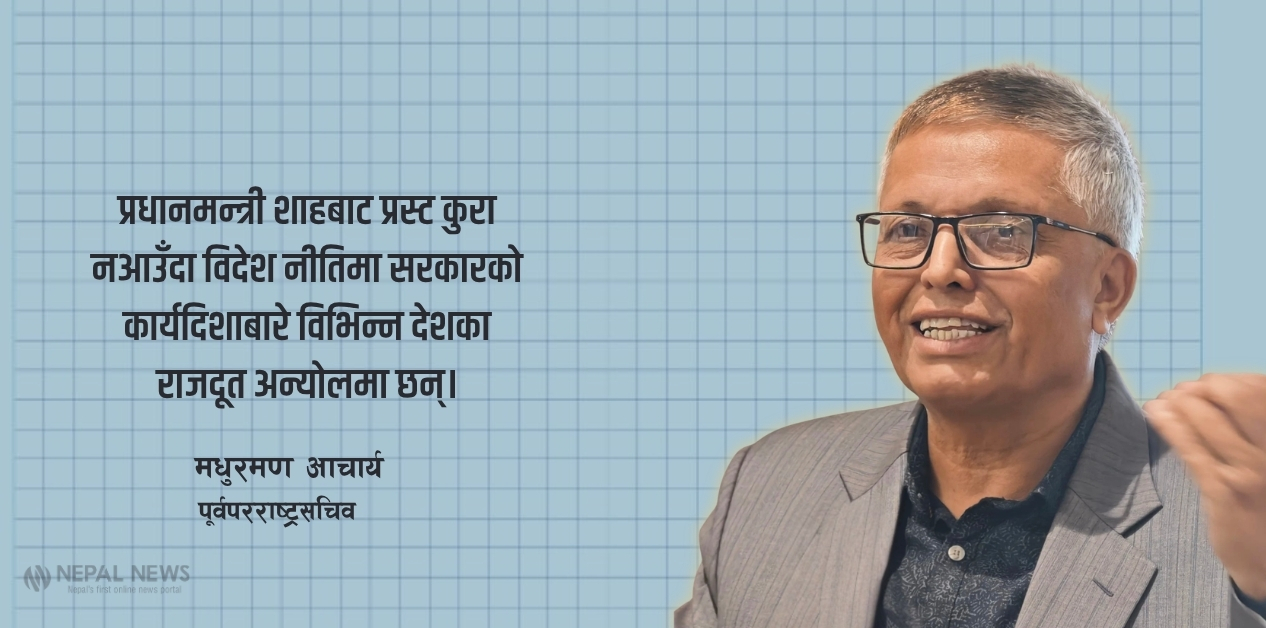
KATHMANDU: Madhu Raman Acharya is a former Foreign Secretary. Having served as the Nepali Ambassador to Bangladesh, Acharya also worked as Nepal’s Permanent Representative to the United Nations. He possesses experience working in UN missions in Iraq, as well as in Cambodia, South Africa, and Liberia.
Mani Dahal spoke with Acharya for Nepal News regarding the impact of Prime Minister Balendra Shah’s statements on boundaries, the ambassadorial appointment process, the diplomatic style of the new government, and its impending effects. The edited excerpts:
The expression spoken by Prime Minister Balendra Shah from the rostrum of the parliament stating “It turns out Nepal has also encroached upon India’s land” became highly controversial. What might be its consequences in the coming days?
I do not think a single address will affect the relationship. Nothing happens merely because news and commentaries appear on the Nepali side in the media claiming that diplomatic relations have been negatively impacted. We must look at how this matter is taken in India. Will the question arise in the Indian Parliament as to ‘what our government is doing while Nepal encroaches on our border’ or not? If the Government of India says, ‘the border has not been encroached, the Prime Minister of Nepal must have spoken about the encroachment of the no-man’s-land area,’ then it ends right there. However, if statements emerge claiming that encroachment has occurred in specific places, it will yield a different result. It seems to me that the Prime Minister spoke about the encroachment of the no-man’s-land.
According to you, does India’s Parliament hold the main significance for India to form a concrete stance on this matter?
If this matter is not raised in India’s Parliament, it should be understood that India did not take it seriously. If taken seriously, the matter will be raised. Indian media and some analysts did discuss our Prime Minister’s expression quite fiercely. However, it does not seem that they presented the news or commented with a correct understanding.
It also did not seem that the Prime Minister’s speech was understood correctly in Nepal either.
Another thing, out of the 275-member House of Representatives, 182 MPs belong to RSP (Rastriya Swatantra Party) alone. When the Prime Minister stood at the rostrum and stated that Nepal had encroached upon India’s border, the MPs were seen thumping the tables happily. If they are clattering and clapping out of happiness, there is no point in only us worrying too much.
The RSP-led government has been saying that it will keep the conduct of diplomacy separate from politics. What do you have to say on this matter?
In a multi-party system, it is not a sin or a disqualification for a person to be involved in a political party. In our context, there is a belief that everyone involved in another party is unqualified, while those in one’s own party are qualified, and that all work done by others is wrong, but the same thing becomes right when done by oneself. It does not work that way.
What is said in diplomacy is that whoever comes to power only does as much as they can. The international situation, our geopolitical location, and historical facts have not changed. In such a situation, what the government can do in diplomacy is merely change its priorities regarding which issues to push forward. Changing diplomacy altogether does not arise. They have also stated they will not do so. Foreign Minister Shisir Khanal has also mentioned that we will be guided by the principles of the Constitution. It is just as the Minister stated. I do not think the government will do anything going beyond that.
The government, for the first time, called for open applications to appoint ambassadors; is this appropriate or not?
I have been saying this in a slightly humorous style. The advertisement made for ambassadors is of a category that says ‘hold a passport, do a medical report, wear a tie, know how to speak English, hold a certificate of some skill, and submit an application for labor approval’ to go for foreign employment. When applications are requested this way, only those who possess that specific kind of qualification will apply. Truly expert and distinguished individuals will not apply.
An ambassador is a position that represents the country. Countries like America and Britain form a ‘Search Committee’ for appointing ambassadors. In our case too, instead of requesting applications, it would have been better if a search committee had been formed. However, calling for applications through an actual advertisement is our first practice. Thinking positively, let us expect that qualified individuals might come forward, and let us hope it inspires young, capable individuals who lack political access to compete. However, I am not that optimistic.
Prime Minister Shah seems to have changed his style regarding meeting foreign diplomats. What kind of result will this bring?
Foreign ambassadors who meet me ask, “Your Prime Minister rarely speaks, his thoughts are not known at all, what could Nepal be thinking regarding its foreign policy?”
In response, I have been saying, “The Foreign Minister has already stated that there will not be such a major change in the fundamental aspects of foreign policy. There could be a change in the working style—you might not get as much access to the Prime Minister as before. The past situation of gaining access right up to the bedroom might not exist. If something arises at the level of the Head of State or Head of Government, you might get to meet. You might meet collectively. The Prime Minister might be of the thought that the Ministry of Foreign Affairs itself looks after diplomatic matters, and I will focus on political and administrative issues.”
Leaving diplomatic matters to the Ministry of Foreign Affairs is not wrong. However, ‘diplomatic engagement’ must be increased. When all power rests with the Prime Minister but it is not known what he is thinking, others do not give importance to or believe the things conveyed through the Foreign Ministry or other mediums. It is not objectionable for the Ministry of Foreign Affairs to look after diplomatic matters; it can be done by the Secretary instead of the Minister, or it can be done from the level of the ambassador. But what the Prime Minister is thinking must be known. To diplomats, he appears a bit mysterious, making it look as though it is difficult to understand his thoughts.
Does the Prime Minister lack good communication skills?
Sher Bahadur Deuba did not speak either, but he used to keep people engaged. Therefore, it is not that one absolutely must speak. One does not have to be extremely eloquent. KP Sharma Oli used to speak more, but Deuba could keep people engaged even without speaking. The point that the Prime Minister is not the one to engage ambassadors is fine, but foreign policy means engaging other parties in our agenda. That is not visible to that extent. When clear matters do not come from the Prime Minister’s level, ambassadors appear confused about what the government’s direction is. Diplomatically, this is not a very good situation.
Rumors also surfaced that the Indian Foreign Secretary’s visit to Kathmandu was halted precisely because the Prime Minister did not give time!
We cannot make assertions merely based on what appears in the media. If the Indian Foreign Secretary did not come because a meeting with the Prime Minister could not take place, then it is indeed a rather difficult matter. Because, the Foreign Secretary could have been coming as a special envoy of the Indian Prime Minister. When coming as an envoy, one must definitely meet the Prime Minister here. It cannot be argued that ‘I will not meet a Secretary.’ In India, a Joint Secretary of the North Division looks after everything regarding Nepal. Briefing to the Secretary happens only occasionally. In some countries, an Under Secretary looks after Nepal. In such scenarios, you look at where your interest lies, not at what level the person belongs to. Protocol must be maintained in diplomacy, but primarily, interest is looked at. The benefit of the country and the self-respect of the citizens are looked at. Previously, when the Foreign Minister of India arrived, former Prime Ministers used to line up to meet him at hotels. In terms of protocol, the Foreign Minister should go to meet a former Prime Minister. But by lining up to meet the Foreign Minister, the public felt that a compromise had been made on the self-respect they deemed necessary to protect.
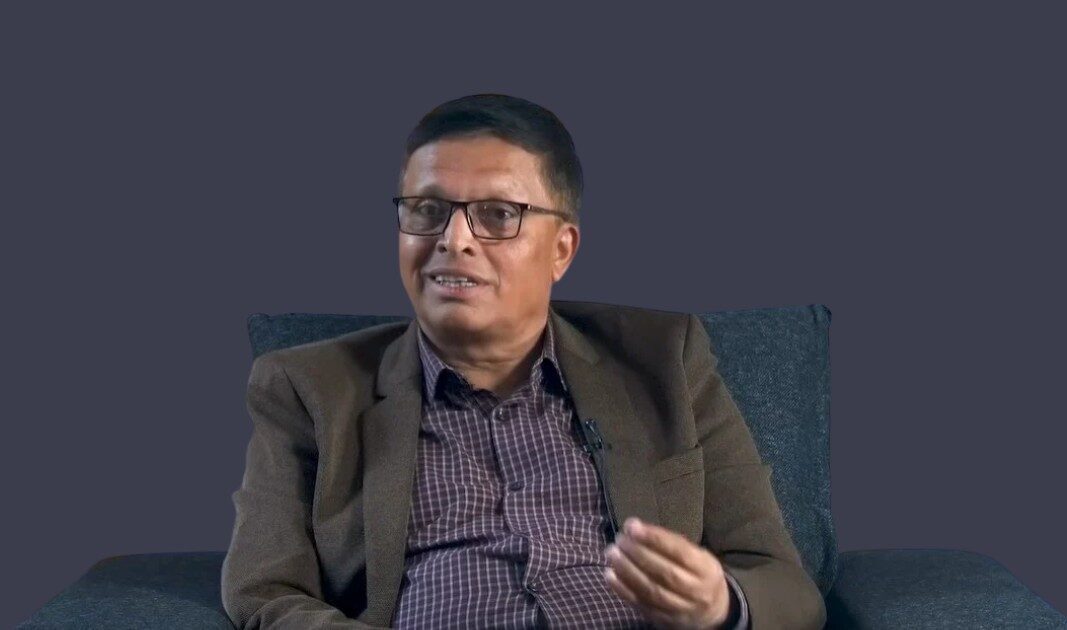
Madhuram Acharya. Photo source: Deshsanchar.com’s YouTube.
Around 90 percent of our engagement in diplomatic relations is with India and China. When there is a powerful government in our country, what is their expectation?
They seem to have given the message that they are ready to work together with a government that has come with a mandate. And they are trying to engage us in that very manner. India and China have sent lower-level officials. Those from America are coming a bit more frequently. Their expectations are also visible from this. However, it remains to be seen how this moves forward.
When there is a strong government, it can take decisions on important matters. In the past, because there was no political consensus in Nepal, attempts are made by those countries with the thought that success can be achieved in some of the pending issues and difficult matters. Talking about India, the extradition treaty has not happened, the border issue has not been settled, and there are matters like submitting the report of the Eminent Persons Group (EPG) and operating the Pokhara and Bhairahawa airports. Various issues remain pending with China as well, such as the non-implementation of the ‘Belt and Road Initiative (BRI)’.
Therefore, powerful nations feel that the right time has now come to talk about these important matters. Traditional powerful nations initially try to dialogue and reach consensus through a strong government. If a strong government fails to deliver, they stir up various factions. The government led by KP Sharma Oli also held nearly a two-thirds majority. The same thing happened then.
Looking from the outside, even when assuming that RSP Chairman Rabi Lamichhane and senior leader as well as Prime Minister Balendra Shah are in the same place till now, they can play within that. It was said that when Arzu Deuba went to India in 2024, Narendra Modi and India welcomed and honored her like a Prime Minister. A different interpretation emerges regarding the photograph of the meeting between Rabi and Modi. ‘Play’ begins to happen in that. Powerful nations do such things circuitously. Its impact can fall here. The approach is to make one weak and accomplish what they desire.
Whether a government is strong or weak, powerful nations try to get their work done by everyone. That is to say, they never miss an opportunity at any time. They try to take advantage even by making the strong weak. If it becomes too weak and they feel it cannot deliver, they also try to remove it from power, concluding that its utility has ended. Our history is exactly that.
What are the things Nepal needs to do for engagement?
First, one’s own plan is required. What do we want from China, India, and other power nations? To create the appropriate external environment for that, the government must do whatever is necessary. Currently, we do not have ambassadors in various countries. The ambassadorial appointment is in the process itself.
The Prime Minister is avoiding foreign visits. Because of that, a sort of vacuum is visible in diplomacy. Foreign Minister Shishir Khanal went to Mauritius. The previous Foreign Minister, Balananda Sharma, went to Bangladesh twice. That was a visit demanded by the situation of the other party, not of Nepal. What did we demand during this interval? There is nothing.
Without clarifying what is intended to be done in external diplomacy, merely advertising for ambassadorial appointments and claiming ‘we are doing this and that, we are making country-specific strategies’ will not suffice. Making country-specific strategies is good, but that alone is not enough. Our foreign policy sector has been facing the problems of lack of staff, weak performance, and low utilization of available resources. Now, there is even talk of reducing the embassies located in various countries. While we have diplomatic relations with 183 countries, there are 30 residential embassies, three permanent missions, and seven consulates general.
Nepal reaps whatever benefits it has to take only through diplomacy. Because, we do not possess ‘hard power’, we do not have a large geography, and our population is small. Weakening diplomacy means weakening the power of Nepal. Finance Minister Swarnim Wagle stated in the budget speech that billions of rupees would be brought from abroad. Securing such massive resources is impossible without economic diplomacy. Loans have to be brought and investments have to be attracted; for that, it cannot be done without using diplomatic channels.
Currently, the government is working from the perspective of regime transformation—removing or improving old things. They made a rupture; the country did need a shock of sorts, that much is fine. However, there has been more emphasis on showmanship. The government is focused on ostentation and garnering applause from the public, but there is no attention at all toward working on issues of long-term impact. Currently, there is a technocratic executive concept in the government from top to bottom. What should actually exist is political diplomacy and an economic concept.
There is talk that Prime Minister Shah will not go on foreign visits for a year; what kind of matter is this?
The Prime Minister can say that he will focus on internal affairs for some time. However, that is not a very practical and objective thing. Because, international conferences take place. In such conferences, there is an opportunity to meet and dialogue with regional and other powers. There are matters of bilateral affairs. Trust grows between leaders through that.
Therefore, if the Prime Minister does not go abroad, the country may lose numerous opportunities. However, it does not seem likely that the issue of not going on visits will stand. Not going on foreign visits and focusing on internal matters for now, focusing on priorities, might be fine. But, 90 percent of Nepal’s issues, from developing the country to fixing the governance, are related to foreign countries. If there are any major problems, they are related to foreign countries. When talking about producing electricity and exporting it, India itself has to be entreated. To increase tourist arrivals, India itself must be approached. If investments are to be brought in massively, India and China themselves must be spoken to. The Finance Minister has stated he will bring loans; that too must be coming from abroad, right? Therefore, it is simply impossible to focus entirely internally without engaging with external parties.
High-level visits to Nepal from India and China have not occurred much, but frequent visits by American officials are taking place. Has American interest increased in Nepal?
There can be two reasons for the increase in high-level visits. One, with the thought that work of one’s own interest can be done at this time on various issues. Second, because problems are numerous and to find solutions. Problems do not seem to be excessive. Therefore, it might have been thought that this is a good opportunity to push some work forward. This is not a strange thing. If a new government is formed, they naturally desire that Nepal pushes their issues forward. The immediate reaction is to send a delegation. Their coming is one thing, but we must look at what we engaged them with. Engagement that is one-sided cannot be called diplomacy at all. They sent representatives, we listened to them—that is fine, but what did we do from our side? That becomes important.
Finally, the balance of power seems to have changed after the war in West Asia. What kind of effects does this have on us?
This brings two types of effects on us.
First, in the immediate term, we have already experienced its ‘side effects’. It affected the supply chain. The price of petroleum products increased. Remittances will be affected. Inconvenience was caused to travel. Obstacles will emerge in the environment of receiving grants to investments. The diplomatic impact this has on us could be long-term. However, adequate preparation for that does not seem to have been made. The mindset is at a level that this is nothing and will end in a few days. The Ministry of Foreign Affairs holds a press conference every day and appears limited to stating the status of Nepalis. Under the current adverse situation, I have not seen the government working on what we should do and where the tension in West Asia affects us.
When this happens, the question also arises as to whose side the country will take in the global power equation. Everyone observes that carefully. For example, a proposal against Iran on behalf of the Gulf countries had gone to the United Nations. We did not cast a vote in favor of the Gulf countries’ proposal. Others keep watching such things. Countries like America might think that we share a friendly relationship with Nepal, a ‘logistics base’ can be kept there, and it might be possible to keep planes at the airport for a couple of days. They try to seek support and cooperation. The same had happened previously as well. When talking about attacking Afghanistan, America had proposed an agreement (SOFA—Status of Forces Agreement) with Nepal. It had requested to allow keeping a ‘logistics base’. But, we did not grant it. If the fight elongates, they start seeking this kind of support.
The second effect is diplomatic influence. Diplomatic activity changes. When that happens, the problem of whose side to take arises. Neutrality is also not that easy. Even abstaining from voting amounts to supporting someone. When voting took place in the United Nations on the issue of Russia’s attack against Ukraine, India and China abstained. Russia received assistance through that.