Kathmandu
Monday, July 27, 2026





Tribhuvan University Service Commission left leaderless; promotions and permanent appointments of 1,350 professors and staff left in limbo
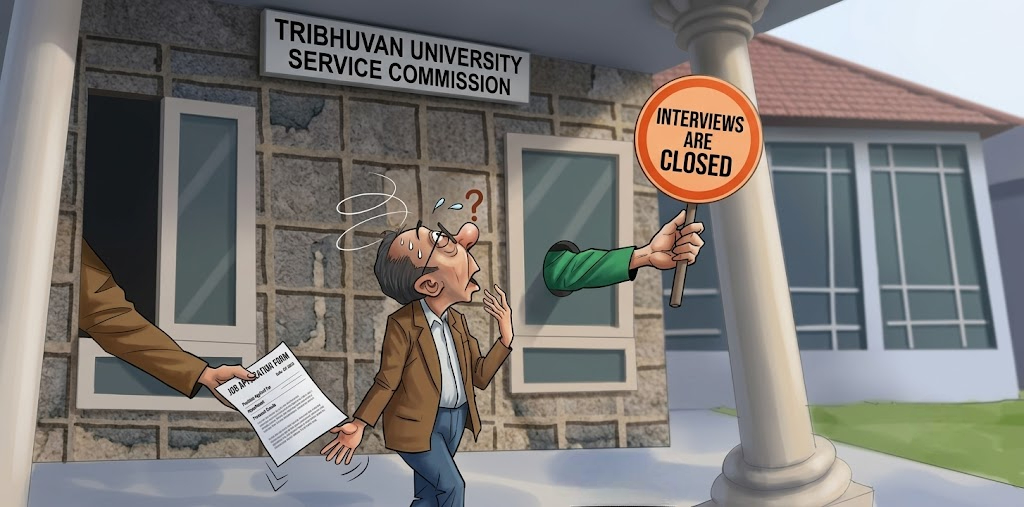
KATHMANDU – Chhabilal Chidi has been teaching at Tribhuvan University (TU) for 25 years. Currently an Assistant Professor at the Central Department of Geography, his sole remaining aspiration is to be promoted to full Professor before he retires. Nearing the mandatory retirement age of 63, he is scheduled to retire on October 5, 2026. He had been waiting for his promotion interview, but a sudden postponement of the scheduled interviews has left him in a state of deep uncertainty. Because the government remains indecisive about when to appoint new officials to the Commission, the career progression of Chidi and hundreds of other faculty members and administrative staff has hit a dead end.
The interviews were abruptly halted after the government issued an ordinance on May 2, 2026, removing the sitting officials of the TU Service Commission, including its chairman, Ghanshyam Bhattarai. This move shattered Assistant Professor Chidi’s long-cherished dream of becoming a Professor. “There were only 10 days left for my turn, which was scheduled for May 11, when the interviews were called off,” Chidi lamented. “After serving TU for so many years, I wished to retire with the dignity of a Professor. Look how it has turned out!”
Chidi began his teaching journey at TU as a volunteer in 2001. He was appointed on a contract basis in 2005 and secured a permanent position as an Assistant Professor in 2011. With only four months left before his mandatory retirement, he fears his lifelong dream will remain unfulfilled.
Public body officials across the country, including those at the TU Service Commission, were automatically dismissed after President Ram Chandra Paudel issued the ‘Special Provisions on the Dismissal of Public Officials Ordinance, 2026’ on the recommendation of the Council of Ministers. Consequently, the regular operations of the Service Commission have ground to a halt. The suspension of promotions and permanent appointments has deprived Chidi and countless others of their professional advancement. Those on the verge of mandatory retirement face losing out on both the prestigious titles and the corresponding financial benefits. “Even if a new leadership takes charge now, the process will take time, which heavily impacts those of us who are about to retire,” Chidi added.
According to Bishnu Prasad Aryal, the Administrative Chief of the TU Service Commission, around 1,350 professors and non-teaching staff in line for promotions and permanent appointments have been affected by the suspension. This includes roughly 200 Associate Professors and Assistant Professors waiting for career progression. Some have even reached retirement age while waiting. For instance, Yagya Ratha Khadka, an Assistant Professor at Patan Campus, reached his mandatory retirement last week while still waiting for his interview date to be announced.
Meanwhile, Shivakumar Sapkota, Joint Secretary and Spokesperson for the Ministry of Education, Science, and Technology, stated that the professors and staff retiring right on the verge of promotion have become “victims of circumstance.” He remarked, “They have faced a genuine grievance. While it is tragic, they have no option but to endure it.”
Risks of lost opportunities
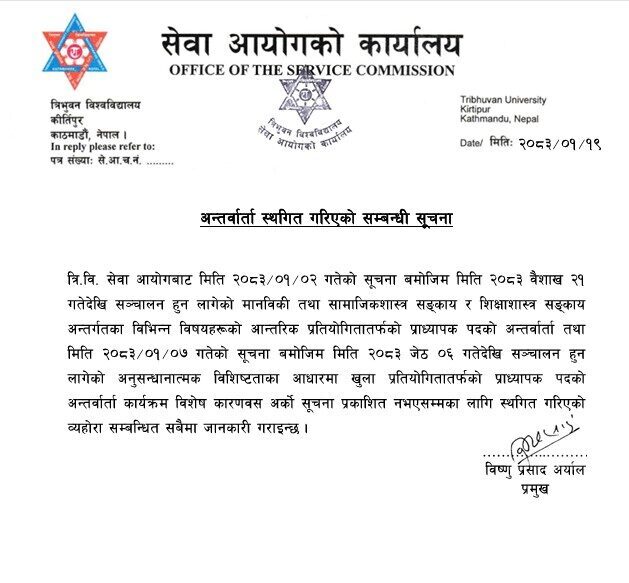
Left without leadership, the TU Service Commission issued a notice on May 1, 2026, postponing the internal competition interviews for the Faculty of Humanities and Social Sciences and the Faculty of Education until further notice. Administrative Chief Aryal shared that the internal promotion interviews for these faculties were scheduled from May 4 to May 18, while the open-category interviews—incorporating external foreign experts—were slated for May 20 to May 25.
Interviews for seven other faculties outside of Humanities and Education had already been completed. The Service Commission had planned to wrap up internal interviews across all faculties before commencing the open recruitment interviews. Aryal explained that they were forced to halt the entire process midway after the government sacked the Commission’s leadership. “We cannot move an inch without the executive officials in place,” he stated.
Kundan Aryal, an Associate Professor at TU’s Central Department of Journalism and Mass Communication, estimated that around 4,400 applicants competing for 1,300 vacant and promotional seats have been affected. “This crisis erupted because the government abruptly vacated the leadership through an ordinance. Around 4,400 of us are currently stranded waiting for interviews,” he said. “In the meantime, several peers have already retired.” He added that delays in receiving professorial status have resulted in substantial professional and financial losses.
A month has passed since the government dismissed the officials, yet no steps have been taken to appoint new leadership.
This has escalated anxiety among those awaiting appointments. Associate Professor Mrigendra Bahadur Karki, who also serves as the Executive Director of the Centre for Nepal and Asian Studies (CNAS) under TU, expressed his frustration: “Many of our peers gave their interviews earlier and have already become Professors. Because our sessions were canceled, we are just stuck waiting indefinitely.”
According to Krishna Hari Acharya, Chief of TU’s Personnel Administration Division, the university employs roughly 16,000 professors, teachers, and staff across the country. Among them, 7,966 are academic faculty. The permanent academic workforce consists of 566 Professors, 2,206 Associate Professors, 3,060 Assistant Professors, and 4 Teaching Assistants. In the current fiscal year 2026/27, a total of 104 academics are set for mandatory retirement, including 25 Professors, 48 Associate Professors, and 31 Assistant Professors.
As Nepal’s oldest university, TU is recognized as the country’s primary cradle of knowledge. However, it frequently faces criticism for failing to maintain an organized workspace and a quality academic environment—a problem deeply tied to its recruitment and promotion system. Faculty and staff have long been frustrated by bureaucratic delays; the Service Commission routinely goes years without opening vacancies, delays exams when vacancies are announced, and halts interviews even after written exams are cleared. This systemic lethargy has routinely disrupted lectures, academic calendars, and exam result publications.
Acharya admitted that suspending the promotion and permanent appointment processes has created severe challenges in human resource management. “TU regulations mandate that vacancies be announced every year. This time, applications were opened after a five-year gap, but the suspension of interviews has put everyone in a tough spot,” he said. Outlying constituent campuses have already begun reporting acute shortages of professors and teachers. “Since permanent quotas were technically opened, we are restricted from hiring temporary contract staff. On the flip side, the results of those who sat for the permanent exams cannot be published,” Acharya added.
Associate Professor Karki had initially felt optimistic when recruitment for around 1,350 positions opened up after a five-year hiatus. “Previously, the Service Commission created an imbalance by denying quotas where needed, and over-allocating where they weren’t,” he noted. “When applications finally opened across all faculties after five years, it felt like a golden opportunity. But the moment the Commission was left leaderless, the interviews vanished.”
Karki had met the criteria to compete for a professorship back in 2020 when applications opened. At that time, there was only one quota available for the Faculty of Sociology. There were three contenders, and Karki stepped back as he was the junior-most applicant. Of the other two contenders who missed out back then, one has already retired. Today, Karki is the sole contender for that single seat. With the interview process abandoned, his highly probable promotion has been thrown into complete jeopardy. “Delaying the process breeds severe demoralization, and that is exactly what is happening,” he said.
Karki has served TU for 28 years, 14 of those as an Associate Professor. He argued that if the government only focuses on logistics like textbooks, timely exams, and results while ignoring the dignity and career progression of the faculty, the desired standard of education will never be met.
“There is zero investment in the educators. Even if the Service Commission announces vacancies, exams are never held on time. This is precisely why our educators are forced to migrate abroad,” he stated.
Another Associate Professor, speaking on condition of anonymity, blamed the government for ruining a rare opportunity by decapitating the Commission without setting up a transitional mechanism. “This is gross negligence on the part of the government and a complete betrayal of the faculty,” he said. “Educators dedicate decades of service, but when the time comes for promotions, the Service Commission is intentionally crippled into paralysis. We are facing sheer injustice.”
Renowned educationist and former Vice-Chancellor of TU, Kedar Bhakta Mathema, argued that the university should have maintained regular operations by appointing an acting chairperson. “Conducting exams and publishing results for professors and staff are routine administrative tasks of the Service Commission. They should not stop. The government should have appointed an acting head to keep the wheels turning,” Mathema insisted.
Mathema warned that blocking the career growth of educators will yield disastrous consequences for higher education. “This is an extremely sensitive matter,” he said. “People might wait if they believe the government is genuinely pursuing reforms, but you cannot choke regular career progression and penalize your teachers and staff in the process.”
Ministry of Education Spokesperson Shivakumar Sapkota clarified that because the law makes no provision for an “acting” chief within the Service Commission, the university has no choice but to wait for a full executive appointment. Section 15 of the Tribhuvan University Act, 1992, dictates that the recruitment and promotion of university staff require a three-member committee, including the Chairman of the Service Commission. It specifies a three-year tenure for the officials appointed by the Prime Minister (who serves as the Chancellor), but remains completely silent on an alternative or transitional leadership structure.
Sapkota acknowledged the immense hardship faced by retiring professors but noted that there is no mechanism for financial compensation. “As far as I am aware, there is no precedent for providing compensation in such scenarios. However, if the Commission is granted special discretionary powers once it is fully formed, it might be looked into.”
The Ministry of Education has indicated that it will proceed with appointments to the Service Commission only after filling the vacant post of TU Vice-Chancellor. Following a public call for applications for the Vice-Chancellor position, the recommendation committee approved 43 applications on May 27, 2026. The government is expected to appoint the new Vice-Chancellor from this pool after completing the remaining vetting procedures.