Kathmandu
Monday, June 22, 2026





A shrinking agriculture budget, a fertilizer bill that swallows nearly seven of every ten rupees set aside for farming, and a few hundred million rupees for organic alternatives expose a policy that still treats imported chemical inputs as the default and domestic, soil friendly options as an afterthought.
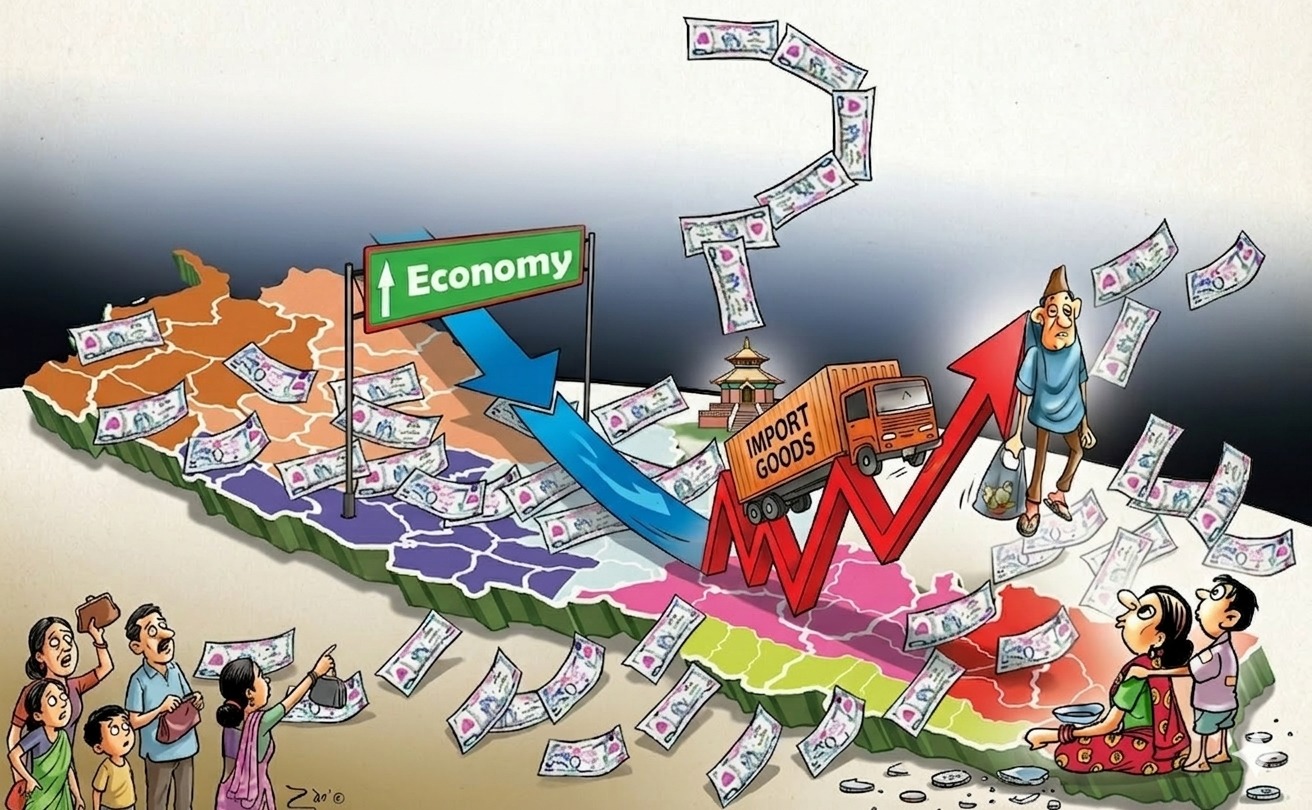
KATHMANDU: Every year around budget season, Nepal’s finance minister stands before parliament and promises that this will be the year agriculture finally gets the attention it deserves. Every year, the actual numbers tell a narrower story: a sector that feeds and employs the majority of the country keeps losing ground in the national budget even as the bill for imported chemical fertilizer keeps climbing.
The budget for fiscal year 2026/27 repeats this pattern almost exactly. The Ministry of Agriculture and Livestock Development received Rs 46.92 billion for the coming year, down from Rs 57.48 billion the previous year, a cut of roughly Rs 10.5 billion, even though the new coalition government had set expectations that agriculture, a sector it had repeatedly called central to its economic revival plan, would see its allocation grow rather than shrink.
Within that smaller pool of money, the government still found room to raise the chemical fertilizer budget to Rs 32.46 billion, an increase from the Rs 28.82 billion allocated the year before. The arithmetic is simple and damning: fertilizer imports now account for close to seven out of every ten rupees the state spends on agriculture, while organic and green fertilizer promotion was handed roughly Rs 360 million, a figure so small relative to the fertilizer budget that it barely registers as a rounding error.
This is not a new contradiction, but it has become a starker one. For more than a decade, Nepal’s agriculture budget has followed a familiar pattern of headline increases to the fertilizer line alongside stagnant or shrinking allocations everywhere else, from research stations to extension services to the long promised but never built domestic fertilizer factory.
What makes the current budget worth examining closely is the gap between expectation and delivery. A new government took office promising a productivity led transformation of farming, language that suggested a decisive break from decades of subsidy heavy, output light agricultural policy. Instead, the sector’s total allocation fell, insurance subsidies were trimmed, livestock disease control remained badly underfunded, and the chemical fertilizer share of the budget grew larger rather than smaller. None of this happened quietly or without prior warning.
The Auditor General’s office has spent years documenting, fiscal year after fiscal year, that the nearly two hundred billion rupees Nepal has poured into agricultural subsidies over the past decade has not produced a matching rise in farm output, a finding detailed in this publication’s earlier explainer on the decade long subsidy bill now under formal government investigation. The new budget numbers suggest that warning has yet to change the underlying spending logic in any meaningful way.
Office of the Auditor General
Why the fertilizer bias persists
The preference for chemical fertilizer over organic and domestic alternatives is not simply inertia. It reflects a set of institutional incentives that make imported fertilizer the easiest, most politically convenient option for any government to fund, regardless of which party or coalition is in power. Chemical fertilizer procurement runs through two established, state linked entities, the Agricultural Inputs Company and the Salt Trading Corporation, which between them have handled the import and distribution of subsidized fertilizer for years.
Bulk procurement through two known channels is administratively simple. A finance ministry official can announce a single, large allocation, sign off on a handful of import contracts, and report visible progress within a single budget cycle. Organic fertilizer promotion, by contrast, requires building entirely different infrastructure: composting facilities, manure collection and processing systems, farmer training programs, certification mechanisms, and distribution networks that do not yet exist at scale in most of the country.
There is no equivalent two company shortcut for organic inputs, which means building that capacity requires years of unglamorous groundwork rather than a single budget line that can be announced with a large number attached to it.
Politics reinforces the bureaucratic convenience. Fertilizer shortages during the planting season are immediate, visible, and easy for farmers to blame on the government, which makes fertilizer subsidies one of the most electorally sensitive line items any agriculture minister manages. A minister who cuts the fertilizer budget risks farmers queuing outside depots and television crews filming empty fertilizer godowns within weeks.
A minister who underfunds organic fertilizer development faces no equivalent immediate backlash, because the absence of an organic input ecosystem has never been built into farmers’ expectations of what the state owes them in the first place. This asymmetry in political cost explains why, even when a new coalition signals a productivity focused agenda, the actual budget still defaults to the same chemical fertilizer first structure that every government before it has used.
Nepal’s own Ministry of Agriculture has acknowledged that domestic chemical fertilizer demand runs between roughly 700,000 and 800,000 metric tons a year, while the state has typically been able to supply subsidized fertilizer for somewhere between 550,000 and 600,000 metric tons, leaving a persistent shortfall that fuels public pressure to spend more on imports rather than questioning the import dependent model itself.
The ministry has separately put the value of Nepal’s annual chemical fertilizer imports at around Rs 40 billion, a figure that captures the scale of foreign exchange leaving the country every year for an input that domestic organic alternatives could partially replace.
The numbers behind the imbalance
Looking closely at where the Rs 46.92 billion sectoral allocation actually goes makes the imbalance harder to miss. Chemical fertilizer alone takes Rs 32.46 billion, or close to 70 percent of the entire agriculture and livestock budget for the year. That leaves roughly Rs 14.5 billion to cover every other function the ministry is responsible for, including agricultural research, the extension services that are supposed to bring new techniques to farmers, irrigation related coordination, livestock disease control, agricultural insurance subsidies, the national farmer identification and registration drive, and the various grant and incentive schemes meant to encourage commercial farming.
Spread across all of those competing priorities, the remaining money cannot do much. Livestock disease control, covering threats such as foot and mouth disease that can wipe out a herd and a farming household’s income within days, received Rs 240 million for the entire country, a figure that veterinary officials and livestock associations have long argued is inadequate given the size of Nepal’s cattle, buffalo, goat and poultry populations and the recurring outbreaks the country has faced.
Crop and livestock insurance premium subsidies, the mechanism meant to protect farmers from exactly the kind of climate and disease shocks that are becoming more frequent, were allocated Rs 2.19 billion, down from roughly Rs 2.3 billion the previous year, even as insurance officials and farmer advocates have pushed for expansion rather than contraction of a scheme that already reaches only a small fraction of the country’s farming households.
The organic and green fertilizer allocation of Rs 360 million has to be understood against this backdrop. It is structured as a conditional grant that the federal government transfers to local governments specifically to promote organic and green manure use, which on paper signals at least some recognition that soil health and chemical dependence are problems worth addressing. In practice, Rs 360 million distributed across more than seven hundred local governments translates into an amount per municipality too small to fund anything beyond token awareness programs or a handful of demonstration plots.
Compare that to the roughly Rs 32 billion fertilizer allocation, and the ratio tells its own story: for roughly every one rupee the state commits to organic fertilizer promotion, it commits about ninety rupees to importing chemical fertilizer. A budget that genuinely intended to shift Nepal’s farming away from import dependence over the medium term would need that ratio to move by an order of magnitude, not stay frozen at a level where organic promotion functions as a symbolic gesture rather than a serious alternative pathway.
The green urea promise and its limits
The one genuinely new idea in this year’s fertilizer policy is the plan to develop a so called green urea industry through a company model involving the Nepal Electricity Authority and private investors, using domestic hydropower to manufacture urea rather than relying entirely on imports. The government has pledged subsidised electricity rates and procurement guarantee agreements to make the venture attractive to private capital.
On its face, this addresses the structural problem that has blocked every previous attempt at a domestic fertilizer factory: Nepal has no natural gas reserves to use as feedstock, but it does have hydropower capacity that, if directed toward fertilizer manufacturing instead of being exported or left underused during wet season surplus periods, could in theory produce urea domestically using an energy intensive electrochemical process rather than the gas based process used in most fertilizer producing countries.
The catch is that green urea, even if it eventually works at scale, remains a chemical fertilizer strategy, not an organic one. It would reduce Nepal’s exposure to global fertilizer price shocks and import logistics bottlenecks, which is a real and valuable goal given how sharply subsidy costs spiked after the COVID-19 pandemic and the disruption to global fertilizer markets following the war in Ukraine.
But it does nothing to address the separate, longer term concern that repeated chemical fertilizer use without matching organic input is gradually degrading soil structure and microbial health in many parts of Nepal’s farmland, a concern that agricultural scientists and soil specialists have raised for years without it translating into proportionate budget action.
A green urea factory, even a successful one, still feeds the same chemical first model; it simply changes where the chemical comes from. Nepal would still be choosing to scale up synthetic nitrogen application rather than building the organic fertilizer, composting, and integrated soil management capacity that several agricultural economists argue is necessary to keep yields rising over the next several decades rather than plateauing as soil quality declines.
The investment plans around green urea are also still in an early stage, with feasibility groundwork and electricity supply arrangements yet to be finalized, meaning any productivity benefit from this initiative is years away even in an optimistic scenario, while the Rs 32 billion in conventional fertilizer imports continues every single year in the meantime.
Why farmers have no reason to switch
Even where organic fertilizer is technically available, Nepali farmers have little economic incentive to choose it over the subsidized chemical alternative. Subsidized urea and other chemical fertilizers, despite well documented shortages and late deliveries, remain by far the cheaper option per unit of nutrient delivered once the roughly seventy percent state subsidy is factored in. Organic alternatives, including farmyard manure, compost, and commercially processed bio fertilizer, generally carry no equivalent state subsidy, require more labor and time to produce or apply effectively, and tend to show their yield benefits only after several growing seasons of sustained use rather than the faster, more visible response chemical fertilizer delivers within a single crop cycle.
For a smallholder farmer operating on thin margins and facing immediate cash flow pressure, the rational short term choice is almost always to use whatever chemical fertilizer can be obtained at the subsidized price, even amid shortages, rather than investing time and money into building an organic input system whose benefits accrue slowly and whose market value is not reflected in any comparable government support scheme.
This is where Nepal’s own livestock sector represents an underused resource hiding in plain sight. The country’s poultry, cattle, buffalo and goat populations generate a continuous supply of manure that, if systematically collected, processed and distributed, could meaningfully substitute for a portion of imported chemical fertilizer, particularly in regions with concentrated livestock farming.
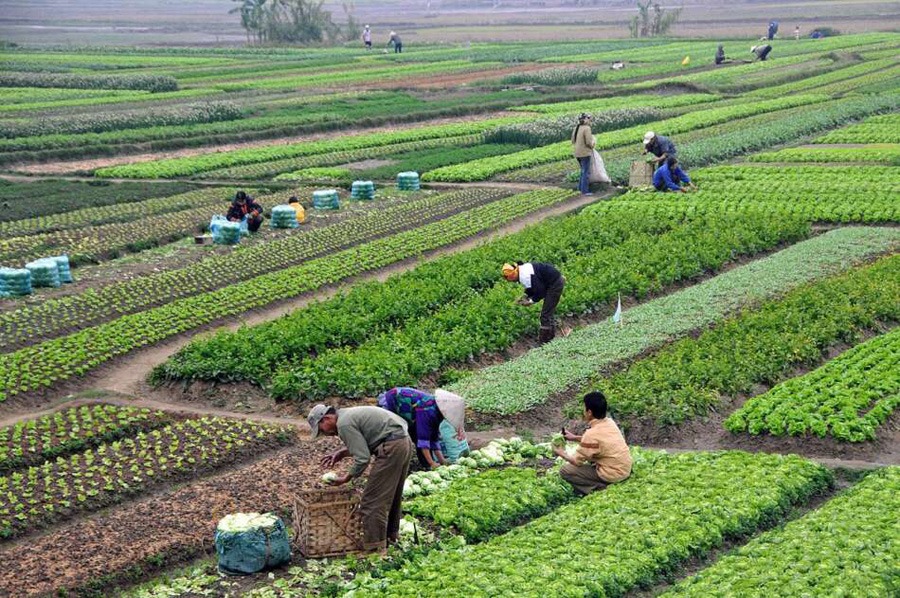
Farmers working meticulously across a patchwork of vibrant vegetable plots in Chitwan. File photo
Industry observers and agricultural researchers have pointed to the volume of manure generated daily by Nepal’s poultry sector alone as evidence that the raw material for a much larger organic fertilizer industry already exists within the country; what is missing is the collection infrastructure, processing capacity, and market incentive structure to turn that raw material into a viable substitute product at the scale fertilizer dependent farmers would need. Without a serious government commitment of the kind currently being extended only to chemical fertilizer and to the still nascent green urea project, that domestic potential will likely keep going to waste while the import bill keeps climbing.
The grant model and who it actually helps
The new investment linked incentive scheme introduced in this year’s budget illustrates a parallel problem in how Nepal designs agricultural support more broadly, even in programs that have nothing directly to do with fertilizer. Under the scheme, farms or farmers investing at least Rs 20 million, the equivalent of roughly two crore rupees, in agricultural or livestock production become eligible for a government subsidy of up to 40 percent of that investment, paid back gradually at a rate of 10 percent annually over four years once production begins.
The structure has clear logic from a fiscal planning perspective: tying the subsidy to actual operational production, rather than disbursing it upfront, is meant to prevent the kind of fund diversion and ghost project problem that has plagued earlier subsidy schemes, including the cases of commission taking and double benefit claims documented in earlier audit findings on the broader subsidy program.
The trouble is the entry threshold. A minimum investment of Rs 20 million is well beyond the reach of the overwhelming majority of Nepali farming households, most of which operate on landholdings smaller than a hectare and have no access to that scale of capital, whether from savings or from formal credit. The scheme is, by design, built for commercial operators, agribusiness companies, and well capitalized entrepreneurs rather than the smallholder cultivators who make up the bulk of the country’s farming population and who are explicitly named as the intended beneficiaries of most other agricultural subsidy programs.
This mirrors a pattern this publication has documented before in the broader subsidy system, where concessional credit and grant schemes nominally designed for small and first time farmers ended up structurally favoring larger, better connected applicants because eligibility thresholds and loan ceilings were set high enough to capture commercial operators alongside or instead of the intended smallholders.
A genuinely productivity focused budget would likely need a tiered structure, with meaningfully lower entry thresholds and smaller subsidy percentages scaled for smallholder investment, alongside the higher threshold commercial tier, rather than a single scheme that effectively excludes most of the farming population from the one new incentive program this year’s budget introduced.
Infrastructure over apps
A further structural weakness in current agricultural policy is the tendency to substitute digital tools for physical infrastructure investment. Recent budgets, including this one, have repeatedly emphasized digital agriculture information systems, farmer identification databases, and technology platforms intended to connect farmers with markets and services. These are not without value, particularly for transparency and for closing the registry gaps that have made subsidy oversight so difficult, as documented in the ongoing investigation into a decade of agricultural subsidy spending.
But digital platforms cannot substitute for the physical market infrastructure that determines whether a harvest actually reaches a paying buyer in usable condition. Nepal continues to suffer from a shortage of organized collection centers near production zones, adequately equipped wholesale vegetable markets, and cold storage or basic warehousing that would allow farmers to hold perishable produce for even a few days without spoilage while they search for a fair price.
Investing in a farmer identification app while leaving the physical collection center and storage gap largely unaddressed risks digitizing inefficiency rather than fixing it. A farmer who has been registered in a national database but still has nowhere nearby to sell tomatoes before they rot has gained very little from that registration.
Analysts who have reviewed the pattern of recent agricultural budgets argue that the balance between digital initiatives and physical market infrastructure spending needs to tilt more decisively toward the latter, since storage and collection capacity directly determines farm gate prices and post harvest losses in a way that an information system, however well designed, cannot.
What the numbers add up to
None of these individual policy choices exist in isolation. Together they describe a budget that talks about productivity and modernization while its actual spending allocations reinforce the same import dependent, chemical fertilizer centered model that has defined Nepali agriculture for decades. A sector that still employs the majority of the population and contributes roughly a quarter of national output received a smaller allocation this year than last, even as expectations for a new government’s agricultural agenda ran high.
Within that smaller pool, fertilizer imports absorbed an even larger share than before, organic alternatives received funding too small to build real capacity, livestock health protection remained underfunded relative to the size of the sector it covers, and insurance subsidies that protect against exactly the climate and disease risks farmers face most acutely were trimmed rather than expanded.
The one new investment incentive introduced this year is built for commercial capital rather than the smallholders who dominate the sector, and the digital tools receiving budget attention cannot substitute for the physical collection, storage and market infrastructure that farmers say they actually need.
This pattern connects directly to the broader credibility problem now facing the government’s newly announced investigation into a decade of agricultural subsidy misuse. A committee tasked with finding out why nearly two hundred billion rupees in subsidies failed to lift farm productivity will eventually have to answer a question this year’s budget makes harder to avoid: if the spending pattern that produced those disappointing results, heavy on imported chemical fertilizer, light on organic alternatives, light on monitoring, and light on smallholder focused incentives, continues largely unchanged in the very budget passed while that investigation is underway, what reason is there to expect the next decade of agricultural spending to produce a different outcome than the last one did.
Until the ratio between what Nepal spends on imported chemical inputs and what it spends on building a domestic, soil sustaining alternative shifts by more than a rounding error, the country’s farmers, and its long term food security, will keep paying the price for a policy preference the budget numbers make impossible to disguise.