Kathmandu
Wednesday, July 8, 2026





Despite aggressive law enforcement efforts to impound smuggling vehicles, rampant blame-shifting among local monitoring agencies ensures that the illegal extraction of sand and gravel continues unabated
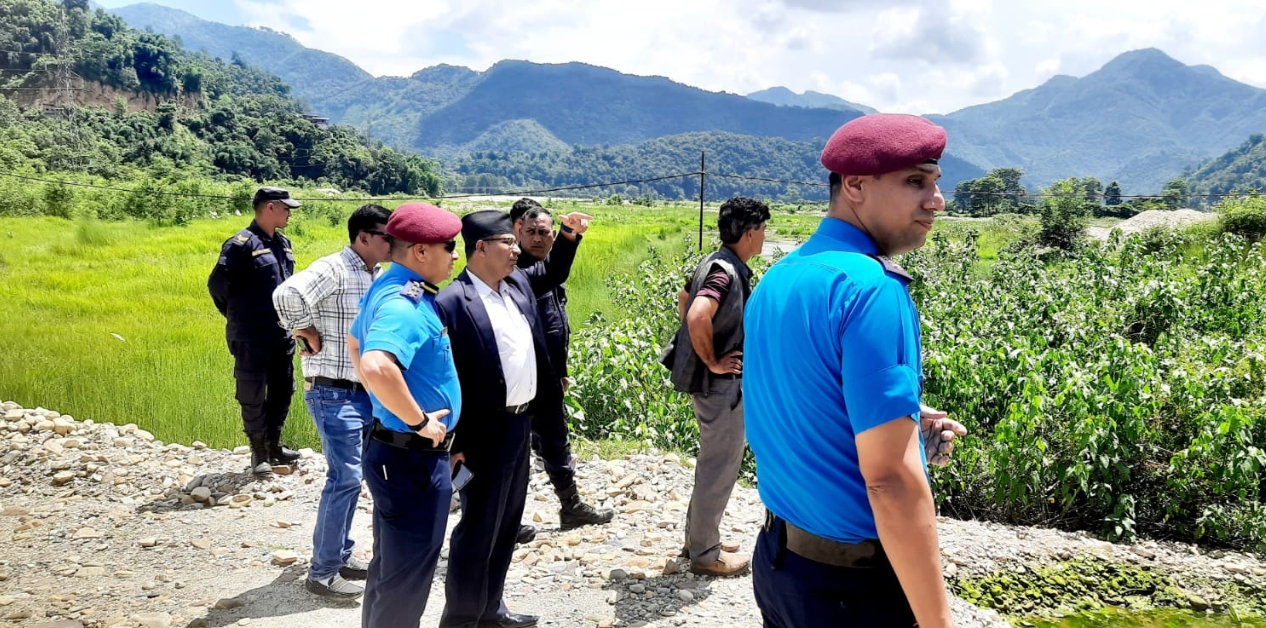
KASKI: On May 5 this year, a police team seized a tipper truck illegally transporting excavated riverbed materials during a routine checkpoint inspection on a secondary road in Gachheni, Shuklagandaki Municipality-2, Tanahun.
On the same evening at around 6 PM, Syangja police took control of a tractor that was excavating grit contrary to the standards from the Andhikhola River located in Putalibazar Municipality-13. Five days later, on May 10, another tractor carrying sand contrary to the standards was taken into control from the banks of the Kaligandaki River located in Chapakot Municipality-9, Nirdimghat.
Although appearing separate, these incidents show a single picture of the illegal excavation of riverbed materials spread across Gandaki Province. According to the Province Police Office Gandaki, by the end of Chaitra of the fiscal year 2025/26, at least 356 vehicles involved in the illegal transport of riverbed materials have been taken into custody from nine districts of the province. The revenue value of the materials taken into control by the police is equivalent to over Rs 6.4 million.
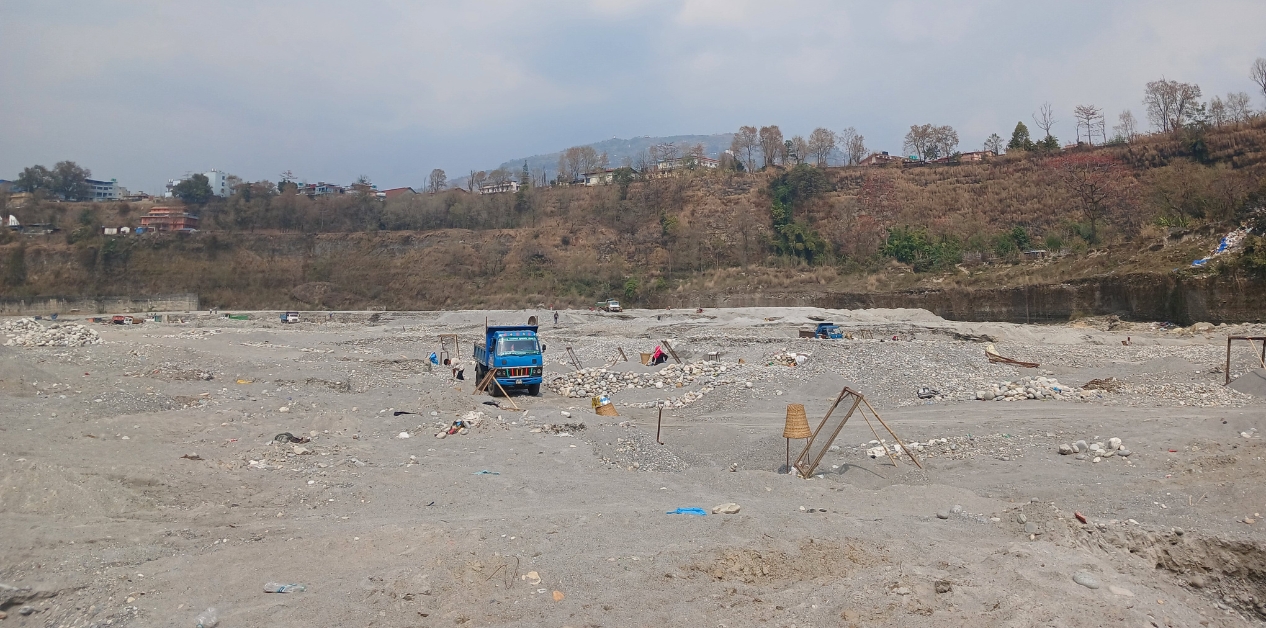
Extraction of riverbed materials in Kaski. Photos: Reena Thapa
Out of that, riverbed materials equivalent to over Rs 2.5 million in Nawalparasi (Bardaghat Susta Purba), over Rs 1.2 million in Tanahun, and over Rs 1.2 million in Syangja have come under control.
Police statistics show that illegal excavation is not a problem of only one district. In the fiscal year 2023/24, at least 399 vehicles had fallen under control across the province. In that year, riverbed materials equivalent to over Rs 5.5 million had come under control. In the fiscal year 2024/25, at least 271 vehicles were taken into control, from which materials equivalent to over Rs 4.5 million were seized.
The Patikhola and Ratikhola rivers, which flow through Modi Rural Municipality-2 and 5 of Parbat, were leased out under contract by the rural municipality last year. However, according to locals, riverbed materials were excavated even by going outside the boundary provided for the contract. Initially, the locals remained silent. But after the excavation began affecting private lands, protest occurred.
At the local level, these incidents usually appear as small disputes. However, police statistics, opposition from locals, and blame games between monitoring bodies show that the problem is deep.
Community backlash over river excavation in Modi
The Patikhola and Ratikhola rivers, which flow through Modi Rural Municipality-2 and 5 of Parbat, were leased out under contract by the rural municipality last year. However, according to locals, riverbed materials were excavated even by going outside the boundary provided for the contract. Initially, the locals remained silent. But after the excavation began affecting private lands, protest occurred.
According to local Prem Chapagain, the excavation contrary to the standards stopped after the opposition. However, he states that the extraction of stones is still not completely stopped by showing private land plots. “The local government unit gave the contract. In the process of digging, they do a bit too much out of greed,” he says, “Protest happened; everything happened. Even now, they have exported some stones, claiming they are of their own landownership certificates.”
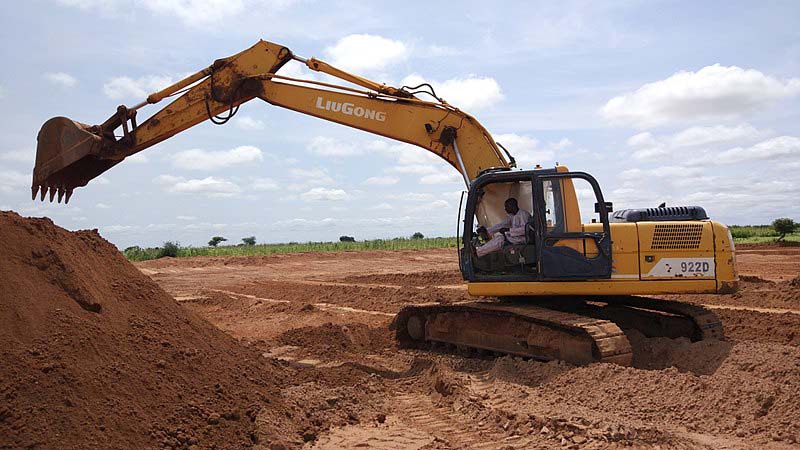
An excavator digs up sand. Representational file photo
Both Patikhola and Ratikhola are flash-flood-prone nature streams. According to locals, changes in the flow have been seen in some places after the excavation. Another local, who did not wish to make their name public, stated that although the contract was for one place, excavation took place in another direction. “We started opposing after the contractor began excavating towards personal land,” he says, “They had started digging by bringing heavy machines. After their area finished, they moved towards the land of individuals.”
The excavation had stopped after the opposition from locals. In the said area that was contracted last year, the rural municipality has not given a contract in the current fiscal year.
Strict Enforcement and Higher Seizures in Nawalparasi
In the incidents of controlling illegal riverbed materials in Gandaki, Nawalparasi (Bardaghat Susta Purba) appears continuously ahead. In the fiscal year 2023/24, at least 105 vehicles were taken into control from Nawalparasi (Bardaghat Susta Purba) alone. In that year, the police had controlled illegal riverbed materials equivalent to over Rs 2.3 million.
In the fiscal year 2024/25, illegal riverbed materials equivalent to over Rs 1.7 million were controlled from Nawalparasi (Bardaghat Susta Purba). Until the end of Chaitra of the current fiscal year as well, the highest amount of materials, equivalent to over Rs 2.5 million, has been taken into control in Nawalparasi (Bardaghat Susta Purba) itself, according to the police.
District Coordination Committee, Nawalpur Vice-Chief Shakuntala Lamsal claims that monitoring is being effective in the district. According to her, after the police take control of materials excavated or transported contrary to agreements, they are handed over to the related local government unit. The local government unit measures such materials and collects revenue.
“After finding out that riverbed materials have been stockpiled through illegal excavation, we coordinate with the local government unit,” Lamsal says, “We go along with a team from the District Monitoring Committee and the local government unit. After the technician measures it, we hand over such material to the local government unit. The revenue is collected by the local government unit itself.”
In Manang and Mustang, which fall under the Annapurna Conservation Area, legal provisions regarding excavation are even stricter. Although three vehicles fell under control from Mustang in the fiscal year 2023/24, no vehicle appears to have been taken into custody from Manang and Mustang in the fiscal year 2024/25, according to police statistics.
From community resistance to lawsuits
In many local government units of Gandaki, the excavation of riverbed materials has become a subject of dispute. In some places, locals have stopped excavation by opposing, while in some places, it has reached disputes, physical assaults, and court cases.
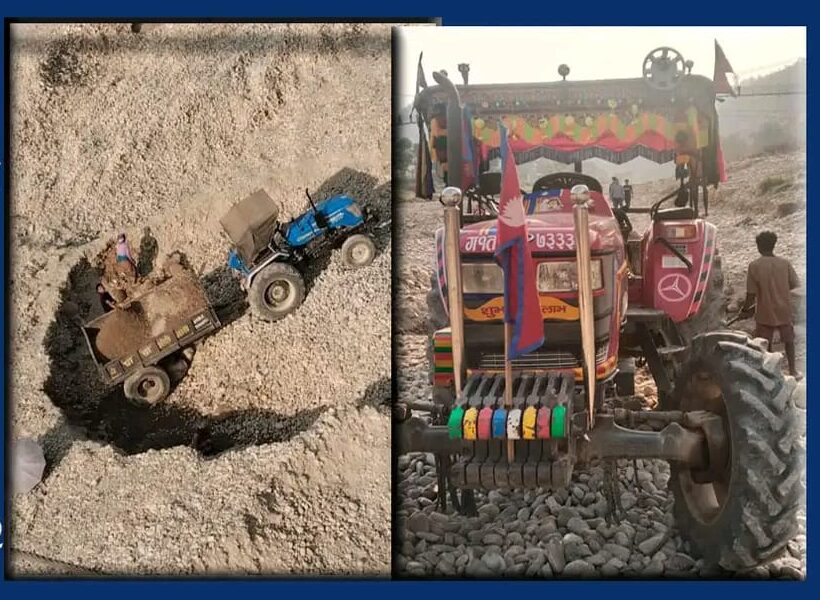
Two tractors impounded by the District Police Office in Waling Municipality, Syangja, after being caught illegally excavating riverbed materials. Photo Courtesy: District Police Office, Syangja
In Waling of Syangja, locals opposed the excavation of sand and gravel taking place in the Andhikhola River. Although there is a standard that riverbed materials cannot be extracted within 500 meters around a bridge, their allegation was that excavation was taking place near the bridge.
On June 17, the Andhikhola Struggle Committee opposed, stating that excavation took place by breaching the standards. On the same issue, Waling Municipality-10 Ward Chairman Sunil Khanal is accused of attacking activist Dinkar Nepal. Following the incident, a case has been registered in court against the ward chairman, but the verdict has not yet arrived.
According to Nepal, the excavation has stopped at the location where the opposition was made. He says, “Excavation had occurred by breaching the stanchions of the bridge. Now, however, it is not being done illegally by using bulldozers like before.”
The said incident has made it clear that the river excavation dispute is not only an environmental issue but is also connected with local governance, contracts, revenue, and citizen security.
Blame game in monitoring
District Coordination Committee, Syangja, Vice Chief Khadak Raj Subedi claims that monitoring has been good in the district. According to him, fines have been slapped on those who excavate contrary to the standards. “The monitoring of stones, gravel, and sand has been quite good in Syangja,” he says, “We have penalized many in places. We have done well.”
However, in Subedi’s own words, the people’s representatives of the local levels themselves are the main challenge. He claims that if the people’s representatives work according to the law, the problem will be resolved to a large extent.
“Due to a shortage of manpower, employees and municipal police cannot conduct daily inspections,” said Deputy-Mayor Khum Bahadur BK of Shuklagandaki Municipality, Tanahun.
“The challenge is the people’s representatives of the local levels themselves,” he says, “If they work easily and according to the law, then stones, gravel, and sand can all be done lawfully. The role of the people’s representatives itself is suspicious.”
However, representatives of local levels say that the monitoring of the District Coordination Committee is not effective. According to Shuklagandaki Municipality Deputy-Mayor Khum Bahadur BK of Tanahun, the problem has increased as the District Coordination Committee does not do sufficient monitoring according to its authority.
“The problem has occurred as the District Coordination Committee does not do effective monitoring,” BK says, “The District Coordination Committee has the authority, but it does not perform adequate monitoring. It leaves it to the local government units.”
According to him, due to contractors having local relationships, political influence, and monitoring not being regular, excavation occurs by going outside the designated area. He states that although the municipality monitors from time to time and makes them pay fines according to rules, the problem has not been able to come fully under control.
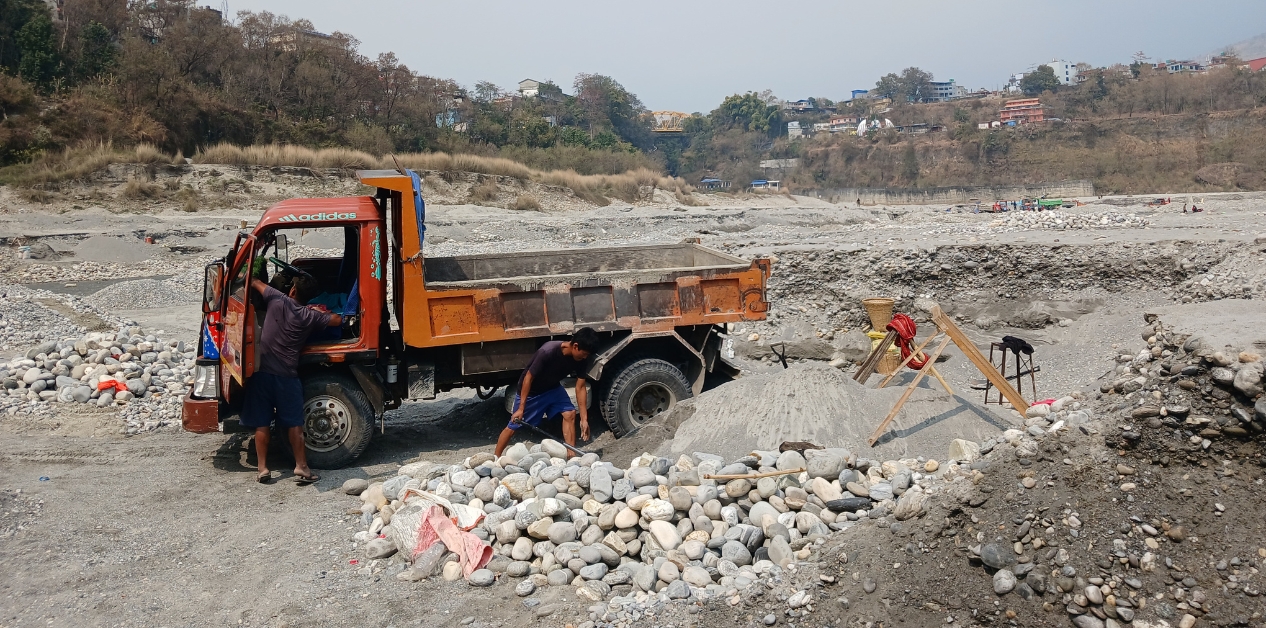
Extraction of riverbed materials. Photos: Reena Thapa
In Tanahun alone, illegal riverbed materials equivalent to over Rs 1.2 million have been taken into custody as of April 13 of the current fiscal year 2025/26. Materials equivalent to Rs 674,000 in the fiscal year 2023/24 and Rs 1 million in the fiscal year 2024/25 had been taken into custody by the police.
“We have given one place to the contractor; they dig further down,” BK says, “Due to a shortage of manpower, employees and municipal police cannot conduct daily inspections. The problem remains of doing a little bit of theft outside the designated area. No matter how much effort is made, it has not been possible to completely stop it.”