Kathmandu
Tuesday, July 28, 2026





From a government delegation to Saudi Arabia in 2005 to today's Gen Z protests, the frustrations of Nepali workers remain strikingly unchanged. Nepal can no longer afford to ignore the human cost of an economy built on exporting its youth.
KATHMANDU: Recently, news broke that on June 30, the Saudi Arabian government granted royal pardons to 33 Nepali citizens serving sentences in various prisons. Saudi Arabia customarily grants royal pardons to prisoners every year, particularly on the occasion of Ramadan.
This incident brought back memories of my visit to Saudi Arabia in 2005. Around 1998, after Kani Sherpa—a woman from Sindhupalchok who had gone abroad for domestic work—passed away, the government imposed a ban on women going to Gulf countries for domestic labor. Despite that restriction, Nepali women continued to go via India or other routes. As a result, an increasing number of those who went through such channels found themselves stranded and reached the Nepali Embassy in Saudi Arabia seeking assistance.
The embassy sent an urgent memorandum to the Ministry of Labor, noting that they were facing severe difficulties in arranging shelter, food, clothing, medical care, and return tickets for these women, adding that some were pregnant and others were suffering from mental health issues. Following discussions, a government delegation was dispatched to Saudi Arabia to address the issue. Having served as a member of the drafting committee for the Foreign Employment Act, I was also part of that delegation. During that trip to understand the situation of the workers, I gained key insights and learned several valuable lessons.
My first lesson came while securing a visa before departure. Because Saudi Arabia did not have an embassy in Nepal at the time, we had to obtain our visas through India. Since the visas had to be processed from India, additional money was flowing out to India.
During a few hours of layover in Doha, we went into a restaurant to grab a snack. There, we met three or four young Nepali brothers working at the establishment. We received a very affectionate welcome.
One of the young men asked, “Sister, how is Nepal right now? Is it still the same, or has it improved at all?”
I smiled and replied, “When all of you young people have come abroad, how can the country improve, brother?”
One of them replied emotionally, “What would we do if we returned to Nepal? There are no jobs. How long can we keep marching in rallies and joining riots? We have to feed our families. We have to pay off our debts. Tell us yourself, sister—when will the government provide employment in Nepal?”
Hearing his answer and counter-question, I was rendered speechless. Even 20 years later, that young man’s question remains just as sharp and relevant.
Once our team arrived in Riyadh, the capital of Saudi Arabia, the embassy arranged a meeting with Nepali workers. There was a mountain of grievances and questions from the workers: they did not get the work they were promised; every death of a worker was conveniently explained away as dying in their sleep; why hasn’t the Nepal government opened consulate offices in major foreign cities; why hasn’t Nepal Airlines operated direct flights; why hasn’t the government educated and prepared young people before sending them off, especially when Nepali youth are dying in road accidents abroad, and so on. One middle-aged man said in deep distress, “Working in such heat, we have turned into dried meat—why doesn’t the government care?”
These questions and complaints drained us.
Addressing the middle-aged man’s frustration, I asked, “There are so many problems here, yet why hasn’t the number of Nepalis coming here decreased? Why are you willing to come back time and again to be turned into dried meat?”
Their response was, “There are problems here, but the good thing is that we can save the money we earn. The chances of falling into bad habits like going to discos or drinking alcohol are lower here. On the other hand, we don’t have to pay income tax. Some have even made significant leaps after coming here. There are people who came as ordinary laborers, took online courses, and became engineers. Some are practicing journalism. Those who come here truly understand the value of their homeland.”
I asked again, “Some of you here have been working for 10 years, some for 12 years. Why do you keep returning here again and again after going home? Until when will you keep coming abroad?”
One person said, “Now, when we go home and stay, the family’s day-and-night nagging becomes irritating. Money is never enough for the family. When we go home, we don’t even find friends in the village. Even if we meet them, we don’t connect like before. That is why, even after reaching home, we end up coming back to this foreign land again and again.”
He raised a point that sounded simple at first, but was profoundly serious. The country has not even reflected on this issue. How do we address those steps that do not just return once or twice, but take the path abroad ten times over after returning home? I realized that if the most productive years of life pass without a plan like this, our brothers will end up nowhere. I became lost in thought about why this situation—where youth cannot stay at home—does not pain the country, and what long-term impact this situation of migrating or being forced to migrate abroad will have on families, society, and the nation. I felt disappointed realizing that we have not done a single thing to break the circumstances that make it impossible for young people to stay at home.
To lighten the heavy atmosphere created by the young man’s complaint, I said in a playful tone, “Is your role at home merely like that of a visiting professor? Does sending a salary once a month fulfill your duties as a parent, husband, son, and citizen?”
However, he gave a blunt reply: “It is the government that should think about this—how to provide employment to its citizens within the country and how to create an environment to live in peace. The fruits of our hard work, sweat, and lives are benefiting the country itself. The remittances we send are sustaining the country’s economy.”
Another person added, “The government doesn’t even have to arrange employment for millions like us. It just ships us off smoothly to another country—how convenient!”
I had no reply.
Nearly two decades later, during last year’s Gen Z protest, the youth of Nepal raised those very same questions: “Should we pay taxes in Nepal and search for jobs abroad?”, “Are documents from Saudi Arabia, Qatar, and the UAE always destined to be on our backs?”, “Your father rides in shiny cars, while our father is in the Gulf?”
In other words, the concerns of the youth remain the same. The compulsion remains unchanged.
For as long as I stayed in Saudi Arabia, a mental conflict raged in my mind and heart between nationalism and pragmatism—what is right and what is wrong. I kept wondering whether the fate of a poor nation is always to send its citizens to labor in foreign lands.
During our visits, the Nepali delegation was scheduled to meet the then-Labor Minister of Saudi Arabia, Ghazi bin Al Abdul Rahman Gosaibi. We presented our concerns to the minister. He drew our attention to the fact that even though Nepal had banned women from going into domestic labor, those coming through unsafe channels were falling into even greater trouble.
I suggested that if the Saudi government opened an embassy in Nepal, it would make things easier for our workers. He replied that if Nepal sent 200,000 domestic workers, they would open an embassy. We also voiced complaints to the minister about the problems and hardships reported by Nepali workers. Presenting a list of reforms Nepal needed to undertake, he explained that most workers faced issues because they arrived without receiving adequate training in Nepal.
Seeing the level of the minister’s knowledge, we later discussed among ourselves that Saudi Arabia had entrusted a truly capable individual with such a sensitive domain as labor. Holding a Ph.D. from the UK in international relations and human resources, he was well-known as a visionary policymaker.
In the course of our meetings, we traveled from Riyadh to Dammam. Since it was Ramadan, one could not even drink water during the day. If someone was seen drinking water inside a car, the police would penalize them. Fearing we would go hungry all day, a fellow Nepali brother had fortunately fed us a full breakfast early in the morning. That meal sustained us through the day.
On the way to Dammam, the scorching heat felt as though seven suns were shining all at once. I wondered how our Nepali brothers managed to work in such an unfavorable place with extreme heat, arid land, and a completely different language, culture, and food. My heart grew heavy. Remembering the contribution of these workers, who were acting as the engine of the country’s economy while working under such hardship, brought tears to my eyes.
Just then, I saw Nepali lettering written on a large truck driving ahead: “Pheri Bhetaula” (Until we meet again). It turned out that most of the truck and lorry drivers there were Nepali. Seeing the Nepali script on a truck brought a simultaneous surge of surprise and joy.
After that, we started looking at one truck and lorry after another. Words and phrases written in the Nepali language appeared on other trucks as well: “Jai Nepal”, “Namaste”, “Bistarai Aanos” (Drive slowly), “Timilai Kasaile Parkhibaseko Chha” (Someone is waiting for you), “Samjhana Junibharilai” (Memories for a lifetime), “Nepali Topi Nabirsau” (Let’s not forget the Nepali cap), and more.
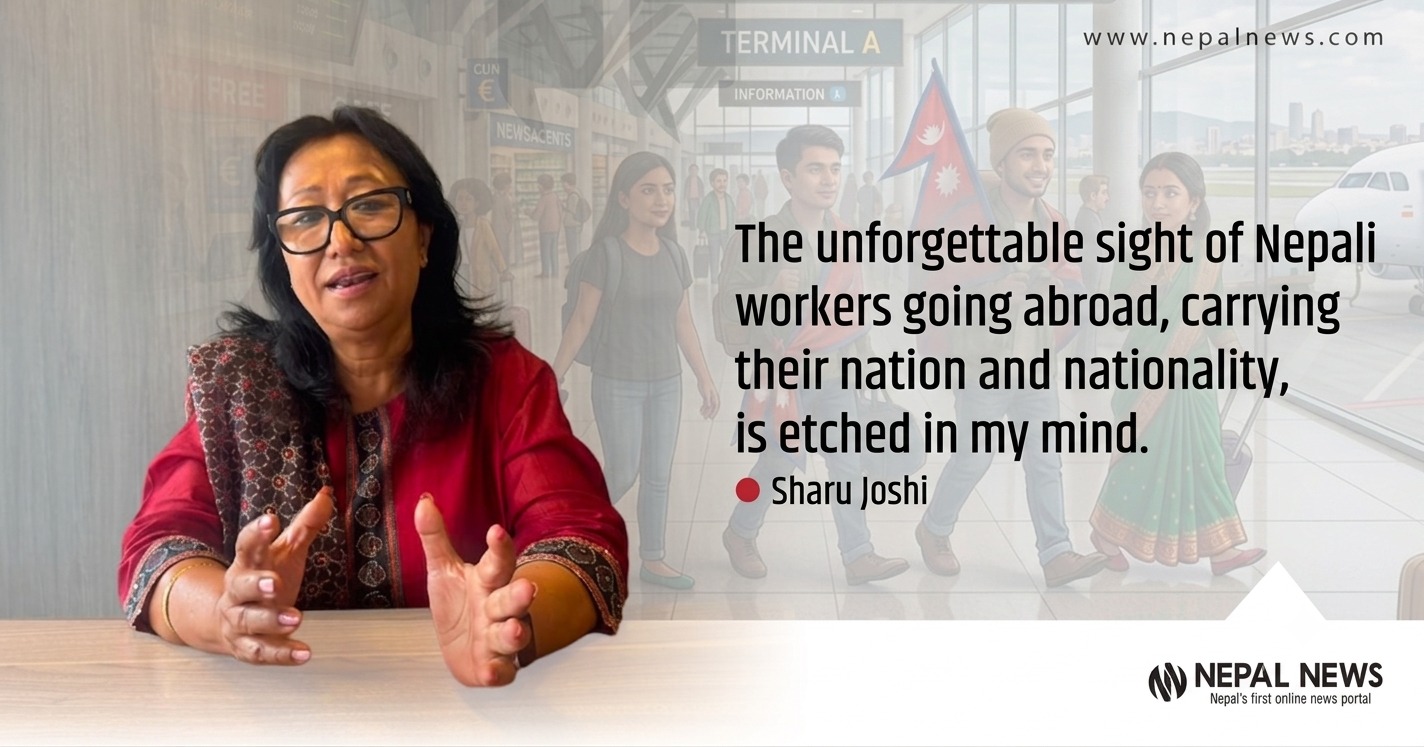
On the trucks, images were painted of a khukuri here, a rhododendron there, the Himalayas in one spot, a Danphe bird in another, and the fluttering Nepali flag elsewhere. As we drove along the roads of Saudi Arabia, I suddenly felt a cool breeze as if I had reached the Himalayan lap of my own country. My heart swelled with pride. Seeing the driver brothers carrying Nepal with them all across the roads of Saudi Arabia made me want to salute them. That scene of Nepalis who had gone abroad for employment carrying their nation and nationality with them remains indelibly etched within me.
The Saudi Arabia seen in 2005 has changed immensely 20 years later. Under “Vision 2030,” Saudi Arabia is expanding its economic footprint by making massive investments in tourism, technology, services, and infrastructure beyond an oil-dependent economy. Mega tourism projects have created demand for thousands of foreign workers. This is expanding opportunities for Nepali workers not only in construction, but also in technical fields, hospitality, healthcare, and information technology.
The relationship between Nepal and Saudi Arabia should no longer remain limited to sending construction workers. The time has come to transform this relationship into labor diplomacy that links worker safety, skill development, social security, and economic partnership. Today, not only has the Saudi labor market changed, but the role of Nepali workers is also evolving.
However, one question remains: Will Nepal continue to limit the contribution of its citizens working on foreign soil to mere remittance figures, or will it utilize their skills, experience, and global networks as capital for nation-building?
For over two and a half decades, the government’s perspective on female domestic workers has failed to change. Because women are banned from going for domestic work, they are deprived of even basic government services and facilities. The crucial future debates regarding foreign employment must center around these very issues.